
$5one-time
- 37-page printable PDF
- 183 terms with examples
- 40 practice questions, answers explained
- 2-page cram sheet and study plans
Everything the CLEP American Literature exam tests, in one PDF you can print. Built from the College Board's official outline, heaviest topics first.
Last updated 2026 · exam details checked against the College Board's published exam information in 2026
Real pages from the 37-page PDF.

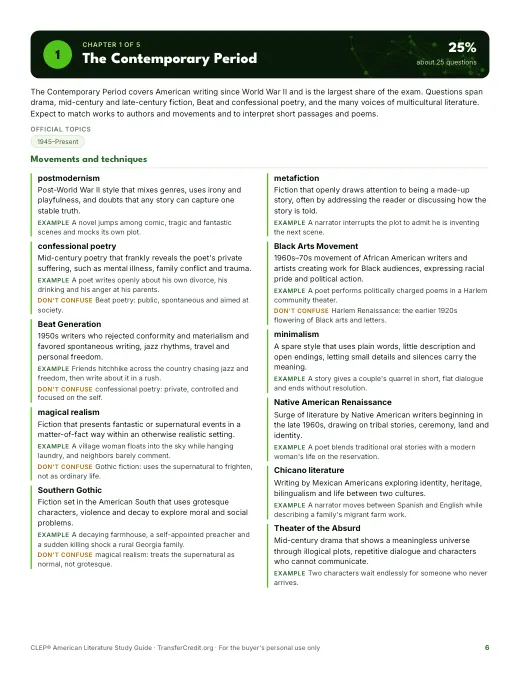
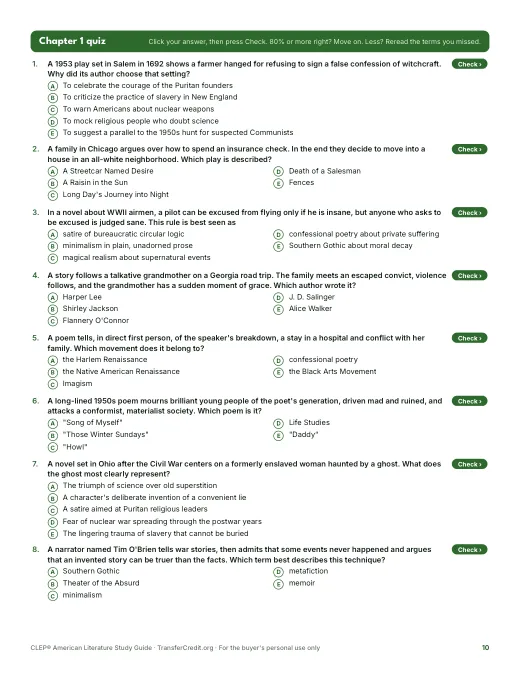
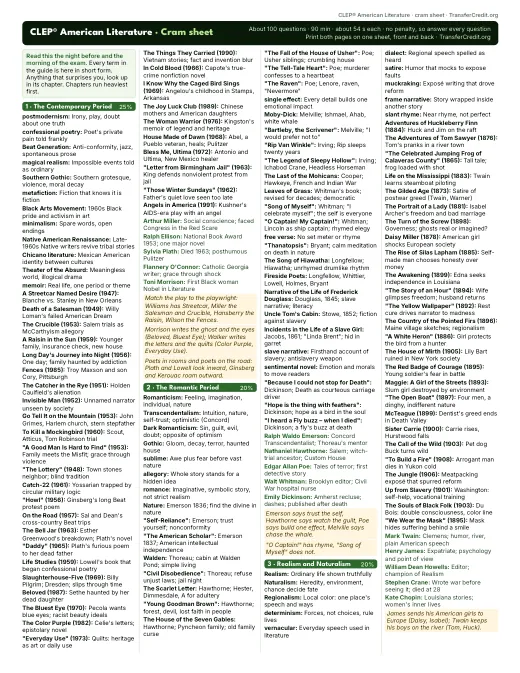
One chapter for each official content area, in the order the exam weighs them.
In the style of the real exam, from all 5 areas. About 10 minutes, with every answer explained and a score by area.
A 1953 play set in Salem in 1692 shows a farmer hanged for refusing to sign a false confession of witchcraft. Why did its author choose that setting?
Answer: C. To suggest a parallel to the 1950s hunt for suspected Communists. Miller used the witch trials as an allegory for McCarthy-era accusations, in which people were pressed to confess and name others.
The trap: Celebrating the Puritan founders is wrong: the play shows Puritan leaders and townspeople as fearful and cruel.
Miller used the witch trials as an allegory for McCarthy-era accusations, in which people were pressed to confess and name others.
The trap: Celebrating the Puritan founders is wrong: the play shows Puritan leaders and townspeople as fearful and cruel.
A novel begins, "Call me Ishmael." Later in the book, its captain risks his entire crew because of one overpowering goal. What is that goal?
Answer: A. Revenge on a white whale. In Melville's Moby-Dick, Captain Ahab's obsessive pursuit of the white whale that took his leg drives the Pequod and its crew toward disaster.
The trap: Finding a lost love at sea is tempting because the sea voyage seems romantic, but the book is driven by Ahab's revenge, not romance.
In Melville's Moby-Dick, Captain Ahab's obsessive pursuit of the white whale that took his leg drives the Pequod and its crew toward disaster.
The trap: Finding a lost love at sea is tempting because the sea voyage seems romantic, but the book is driven by Ahab's revenge, not romance.
A novel opens: "You don't know about me without you have read a book by the name of The Adventures of Tom Sawyer; but that ain't no matter." Which technique does this opening show most clearly?
Answer: D. Vernacular narration that imitates a character's everyday speech. The narrator speaks in plain, ungrammatical everyday language, which is the vernacular voice Twain made central to American fiction.
The trap: Frame narrative is wrong: no outer narrator introduces a story within a story here; Huck simply speaks for himself.
The narrator speaks in plain, ungrammatical everyday language, which is the vernacular voice Twain made central to American fiction.
The trap: Frame narrative is wrong: no outer narrator introduces a story within a story here; Huck simply speaks for himself.
A poem reads in full: "The apparition of these faces in the crowd; / Petals on a wet, black bough." Which movement does it belong to?
Answer: B. Imagism. Ezra Pound's two-line poem relies on one precise image and no commentary, which is the core of Imagism.
The trap: Romanticism is tempting because the poem mentions nature, but Romantic poems explain and express emotion openly, while this poem only presents an image.
Ezra Pound's two-line poem relies on one precise image and no commentary, which is the core of Imagism.
The trap: Romanticism is tempting because the poem mentions nature, but Romantic poems explain and express emotion openly, while this poem only presents an image.
A teacher reads aloud: "For we must consider that we shall be as a city upon a hill. The eyes of all people are upon us." Which work is the source?
Answer: E. "A Model of Christian Charity". The "city upon a hill" image comes from John Winthrop's 1630 address to the Massachusetts Bay settlers, who were to be an example to the world.
The trap: Of Plymouth Plantation is tempting because it is also a Puritan-era text, but Bradford's work is a history of the Plymouth colony, not a sermon on community.
The "city upon a hill" image comes from John Winthrop's 1630 address to the Massachusetts Bay settlers, who were to be an example to the world.
The trap: Of Plymouth Plantation is tempting because it is also a Puritan-era text, but Bradford's work is a history of the Plymouth colony, not a sermon on community.
A family in Chicago argues over how to spend an insurance check. In the end they decide to move into a house in an all-white neighborhood. Which play is described?
Answer: C. A Raisin in the Sun. Lorraine Hansberry's Younger family uses the money for a house, and they choose to move despite pressure from the neighborhood.
The trap: Fences is tempting because it also centers on a Black family, but it is set in Pittsburgh and turns on Troy Maxson and his son.
Lorraine Hansberry's Younger family uses the money for a house, and they choose to move despite pressure from the neighborhood.
The trap: Fences is tempting because it also centers on a Black family, but it is set in Pittsburgh and turns on Troy Maxson and his son.
A Wall Street lawyer hires a copyist who answers every request with "I would prefer not to" and eventually refuses to leave the office. Which story is this?
Answer: D. "Bartleby, the Scrivener". Melville's 1853 story centers on Bartleby's quiet, polite refusal of all work, and on his employer's puzzled response.
The trap: "The Tell-Tale Heart" is tempting because its narrator also behaves oddly, but Poe's narrator is a murderer, not a copyist who refuses to work.
Melville's 1853 story centers on Bartleby's quiet, polite refusal of all work, and on his employer's puzzled response.
The trap: "The Tell-Tale Heart" is tempting because its narrator also behaves oddly, but Poe's narrator is a murderer, not a copyist who refuses to work.
A novel presents a poor laborer whose violent temper, inherited from his father, and whose crowded slum life doom him whatever he tries. The narrator stays coldly detached. This is typical of
Answer: B. Naturalism. Heredity, environment and chance control the character, and the narrator's detached tone matches the scientific attitude of Naturalism.
The trap: Realism is tempting because it also shows ordinary life, but Realism leaves room for choice, while here outside forces decide everything.
Heredity, environment and chance control the character, and the narrator's detached tone matches the scientific attitude of Naturalism.
The trap: Realism is tempting because it also shows ordinary life, but Realism leaves room for choice, while here outside forces decide everything.
A speaker mending a stone wall with his neighbor thinks, "Before I built a wall I'd ask to know / What I was walling in or walling out," while the neighbor only repeats an old saying. What attitude does the speaker show?
Answer: A. He questions a custom his neighbor accepts. In Frost's "Mending Wall," the speaker asks what a wall would keep in or out, questioning the habit his neighbor repeats without thought: "Good fences make good neighbors."
The trap: Agreeing that walls always keep the peace is tempting because the neighbor's saying claims this, but the speaker questions the saying instead of sharing it.
In Frost's "Mending Wall," the speaker asks what a wall would keep in or out, questioning the habit his neighbor repeats without thought: "Good fences make good neighbors."
The trap: Agreeing that walls always keep the peace is tempting because the neighbor's saying claims this, but the speaker questions the saying instead of sharing it.
A passage states: "We hold these truths to be self-evident, that all men are created equal, that they are endowed by their Creator with certain unalienable Rights." Which intellectual movement most shaped this idea?
Answer: E. The Enlightenment. The idea that people have natural rights that governments must protect comes from Enlightenment thinking, which valued reason and natural law.
The trap: The Great Awakening is tempting because the passage mentions a Creator, but that revival stressed emotion and conversion, not natural rights.
The idea that people have natural rights that governments must protect comes from Enlightenment thinking, which valued reason and natural law.
The trap: The Great Awakening is tempting because the passage mentions a Creator, but that revival stressed emotion and conversion, not natural rights.
The CLEP American Literature exam is a computer-based test from the College Board. The test contains approximately 100 questions to be answered in 90 minutes, and some are pretest questions that will not be scored. A score of 50 on the 20–80 scale earns an ACE credit recommendation of 3 semester hours, though each college sets its own policy. The exam covers 5 content areas; the heaviest is the Contemporary Period at 25%.
5 areas, heaviest first. The guide's chapters follow this order.
Start with the guide, or get everything for CLEP in one plan.
CLEP® is a registered trademark of the College Board, which was not involved in producing this guide and does not endorse it. TransferCredit.org is independent and not affiliated with the College Board. © 2026 UPI Globale Edu Inc.