← CLEP College Composition course
CLEP® Study Guide Printable PDF · 35 pages

CLEP College Composition Study Guide

Everything the CLEP College Composition exam tests, in one PDF you can print. Built from the College Board's official outline, heaviest topics first.

  • 180 key terms, each with an example
  • 41 practice questions with every answer explained
  • A 2-page cram sheet for the night before
  • 2-, 4- and 8-week study plans built from the exam weights
Not sure yet? Try 10 free questions

Last updated 2026 · exam details checked against the College Board's published exam information in 2026

Look inside the guide

Real pages from the 35-page PDF.

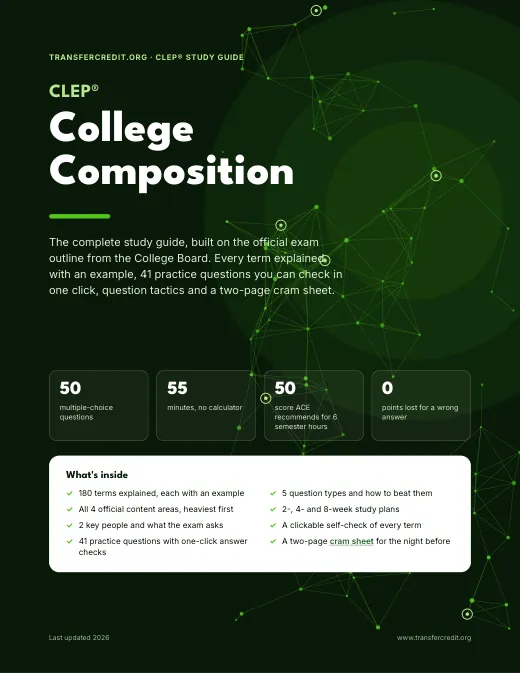
Page 1 of the CLEP College Composition Study Guide: the cover
Page 1 The cover
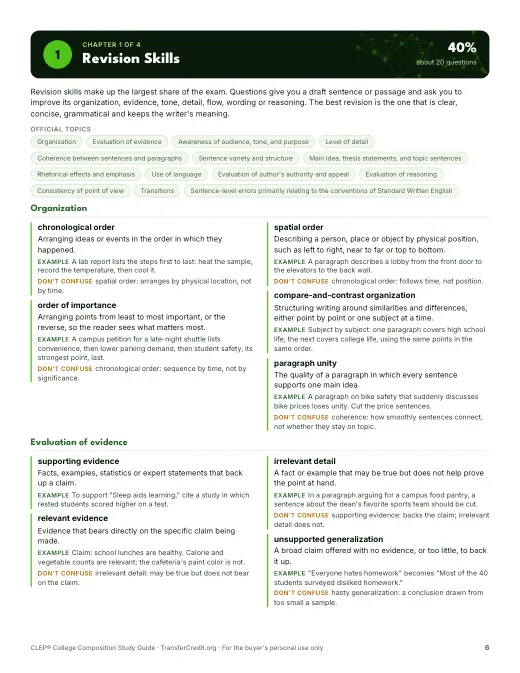
Page 6 of the CLEP College Composition Study Guide: the Chapter 1 opener
Page 6 The Chapter 1 opener
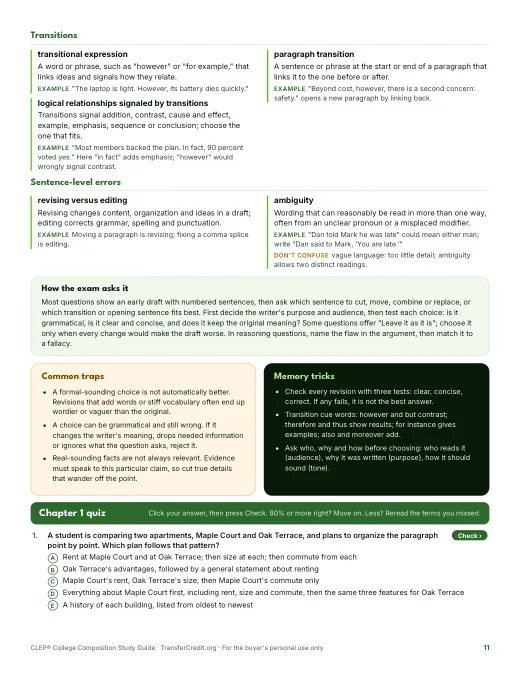
Page 11 of the CLEP College Composition Study Guide: a chapter quiz
Page 11 A chapter quiz
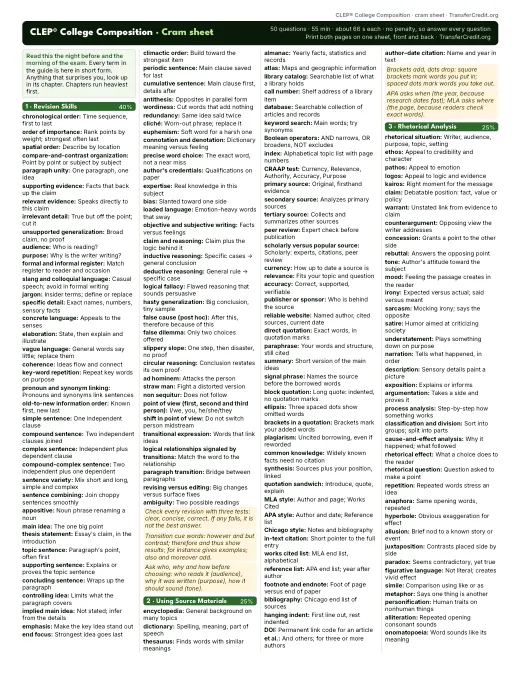
Page 34 of the CLEP College Composition Study Guide: the 2-page cram sheet
Page 34 The 2-page cram sheet

What you get for $5

One chapter for each official content area, in the order the exam weighs them.

  • 📘35pages, printable
  • 🧭4chapters, heaviest first
  • 🔑180terms with examples
  • ✍️41practice questions, answers explained
  • ⚠️12exam traps to avoid
  • 📄2page cram sheet

Try 10 free College Composition questions

In the style of the real exam, from all 4 areas. About 10 minutes, with every answer explained and a score by area.

10 questions  
  1. Question 1 · Revision Skills

    A student is comparing two apartments, Maple Court and Oak Terrace, and plans to organize the paragraph point by point. Which plan follows that pattern?

    Show the answer

    Answer: C. Rent at Maple Court and at Oak Terrace; then size at each; then commute from each. Point-by-point organization takes one feature at a time and compares both subjects before moving to the next feature.

    The trap: Covering everything about Maple Court and then everything about Oak Terrace is subject-by-subject organization, not point by point.

  2. Question 2 · Ability to Use Source Materials

    A student researching how social media affects teenage sleep gets thousands of irrelevant hits for the search "social media". Which revised search is most likely to return relevant results?

    Show the answer

    Answer: D. social media AND teenagers AND sleep. AND requires every term to appear, so each added term narrows the search toward the topic.

    The trap: OR looks like adding detail, but it broadens the search, so the student would see even more irrelevant results.

  3. Question 3 · Rhetorical Analysis

    An advertisement for a retirement fund opens with a financial planner who explains that she has advised families for thirty years. This opening is mainly an appeal to

    Show the answer

    Answer: B. ethos. Citing years of experience builds the speaker's credibility, which is an appeal to ethos.

    The trap: Logos is tempting because retirement planning involves money, but the opening offers her experience, not facts or reasoning.

  4. Question 4 · Conventions of Standard Written English

    Which of the following sentences is correctly punctuated?

    Show the answer

    Answer: E. The committee reviewed every proposal; however, only two met the budget.. A semicolon can join two independent clauses, and however is set off by a comma when it introduces the second clause.

    The trap: The version with a comma before however is tempting, but a comma alone cannot join two independent clauses, so it is a comma splice.

  5. Question 5 · Revision Skills

    Read the paragraph.
    (1) Community gardens give city residents fresh produce at low cost. (2) Many plots yield enough vegetables to feed a family through the summer. (3) The city's public library has a large collection of mystery novels. (4) Gardeners also trade seeds and recipes, which saves even more money.
    Which sentence should be deleted to improve the paragraph's unity?

    Show the answer

    Answer: A. Sentence 3. Sentence 3 is about the library's books and does not relate to community gardens, so it breaks the paragraph's unity.

    The trap: Sentence 4 may seem like a side note, but trading seeds and recipes saves money, so it supports the paragraph's point about low cost.

  6. Question 6 · Ability to Use Source Materials

    A student writing about the 1906 San Francisco earthquake needs a primary source. Which is the best choice?

    Show the answer

    Answer: A. A letter a survivor wrote a week after the quake. A survivor's letter is a firsthand record from the time of the event.

    The trap: The documentary is tempting because it uses footage, but it interprets the event decades later with commentary, which makes it a secondary source.

  7. Question 7 · Rhetorical Analysis

    Questions 2–3 refer to the following passage.
    (1) The new library is, by any measure, a triumph. (2) Its tall windows catch the morning light, its shelves invite wandering, and even the elevator is too polite to interrupt a reader.
    The tone of the passage is best described as

    Show the answer

    Answer: C. admiring. Phrases such as a triumph and invite wandering express approval of the library.

    The trap: Skeptical is tempting because by any measure can sound defensive, but every detail that follows is praise.

  8. Question 8 · Conventions of Standard Written English

    Which of the following revisions of "The job requires patience, being organized, and to communicate clearly" is parallel?

    Show the answer

    Answer: B. The job requires patience, organization, and clear communication.. Three nouns (patience, organization, communication) form a series with matching structure.

    The trap: The version ending with that you communicate clearly is tempting, but that you communicate clearly is a clause, not a noun like patience and organization, so the series is still not parallel.

  9. Question 9 · Revision Skills

    A student is writing an essay arguing that planting trees along downtown streets would make summers cooler for residents. Which piece of evidence would best support the argument?

    Show the answer

    Answer: D. Temperature readings from a nearby city showing that its tree-lined blocks stay several degrees cooler in July. Temperature readings from a comparable city measure the very effect the student claims, so they bear directly on the argument.

    The trap: The poll shows that residents like trees, not that trees cool the streets, so it does not support the claim about temperature.

  10. Question 10 · Ability to Use Source Materials

    Which feature most strongly suggests that an article is a scholarly source?

    Show the answer

    Answer: E. It was evaluated by outside experts before publication.. Peer review by experts before publication is the mark of a scholarly journal article.

    The trap: A .org address is tempting, but anyone can register one and it says nothing about expert review.

The CLEP College Composition exam at a glance

The CLEP College Composition exam is a computer-based test from the College Board. The exam has a total testing time of 125 minutes: 50 multiple-choice questions to be answered in 55 minutes, and 2 essays to be written in 70 minutes. A score of 50 on the 20–80 scale earns an ACE credit recommendation of 6 semester hours, though each college sets its own policy. The exam covers 4 content areas; the heaviest is Revision Skills at 40%.

Questions
50multiple choice
Time
55 minplus timed essays
Passing score
50on a 20–80 scale
ACE credit
6semester hours
Exam fee
$97paid to College Board
Calculator
Nonot allowed

Source: official CLEP College Composition exam page.

What the exam covers

4 areas, heaviest first. The guide's chapters follow this order.

  1. Revision Skills40%
  2. Ability to Use Source Materials25%
  3. Rhetorical Analysis25%
  4. Conventions of Standard Written English10%

How it works

  1. 1Buy once, $5Secure checkout. No subscription needed.
  2. 2Download the PDFFrom your TransferCredit.org account, right away and any time later.
  3. 3Study the heaviest areas firstFollow the 2-, 4- or 8-week plan, then read the cram sheet the night before.

Questions students ask

What's in the full CLEP College Composition study guide?
35 pages: 4 chapters, one per official content area, heaviest first. 180 terms, each with a plain-English definition and an example, 2 key people, common traps and memory tricks, 41 practice questions with an answer key that explains every answer, question tactics, 2-, 4- and 8-week study plans and a 2-page cram sheet.
How much is the full CLEP College Composition study guide?
The full 35-page PDF is $5, a one-time payment. The 10 practice questions on this page are free, with no account.
What does the $29 plan include?
$29 a month gives you all 28 CLEP subjects: every CLEP study guide plus the full prep course for each subject, and you can cancel anytime. If you only need this exam, the guide on its own is a one-time $5.
How do I get the full guide?
Choose Buy this guide ($5) and check out. Then sign in to your TransferCredit.org account, then open the course and its Download Your Study Guide lesson. The PDF is yours to keep, and you can download it again from your account at any time.
Can I print the guide or use it on my phone?
Yes. It's a PDF, so it opens on phones, tablets and computers, and printing is allowed. Its tick boxes and answer bubbles work in PDF readers that support forms. Copying and editing are turned off.
Is this an official CLEP study guide?
No. CLEP® is a registered trademark of the College Board, which was not involved in producing this guide and does not endorse it. TransferCredit.org is independent. We built the guide from the official exam outline, and the exam details were checked against the College Board's published exam information in 2026.
Why is this study guide better than a generic review?
It follows the official outline area by area and spends the most pages on what the exam weighs most. Every term comes with an example, each chapter names the traps the exam sets, and the answer key explains why the most tempting wrong answer is wrong, not just which answer is right. It ends with a 2-page cram sheet for the night before.
What is the CLEP College Composition exam?
The CLEP College Composition exam is a computer-based test from the College Board. The exam has a total testing time of 125 minutes: 50 multiple-choice questions to be answered in 55 minutes, and 2 essays to be written in 70 minutes. A score of 50 on the 20–80 scale earns an ACE credit recommendation of 6 semester hours, though each college sets its own policy. The exam covers 4 content areas; the heaviest is Revision Skills at 40%.
More questions about the CLEP College Composition exam (21)
How many questions are on the CLEP College Composition exam, and how long is it?
The exam has a total testing time of 125 minutes: 50 multiple-choice questions to be answered in 55 minutes, and 2 essays to be written in 70 minutes. The first essay has 30 minutes and the second has 40 minutes to read two sources and write; the essays must be typed on the computer. Each essay is scored by at least two readers, and the essay score is weighted equally with the multiple-choice score. The combined result is reported as a single scaled score between 20 and 80; separate multiple-choice and essay scores are not reported, and scores arrive one to two weeks after the test date. Some multiple-choice questions are pretest questions that are not scored.
What is the passing score for CLEP College Composition?
The passing score is 50 on a 20–80 scale. At 50 or above, the American Council on Education (ACE) recommends 6 semester hours. Each college sets its own passing score and credit award, so check your school's policy before you book.
How much does the CLEP College Composition exam cost?
The exam fee is $97, paid to the College Board. Test centers may add their own administration fee. Eligible U.S. military service members can usually test for free through DANTES.
How many college credits is CLEP College Composition worth?
ACE recommends 6 semester hours for a passing score of 50. Your college decides how many credits it awards and which course they replace. Check your college's policy.
Is there a penalty for guessing on CLEP College Composition?
No. Your score counts only correct answers, so a wrong answer costs nothing. Never leave a question blank: rule out what you can and pick your best guess.
What topics are on the CLEP College Composition exam?
4 content areas, from the official outline: Revision Skills (40%); Ability to Use Source Materials (25%); Rhetorical Analysis (25%); Conventions of Standard Written English (10%).
Which CLEP College Composition topics should I study first?
Start with the three heaviest: Revision Skills (40%), Ability to Use Source Materials (25%) and Rhetorical Analysis (25%). Together they are about 90% of the exam, roughly 45 of 50 questions. The guide's chapters run in that order, heaviest first.
Is the CLEP College Composition exam hard?
It depends on what you already know. The exam has only 4 content areas, so each one carries real weight: Revision Skills (40%), Ability to Use Source Materials (25%), Rhetorical Analysis (25%) and Conventions of Standard Written English (10%). Take the free diagnostic above to see where you stand in about 10 minutes.
What kinds of questions are on the CLEP College Composition exam?
The guide sorts them into 5 types: “Find the error”, “Best revision in context”, “Combine the sentences”, “Source and citation questions” and “Passage-based rhetorical analysis”. Every question has 5 answer choices. Try the 10 free questions above to see the style.
How long should I study for CLEP College Composition?
Use the diagnostic to decide. If you already know most areas, two weeks of daily review is often enough; if the subject is new to you, plan on eight. The full guide has 2-, 4- and 8-week plans built from the exam weights.
How should I pace myself on the CLEP College Composition exam?
On average you have about 66 seconds per question (55 minutes for 50 questions). Be past question 17 a third of the way through and past question 33 two-thirds through. If a question takes more than a minute, pick your best guess, mark it and come back.
What happens if I don't pass CLEP College Composition?
You can retake a CLEP exam after three months. Use the wait to work through the areas the score report and the diagnostic show you missed.
Do colleges accept CLEP College Composition for credit?
CLEP exams are accepted at more than 2,900 U.S. colleges and universities, but each school decides which exams it accepts, the score it requires and the credit it gives. Look up your college's CLEP policy before you book.
How is the guide different from the CLEP College Composition course?
The guide is a 35-page PDF for review and self-testing. The CLEP College Composition course is a full online course with lessons, quizzes and a practice exam, for $19 with lifetime access. Many students use the guide first, then take the course for the areas the diagnostic flags.
How up to date is this CLEP College Composition guide?
Last updated 2026. The exam details were checked against the College Board's published exam information in 2026. Exams change, so confirm the details on the official exam page before you register.
What should I do the night before the exam?
Read the cram sheet once, slowly. Check your test time, the location or remote-proctoring setup, and the ID you need. Then sleep: a rested brain recalls more than a crammed one. In the morning, skim the memory tricks and common traps, then stop studying.
What is the difference between College Composition and College Composition Modular?
College Composition has 50 multiple-choice questions in 55 minutes plus two essays in 70 minutes, and earns 6 credits. College Composition Modular has about 90 multiple-choice questions in 95 minutes, no essays, and earns 3 credits. Both test the same four skill areas.
How are the CLEP College Composition essays scored?
Each essay is scored on a 0–6 scale by at least two college English faculty readers. The essay scores are combined and weighted equally with the multiple-choice score into one scaled score from 20 to 80.
When do I get my CLEP College Composition score?
Because essays are scored by faculty, College Composition results come one to two weeks after the test. The Modular exam, which has no essays, reports scores immediately.
How much time do I get for each CLEP College Composition essay?
You get 30 minutes for the first essay, where you agree or disagree with a given statement, and 40 minutes to read two sources and write the second, synthesis essay. Both essays are typed on the computer.
Which citation styles are on CLEP College Composition?
Documentation questions include, but aren't limited to, MLA, APA and Chicago styles.

Choose how you want to study

Start with the guide, or get everything for CLEP in one plan.

This study guide
$5one-time
  • 35-page printable PDF
  • 180 terms with examples
  • 41 practice questions, answers explained
  • 2-page cram sheet and study plans
Get the guide · $5
Best value Get it all
$29/month
  • Every CLEP study guide
  • Prep courses for all 28 CLEP subjects
  • Cancel anytime
Get it all · $29/mo

CLEP® is a registered trademark of the College Board, which was not involved in producing this guide and does not endorse it. TransferCredit.org is independent and not affiliated with the College Board. © 2026 UPI Globale Edu Inc.