
$5one-time
- 39-page printable PDF
- 180 terms with examples
- 42 practice questions, answers explained
- 2-page cram sheet and study plans
Everything the CLEP English Literature exam tests, in one PDF you can print. Built from the College Board's official outline, heaviest topics first.
Last updated 2026 · exam details checked against the College Board's published exam information in 2026
Real pages from the 39-page PDF.
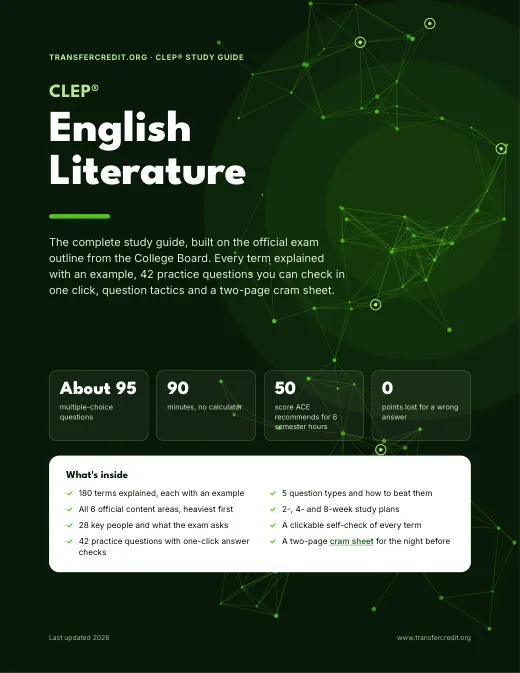
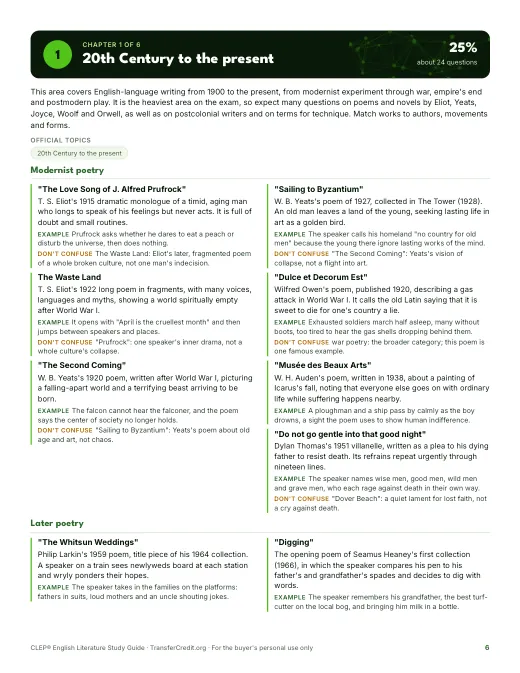
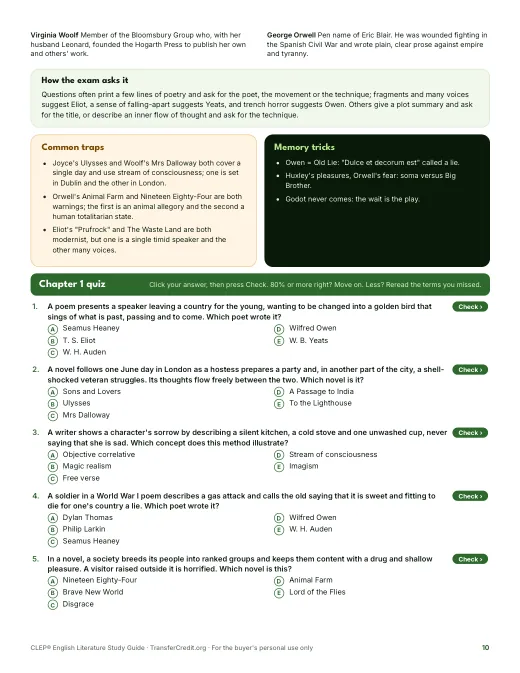
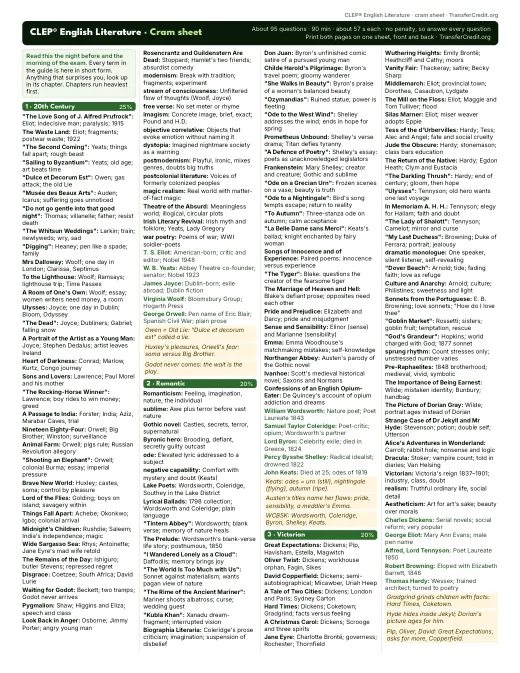
One chapter for each official content area, in the order the exam weighs them.
In the style of the real exam, from all 6 areas. About 10 minutes, with every answer explained and a score by area.
A poem presents a speaker leaving a country for the young, wanting to be changed into a golden bird that sings of what is past, passing and to come. Which poet wrote it?
Answer: B. W. B. Yeats. Yeats's "Sailing to Byzantium" imagines an old man escaping age by becoming a golden bird, a symbol of lasting art.
The trap: Eliot is tempting because both were major modernist poets, but Eliot's best-known works use fragments and doubting speakers, not a flight into art.
Yeats's "Sailing to Byzantium" imagines an old man escaping age by becoming a golden bird, a symbol of lasting art.
The trap: Eliot is tempting because both were major modernist poets, but Eliot's best-known works use fragments and doubting speakers, not a flight into art.
A poem's narrator describes a ship stuck in the heat, with sailors thirsting amid "Water, water, every where, / Nor any drop to drink." Which poem is it?
Answer: A. "The Rime of the Ancient Mariner". These lines come from Coleridge's tale of a becalmed ship after the mariner shoots the albatross.
The trap: Childe Harold's Pilgrimage is tempting because it also travels by sea, but it is Byron's travel poem and has no cursed ship.
These lines come from Coleridge's tale of a becalmed ship after the mariner shoots the albatross.
The trap: Childe Harold's Pilgrimage is tempting because it also travels by sea, but it is Byron's travel poem and has no cursed ship.
A schoolroom speaker declares: "Now, what I want is, Facts. Teach these boys and girls nothing but Facts." What does Dickens criticize through this speech?
Answer: D. A school system that leaves no room for fancy or feeling. In Hard Times, Mr. Gradgrind's insistence on facts alone stands for an education and a philosophy that crush imagination and feeling.
The trap: Workhouses are tempting because Dickens attacks them elsewhere, but the workhouse is the target of Oliver Twist, not this schoolroom scene.
In Hard Times, Mr. Gradgrind's insistence on facts alone stands for an education and a philosophy that crush imagination and feeling.
The trap: Workhouses are tempting because Dickens attacks them elsewhere, but the workhouse is the target of Oliver Twist, not this schoolroom scene.
Hearing that his wife is dead, a king who murdered his way to the throne says, "Tomorrow, and tomorrow, and tomorrow, / Creeps in this petty pace from day to day," and broods on life's emptiness. Which play is this?
Answer: C. Macbeth. The speech, delivered when Macbeth hears of his wife's death, calls life a meaningless, creeping sequence of days.
The trap: Hamlet is tempting because it also broods on life and death, but the speaker here is the Scottish tyrant after his wife's death.
The speech, delivered when Macbeth hears of his wife's death, calls life a meaningless, creeping sequence of days.
The trap: Hamlet is tempting because it also broods on life and death, but the speaker here is the Scottish tyrant after his wife's death.
At an inn outside London, a group of travelers agrees on a storytelling contest to pass the time on their journey to a saint's shrine. Which work is this?
Answer: E. The Canterbury Tales. Chaucer's frame story has pilgrims bound for Canterbury, each telling tales along the road.
The trap: Piers Plowman is tempting because it is a medieval English poem about social life, but it is a dream allegory with one seeker, not a group of travelers.
Chaucer's frame story has pilgrims bound for Canterbury, each telling tales along the road.
The trap: Piers Plowman is tempting because it is a medieval English poem about social life, but it is a dream allegory with one seeker, not a group of travelers.
An essay's calm, reasonable speaker proposes that poor families can solve their hunger by selling their infants to be eaten by the rich. What is the author's real purpose?
Answer: D. To shame readers into facing poverty. The outrageous solution, delivered in a straight-faced tone, is Swift's way of attacking indifference to Irish poverty.
The trap: Persuading Parliament is tempting because the speaker sounds earnest, but a straight-faced tone is the satirist's mask.
The outrageous solution, delivered in a straight-faced tone, is Swift's way of attacking indifference to Irish poverty.
The trap: Persuading Parliament is tempting because the speaker sounds earnest, but a straight-faced tone is the satirist's mask.
A novel follows one June day in London as a hostess prepares a party and, in another part of the city, a shell-shocked veteran struggles. Its thoughts flow freely between the two. Which novel is it?
Answer: C. Mrs Dalloway. Woolf's Mrs Dalloway follows Clarissa Dalloway's day and Septimus Smith's troubles in London, using stream of consciousness.
The trap: Ulysses is tempting because it also covers one day with inner thought, but it is set in Dublin and follows Leopold Bloom.
Woolf's Mrs Dalloway follows Clarissa Dalloway's day and Septimus Smith's troubles in London, using stream of consciousness.
The trap: Ulysses is tempting because it also covers one day with inner thought, but it is set in Dublin and follows Leopold Bloom.
A traveler reports a broken statue in the desert whose pedestal reads "My name is Ozymandias, king of kings: / Look on my works, ye Mighty, and despair!" What is the poem's central irony?
Answer: B. The king's boast of greatness is undone by ruin. The words call on others to despair at his might, but only a shattered statue and endless sand remain, so the boast mocks itself.
The trap: The sculptor being forgotten is tempting because the poem does mention the sculptor's skill, but the irony lies in the king's boast.
The words call on others to despair at his might, but only a shattered statue and endless sand remain, so the boast mocks itself.
The trap: The sculptor being forgotten is tempting because the poem does mention the sculptor's skill, but the irony lies in the king's boast.
A speaker shows a visitor a painted portrait of his late wife and says, "I gave commands; / Then all smiles stopped together." What form is the poem?
Answer: E. Dramatic monologue. Browning's "My Last Duchess" is a dramatic monologue: one speaker addresses a silent listener and unintentionally reveals his cold jealousy.
The trap: Soliloquy is tempting because one person speaks, but a soliloquy is spoken alone and aloud onstage; here the duke addresses a visitor in the scene.
Browning's "My Last Duchess" is a dramatic monologue: one speaker addresses a silent listener and unintentionally reveals his cold jealousy.
The trap: Soliloquy is tempting because one person speaks, but a soliloquy is spoken alone and aloud onstage; here the duke addresses a visitor in the scene.
A 14-line poem rhymes abab cdcd efef gg. What form is it?
Answer: A. Shakespearean sonnet. Three alternating-rhyme quatrains and a closing couplet define the Shakespearean sonnet.
The trap: Petrarchan sonnet is tempting because it also has fourteen lines, but its octave and sestet use abbaabba then a different sestet scheme.
Three alternating-rhyme quatrains and a closing couplet define the Shakespearean sonnet.
The trap: Petrarchan sonnet is tempting because it also has fourteen lines, but its octave and sestet use abbaabba then a different sestet scheme.
The CLEP English Literature exam is a computer-based test from the College Board. About 95 multiple-choice questions in 90 minutes. A score of 50 on the 20–80 scale earns an ACE credit recommendation of 6 semester hours, though each college sets its own policy. The exam covers 6 content areas; the heaviest is 20th Century to the present at 25%.
6 areas, heaviest first. The guide's chapters follow this order.
Start with the guide, or get everything for CLEP in one plan.
CLEP® is a registered trademark of the College Board, which was not involved in producing this guide and does not endorse it. TransferCredit.org is independent and not affiliated with the College Board. © 2026 UPI Globale Edu Inc.