← CLEP College Composition Modular course
CLEP® Study Guide Printable PDF · 35 pages

CLEP College Composition Modular Study Guide

Everything the CLEP College Composition Modular exam tests, in one PDF you can print. Built from the College Board's official outline, heaviest topics first.

  • 181 key terms, each with an example
  • 41 practice questions with every answer explained
  • A 2-page cram sheet for the night before
  • 2-, 4- and 8-week study plans built from the exam weights
Not sure yet? Try 10 free questions

Last updated 2026 · exam details checked against the College Board's published exam information in 2026

Look inside the guide

Real pages from the 35-page PDF.

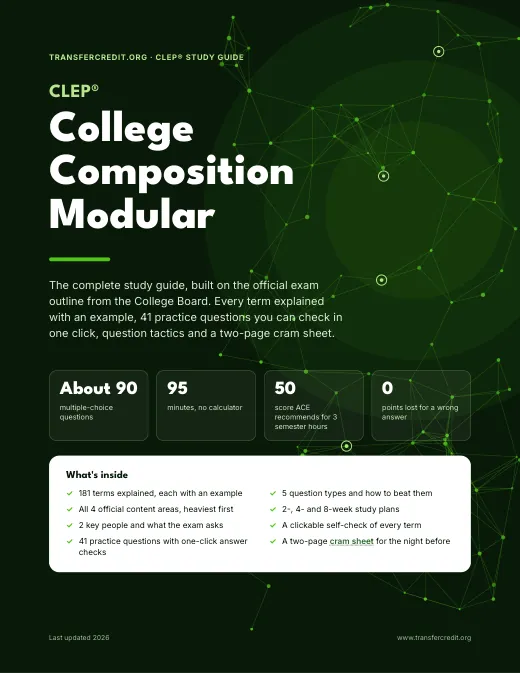
Page 1 of the CLEP College Composition Modular Study Guide: the cover
Page 1 The cover
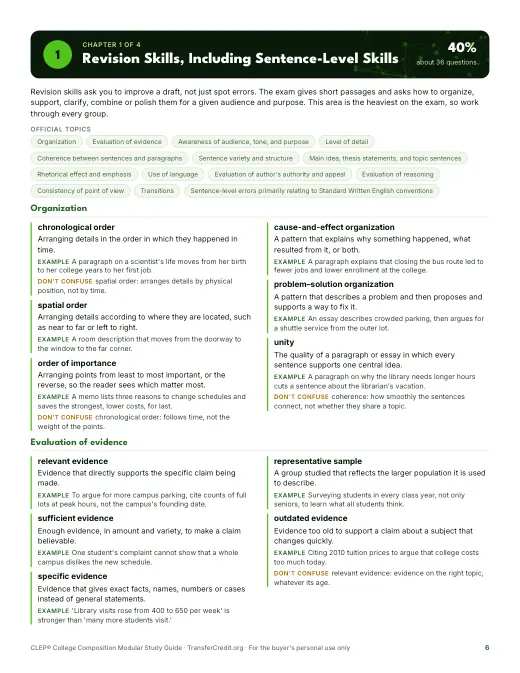
Page 6 of the CLEP College Composition Modular Study Guide: the Chapter 1 opener
Page 6 The Chapter 1 opener
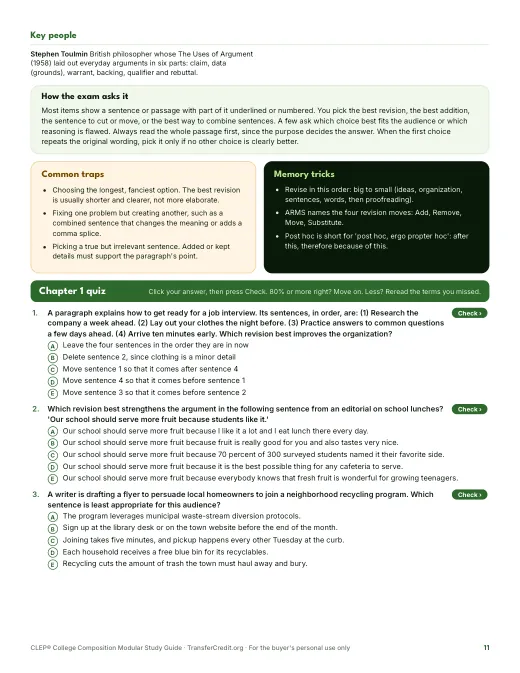
Page 11 of the CLEP College Composition Modular Study Guide: a chapter quiz
Page 11 A chapter quiz
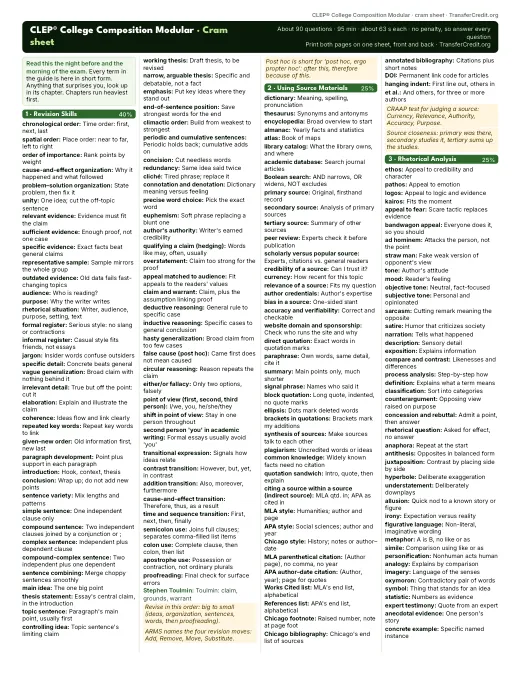
Page 34 of the CLEP College Composition Modular Study Guide: the 2-page cram sheet
Page 34 The 2-page cram sheet

What you get for $5

One chapter for each official content area, in the order the exam weighs them.

  • 📘35pages, printable
  • 🧭4chapters, heaviest first
  • 🔑181terms with examples
  • ✍️41practice questions, answers explained
  • ⚠️12exam traps to avoid
  • 📄2page cram sheet

Try 10 free College Composition Modular questions

In the style of the real exam, from all 4 areas. About 10 minutes, with every answer explained and a score by area.

10 questions  
  1. Question 1 · Revision Skills, Including Sentence-Level Skills

    A paragraph explains how to get ready for a job interview. Its sentences, in order, are: (1) Research the company a week ahead. (2) Lay out your clothes the night before. (3) Practice answers to common questions a few days ahead. (4) Arrive ten minutes early. Which revision best improves the organization?

    Show the answer

    Answer: A. Move sentence 3 so that it comes before sentence 2. The steps follow time order: a week ahead, a few days ahead, the night before, then arrival. Sentence 3 belongs before sentence 2.

    The trap: Leaving the order unchanged keeps 'a few days ahead' after 'the night before,' which breaks chronological order.

  2. Question 2 · Ability to Use Source Materials

    A student wants background on the history of the telephone before choosing a narrower topic. Which source is the best place to start?

    Show the answer

    Answer: C. An encyclopedia article on the telephone. An encyclopedia gives a broad overview that helps a researcher narrow a topic.

    The trap: The patent is a primary source, which is useful later, but it gives a narrow view of one invention, not general background.

  3. Question 3 · Rhetorical Analysis

    An essay urging voters to support a school bond begins: "As a teacher of thirty years and a parent of three graduates, I have seen what underfunded classrooms do." The opening mainly establishes

    Show the answer

    Answer: B. credibility through experience. Naming the writer's years of teaching and parenting builds trust in the writer, which is ethos.

    The trap: Emotional sympathy through a story is tempting because parenting is personal, but no story is told. The writer is citing experience to earn trust.

  4. Question 4 · Conventions of Standard Written English

    Which is the best revision of this sentence? The new manager is known for arriving early, staying late, and her willingness to help.

    Show the answer

    Answer: D. The new manager is known for arriving early, staying late, and helping others.. The three items after for are now all -ing forms, so the series is parallel and concise.

    The trap: The choice that uses to stay late mixes an infinitive with -ing forms, so the series is still not parallel.

  5. Question 5 · Revision Skills, Including Sentence-Level Skills

    Which revision best strengthens the argument in the following sentence from an editorial on school lunches? 'Our school should serve more fruit because students like it.'

    Show the answer

    Answer: E. Our school should serve more fruit because 70 percent of 300 surveyed students named it their favorite side.. Only the survey result gives specific, checkable evidence for the reason the sentence offers: that students like fruit.

    The trap: 'Everybody knows' asserts a popular belief but gives no evidence for it.

  6. Question 6 · Ability to Use Source Materials

    A student searches a database for studies on teenagers and sleep and gets thousands of results. Which change will narrow the search most directly?

    Show the answer

    Answer: A. Adding AND grades to the keywords. AND requires both terms, so the result set shrinks to items that cover both topics.

    The trap: Adding OR adolescents widens the search by accepting either term, which returns more results, not fewer.

  7. Question 7 · Rhetorical Analysis

    A speaker argues: "Don't listen to the mayor's plan for the park. He was fined for a late tax payment years ago." Which fallacy does this commit?

    Show the answer

    Answer: B. Ad hominem. The speaker attacks the mayor's past instead of the park plan, so the argument is aimed at the person.

    The trap: Straw man is tempting, but the plan is not distorted. It is ignored while the person is attacked.

  8. Question 8 · Conventions of Standard Written English

    Which is the best way to correct this sentence? The library closes at nine, students who need more time can use the study hall.

    Show the answer

    Answer: E. The library closes at nine; students who need more time can use the study hall.. A semicolon correctly joins two independent clauses. The original is a comma splice.

    The trap: Adding however after the comma still joins two clauses with only a comma, so the splice remains.

  9. Question 9 · Revision Skills, Including Sentence-Level Skills

    A writer is drafting a flyer to persuade local homeowners to join a neighborhood recycling program. Which sentence is least appropriate for this audience?

    Show the answer

    Answer: C. The program leverages municipal waste-stream diversion protocols.. The sentence about waste-stream diversion protocols is full of jargon that ordinary homeowners would not understand, so it does not suit this audience or purpose.

    The trap: The sentence about the free bin is plain and persuasive, so it fits the flyer well.

  10. Question 10 · Ability to Use Source Materials

    For a paper on a presidential election, which item is a primary source?

    Show the answer

    Answer: D. A candidate's televised concession speech. A speech given by someone in the event is an original, firsthand record.

    The trap: The historian's article is tempting because it is scholarly, but it interprets the election after the fact, so it is secondary.

The CLEP College Composition Modular exam at a glance

The CLEP College Composition Modular exam is a 95-minute, computer-based test from the College Board with about 90 multiple-choice questions. A score of 50 on the 20–80 scale earns an ACE credit recommendation of 3 semester hours, though each college sets its own policy. The exam covers 4 content areas; the heaviest is Revision Skills, Including Sentence-Level Skills at 40%.

Questions
About 90multiple choice
Time
95 minplus timed essays
Passing score
50on a 20–80 scale
ACE credit
3semester hours
Exam fee
$97paid to College Board
Calculator
Nonot allowed

Source: official CLEP College Composition Modular exam page.

What the exam covers

4 areas, heaviest first. The guide's chapters follow this order.

  1. Revision Skills, Including Sentence-Level Skills40%
  2. Ability to Use Source Materials25%
  3. Rhetorical Analysis25%
  4. Conventions of Standard Written English10%

How it works

  1. 1Buy once, $5Secure checkout. No subscription needed.
  2. 2Download the PDFFrom your TransferCredit.org account, right away and any time later.
  3. 3Study the heaviest areas firstFollow the 2-, 4- or 8-week plan, then read the cram sheet the night before.

Questions students ask

What's in the full CLEP College Composition Modular study guide?
35 pages: 4 chapters, one per official content area, heaviest first. 181 terms, each with a plain-English definition and an example, 2 key people, common traps and memory tricks, 41 practice questions with an answer key that explains every answer, question tactics, 2-, 4- and 8-week study plans and a 2-page cram sheet.
How much is the full CLEP College Composition Modular study guide?
The full 35-page PDF is $5, a one-time payment. The 10 practice questions on this page are free, with no account.
What does the $29 plan include?
$29 a month gives you all 28 CLEP subjects: every CLEP study guide plus the full prep course for each subject, and you can cancel anytime. If you only need this exam, the guide on its own is a one-time $5.
How do I get the full guide?
Choose Buy this guide ($5) and check out. Then sign in to your TransferCredit.org account, then open the course and its Download Your Study Guide lesson. The PDF is yours to keep, and you can download it again from your account at any time.
Can I print the guide or use it on my phone?
Yes. It's a PDF, so it opens on phones, tablets and computers, and printing is allowed. Its tick boxes and answer bubbles work in PDF readers that support forms. Copying and editing are turned off.
Is this an official CLEP study guide?
No. CLEP® is a registered trademark of the College Board, which was not involved in producing this guide and does not endorse it. TransferCredit.org is independent. We built the guide from the official exam outline, and the exam details were checked against the College Board's published exam information in 2026.
Why is this study guide better than a generic review?
It follows the official outline area by area and spends the most pages on what the exam weighs most. Every term comes with an example, each chapter names the traps the exam sets, and the answer key explains why the most tempting wrong answer is wrong, not just which answer is right. It ends with a 2-page cram sheet for the night before.
What is the CLEP College Composition Modular exam?
The CLEP College Composition Modular exam is a 95-minute, computer-based test from the College Board with about 90 multiple-choice questions. A score of 50 on the 20–80 scale earns an ACE credit recommendation of 3 semester hours, though each college sets its own policy. The exam covers 4 content areas; the heaviest is Revision Skills, Including Sentence-Level Skills at 40%.
More questions about the CLEP College Composition Modular exam (17)
How many questions are on the CLEP College Composition Modular exam, and how long is it?
It contains approximately 90 multiple-choice questions to be answered in 95 minutes, with no essays. Some questions are pretest questions that will not be counted toward your score.
What is the passing score for CLEP College Composition Modular?
The passing score is 50 on a 20–80 scale. At 50 or above, the American Council on Education (ACE) recommends 3 semester hours. Each college sets its own passing score and credit award, so check your school's policy before you book.
How much does the CLEP College Composition Modular exam cost?
The exam fee is $97, paid to the College Board. Test centers may add their own administration fee. Eligible U.S. military service members can usually test for free through DANTES.
How many college credits is CLEP College Composition Modular worth?
ACE recommends 3 semester hours for a passing score of 50. Your college decides how many credits it awards and which course they replace. Check your college's policy.
Is there a penalty for guessing on CLEP College Composition Modular?
No. Your score counts only correct answers, so a wrong answer costs nothing. Never leave a question blank: rule out what you can and pick your best guess.
What topics are on the CLEP College Composition Modular exam?
4 content areas, from the official outline: Revision Skills, Including Sentence-Level Skills (40%); Ability to Use Source Materials (25%); Rhetorical Analysis (25%); Conventions of Standard Written English (10%).
Which CLEP College Composition Modular topics should I study first?
Start with the three heaviest: Revision Skills, Including Sentence-Level Skills (40%), Ability to Use Source Materials (25%) and Rhetorical Analysis (25%). Together they are about 90% of the exam, roughly 81 of 90 questions. The guide's chapters run in that order, heaviest first.
Is the CLEP College Composition Modular exam hard?
It depends on what you already know. The exam has only 4 content areas, so each one carries real weight: Revision Skills, Including Sentence-Level Skills (40%), Ability to Use Source Materials (25%), Rhetorical Analysis (25%) and Conventions of Standard Written English (10%). Take the free diagnostic above to see where you stand in about 10 minutes.
What kinds of questions are on the CLEP College Composition Modular exam?
The guide sorts them into 5 types: “Best revision of a sentence”, “Spot the error or the correct sentence”, “Revise a passage”, “Sources and documentation” and “Rhetorical analysis”. Every question has 5 answer choices. Try the 10 free questions above to see the style.
How long should I study for CLEP College Composition Modular?
Use the diagnostic to decide. If you already know most areas, two weeks of daily review is often enough; if the subject is new to you, plan on eight. The full guide has 2-, 4- and 8-week plans built from the exam weights.
How should I pace myself on the CLEP College Composition Modular exam?
On average you have about 63 seconds per question (95 minutes for 90 questions). Be past question 30 a third of the way through and past question 60 two-thirds through. If a question takes more than a minute, pick your best guess, mark it and come back.
What happens if I don't pass CLEP College Composition Modular?
You can retake a CLEP exam after three months. Use the wait to work through the areas the score report and the diagnostic show you missed.
Do colleges accept CLEP College Composition Modular for credit?
CLEP exams are accepted at more than 2,900 U.S. colleges and universities, but each school decides which exams it accepts, the score it requires and the credit it gives. Look up your college's CLEP policy before you book.
How is the guide different from the CLEP College Composition Modular course?
The guide is a 35-page PDF for review and self-testing. The CLEP College Composition Modular course is a full online course with lessons, quizzes and a practice exam, for $19 with lifetime access. Many students use the guide first, then take the course for the areas the diagnostic flags.
How up to date is this CLEP College Composition Modular guide?
Last updated 2026. The exam details were checked against the College Board's published exam information in 2026. Exams change, so confirm the details on the official exam page before you register.
What should I do the night before the exam?
Read the cram sheet once, slowly. Check your test time, the location or remote-proctoring setup, and the ID you need. Then sleep: a rested brain recalls more than a crammed one. In the morning, skim the memory tricks and common traps, then stop studying.
What is the difference between College Composition and College Composition Modular?
College Composition has 50 multiple-choice questions in 55 minutes plus two essays in 70 minutes, and earns 6 credits. College Composition Modular has about 90 multiple-choice questions in 95 minutes, no essays, and earns 3 credits. Both test the same four skill areas.

Choose how you want to study

Start with the guide, or get everything for CLEP in one plan.

This study guide
$5one-time
  • 35-page printable PDF
  • 181 terms with examples
  • 41 practice questions, answers explained
  • 2-page cram sheet and study plans
Get the guide · $5
Best value Get it all
$29/month
  • Every CLEP study guide
  • Prep courses for all 28 CLEP subjects
  • Cancel anytime
Get it all · $29/mo

CLEP® is a registered trademark of the College Board, which was not involved in producing this guide and does not endorse it. TransferCredit.org is independent and not affiliated with the College Board. © 2026 UPI Globale Edu Inc.