
$5one-time
- 35-page printable PDF
- 184 terms with examples
- 41 practice questions, answers explained
- 2-page cram sheet and study plans
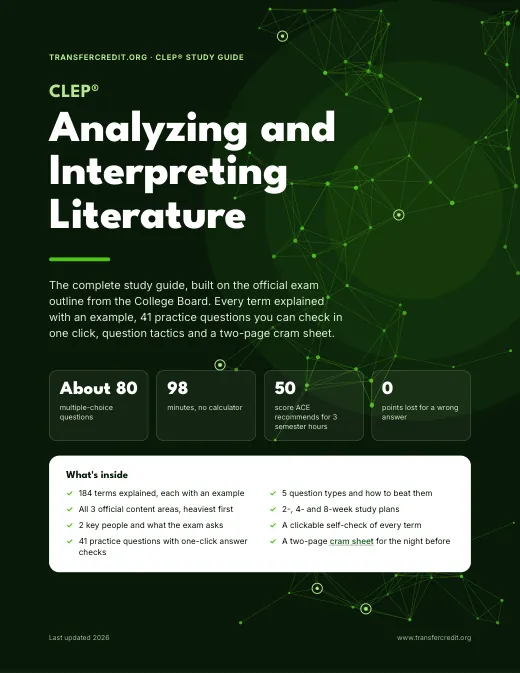
Everything the CLEP Analyzing and Interpreting Literature exam tests, in one PDF you can print. Built from the College Board's official outline, heaviest topics first.
Last updated 2026 · exam details checked against the College Board's published exam information in 2026
Real pages from the 35-page PDF.
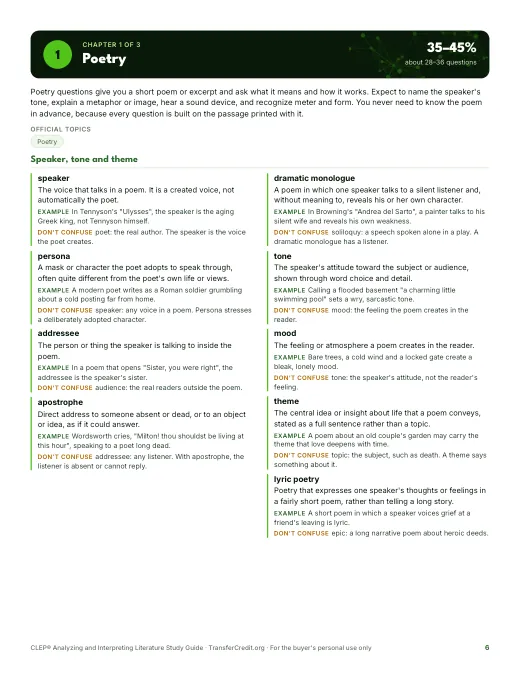
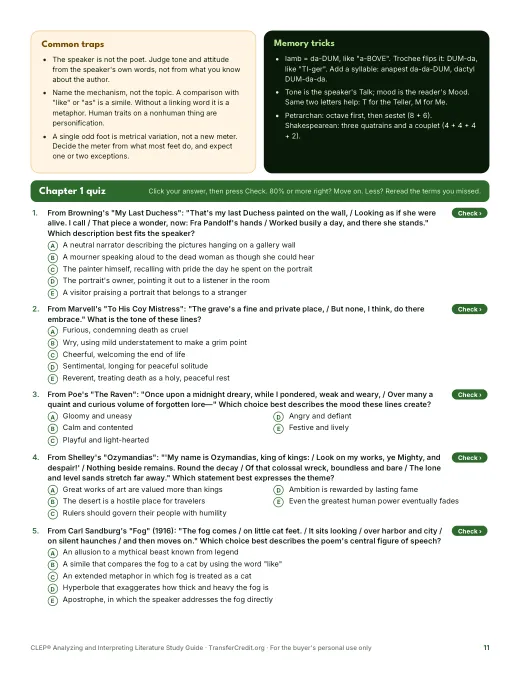
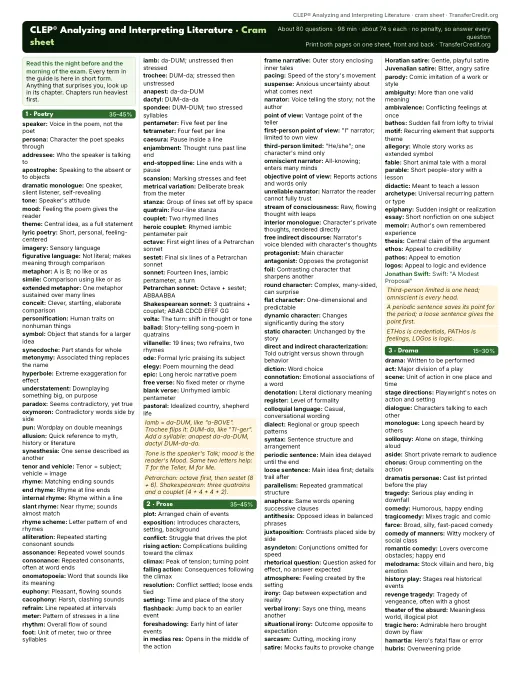
One chapter for each official content area, in the order the exam weighs them.
In the style of the real exam, from all 3 areas. About 10 minutes, with every answer explained and a score by area.
From Browning's "My Last Duchess": "That's my last Duchess painted on the wall, / Looking as if she were alive. I call / That piece a wonder, now: Fra Pandolf's hands / Worked busily a day, and there she stands." Which description best fits the speaker?
Answer: E. The portrait's owner, pointing it out to a listener in the room. The speaker says "That's my last Duchess" and "I call / That piece a wonder", so the portrait is his and he is showing it to someone. He names Fra Pandolf as the painter.
The trap: The painter himself is tempting because the passage dwells on painting, but the speaker credits the work to Fra Pandolf's hands, not his own.
The speaker says "That's my last Duchess" and "I call / That piece a wonder", so the portrait is his and he is showing it to someone. He names Fra Pandolf as the painter.
The trap: The painter himself is tempting because the passage dwells on painting, but the speaker credits the work to Fra Pandolf's hands, not his own.
Read the passage below.
"It is a truth universally acknowledged, that a single man in possession of a good fortune, must be in want of a wife. However little known the feelings or views of such a man may be [...] this truth is so well fixed in the minds of the surrounding families, that he is considered as the rightful property of some one or other of their daughters." (Jane Austen, Pride and Prejudice, 1813)
The narrator's tone is best described as
Answer: C. Ironic, presenting the families' self-interest as a universal truth. The "truth universally acknowledged" turns out to be only what the local families want: a rich newcomer for "their daughters." Dressing up their self-interest as a universal law is gentle irony.
The trap: The earnest choice is tempting because the first sentence sounds like a serious generalization. The second sentence shows the "truth" is just the families' wish, so the narrator does not endorse it.
The "truth universally acknowledged" turns out to be only what the local families want: a rich newcomer for "their daughters." Dressing up their self-interest as a universal law is gentle irony.
The trap: The earnest choice is tempting because the first sentence sounds like a serious generalization. The second sentence shows the "truth" is just the families' wish, so the narrator does not endorse it.
Original passage. Earlier in the play, the audience watched the servant Pell stir poison into a cup of tea.
LADY ORRIN: Ah, Pell, my tea at last. You are the one person in this house I can trust.
PELL: (bowing) Drink while it is warm, madam.
The exchange is best described as an example of
Answer: D. dramatic irony, since the audience knows what she does not. The audience has seen the poisoning, so Lady Orrin's trust means something she cannot understand. That gap between audience and character is dramatic irony.
The trap: Verbal irony is wrong: Lady Orrin means what she says. The irony comes from the audience's knowledge, not her words.
The audience has seen the poisoning, so Lady Orrin's trust means something she cannot understand. That gap between audience and character is dramatic irony.
The trap: Verbal irony is wrong: Lady Orrin means what she says. The irony comes from the audience's knowledge, not her words.
From Marvell's "To His Coy Mistress": "The grave's a fine and private place, / But none, I think, do there embrace." What is the tone of these lines?
Answer: A. Wry, using mild understatement to make a grim point. Calling the grave "a fine and private place" is a deliberately mild way of describing death. The joke about embracing shows a dry, witty tone that urges the listener not to waste time.
The trap: Reverent is tempting because the subject is the grave, but the speaker jokes about it instead of honoring it.
Calling the grave "a fine and private place" is a deliberately mild way of describing death. The joke about embracing shows a dry, witty tone that urges the listener not to waste time.
The trap: Reverent is tempting because the subject is the grave, but the speaker jokes about it instead of honoring it.
Read the passage below.
"I have been assured by a very knowing American of my acquaintance in London, that a young healthy child well nursed, is, at a year old, a most delicious nourishing and wholesome food, whether stewed, roasted, baked, or boiled; and I make no doubt that it will equally serve in a fricasee, or a ragoust." (Jonathan Swift, "A Modest Proposal," 1729)
The speaker's calm, businesslike manner in describing a horrifying idea is used mainly to
Answer: B. Make readers recoil from the cold, calculating attitude that it imitates. The gap between a monstrous idea (a child as "wholesome food") and a reasonable, expert tone is the engine of Juvenalian satire. Readers are meant to be shocked at an attitude that treats people as a resource.
The trap: The choice that says the author is cruel confuses the speaker with the author. Swift created a persona whose calm cruelty he is attacking.
The gap between a monstrous idea (a child as "wholesome food") and a reasonable, expert tone is the engine of Juvenalian satire. Readers are meant to be shocked at an attitude that treats people as a resource.
The trap: The choice that says the author is cruel confuses the speaker with the author. Swift created a persona whose calm cruelty he is attacking.
HAMLET, who believes he is alone, says:
To be, or not to be, that is the question:
Whether 'tis nobler in the mind to suffer
The slings and arrows of outrageous fortune,
Or to take arms against a sea of troubles,
And by opposing end them?
The speech is best described as
Answer: B. a soliloquy that lets the audience hear a private struggle over a choice. Hamlet thinks no one is listening and weighs whether to endure suffering or fight it. Speaking private thoughts aloud while alone is a soliloquy.
The trap: The monologue choice is wrong: a monologue is spoken to other characters, while Hamlet is speaking his thoughts to himself.
Hamlet thinks no one is listening and weighs whether to endure suffering or fight it. Speaking private thoughts aloud while alone is a soliloquy.
The trap: The monologue choice is wrong: a monologue is spoken to other characters, while Hamlet is speaking his thoughts to himself.
From Poe's "The Raven": "Once upon a midnight dreary, while I pondered, weak and weary, / Over many a quaint and curious volume of forgotten lore—" Which choice best describes the mood these lines create?
Answer: D. Gloomy and uneasy. Midnight, "dreary", "weak and weary" and old "forgotten lore" combine to give a heavy, uneasy atmosphere that prepares the reader for something eerie.
The trap: Calm and contented is tempting because the speaker is quietly reading, but the word choices (dreary, weary, forgotten) are not restful.
Midnight, "dreary", "weak and weary" and old "forgotten lore" combine to give a heavy, uneasy atmosphere that prepares the reader for something eerie.
The trap: Calm and contented is tempting because the speaker is quietly reading, but the word choices (dreary, weary, forgotten) are not restful.
Read the sentence below.
"True!—nervous—very, very dreadfully nervous I had been and am; but why will you say that I am mad?" (Edgar Allan Poe, "The Tell-Tale Heart," 1843)
The narrator is best described as
Answer: C. Unreliable, because his agitated, defensive manner undercuts his claim to be sane. He insists he is not mad while sounding frantic, and he answers an accusation no one has been shown making. His own voice gives the reader reason to doubt him.
The trap: Calling him a calm, objective witness ignores the dashes, the repetition and the defensive question. The signs of agitation are exactly what make the account suspect.
He insists he is not mad while sounding frantic, and he answers an accusation no one has been shown making. His own voice gives the reader reason to doubt him.
The trap: Calling him a calm, objective witness ignores the dashes, the repetition and the defensive question. The signs of agitation are exactly what make the account suspect.
LADY BRACKNELL says to Jack Worthing:
To lose one parent, Mr. Worthing, may be regarded as a misfortune; to lose both looks like carelessness.
The tone of the line is best described as
Answer: E. dry, deadpan wit that exposes her snobbish priorities. The balanced, formal phrasing treats losing one's parents as a personal failing. That deadpan cruelty is witty and ironic, a hallmark of the comedy of manners.
The trap: Sympathy is wrong: calling the loss of both parents 'carelessness' mocks Mr. Worthing instead of comforting him.
The balanced, formal phrasing treats losing one's parents as a personal failing. That deadpan cruelty is witty and ironic, a hallmark of the comedy of manners.
The trap: Sympathy is wrong: calling the loss of both parents 'carelessness' mocks Mr. Worthing instead of comforting him.
From Shelley's "Ozymandias": "'My name is Ozymandias, king of kings: / Look on my works, ye Mighty, and despair!' / Nothing beside remains. Round the decay / Of that colossal wreck, boundless and bare / The lone and level sands stretch far away." Which statement best expresses the theme?
Answer: A. Even the greatest human power eventually fades. The ruler's boast of mighty works contrasts with a shattered statue and endless sand. The gap between his claim and what is left shows that human power does not last.
The trap: Governing with humility is tempting because the king's boast sounds proud, but the lines show what time does to power, not how a ruler should behave.
The ruler's boast of mighty works contrasts with a shattered statue and endless sand. The gap between his claim and what is left shows that human power does not last.
The trap: Governing with humility is tempting because the king's boast sounds proud, but the lines show what time does to power, not how a ruler should behave.
The CLEP Analyzing and Interpreting Literature exam is a 98-minute, computer-based test from the College Board with about 80 multiple-choice questions. A score of 50 on the 20–80 scale earns an ACE credit recommendation of 3 semester hours, though each college sets its own policy. The exam covers 3 content areas; the heaviest is Poetry at 35–45%.
Source: official CLEP Analyzing and Interpreting Literature exam page.
3 areas, heaviest first. The guide's chapters follow this order.
Start with the guide, or get everything for CLEP in one plan.
CLEP® is a registered trademark of the College Board, which was not involved in producing this guide and does not endorse it. TransferCredit.org is independent and not affiliated with the College Board. © 2026 UPI Globale Edu Inc.