
$5one-time
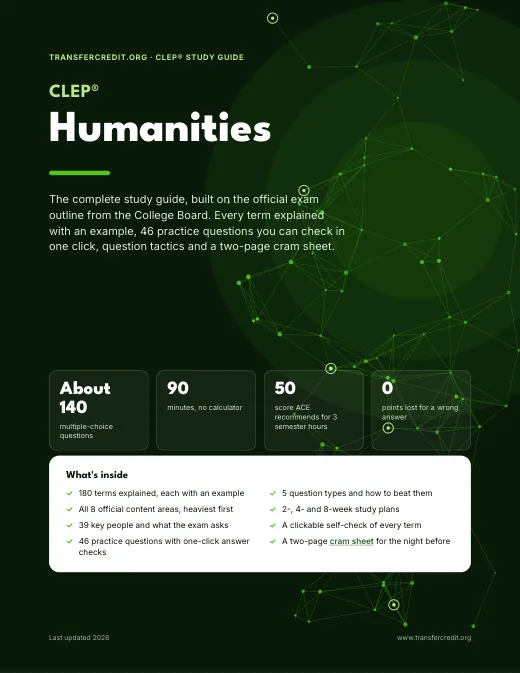
- 38-page printable PDF
- 180 terms with examples
- 46 practice questions, answers explained
- 2-page cram sheet and study plans
Everything the CLEP Humanities exam tests, in one PDF you can print. Built from the College Board's official outline, heaviest topics first.
Last updated 2026 · exam details checked against the College Board's published exam information in 2026
Real pages from the 38-page PDF.
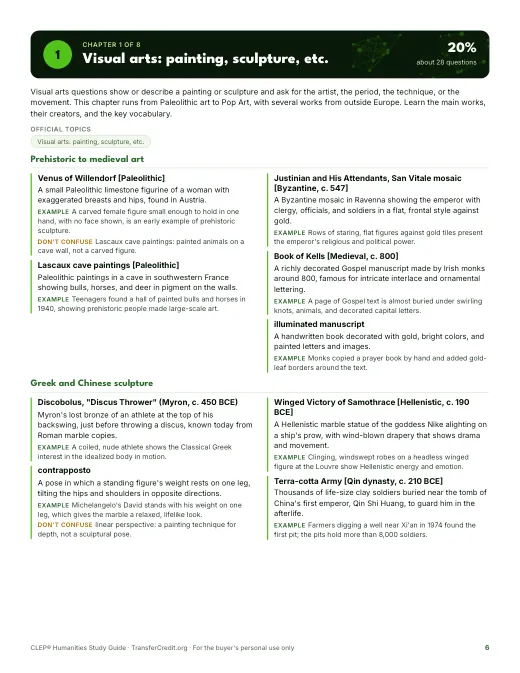
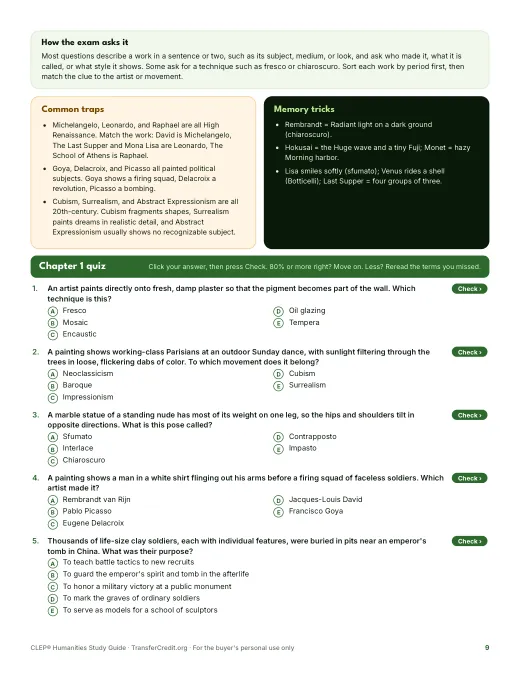
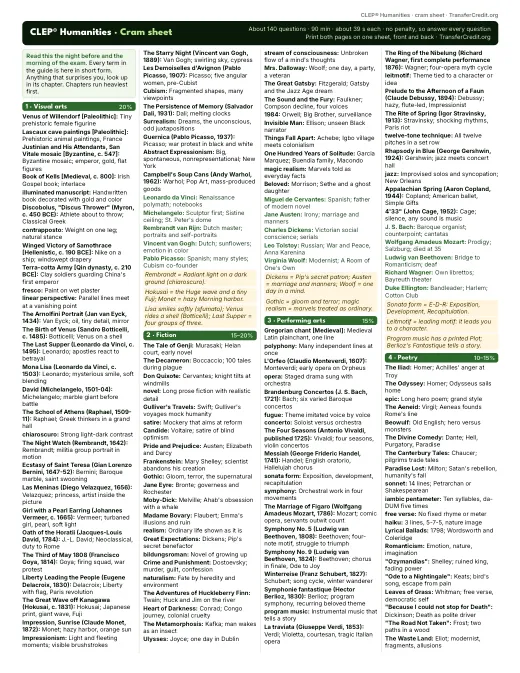
One chapter for each official content area, in the order the exam weighs them.
In the style of the real exam, from all 8 areas. About 5 minutes, with every answer explained and a score by area.
An artist paints directly onto fresh, damp plaster so that the pigment becomes part of the wall. Which technique is this?
Answer: B. Fresco. In fresco, pigment sinks into wet plaster and dries as part of the wall.
The trap: Mosaic also decorates walls, but it is built from small pieces of glass or stone, not paint on plaster.
In fresco, pigment sinks into wet plaster and dries as part of the wall.
The trap: Mosaic also decorates walls, but it is built from small pieces of glass or stone, not paint on plaster.
In a book, a traveler visits a flying island whose scholars are so lost in abstract thought that servants must tap them to get their attention. What is the passage mainly doing?
Answer: E. Satirizing intellectual absurdity. Exaggerating scholars' absent-mindedness to mock human folly is satire. The passage echoes Swift's Gulliver's Travels, which mocks the follies of its own age.
The trap: Blending magic into daily life is tempting because a flying island is impossible, but the scholars are exaggerated to mock them, which is satire.
Exaggerating scholars' absent-mindedness to mock human folly is satire. The passage echoes Swift's Gulliver's Travels, which mocks the follies of its own age.
The trap: Blending magic into daily life is tempting because a flying island is impossible, but the scholars are exaggerated to mock them, which is satire.
Male voices sing a Latin text in unison on a single melodic line, with no instruments, no harmony, and no regular beat. What kind of music is this?
Answer: C. Gregorian chant. One unaccompanied Latin melody in free rhythm is Gregorian chant, the sacred plainchant of the medieval church.
The trap: A motet is also sacred Latin vocal music, but it is polyphonic: several independent lines sound at once.
One unaccompanied Latin melody in free rhythm is Gregorian chant, the sacred plainchant of the medieval church.
The trap: A motet is also sacred Latin vocal music, but it is polyphonic: several independent lines sound at once.
A long poem opens by calling on a Muse, begins in the middle of events, and follows a hero whose deeds shape the fate of a nation. To which genre does it belong?
Answer: A. Epic. Invoking a Muse, starting in the middle of the action and following a hero tied to a people's destiny are marks of the epic, as in Homer and Virgil.
The trap: A ballad also tells a story in verse, but it is short and song-like, without the elevated style and grand scale of an epic.
Invoking a Muse, starting in the middle of the action and following a hero tied to a people's destiny are marks of the epic, as in Homer and Virgil.
The trap: A ballad also tells a story in verse, but it is short and song-like, without the elevated style and grand scale of an epic.
A tragedy centers on a young woman who defies the ruler of Thebes because she believes the laws of the gods outrank the laws of the state. Which play is this?
Answer: D. Antigone. Antigone buries her brother against Creon's decree, setting divine law against state law. That conflict is the core of Sophocles' play.
The trap: Oedipus Rex shares the Theban setting and the author, but its hero is a king uncovering his own past, not a woman defying a ruler's law.
Antigone buries her brother against Creon's decree, setting divine law against state law. That conflict is the core of Sophocles' play.
The trap: Oedipus Rex shares the Theban setting and the author, but its hero is a king uncovering his own past, not a woman defying a ruler's law.
Prisoners chained in a cave take shadows on a wall for reality. One is freed, sees the sun, and returns to find the others mock him. Which work contains this image?
Answer: E. The Republic. The cave image appears in Plato's Republic, where it illustrates how people can mistake appearances for reality.
The trap: Meditations is tempting because Descartes also doubts the senses, but his doubt comes from a deceiver argument, not from a cave.
The cave image appears in Plato's Republic, where it illustrates how people can mistake appearances for reality.
The trap: Meditations is tempting because Descartes also doubts the senses, but his doubt comes from a deceiver argument, not from a cave.
A director cuts quickly among a waving crowd, a marching boot and a baying dog to create a feeling of menace that none of the shots has alone. What technique is this?
Answer: D. Montage. Joining short shots so that their combination produces meaning is montage, the editing method championed by Eisenstein.
The trap: A tracking shot is a single continuous movement of the camera alongside a subject, so it creates no new meaning by joining separate shots.
Joining short shots so that their combination produces meaning is montage, the editing method championed by Eisenstein.
The trap: A tracking shot is a single continuous movement of the camera alongside a subject, so it creates no new meaning by joining separate shots.
A column capital is shaped like a pair of scrolls and has no leaves. Which classical order is it?
Answer: C. Ionic. Scroll-shaped volutes mark the Ionic order.
The trap: Doric is tempting because it is also a simple, early Greek style, but its capital is a plain cushion with no scrolls.
Scroll-shaped volutes mark the Ionic order.
The trap: Doric is tempting because it is also a simple, early Greek style, but its capital is a plain cushion with no scrolls.
A painting shows working-class Parisians at an outdoor Sunday dance, with sunlight filtering through the trees in loose, flickering dabs of color. To which movement does it belong?
Answer: B. Impressionism. Loose, broken brushwork and flickering outdoor light on a modern leisure scene mark Impressionism. This is Renoir's Bal du moulin de la Galette (1876).
The trap: Neoclassicism came earlier and favored sharp outlines, a smooth finish, and serious historical subjects, not loose brushwork and everyday leisure.
Loose, broken brushwork and flickering outdoor light on a modern leisure scene mark Impressionism. This is Renoir's Bal du moulin de la Galette (1876).
The trap: Neoclassicism came earlier and favored sharp outlines, a smooth finish, and serious historical subjects, not loose brushwork and everyday leisure.
A novel set on a single London day moves between characters' minds in long sentences that follow memories and sensations rather than a plot. Which technique is this?
Answer: A. Stream of consciousness. Following the unbroken flow of thoughts, feelings and memories is stream of consciousness, used by Woolf in Mrs. Dalloway and by Joyce.
The trap: Omniscient narration reports a story from outside the characters, so it does not present the loose, associative flow of one mind's thoughts.
Following the unbroken flow of thoughts, feelings and memories is stream of consciousness, used by Woolf in Mrs. Dalloway and by Joyce.
The trap: Omniscient narration reports a story from outside the characters, so it does not present the loose, associative flow of one mind's thoughts.
The CLEP Humanities exam is a 90-minute, computer-based test from the College Board with about 140 multiple-choice questions. A score of 50 on the 20–80 scale earns an ACE credit recommendation of 3 semester hours, though each college sets its own policy. The exam covers 8 content areas; the heaviest is Visual arts: painting, sculpture, etc. at 20%.
Source: official CLEP Humanities exam page.
8 areas, heaviest first. The guide's chapters follow this order.
Start with the guide, or get everything for CLEP in one plan.
CLEP® is a registered trademark of the College Board, which was not involved in producing this guide and does not endorse it. TransferCredit.org is independent and not affiliated with the College Board. © 2026 UPI Globale Edu Inc.