← All study guides
DSST® Study Guide Printable PDF · 41 pages

DSST Management Information Systems Study Guide

Everything the DSST Management Information Systems exam tests, in one PDF you can print. Built from Prometric's official outline, heaviest topics first.

  • 186 key terms, each with an example
  • 47 practice questions with every answer explained
  • A 2-page cram sheet for the night before
  • 2-, 4- and 8-week study plans built from the exam weights
Not sure yet? Try 10 free questions

Last updated 2026 · exam details checked against Prometric's published exam information in 2026

Look inside the guide

Real pages from the 41-page PDF.

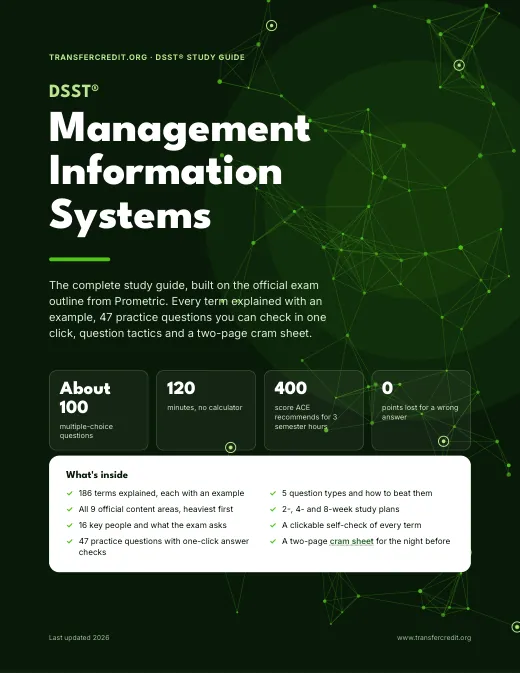
Page 1 of the DSST Management Information Systems Study Guide: the cover
Page 1 The cover
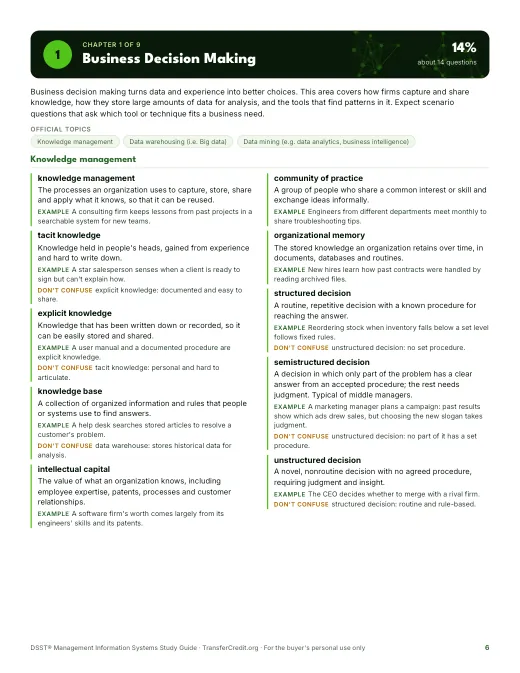
Page 6 of the DSST Management Information Systems Study Guide: the Chapter 1 opener
Page 6 The Chapter 1 opener
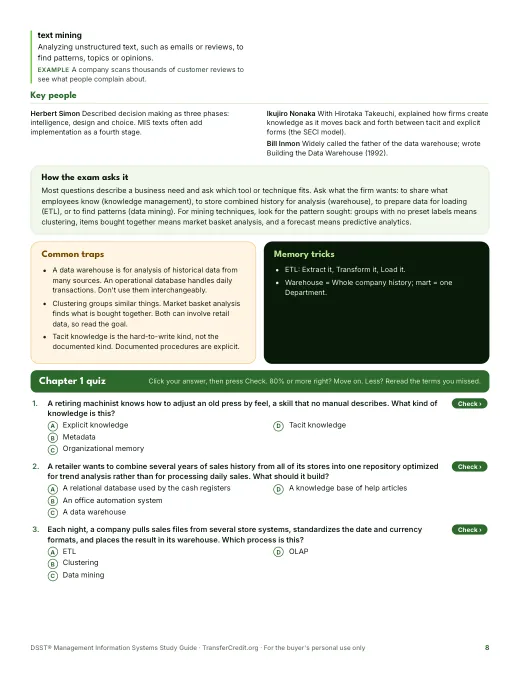
Page 8 of the DSST Management Information Systems Study Guide: a chapter quiz
Page 8 A chapter quiz
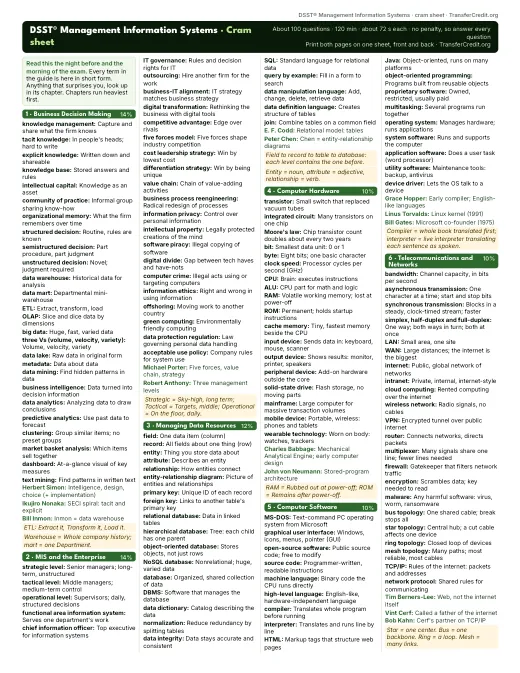
Page 40 of the DSST Management Information Systems Study Guide: the 2-page cram sheet
Page 40 The 2-page cram sheet

What you get for $5

One chapter for each official content area, in the order the exam weighs them.

  • 📘41pages, printable
  • 🧭9chapters, heaviest first
  • 🔑186terms with examples
  • ✍️47practice questions, answers explained
  • ⚠️27exam traps to avoid
  • 📄2page cram sheet

Try 10 free Management Information Systems questions

In the style of the real exam, from all 9 areas. About 10 minutes, with every answer explained and a score by area.

10 questions  
  1. Question 1 · Business Decision Making

    A retiring machinist knows how to adjust an old press by feel, a skill that no manual describes. What kind of knowledge is this?

    Show the answer

    Answer: A. Tacit knowledge. Knowledge that lives in a person's experience and is hard to write down is tacit knowledge.

    The trap: Explicit knowledge has been documented. The scenario states that no manual describes this skill.

  2. Question 2 · MIS and the Enterprise

    A retailer uses its systems to track every item's cost carefully and negotiate with suppliers so that it can charge the lowest prices in its market. Which competitive strategy is it following?

    Show the answer

    Answer: C. Cost leadership. Competing by being the lowest-cost producer is cost leadership.

    The trap: Differentiation is tempting because the retailer stands out, but it stands out on price, not on unique features or service.

  3. Question 3 · Managing Data Resources

    An Orders table includes a CustomerID column so that each order can be matched to a row in the Customers table, where CustomerID uniquely identifies each customer. What is CustomerID in the Orders table?

    Show the answer

    Answer: D. A foreign key. It links to the primary key of another table, which makes it a foreign key in Orders.

    The trap: A primary key must be unique in its own table. In Orders, CustomerID repeats when a customer places several orders.

  4. Question 4 · Computer Hardware

    A bank wants a computer that can process millions of customer transactions each day while serving thousands of users at once. Which type of computer best fits this need?

    Show the answer

    Answer: B. Mainframe. Mainframes are built for high-volume transaction processing for many simultaneous users.

    The trap: A personal computer is tempting because it is a full computer, but it is designed for one user, not thousands at once.

  5. Question 5 · Computer Software

    A developer writes a program in a high-level language and wants the computer to translate the whole program into machine language once, before anyone runs it. Which tool does this?

    Show the answer

    Answer: A. Compiler. A compiler translates the entire source program into machine language ahead of execution.

    The trap: An interpreter is tempting because it also translates code, but it translates and runs one statement at a time rather than the whole program beforehand.

  6. Question 6 · Telecommunications and Networks

    Employees who work from home need to reach the company's internal file server securely over the public internet. Which technology should the firm use?

    Show the answer

    Answer: C. A virtual private network (VPN). A VPN encrypts traffic and creates a private tunnel across the public internet, which is exactly the need described.

    The trap: A firewall filters traffic but does not create a secure, private connection across the internet.

  7. Question 7 · Business Information Systems

    A supermarket's checkout terminals record every sale and immediately update inventory counts. Which type of information system performs this function?

    Show the answer

    Answer: B. Transaction processing system. A transaction processing system captures routine day-to-day transactions as they occur.

    The trap: A decision support system analyzes data to support decisions; it doesn't record individual sales.

  8. Question 8 · Systems Analysis and Design

    A company's quality-control reports on defective items are reviewed each week, and the production line settings are changed to reduce defects. Which characteristic of a system does this describe?

    Show the answer

    Answer: D. Feedback. Information about output (defect reports) is used to adjust processing (line settings). That is feedback.

    The trap: Synergy means the whole achieves more than its parts, which says nothing about adjusting using output information.

  9. Question 9 · Project Management

    A project manager wants a visual that shows each task's start and finish dates on a calendar, along with which tasks overlap. Which tool should she use?

    Show the answer

    Answer: C. Gantt chart. A Gantt chart shows tasks as bars along a time axis, revealing start, finish and overlap.

    The trap: A PERT chart is tempting because it also schedules tasks, but it is a network of dependencies rather than a calendar of bars.

  10. Question 10 · Business Decision Making

    A retailer wants to combine several years of sales history from all of its stores into one repository optimized for trend analysis rather than for processing daily sales. What should it build?

    Show the answer

    Answer: B. A data warehouse. A data warehouse collects historical data from many sources and organizes it for analysis and reporting.

    The trap: A database serving the registers is built for daily transactions, which is the opposite of what the retailer wants.

The DSST Management Information Systems exam at a glance

The DSST Management Information Systems exam is a 120-minute, computer-based test from Prometric with about 100 multiple-choice questions. A score of 400 on the 200–500 scale earns an ACE credit recommendation of 3 semester hours, though each college sets its own policy. The exam covers 9 content areas; the heaviest is Business Decision Making at 14%.

Questions
About 100multiple choice
Time
120 minabout 72 seconds a question
Passing score
400on a 200–500 scale
ACE credit
3semester hours
Exam fee
$100paid to Prometric
Calculator
Nonot allowed

Source: official DSST Management Information Systems exam page.

What the exam covers

9 areas, heaviest first. The guide's chapters follow this order.

  1. Business Decision Making14%
  2. MIS and the Enterprise14%
  3. Managing Data Resources12%
  4. Computer Hardware10%
  5. Computer Software10%
  6. Telecommunications and Networks10%
  7. Business Information Systems10%
  8. Systems Analysis and Design10%
  9. Project Management10%

How it works

  1. 1Buy once, $5Secure checkout. No subscription needed.
  2. 2Download the PDFFrom your TransferCredit.org account, right away and any time later.
  3. 3Study the heaviest areas firstFollow the 2-, 4- or 8-week plan, then read the cram sheet the night before.

Questions students ask

What's in the full DSST Management Information Systems study guide?
41 pages: 9 chapters, one per official content area, heaviest first. 186 terms, each with a plain-English definition and an example, 16 key people, common traps and memory tricks, 47 practice questions with an answer key that explains every answer, question tactics, 2-, 4- and 8-week study plans and a 2-page cram sheet.
How much is the full DSST Management Information Systems study guide?
The full 41-page PDF is $5, a one-time payment. The 10 practice questions on this page are free, with no account.
What does the $29 plan include?
$29 a month gives you all DSST subjects: every DSST study guide plus the full prep course for each subject, and you can cancel anytime. If you only need this exam, the guide on its own is a one-time $5.
How do I get the full guide?
Choose Buy this guide ($5) and check out. Then sign in to your TransferCredit.org account, then open the course and its Download Your Study Guide lesson. The PDF is yours to keep, and you can download it again from your account at any time.
Can I print the guide or use it on my phone?
Yes. It's a PDF, so it opens on phones, tablets and computers, and printing is allowed. Its tick boxes and answer bubbles work in PDF readers that support forms. Copying and editing are turned off.
Is this an official DSST study guide?
No. DSST® is a registered trademark of Prometric, which was not involved in producing this guide and does not endorse it. TransferCredit.org is independent. We built the guide from the official exam outline, and the exam details were checked against Prometric's published exam information in 2026.
Why is this study guide better than a generic review?
It follows the official outline area by area and spends the most pages on what the exam weighs most. Every term comes with an example, each chapter names the traps the exam sets, and the answer key explains why the most tempting wrong answer is wrong, not just which answer is right. It ends with a 2-page cram sheet for the night before.
What is the DSST Management Information Systems exam?
The DSST Management Information Systems exam is a 120-minute, computer-based test from Prometric with about 100 multiple-choice questions. A score of 400 on the 200–500 scale earns an ACE credit recommendation of 3 semester hours, though each college sets its own policy. The exam covers 9 content areas; the heaviest is Business Decision Making at 14%.
More questions about the DSST Management Information Systems exam (22)
How many questions are on the DSST Management Information Systems exam, and how long is it?
It has 100 questions to be answered in 2 hours.
What is the passing score for DSST Management Information Systems?
The passing score is 400 on a 200–500 scale. At 400 or above, the American Council on Education (ACE) recommends 3 semester hours. Each college sets its own passing score and credit award, so check your school's policy before you book.
How much does the DSST Management Information Systems exam cost?
The exam fee is $100, paid to Prometric. Test centers may add their own administration fee. Eligible U.S. military service members can usually test for free through DANTES.
How many college credits is DSST Management Information Systems worth?
ACE recommends 3 semester hours for a passing score of 400. Your college decides how many credits it awards and which course they replace. Check your college's policy.
Can I use a calculator on the DSST Management Information Systems exam?
No. This exam doesn't allow a calculator.
Is there a penalty for guessing on DSST Management Information Systems?
No. Your score counts only correct answers, so a wrong answer costs nothing. Never leave a question blank: rule out what you can and pick your best guess.
What topics are on the DSST Management Information Systems exam?
9 content areas, from the official outline: Business Decision Making (14%); MIS and the Enterprise (14%); Managing Data Resources (12%); Computer Hardware (10%); Computer Software (10%); Telecommunications and Networks (10%); Business Information Systems (10%); Systems Analysis and Design (10%); Project Management (10%).
Which DSST Management Information Systems topics should I study first?
Start with the three heaviest: Business Decision Making (14%), MIS and the Enterprise (14%) and Managing Data Resources (12%). Together they are about 40% of the exam, roughly 40 of 100 questions. The guide's chapters run in that order, heaviest first.
Is the DSST Management Information Systems exam hard?
It depends on what you already know. No single area dominates: the largest, Business Decision Making, is 14% and the smallest, Project Management, is 10%, so broad coverage matters more than deep expertise in one topic. Take the free diagnostic above to see where you stand in about 10 minutes.
What kinds of questions are on the DSST Management Information Systems exam?
The guide sorts them into 5 types: “Term-to-definition”, “Scenario-to-system match”, “Characteristic or concept recognition”, “Compare and contrast” and “Ordered steps and stages”. Every question has 4 answer choices. Try the 10 free questions above to see the style.
How long should I study for DSST Management Information Systems?
Use the diagnostic to decide. If you already know most areas, two weeks of daily review is often enough; if the subject is new to you, plan on eight. The full guide has 2-, 4- and 8-week plans built from the exam weights.
How should I pace myself on the DSST Management Information Systems exam?
On average you have about 72 seconds per question (120 minutes for 100 questions). Be past question 33 a third of the way through and past question 67 two-thirds through. If a question takes more than a minute, pick your best guess, mark it and come back.
What happens if I don't pass DSST Management Information Systems?
You can retake a DSST exam after 30 days. Use the wait to work through the areas the score report and the diagnostic show you missed.
Do colleges accept DSST Management Information Systems for credit?
DSST exams are accepted at more than 1,500 colleges and universities, but each school decides which exams it accepts, the score it requires and the credit it gives. Look up your college's DSST policy before you book.
Should I take DSST Management Information Systems or CLEP Information Systems?
Both cover the same subject. DSST Management Information Systems: about 100 questions, 120 minutes, passing score 400, fee $100. CLEP Information Systems: about 100 questions, 90 minutes, passing score 50, fee $97. Take the one your college accepts; most colleges award the credit once, not for both. See the CLEP Information Systems study guide.
How up to date is this DSST Management Information Systems guide?
Last updated 2026. The exam details were checked against Prometric's published exam information in 2026. Exams change, so confirm the details on the official exam page before you register.
What should I do the night before the exam?
Read the cram sheet once, slowly. Check your test time, the location or remote-proctoring setup, and the ID you need. Then sleep: a rested brain recalls more than a crammed one. In the morning, skim the memory tricks and common traps, then stop studying.
Do I need programming experience for DSST MIS?
No. The exam asks what languages like HTML and Java are used for and how software is developed, but you won't write code.
Does DSST MIS cover databases?
Yes. Managing Data Resources is 12% of the exam and covers data models, entity relationships, types and attributes, database management systems, and querying and updating data. Data warehousing, big data and data mining add another 14% under Business Decision Making.
Is DSST Management Information Systems the same as CLEP Information Systems?
No. They're separate exams with different outlines. DSST MIS has 100 questions in two hours, a passing score of 400, and dedicated areas for project management and business decision making; CLEP Information Systems has about 100 questions in 90 minutes, a passing score of 50, and more weight on office applications and the web. Check which one your college accepts.
Does DSST MIS cover Agile and Scrum?
Yes. Project management is 10% of the exam and covers Waterfall, predictive, Agile, Kanban and Scrum approaches, tools like Gantt charts, PERT and SAFe, and terms like critical path, Six Sigma and the triple constraint.
Can I take DSST Management Information Systems online?
Yes. DSST exams can be taken at a test center or online with a remote Prometric proctor.

Choose how you want to study

Start with the guide, or get everything for DSST in one plan.

This study guide
$5one-time
  • 41-page printable PDF
  • 186 terms with examples
  • 47 practice questions, answers explained
  • 2-page cram sheet and study plans
Get the guide · $5
Best value Get it all
$29/month
  • Every DSST study guide
  • Prep courses for all DSST subjects
  • Cancel anytime
Get it all · $29/mo

DSST® is a registered trademark of Prometric, which was not involved in producing this guide and does not endorse it. TransferCredit.org is independent and not affiliated with Prometric. © 2026 UPI Globale Edu Inc.