← All AP® study guides
AP® Study Guide Printable PDF · 39 pages

TransferCredit.org Guide to AP® Chinese Language and Culture

AP® Chinese Language and Culture study guide: a printable PDF built from the College Board's official course and exam description, heaviest topics first.

  • 188 key terms, each with an example
  • 44 practice questions with every answer explained
  • A 2-page cram sheet for the night before
  • 2-, 4- and 8-week study plans built from the exam weights
Not sure yet? Try 10 free questions

Last updated 2026 · exam details checked against the College Board's published exam information in 2026

Look inside the guide

Real pages from the 39-page PDF.

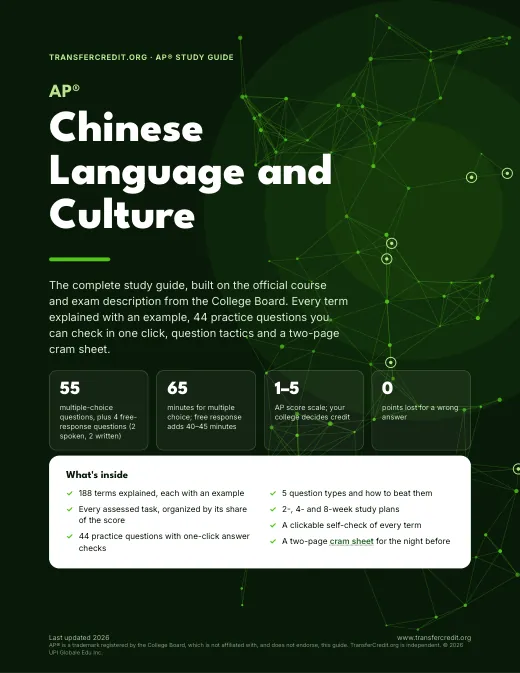
Page 1 of the TransferCredit.org Guide to AP® Chinese Language and Culture: the cover
Page 1 The cover
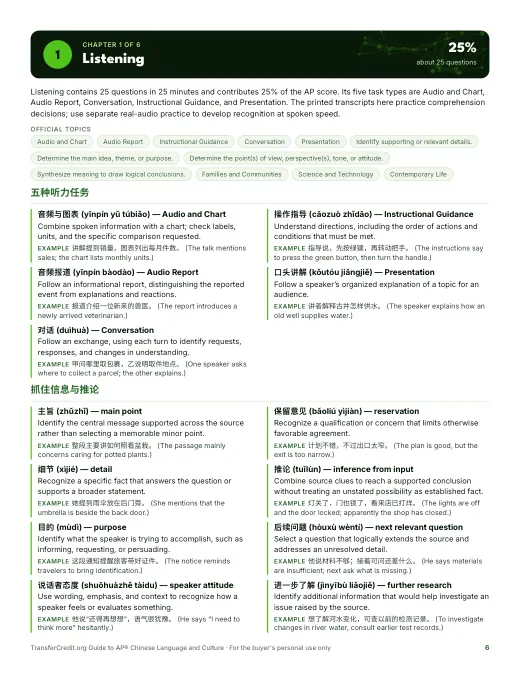
Page 6 of the TransferCredit.org Guide to AP® Chinese Language and Culture: the Chapter 1 opener
Page 6 The Chapter 1 opener
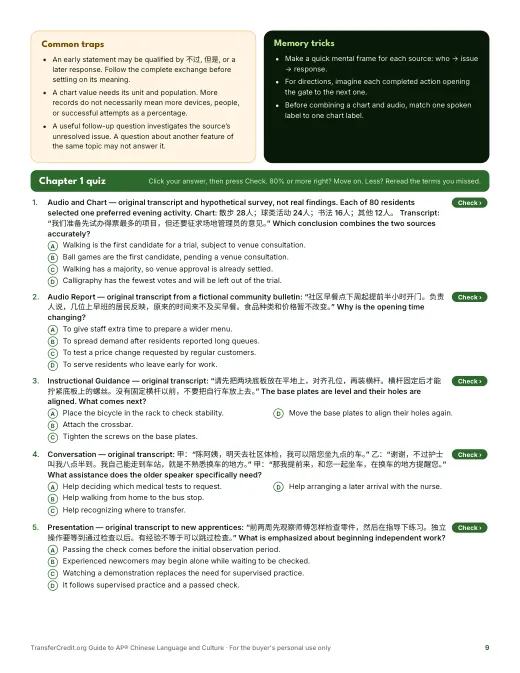
Page 9 of the TransferCredit.org Guide to AP® Chinese Language and Culture: a chapter quiz
Page 9 A chapter quiz
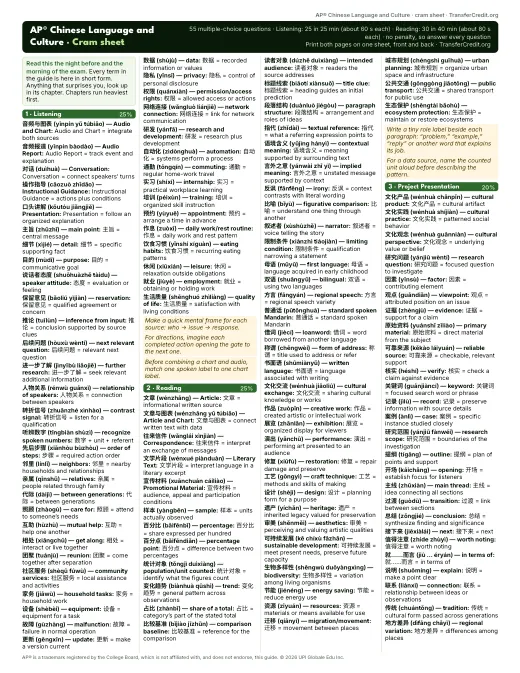
Page 38 of the TransferCredit.org Guide to AP® Chinese Language and Culture: the 2-page cram sheet
Page 38 The 2-page cram sheet

What you get for $5

One chapter for each area of the official course and exam description, heaviest topics first.

  • 📘39pages, printable
  • 🧭6chapters
  • 🔑188terms with examples
  • ✍️44practice questions, answers explained
  • ⚠️18exam traps to avoid
  • 📄2page cram sheet

Try 10 free AP® Chinese Language and Culture questions

Multiple-choice questions taken from the guide's chapter quizzes: 2 multiple-choice areas, heaviest first. About 10 minutes, with every answer explained and a score by area. The exam's free-response questions aren't in this quiz: see how the exam works.

10 questions  
  1. Question 1 · Listening
    Audio and Chart — original transcript and hypothetical survey, not real findings. Each of 80 residents selected one preferred evening activity. Chart: 散步 28人;球类活动 24人;书法 16人;其他 12人。 Transcript: “我们准备先试办得票最多的项目,但还要征求场地管理员的意见。” Which conclusion combines the two sources accurately?
    Show the answer

    Answer: B. Walking is the first candidate for a trial, subject to venue consultation.. Walking has 28 votes, more than any other category. The speaker still requires consultation about the venue. The leading category is 35% of the sample, which is not a majority.

    The trap: The statement about a majority confuses the largest category with more than half the sample and invents completed venue approval.

  2. Question 2 · Reading
    Original Article excerpt:
    “社区预约表原来把步骤写成一整段,有人漏填资料,有人不清楚先做哪一步。服务站把步骤改成编号清单,每一步旁边配上一个例子。表格需要填写的资料没有改变。”

    What is the purpose of the revised format?
    Show the answer

    Answer: D. To clarify the order of the steps and illustrate how to complete them.. The problems were missed entries and unclear order. Numbered steps and accompanying examples address those problems; the required information remains unchanged.

    The trap: “Reduce the amount of information” conflicts with the explicit statement that the information to be supplied has not changed.

  3. Question 3 · Listening
    Audio Report — original transcript from a fictional community bulletin: “社区早餐点下周起提前半小时开门。负责人说,几位上早班的居民反映,原来的时间来不及买早餐。食品种类和价格暂不改变。” Why is the opening time changing?
    Show the answer

    Answer: C. To serve residents who leave early for work.. The residents working early shifts could not buy breakfast at the old opening time. Earlier opening directly addresses their stated difficulty.

    The trap: The wider-menu explanation is unsupported; the report specifically says the food selection will remain unchanged for now.

  4. Question 4 · Reading
    Original Article and Chart, hypothetical survey:
    “同一批一百名受访者分别报告了三月和六月最常用的饮水容器。每人每次只选一类。”
    最常用容器 | 三月人数 | 六月人数
    自带杯 | 35 | 45
    借用杯 | 25 | 30
    一次性杯 | 40 | 25

    Which change is shown by the table?
    Show the answer

    Answer: A. The share choosing a personally carried cup rose by ten percentage points.. The same hundred people each select one category. Personally carried cups increase from 35 of 100 to 45 of 100: a rise of ten percentage points.

    The trap: “Borrowed cup rose by ten percentage points” misreads the change from 25 to 30, which is five percentage points.

  5. Question 5 · Listening
    Instructional Guidance — original transcript: “请先把两块底板放在平地上,对齐孔位,再装横杆。横杆固定后才能拧紧底板上的螺丝。没有固定横杆以前,不要把自行车放上去。” The base plates are level and their holes are aligned. What comes next?
    Show the answer

    Answer: A. Attach the crossbar.. The directions place crossbar installation after alignment. Tightening the base screws and placing a bicycle come only after the crossbar is secured.

    The trap: Tightening the base-plate screws happens too early; the crossbar must be fixed first.

  6. Question 6 · Reading
    Original Article and Chart, hypothetical survey:
    “某小组问一百名受访者最愿意参加哪一种环保活动,每人选一项。表中记录的是意愿,不是实际参加人数。”
    活动 | 选择人数
    交换旧衣 | 40
    修理小家电 | 35
    清洁河岸 | 25

    Which statement is supported by both the article and table?
    Show the answer

    Answer: B. Clothing exchange received the largest share of stated preferences, although fewer than half selected it.. Forty of one hundred is the largest category but less than half. The text explicitly identifies the responses as preferences, rather than attendance.

    The trap: “Clothing exchange was attended by a majority” treats a 40% preference as both actual attendance and more than half.

  7. Question 7 · Listening
    Conversation — original transcript: 甲:“陈阿姨,明天去社区体检,我可以陪您坐九点的车。” 乙:“谢谢,不过护士叫我八点半到。我自己能走到车站,就是不熟悉换车的地方。” 甲:“那我提前来,和您一起坐车,在换车的地方提醒您。” What assistance does the older speaker specifically need?
    Show the answer

    Answer: C. Help recognizing where to transfer.. The older speaker says she can reach the stop herself but is unfamiliar with the transfer location. The other speaker offers to accompany her and point it out.

    The trap: The offer to help with walking overlooks the speaker’s statement that she can walk to the stop on her own.

  8. Question 8 · Reading
    Original Correspondence:
    小林:“演出服装洗好后,能先放在你那里吗?我们的柜子还没修好。”
    阿敏:“可以。不过请用透气袋装好,不要放进密封塑料箱。柜子修好后,再把服装取回去。”

    What does Amin ask Xiaolin to do?
    Show the answer

    Answer: D. Use breathable bags to store the costumes temporarily.. Amin accepts temporary storage but specifically requests breathable bags. The costumes should be collected after the cabinet is repaired.

    The trap: “Sealed plastic boxes” names exactly the container Amin says not to use.

  9. Question 9 · Listening
    Presentation — original transcript to new apprentices: “前两周先观察师傅怎样检查零件,然后在指导下练习。独立操作要等到通过检查以后。有经验不等于可以跳过检查。” What is emphasized about beginning independent work?
    Show the answer

    Answer: A. It follows supervised practice and a passed check.. The speaker gives a progression from observation to supervised practice, with a passed check required before independent operation. Experience does not remove that condition.

    The trap: The statement allowing experienced newcomers to begin alone contradicts the speaker’s warning that experience does not permit skipping the check.

  10. Question 10 · Reading
    Original Correspondence:
    阿文:“你做的纸雕适合我们的展览。你愿意借给我们吗?还想请你写一小段创作说明。”
    小乔:“可以借。不过这件纸雕不能受潮,请放在干燥的展柜里。说明我下周发给你。”

    Which issue has Xiao Qiao already settled in the reply?
    Show the answer

    Answer: C. Whether the paper sculpture may be borrowed.. “可以借” explicitly agrees to the loan. The description will be sent later, and no installation or neighboring works are confirmed.

    The trap: “Already installed a dry display case” turns a storage requirement into a completed action that the reply does not report.

The AP® Chinese Language and Culture exam at a glance

The AP® Chinese Language and Culture exam is from the College Board. It has 55 multiple-choice questions, plus 4 free-response questions (2 spoken, 2 written). You get 65 minutes for multiple choice; free response adds 40–45 minutes. The score scale is 1–5 (AP® score scale; your college decides credit). The guide has 6 chapters, one for each area of the official course and exam description; the heaviest is Listening at 25%.

Questions
55multiple-choice questions, plus 4 free-response questions (2 spoken, 2 written)
Time
65 minfor the 55 multiple-choice questions, in 2 parts timed separately
Score
1–5AP® score scale; your college decides credit
Fee
$99per exam in the U.S. and Canada in 2026-27; your school may charge more
Calculator
Nonot allowed
Wrong answers
No penaltya wrong answer costs nothing
  • Free response is Section I: four questions in 40–45 minutes for 50% of your AP® score. The Project Presentation is 20%, Project Q&A 15%, Story Narration 7.5% and Email Response 7.5%. Speaking takes about 15 minutes; the two writing tasks share 30 minutes.
  • Multiple choice comes in Section II: 55 questions in 65 minutes for 50% of your score. Listening has 25 questions in 25 minutes; Reading has 30 questions in 40 minutes. Each part contributes 25% of the whole AP® score. The 11 sets contain 5 questions each.
  • Research the project topic released in January, then submit your Personalized Project Reference through the AP® Digital Portfolio by April 30, 2027, 11:59 p.m. ET. It supports your exam presentation. Story Narration and Email Response are independent of the project.
  • Use Chinese to record the spoken tasks and type both written tasks in Bluebook. You can toggle simplified/traditional display; permitted writing inputs are Pinyin Simplified, Pinyin Traditional and Bopomofo. Display/input choices do not affect your score. This guide uses simplified characters with pinyin in its term explanations.
  • The exam is Thursday, May 13, 2027, Session 2. Your AP® coordinator confirms the start time and room. Use the exact separate section times above when you practice.
  • Your multiple-choice score counts correct answers, with no deduction for wrong answers. The six themes have no individual weights; chapter weights here are shares of the entire AP® score. Current CED multiple-choice samples pair Chinese sources with English questions and choices; the comprehension quizzes use that format.

Source: official AP® Chinese Language and Culture page and the official course and exam description. Last updated 2026.

What the exam covers

6 chapters, heaviest first, with each area's official weight. The guide's chapters follow this order.

  1. Listening25% · ~25 Q
  2. Reading25% · ~30 Q
  3. Project Presentation20% · 1 of 4 free-response
  4. Project Q&A15% · 1 of 4 free-response
  5. Story Narration7.5% · 1 of 4 free-response
  6. Email Response7.5% · 1 of 4 free-response

Where to start: the 3 heaviest areas (marked in the map) carry about 70% of your score. The guide puts them first, so working front to back covers the most points earliest.

AP® Chinese Language and Culture study guide by area

The heaviest area is open to read now. The full guide has a chapter for every area, each with all its terms, a quiz and an answer key.

1 of 6 chapters open  ·  in the guide's order
25% · about 25 questions · free preview Listening Chapter 1 of the guide

Listening contains 25 questions in 25 minutes and contributes 25% of the AP® score. Its five task types are Audio and Chart, Audio Report, Conversation, Instructional Guidance, and Presentation. The printed transcripts here practice comprehension decisions; use separate real-audio practice to develop recognition at spoken speed.

Key terms, with examples

音频与图表 (yīnpín yǔ túbiǎo) — Audio and Chart
Combine spoken information with a chart; check labels, units, and the specific comparison requested.
Example: 讲解提到销量,图表列出每月件数。 (The talk mentions sales; the chart lists monthly units.)
主旨 (zhǔzhǐ) — main point
Identify the central message supported across the source rather than selecting a memorable minor point.
Example: 整段主要讲如何照看盆栽。 (The passage mainly concerns caring for potted plants.)
邻里 (línlǐ) — neighbors
Refer to people or households living near each other and their local relationships.
Example: 邻里约好轮流浇门口的花。 (Neighbors agreed to take turns watering the entrance flowers.)
设备 (shèbèi) — equipment
Refer collectively to tools, machines, or apparatus used for a task.
Example: 演播室的新设备已经装好了。 (The studio’s new equipment has been installed.)
通勤 (tōngqín) — commuting
Refer to regular travel between home and a workplace.
Example: 她每天骑车二十分钟去上班。 (She cycles twenty minutes to work each day.)
音频报道 (yīnpín bàodào) — Audio Report
Follow an informational report, distinguishing the reported event from explanations and reactions.
Example: 报道介绍一位新来的兽医。 (The report introduces a newly arrived veterinarian.)
细节 (xìjié) — detail
Recognize a specific fact that answers the question or supports a broader statement.
Example: 她提到雨伞放在后门旁。 (She mentions that the umbrella is beside the back door.)
亲属 (qīnshǔ) — relatives
Refer to people connected through family ties; the term includes more than the immediate household.
Example: 来信的是她的一位远房亲属。 (The letter came from one of her distant relatives.)
故障 (gùzhàng) — malfunction
Identify a failure that prevents equipment or a system from working normally.
Example: 打印机出了故障,纸卡在里面。 (The printer malfunctioned, trapping paper inside.)
实习 (shíxí) — internship
Refer to temporary practical work experience used to learn about a field or occupation.
Example: 他在报社实习,跟着记者整理稿件。 (He interns at a newspaper, helping a reporter organize drafts.)
对话 (duìhuà) — Conversation
Follow an exchange, using each turn to identify requests, responses, and changes in understanding.
Example: 甲问哪里取包裹,乙说明取件地点。 (One speaker asks where to collect a parcel; the other explains.)
目的 (mùdì) — purpose
Identify what the speaker is trying to accomplish, such as informing, requesting, or persuading.
Example: 这段通知提醒旅客带好证件。 (The notice reminds travelers to bring identification.)

What this area covers

五种听力任务抓住信息与推论家庭与社区科技语境当代生活

How the exam asks it

The exam has one five-question set for each listening task type. Chinese sources support English question stems and four English choices in the current CED samples. These original transcript exercises ask you to connect details, recognize purpose or perspective, follow conditions, and draw only supported conclusions; chart exercises use explicitly hypothetical data.

Common traps

Trap 1. An early statement may be qualified by 不过, 但是, or a later response. Follow the complete exchange before settling on its meaning.

Trap 2. A chart value needs its unit and population. More records do not necessarily mean more devices, people, or successful attempts as a percentage.

Trap 3. A useful follow-up question investigates the source’s unresolved issue. A question about another feature of the same topic may not answer it.

Memory trick

Make a quick mental frame for each source: who → issue → response.

For directions, imagine each completed action opening the gate to the next one.

How AP® Chinese Language and Culture questions are written

The exam has 55 multiple-choice questions, plus 4 free-response questions (2 spoken, 2 written). The guide sorts the questions into 5 types; spot the type and you'll know what the question wants before you read the choices.

Type 1

Listening: Conversation

An audio exchange with English questions and four English choices. This printed example is an original transcript, so it practices comprehension rather than hearing.

  • Identify what each speaker needs or proposes.
  • Connect the reply with the earlier problem; distinguish a plan from a completed action.
  • Choose the meaning supported by the exchange.
Type 2

Reading: Article and Chart

Chinese text paired with a chart or table, followed by English questions. Read the counted unit, response rules and any relevant qualifications.

  • Read the heading, labels and the text’s description of how data were collected.
  • Locate the values needed for the question.
  • Choose a claim that fits both the wording and the data.
Type 3

Reading: Correspondence

A Chinese message and reply, with questions about the purpose, requests, conditions or information established across the exchange.

  • Identify the sender and recipient of each message.
  • Match each reply with the request it answers.
  • Track deadlines and distinguish permission from a completed action.
Type 4

Reading: Literary Text

An original story excerpt followed by English questions about language, structure, feelings or implications. Article and Literary Text are not guaranteed in every annual Reading source mix.

  • Track changes in time, actions and the narrator’s attitude.
  • Use particular words or contrasts to support an interpretation.
  • Reject interpretations requiring an event or explanation the text does not supply.
Type 5

Reading: Promotional Material

A Chinese announcement or promotional text with English questions about the audience, appeal or participation requirements.

  • Identify what is offered and who may participate.
  • Map each condition to the activity it governs.
  • Check whether the question asks about one option or several.

Test-day habits that add points

  1. Answer every question. There's no penalty for a wrong answer. A blank is always worth zero, so never leave one.
  2. Predict, then look. Name the answer before reading the choices. It protects you from distractors written to sound right.
  3. Eliminate. Cross out choices you know are wrong. Every choice you rule out raises your odds on a guess.
  4. Manage the Reading clock. Reading has its own 40-minute limit. If an item stalls you, select your best supported answer and return if the available time and navigation allow. Practice Listening separately within its 25-minute limit.
  5. Match the source’s scope. Keep the source’s qualifications, conditions and time frame. A broad claim may go beyond the evidence; a strongly worded claim can still be correct when the source supports it.
  6. Change answers for a reason. Switch an answer only when you can say why the new one is better, such as a detail you missed.
  7. Prepare with genuine audio. A transcript cannot test hearing. Practice the five Listening source types with real Mandarin audio: Audio and Chart, Audio Report, Conversation, Instructional Guidance and Presentation. Listen for meaning before reading a transcript, then check the words or tone contrasts you missed.
  8. Present your researched project. Free response comes first: four tasks in 40–45 minutes, worth 50% together. For the Project Presentation, use the 3-minute preparation period to organize your response to the actual project prompt, with your Personalized Project Reference. Present in Chinese for up to 3 minutes. This task is 20% of the AP® score and has 11 rubric points. Research and prepare your own work under the project rules; the January 2027 topic is not yet available.
  9. Practice the Project Q&A aloud. Four prerecorded questions each play twice; you have 40 seconds to record each response in Chinese. Answer the question asked with relevant researched information and explanation. Practice reflecting on your project and connecting cultural examples with perspectives. The Q&A is 15% of the AP® score and has 9 rubric points.
  10. Complete both written tasks. Story Narration and Email Response share 30 minutes. Write a complete, coherent story consistent with all four pictures, with relevant details and logical flow. For the email, develop both requests with details or examples, connect your ideas and match the sender’s register. Each task is 7.5% of the AP® score and has 8 rubric points. Practice typing both full responses within the shared limit; these planning choices do not replace that practice.

Pacing: Part A, Listening: 25 questions in 25 minutes, about 60 seconds a question. Part B, Reading: 30 questions in 40 minutes, about 80 seconds a question.

AP® Chinese Language and Culture flashcards

Try the first 8 cards free. Read the term, say the definition out loud, then select the card to check yourself. Arrow keys move between cards.

Free card 1 of 8 (deck total: 188)

How to study for AP® Chinese Language and Culture: a 5-step plan

Follow the steps, then enter your test date. The planner gives you a dated plan that starts with the heaviest areas and saves the last days for review.

  1. Take the 10 free questionsSee which AP® Chinese Language and Culture areas you already know.
  2. Study the heaviest areas firstStart with Listening, Reading and Project Presentation, then work down the exam map.
  3. Learn each term with an exampleSay the definition out loud, then check it with the flashcards. A term you can't use in an example isn't learned yet.
  4. Quiz yourself and study the trapsAfter each area, answer its quiz and read why the tempting wrong answer is wrong.
  5. Plan backwards from your exam dateBuild a dated plan, keep the last days for a full review, and read the cram sheet the night before.

How it works

  1. 1Check outSelect Get the guide · $5 and pay on TransferCredit.org's secure checkout.
  2. 2Download the PDFFrom your TransferCredit.org account.
  3. 3Study the heaviest areas firstFollow the 2-, 4- or 8-week plan, then read the cram sheet the night before.

This page or the full guide

Everything on this page is free with no account. The full guide is a PDF you keep.

What's on this page and in the full study guide
Study toolThis pageFull study guide ($5)
ChaptersA preview of 1 of 6All 6
Terms explainedA sample from the open chaptersAll 188, each with an example
Practice questions10 free questions44, with an answer key
Flashcards8 cardsAll 188 terms on the self-check list
Study planDated planner2-, 4- and 8-week plans
Cram sheet—2 pages, for the night before
FormatWeb page39-page PDF, printable

Questions students ask

What's in the full AP® Chinese Language and Culture study guide?
39 pages: 6 chapters, one for each area of the College Board's official course and exam description, heaviest topics first. 188 terms, each with a plain-English definition and an example, common traps and memory tricks, 44 practice questions with an answer key that explains every answer, question tactics, 2-, 4- and 8-week study plans and a 2-page cram sheet.
How much is the full AP® Chinese Language and Culture study guide?
The full 39-page PDF is $5. The 10 practice questions on this page are free.
How do I get the full guide?
Select Get the guide · $5 and check out on TransferCredit.org. Then sign in to your TransferCredit.org account to download the PDF.
Can I print the guide or use it on my phone?
Yes. It's a PDF, so it opens on phones, tablets and computers, and printing is allowed. Its tick boxes and answer bubbles work in PDF readers that support forms. Copying and editing are turned off.
Can I try the AP® Chinese Language and Culture guide before I buy it?
Yes. This page has 10 questions from the guide's own chapter quizzes, a preview of the heaviest area, 8 flashcards and a study planner. No account needed.
Is this an official AP® study guide?
No. AP® is a trademark registered by the College Board, which is not affiliated with, and does not endorse, this guide. TransferCredit.org is independent. We built the guide from the College Board's official course and exam description, and the exam details were checked against the College Board's published exam information in 2026.
How was this study guide made?
One chapter for each area of the official course and exam description, using its published weights. Each chapter was written, then fact-checked against the official exam information in a separate review. The practice questions are original: none are copied from the College Board's released questions.
How up to date is this AP® Chinese Language and Culture guide?
Last updated 2026. The exam details were checked against the College Board's published exam information in 2026. Exams change, so confirm the details on the official AP® Chinese Language and Culture page before you test.
More questions about the AP® Chinese Language and Culture exam (15)
What is the AP® Chinese Language and Culture exam?
The AP® Chinese Language and Culture exam is from the College Board. It has 55 multiple-choice questions, plus 4 free-response questions (2 spoken, 2 written). You get 65 minutes for multiple choice; free response adds 40–45 minutes. The score scale is 1–5 (AP® score scale; your college decides credit). The guide has 6 chapters, one for each area of the official course and exam description; the heaviest is Listening at 25%.
How many questions are on the AP® Chinese Language and Culture exam, and how long is it?
Free response is Section I: four questions in 40–45 minutes for 50% of your AP® score. The Project Presentation is 20%, Project Q&A 15%, Story Narration 7.5% and Email Response 7.5%. Speaking takes about 15 minutes; the two writing tasks share 30 minutes. Multiple choice comes in Section II: 55 questions in 65 minutes for 50% of your score. Listening has 25 questions in 25 minutes; Reading has 30 questions in 40 minutes. Each part contributes 25% of the whole AP® score. The 11 sets contain 5 questions each.
How is the AP® Chinese Language and Culture exam scored?
The score scale is 1–5: AP® score scale; your college decides credit. Your multiple-choice score counts correct answers, with no deduction for wrong answers.
What AP® Chinese Language and Culture score do I need for college credit?
Your college decides credit. Each college sets its own credit policy, so check the one at your college before you count on the credit.
How much does the AP® Chinese Language and Culture exam cost?
The fee is $99: per exam in the U.S. and Canada in 2026-27; your school may charge more. Fees can change, so check the official page when you register.
Can I use a calculator on the AP® Chinese Language and Culture exam?
No. A calculator isn't allowed.
Is there a penalty for guessing on AP® Chinese Language and Culture?
No. There's no penalty for a wrong answer. A blank is always worth zero, so never leave one.
What topics are on the AP® Chinese Language and Culture exam?
6 areas, from the official course and exam description: Listening (25%); Reading (25%); Project Presentation (20%); Project Q&A (15%); Story Narration (7.5%); Email Response (7.5%).
Which AP® Chinese Language and Culture topics should I study first?
The 3 heaviest areas (marked in the map) carry about 70% of your score. The guide puts them first, so working front to back covers the most points earliest.
Is the AP® Chinese Language and Culture exam hard?
It depends on what you already know. The largest area, Listening, is 25%, and the smallest, Email Response, is 7.5%. Try the 10 free questions above to see where you stand in about 10 minutes.
What kinds of questions are on the AP® Chinese Language and Culture exam?
The exam has 55 multiple-choice questions, plus 4 free-response questions (2 spoken, 2 written). The guide sorts the questions into 5 types: “Listening: Conversation”, “Reading: Article and Chart”, “Reading: Correspondence”, “Reading: Literary Text” and “Reading: Promotional Material”. Multiple-choice questions have 4 answer choices. See how each type is written.
How should I pace myself on the AP® Chinese Language and Culture exam?
Part A, Listening: 25 questions in 25 minutes, about 60 seconds a question. Part B, Reading: 30 questions in 40 minutes, about 80 seconds a question.
How long should I study for AP® Chinese Language and Culture?
Take the 10 free questions to see where you stand. The full guide has 2-, 4- and 8-week plans built from the exam weights, and the planner on this page builds a dated plan from your exam date.
How do I know I'm ready for the AP® Chinese Language and Culture exam?
The guide's readiness checklist: You can use the term checklist to explain Chinese examples and recognize their meanings in unfamiliar contexts. You can justify your quiz answers from each source and explain why the tempting distractors fail; a quiz percentage alone does not establish exam readiness. You can comprehend genuine Mandarin audio and complete separately timed Listening and Reading practice. You have prepared your own project and Personalized Project Reference under the current instructions, and can deliver the presentation and answer timed questions aloud. You can type a complete story from four pictures and an email addressing both requests within the shared 30-minute writing period. You have practiced the current Bluebook recording tools and your permitted Chinese input method, and confirmed your exam arrangements with the AP® coordinator.
What should I do the night before?
Read the 2-page cram sheet once, slowly. Confirm start time and room with your AP® coordinator. Practice the current Bluebook recording tools and your permitted Chinese input method. Your printed Personalized Project Reference supports the presentation; the writing tasks are unrelated to it. In the morning, skim the traps, then stop studying.

How we built this guide

We built one chapter for each area of the College Board's official course and exam description for AP® Chinese Language and Culture, using its published weights to order the chapters and size the quizzes. Each chapter was written, then fact-checked against the official exam information in a separate review. The exam details were checked against the College Board's published exam information in 2026.

Sources: official AP® Chinese Language and Culture page, official course and exam description. Last updated 2026.

AP® is a trademark registered by the College Board, which is not affiliated with, and does not endorse, this guide. TransferCredit.org is independent and not affiliated with the College Board. © 2026 UPI Globale Edu Inc.

Ready for the full AP® Chinese Language and Culture guide? 39 pages, 188 terms, 44 practice questions and a 2-page cram sheet, $5.

Get the guide · $5

In the full guide

TransferCredit.org Guide to AP® Chinese Language and Culture

  • All 6 chapters
  • 188 terms with examples
  • 44 practice questions with an answer key
  • A 2-page cram sheet and 2-, 4- and 8-week plans
Get the guide · $5