← All AP® study guides
AP® Study Guide Printable PDF · 38 pages

TransferCredit.org Guide to AP® Italian Language and Culture

AP® Italian Language and Culture study guide: a printable PDF built from the College Board's official course and exam description, heaviest topics first.

  • 186 key terms, each with an example
  • 40 practice questions with every answer explained
  • A 2-page cram sheet for the night before
  • 2-, 4- and 8-week study plans built from the exam weights
Not sure yet? Try 10 free questions

Last updated 2026 · exam details checked against the College Board's published exam information in 2026

Look inside the guide

Real pages from the 38-page PDF.

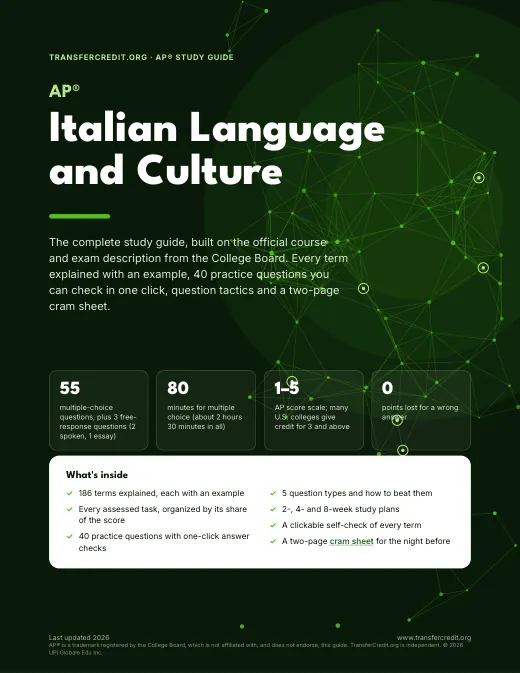
Page 1 of the TransferCredit.org Guide to AP® Italian Language and Culture: the cover
Page 1 The cover
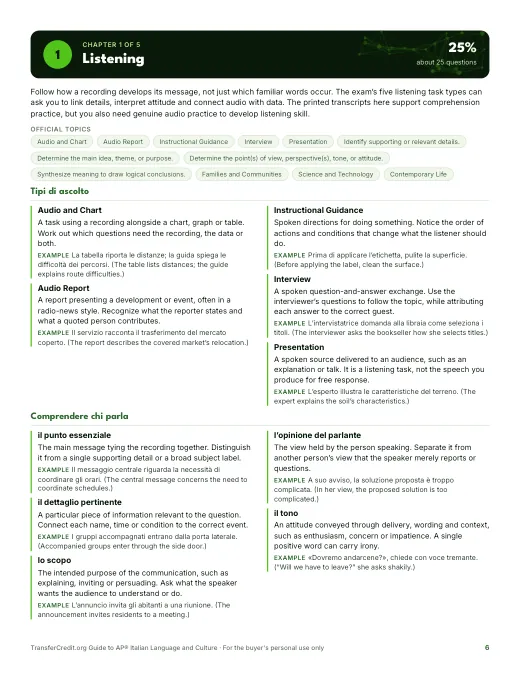
Page 6 of the TransferCredit.org Guide to AP® Italian Language and Culture: the Chapter 1 opener
Page 6 The Chapter 1 opener
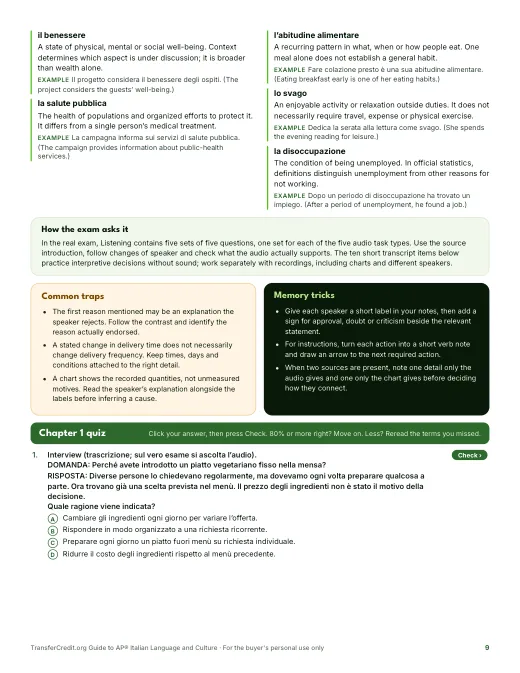
Page 9 of the TransferCredit.org Guide to AP® Italian Language and Culture: a chapter quiz
Page 9 A chapter quiz
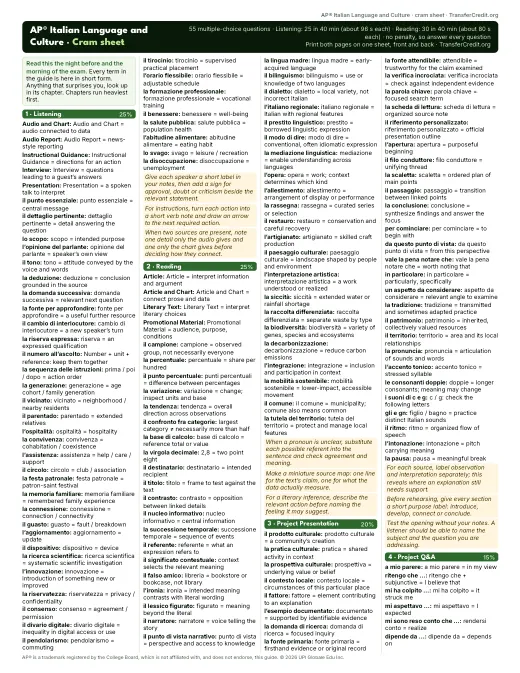
Page 37 of the TransferCredit.org Guide to AP® Italian Language and Culture: the 2-page cram sheet
Page 37 The 2-page cram sheet

What you get for $5

One chapter for each area of the official course and exam description, heaviest topics first.

  • 📘38pages, printable
  • 🧭5chapters
  • 🔑186terms with examples
  • ✍️40practice questions, answers explained
  • ⚠️15exam traps to avoid
  • 📄2page cram sheet

Try 10 free AP® Italian Language and Culture questions

Multiple-choice questions taken from the guide's chapter quizzes: 2 multiple-choice areas, heaviest first. About 15 minutes, with every answer explained and a score by area. The exam's free-response questions aren't in this quiz: see how the exam works.

10 questions  
  1. Question 1 · Listening
    Interview (trascrizione; sul vero esame si ascolta l’audio).
    DOMANDA: Perché avete introdotto un piatto vegetariano fisso nella mensa?
    RISPOSTA: Diverse persone lo chiedevano regolarmente, ma dovevamo ogni volta preparare qualcosa a parte. Ora trovano già una scelta prevista nel menù. Il prezzo degli ingredienti non è stato il motivo della decisione.
    Quale ragione viene indicata?
    Show the answer

    Answer: D. Rispondere in modo organizzato a una richiesta ricorrente.. The speaker says the regular requests previously required separate preparation; a fixed menu choice provides for those requests in advance.

    The trap: Reducing ingredient costs is explicitly rejected as the reason for the decision.

  2. Question 2 · Reading
    Article — Testo originale; situazione ipotetica
    Durante il controllo del tetto di un condominio, una tecnica individua alcuni nidi di rondone ancora occupati. I lavori erano previsti per la settimana seguente. Dopo il sopralluogo, l’amministratrice propone di rinviarli e concordare un nuovo calendario con gli specialisti. Questa scelta viene comunicata ai residenti insieme a una spiegazione sul valore degli spazi di nidificazione negli edifici cittadini.

    Quale decisione è stata proposta dopo il sopralluogo?
    Show the answer

    Answer: C. Rinviare il lavoro previsto e concordare con gli specialisti le nuove date dell’intervento.. The proposed action is postponement and a new schedule agreed with specialists. The source does not propose resident inspection or nest relocation.

    The trap: “Mantenere il calendario” contradicts rinviarli, which refers to postponing the work.

  3. Question 3 · Listening
    Interview (trascrizione).
    DOMANDA: Come trova la nuova stanza silenziosa in ufficio?
    RISPOSTA: Per concentrarmi è ottima. Apprezzo che non vi si possano fare telefonate. La prenotazione, però, richiede ancora troppi passaggi e qualche volta rinuncio proprio per questo.
    Qual è l’atteggiamento della persona?
    Show the answer

    Answer: B. Apprezza l’ambiente silenzioso, ma critica le difficoltà della prenotazione.. The space is praised for concentration and the phone restriction, while the booking process is the stated drawback.

    The trap: The option about excessive phone calls contradicts the speaker’s approval that calls are not allowed there.

  4. Question 4 · Reading
    Article — Testo originale; situazione ipotetica
    Durante il controllo del tetto di un condominio, una tecnica individua alcuni nidi di rondone ancora occupati. I lavori erano previsti per la settimana seguente. Dopo il sopralluogo, l’amministratrice propone di rinviarli e concordare un nuovo calendario con gli specialisti. Questa scelta viene comunicata ai residenti insieme a una spiegazione sul valore degli spazi di nidificazione negli edifici cittadini.

    A che cosa si riferisce «Questa scelta»?
    Show the answer

    Answer: A. Alla proposta di modificare il calendario dei lavori. The demonstrative refers back to the administrator’s proposed postponement and new schedule, the decision immediately preceding it. A discovered fact is not itself the choice.

    The trap: “Alla presenza di nidi occupati” names the observation motivating the decision rather than the decision.

  5. Question 5 · Listening
    Interview (trascrizione).
    DOMANDA: Avete cambiato il modo di registrare i livelli dell’acqua nei canali?
    RISPOSTA: Sì, ora usiamo un modulo sul telefono. Le misure si inseriscono nello stesso modo di prima; la novità è che gli altri addetti le vedono subito e non devono aspettare il quaderno a fine turno.
    Quale domanda approfondisce una novità non ancora spiegata?
    Show the answer

    Answer: B. In che modo gli altri addetti sfruttano la disponibilità immediata delle misure?. The interview explains the recording tool, unchanged entry method and immediate visibility, but not how colleagues use that immediate access.

    The trap: Asking when colleagues see the measures repeats the answer that they see them immediately.

  6. Question 6 · Reading
    Article — Testo originale; situazione ipotetica
    Durante il controllo del tetto di un condominio, una tecnica individua alcuni nidi di rondone ancora occupati. I lavori erano previsti per la settimana seguente. Dopo il sopralluogo, l’amministratrice propone di rinviarli e concordare un nuovo calendario con gli specialisti. Questa scelta viene comunicata ai residenti insieme a una spiegazione sul valore degli spazi di nidificazione negli edifici cittadini.

    Perché la comunicazione ai residenti comprende una spiegazione sugli spazi di nidificazione?
    Show the answer

    Answer: D. Per rendere comprensibile il motivo della modifica proposta.. Explaining the value of nesting spaces makes the proposed schedule change understandable. The source does not ask residents to inspect nests or report completed work or a measured increase in nests.

    The trap: “Un aumento dei nidi già misurato” turns a reason for postponement into a reported result that the source never provides.

  7. Question 7 · Listening
    Audio Report (trascrizione).
    Nel piano invernale della località immaginaria di Selvariva, lo spazzaneve passerà prima sulla strada dell’ambulatorio e poi sulle vie residenziali. Non cambiano i mezzi disponibili: cambia l’ordine degli interventi, per mantenere raggiungibile l’assistenza sanitaria.
    Qual è il punto centrale della notizia?
    Show the answer

    Answer: C. La priorità di sgombero viene assegnata alla strada dell’ambulatorio.. The change concerns intervention order: the clinic road comes first to keep health care accessible, with the same equipment.

    The trap: The answer about a new vehicle contradicts the explicit statement that available equipment is unchanged.

  8. Question 8 · Reading
    Article and Chart — Dati interamente ipotetici
    In dieci appartamenti sono stati misurati gli usi dell’elettricità per un mese: 900 kWh complessivi. Il rapporto confronta le categorie per individuare dove approfondire le possibili riduzioni dei consumi; non misura ancora l’effetto di alcun intervento.
    Tabella: quote dei 900 kWh osservati
    Cucina | 45 %
    Acqua calda | 25 %
    Illuminazione | 20 %
    Altri usi | 10 %

    Quale affermazione descrive correttamente la quota della cucina?
    Show the answer

    Answer: A. La cucina ha la quota più alta, ma il suo 45% non supera la metà dell’elettricità misurata.. At 45%, cooking is the largest category but below 50% of the measured electricity. The table measures electricity shares, not percentages of apartments.

    The trap: “La maggioranza … perché supera ogni altra categoria” confuses being largest with accounting for more than half.

  9. Question 9 · Listening
    Audio Report (trascrizione).
    Il servizio di consegna dei prodotti freschi resta attivo il lunedì e il giovedì, ma dal prossimo mese partirà all’alba. L’orario anticipato permette di viaggiare nelle ore meno calde. I punti di consegna non cambiano.
    Quale cambiamento viene annunciato?
    Show the answer

    Answer: A. Le partenze avverranno prima, negli stessi giorni di servizio.. Only departure time changes: the existing Monday-and-Thursday schedule and delivery points remain.

    The trap: The option about different service days confuses an earlier hour with a change in weekly schedule.

  10. Question 10 · Reading
    Article and Chart — Dati interamente ipotetici
    In dieci appartamenti sono stati misurati gli usi dell’elettricità per un mese: 900 kWh complessivi. Il rapporto confronta le categorie per individuare dove approfondire le possibili riduzioni dei consumi; non misura ancora l’effetto di alcun intervento.
    Tabella: quote dei 900 kWh osservati
    Cucina | 45 %
    Acqua calda | 25 %
    Illuminazione | 20 %
    Altri usi | 10 %

    Qual è la differenza fra cucina e acqua calda?
    Show the answer

    Answer: C. 20 punti percentuali. The percentage-point difference is 45 − 25 = 20. It is a subtraction between shares, not the cooking share alone or the sum.

    The trap: “70 punti percentuali” adds the two category shares instead of finding their difference.

The AP® Italian Language and Culture exam at a glance

The AP® Italian Language and Culture exam is from the College Board. It has 55 multiple-choice questions, plus 3 free-response questions (2 spoken, 1 essay). You get 80 minutes for multiple choice (about 2 hours 30 minutes in all). The score scale is 1–5 (AP® score scale; many U.S. colleges give credit for 3 and above). The guide has 5 chapters, one for each area of the official course and exam description; the heaviest is Listening at 25%.

Questions
55multiple-choice questions, plus 3 free-response questions (2 spoken, 1 essay)
Time
80 minfor the 55 multiple-choice questions, in 2 parts timed separately
Score
1–5AP® score scale; many U.S. colleges give credit for 3 and above
Fee
$99per exam in the U.S. and Canada in 2026-27; your school may charge more
Calculator
Nonot allowed
Wrong answers
No penaltya wrong answer costs nothing
  • Section I comes first and is worth 50% of your AP® score. Its three free-response questions take 65–70 minutes: Project Presentation 20%, Project Q&A 15%, Argumentative Essay 15%. The two speaking tasks occupy about 15 minutes in all; writing has 55 minutes.
  • Section II has 55 multiple-choice questions for 50% of the AP® score, arranged in 11 sets of 5. Listening has 25 questions in 40 minutes and Reading 30 questions in 40 minutes. Each part is worth 25% of your score; its time is separate.
  • The research project topic is announced in January of the exam year. Research it before exam day and submit your Personalized Project Reference through the AP® Digital Portfolio by April 30, 2027, 11:59 p.m. ET. You get a printed copy for the presentation; the essay is unrelated to this project.
  • This is a fully digital Bluebook exam: record spoken responses and type the essay. The official exam date is Monday, May 3, 2027, Session 2. Your AP® coordinator gives you the start time and location.
  • Your multiple-choice score counts correct answers. There is no deduction for an incorrect answer, so attempt every question.
  • The chapter weights describe shares of your total AP® score. The six thematic units supply contexts rather than separate percentages. Cultural understanding is assessed directly through speaking and writing; the comprehension sources also concern culture or other disciplines. Practice written before 2027 follows an older exam format.

Source: official AP® Italian Language and Culture page and the official course and exam description. Last updated 2026.

What the exam covers

5 chapters, heaviest first, with each area's official weight. The guide's chapters follow this order.

  1. Listening25% · ~25 Q
  2. Reading25% · ~30 Q
  3. Project Presentation20% · 1 of 3 free-response
  4. Project Q&A15% · 1 of 3 free-response
  5. Argumentative Essay15% · 1 of 3 free-response

Where to start: the 3 heaviest areas (marked in the map) carry about 70% of your score. The guide puts them first, so working front to back covers the most points earliest.

AP® Italian Language and Culture study guide by area

The heaviest area is open to read now. The full guide has a chapter for every area, each with all its terms, a quiz and an answer key.

1 of 5 chapters open  ·  in the guide's order
25% · about 25 questions · free preview Listening Chapter 1 of the guide

Follow how a recording develops its message, not just which familiar words occur. The exam’s five listening task types can ask you to link details, interpret attitude and connect audio with data. The printed transcripts here support comprehension practice, but you also need genuine audio practice to develop listening skill.

Key terms, with examples

Audio and Chart
A task using a recording alongside a chart, graph or table. Work out which questions need the recording, the data or both.
Example: La tabella riporta le distanze; la guida spiega le difficoltà dei percorsi. (The table lists distances; the guide explains route difficulties.)
il punto essenziale
The main message tying the recording together. Distinguish it from a single supporting detail or a broad subject label.
Example: Il messaggio centrale riguarda la necessità di coordinare gli orari. (The central message concerns the need to coordinate schedules.)
la generazione
People belonging to a similar age group or position in a family’s line of descent. Context determines which sense applies.
Example: Tre generazioni abitano nello stesso edificio. (Three generations live in the same building.)
la connessione
A connection or link, often between a device and a network. The context may concern availability, quality or a physical connection.
Example: La connessione si interrompe durante il temporale. (The connection drops during the thunderstorm.)
il pendolarismo
Regular travel between home and a place of work or study. Distinguish a daily commute from a one-time trip.
Example: Il pendolarismo occupa una parte significativa della sua giornata. (Commuting occupies a significant part of her day.)
Audio Report
A report presenting a development or event, often in a radio-news style. Recognize what the reporter states and what a quoted person contributes.
Example: Il servizio racconta il trasferimento del mercato coperto. (The report describes the covered market’s relocation.)
il dettaglio pertinente
A particular piece of information relevant to the question. Connect each name, time or condition to the correct event.
Example: I gruppi accompagnati entrano dalla porta laterale. (Accompanied groups enter through the side door.)
il vicinato
The people living nearby, or relationships among them. It often refers to everyday neighborhood contacts rather than an official administrative area.
Example: Il vicinato si riunisce per discutere il nuovo cancello. (The neighbors meet to discuss the new gate.)
il guasto
A fault or breakdown in equipment or a system. Distinguish a technical fault from scheduled maintenance.
Example: Il tecnico cerca il guasto nel circuito. (The technician looks for the fault in the circuit.)
il tirocinio
A supervised period of practical learning or work experience. Its requirements and compensation depend on the particular arrangement.
Example: Il tirocinio si svolge presso un laboratorio odontotecnico. (The practical placement takes place at a dental laboratory.)
Instructional Guidance
Spoken directions for doing something. Notice the order of actions and conditions that change what the listener should do.
Example: Prima di applicare l’etichetta, pulite la superficie. (Before applying the label, clean the surface.)
lo scopo
The intended purpose of the communication, such as explaining, inviting or persuading. Ask what the speaker wants the audience to understand or do.
Example: L’annuncio invita gli abitanti a una riunione. (The announcement invites residents to a meeting.)

What this area covers

Tipi di ascoltoComprendere chi parlaFamiglie e comunitàScienza e tecnologiaVita contemporanea

How the exam asks it

In the real exam, Listening contains five sets of five questions, one set for each of the five audio task types. Use the source introduction, follow changes of speaker and check what the audio actually supports. The ten short transcript items below practice interpretive decisions without sound; work separately with recordings, including charts and different speakers.

Common traps

Trap 1. The first reason mentioned may be an explanation the speaker rejects. Follow the contrast and identify the reason actually endorsed.

Trap 2. A stated change in delivery time does not necessarily change delivery frequency. Keep times, days and conditions attached to the right detail.

Trap 3. A chart shows the recorded quantities, not unmeasured motives. Read the speaker’s explanation alongside the labels before inferring a cause.

Memory trick

Give each speaker a short label in your notes, then add a sign for approval, doubt or criticism beside the relevant statement.

For instructions, turn each action into a short verb note and draw an arrow to the next required action.

How AP® Italian Language and Culture questions are written

The exam has 55 multiple-choice questions, plus 3 free-response questions (2 spoken, 1 essay). The guide sorts the questions into 5 types; spot the type and you'll know what the question wants before you read the choices.

Type 1

Listening: a recording without a data display

An Audio Report, Interview, Instructional Guidance or Presentation supplies the evidence for a five-question set. The actual exam plays sound; this example is a newly written transcript for paper practice.

  • Use the opening information to establish the setting and speaker roles.
  • Separate what the speaker wants to achieve from the method used to achieve it.
  • Test the entire answer against the recording, including any limitation or qualification.
Type 2

Reading or listening paired with numerical evidence

Article and Chart and Audio and Chart connect language with a graph, table or other data image. The set may ask what one source establishes or how the sources relate.

  • Identify the measured quantity and the base shared by the figures.
  • Read the text’s precise claim before deciding what the numbers support.
  • For a calculation, name the operation in words before using the values.
Type 3

Reading an article’s reasoning

A written article develops a subject or argument. Questions can examine its organization, intended audience, contextual meaning or the limits of a conclusion.

  • Mark the difference between reported evidence and the writer’s interpretation.
  • Follow reference words such as questo or tale back to the relevant idea.
  • Prefer the inference requiring the fewest unstated assumptions.
Type 4

Reading a literary scene

A Literary Text set draws on an imaginative passage. Interpret how actions, pacing, description and access to thought guide the reader, rather than treating the narrator as the author.

  • List the actions in the order the text gives them.
  • Notice a change in who acts, waits, speaks or makes a decision.
  • Ground an interpretation in those details instead of supplying a hidden event.
Type 5

Interpreting a promotional offer

Promotional Material combines text and imagery to encourage an action. Questions may concern the offer’s audience, conditions or visual emphasis. The exercise below provides only the written component.

  • State what is being offered and what the reader is expected to do.
  • Distinguish supplied services from items the customer must provide.
  • On the actual exam, include the picture and captions in your reading.

Test-day habits that add points

  1. Answer every question. There's no penalty for a wrong answer. A blank is always worth zero, so never leave one.
  2. Predict, then look. Name the answer before reading the choices. It protects you from distractors written to sound right.
  3. Eliminate. Cross out choices you know are wrong. Every choice you rule out raises your odds on a guess.
  4. Mark and move on. For a difficult multiple-choice item, choose your best answer and mark it. Review within the current timed part if the interface permits; do not plan to borrow time from another part.
  5. Watch absolute words. Choices with "always", "never" or "only" are often wrong, because most rules and findings have exceptions. Treat this as a tiebreaker, not a rule.
  6. Change answers for a reason. Switch an answer only when you can say why the new one is better, such as a detail you missed.
  7. Carry the project into the speaking tasks. For the Project Presentation, use three minutes to prepare and three to speak, with the printed Personalized Project Reference. Explain three or more relevant factors using researched cultural details. The task contributes 20% of the AP® score and has 11 rubric points. Project Q&A follows: four prerecorded questions, heard twice each, with 40 seconds per reply; it contributes 15% and has 9 points. These written quizzes help you choose a response, but you also need complete recorded speaking practice. Submit the official project reference in AP® Digital Portfolio by April 30, 2027, 11:59 p.m. ET, following the current template and project rules.
  8. Build a complete argumentative essay. The essay is a separate topic from the project and gives 55 minutes, including two chances to hear its audio. Use the three provided sources, both print and audio, to defend a clear position. Explain how evidence supports each claim and identify its source. The essay contributes 15% of your AP® score and has 10 rubric points. Practice a full timed response in Italian, then use the actual Italian scoring guidelines to distinguish source use, reasoning, organization and language control. Consult the current official rules on outside help, translation and AI before preparing project material.
  9. Practice hearing as well as reading. Printed transcripts remove the need to recognize speech in real time, so add real Italian recordings to your study. Alternate reports, interviews, explanations and instructions. Write a short account of the speaker’s purpose and supporting details after listening, then replay to check your interpretation. Try recordings with different voices and regional speech. Rehearse listening, microphone use and typing Italian accents in the current Bluebook preview, rather than relying on paper quizzes alone.

Pacing: Part A, Listening: 25 questions in 40 minutes, about 96 seconds a question. Part B, Reading: 30 questions in 40 minutes, about 80 seconds a question.

AP® Italian Language and Culture flashcards

Try the first 8 cards free. Read the term, say the definition out loud, then select the card to check yourself. Arrow keys move between cards.

Free card 1 of 8 (deck total: 186)

How to study for AP® Italian Language and Culture: a 5-step plan

Follow the steps, then enter your test date. The planner gives you a dated plan that starts with the heaviest areas and saves the last days for review.

  1. Take the 10 free questionsSee which AP® Italian Language and Culture areas you already know.
  2. Study the heaviest areas firstStart with Listening, Reading and Project Presentation, then work down the exam map.
  3. Learn each term with an exampleSay the definition out loud, then check it with the flashcards. A term you can't use in an example isn't learned yet.
  4. Quiz yourself and study the trapsAfter each area, answer its quiz and read why the tempting wrong answer is wrong.
  5. Plan backwards from your exam dateBuild a dated plan, keep the last days for a full review, and read the cram sheet the night before.

How it works

  1. 1Check outSelect Get the guide · $5 and pay on TransferCredit.org's secure checkout.
  2. 2Download the PDFFrom your TransferCredit.org account.
  3. 3Study the heaviest areas firstFollow the 2-, 4- or 8-week plan, then read the cram sheet the night before.

This page or the full guide

Everything on this page is free with no account. The full guide is a PDF you keep.

What's on this page and in the full study guide
Study toolThis pageFull study guide ($5)
ChaptersA preview of 1 of 5All 5
Terms explainedA sample from the open chaptersAll 186, each with an example
Practice questions10 free questions40, with an answer key
Flashcards8 cardsAll 186 terms on the self-check list
Study planDated planner2-, 4- and 8-week plans
Cram sheet—2 pages, for the night before
FormatWeb page38-page PDF, printable

Questions students ask

What's in the full AP® Italian Language and Culture study guide?
38 pages: 5 chapters, one for each area of the College Board's official course and exam description, heaviest topics first. 186 terms, each with a plain-English definition and an example, common traps and memory tricks, 40 practice questions with an answer key that explains every answer, question tactics, 2-, 4- and 8-week study plans and a 2-page cram sheet.
How much is the full AP® Italian Language and Culture study guide?
The full 38-page PDF is $5. The 10 practice questions on this page are free.
How do I get the full guide?
Select Get the guide · $5 and check out on TransferCredit.org. Then sign in to your TransferCredit.org account to download the PDF.
Can I print the guide or use it on my phone?
Yes. It's a PDF, so it opens on phones, tablets and computers, and printing is allowed. Its tick boxes and answer bubbles work in PDF readers that support forms. Copying and editing are turned off.
Can I try the AP® Italian Language and Culture guide before I buy it?
Yes. This page has 10 questions from the guide's own chapter quizzes, a preview of the heaviest area, 8 flashcards and a study planner. No account needed.
Is this an official AP® study guide?
No. AP® is a trademark registered by the College Board, which is not affiliated with, and does not endorse, this guide. TransferCredit.org is independent. We built the guide from the College Board's official course and exam description, and the exam details were checked against the College Board's published exam information in 2026.
How was this study guide made?
One chapter for each area of the official course and exam description, using its published weights. Each chapter was written, then fact-checked against the official exam information in a separate review. The practice questions are original: none are copied from the College Board's released questions.
How up to date is this AP® Italian Language and Culture guide?
Last updated 2026. The exam details were checked against the College Board's published exam information in 2026. Exams change, so confirm the details on the official AP® Italian Language and Culture page before you test.
More questions about the AP® Italian Language and Culture exam (16)
What is the AP® Italian Language and Culture exam?
The AP® Italian Language and Culture exam is from the College Board. It has 55 multiple-choice questions, plus 3 free-response questions (2 spoken, 1 essay). You get 80 minutes for multiple choice (about 2 hours 30 minutes in all). The score scale is 1–5 (AP® score scale; many U.S. colleges give credit for 3 and above). The guide has 5 chapters, one for each area of the official course and exam description; the heaviest is Listening at 25%.
How many questions are on the AP® Italian Language and Culture exam, and how long is it?
Section I comes first and is worth 50% of your AP® score. Its three free-response questions take 65–70 minutes: Project Presentation 20%, Project Q&A 15%, Argumentative Essay 15%. The two speaking tasks occupy about 15 minutes in all; writing has 55 minutes. Section II has 55 multiple-choice questions for 50% of the AP® score, arranged in 11 sets of 5. Listening has 25 questions in 40 minutes and Reading 30 questions in 40 minutes. Each part is worth 25% of your score; its time is separate.
How is the AP® Italian Language and Culture exam scored?
The score scale is 1–5: AP® score scale; many U.S. colleges give credit for 3 and above. Your multiple-choice score counts correct answers. There is no deduction for an incorrect answer, so attempt every question.
What AP® Italian Language and Culture score do I need for college credit?
Many U.S. colleges give credit for 3 and above. Each college sets its own credit policy, so check the one at your college before you count on the credit.
How much does the AP® Italian Language and Culture exam cost?
The fee is $99: per exam in the U.S. and Canada in 2026-27; your school may charge more. Fees can change, so check the official page when you register.
Can I use a calculator on the AP® Italian Language and Culture exam?
No. A calculator isn't allowed.
Is there a penalty for guessing on AP® Italian Language and Culture?
No. There's no penalty for a wrong answer. A blank is always worth zero, so never leave one.
What topics are on the AP® Italian Language and Culture exam?
5 areas, from the official course and exam description: Listening (25%); Reading (25%); Project Presentation (20%); Project Q&A (15%); Argumentative Essay (15%).
Which AP® Italian Language and Culture topics should I study first?
The 3 heaviest areas (marked in the map) carry about 70% of your score. The guide puts them first, so working front to back covers the most points earliest.
Is the AP® Italian Language and Culture exam hard?
It depends on what you already know. The largest area, Listening, is 25%, and the smallest, Argumentative Essay, is 15%. Try the 10 free questions above to see where you stand in about 15 minutes.
What kinds of questions are on the AP® Italian Language and Culture exam?
The exam has 55 multiple-choice questions, plus 3 free-response questions (2 spoken, 1 essay). The guide sorts the questions into 5 types: “Listening: a recording without a data display”, “Reading or listening paired with numerical evidence”, “Reading an article’s reasoning”, “Reading a literary scene” and “Interpreting a promotional offer”. Multiple-choice questions have 4 answer choices. See how each type is written.
What are the free-response questions on the AP® Italian Language and Culture exam?
For the Project Presentation, use three minutes to prepare and three to speak, with the printed Personalized Project Reference. Explain three or more relevant factors using researched cultural details. The task contributes 20% of the AP® score and has 11 rubric points. Project Q&A follows: four prerecorded questions, heard twice each, with 40 seconds per reply; it contributes 15% and has 9 points. These written quizzes help you choose a response, but you also need complete recorded speaking practice. Submit the official project reference in AP® Digital Portfolio by April 30, 2027, 11:59 p.m. ET, following the current template and project rules. The essay is a separate topic from the project and gives 55 minutes, including two chances to hear its audio. Use the three provided sources, both print and audio, to defend a clear position. Explain how evidence supports each claim and identify its source. The essay contributes 15% of your AP® score and has 10 rubric points. Practice a full timed response in Italian, then use the actual Italian scoring guidelines to distinguish source use, reasoning, organization and language control. Consult the current official rules on outside help, translation and AI before preparing project material.
How should I pace myself on the AP® Italian Language and Culture exam?
Part A, Listening: 25 questions in 40 minutes, about 96 seconds a question. Part B, Reading: 30 questions in 40 minutes, about 80 seconds a question. For a difficult multiple-choice item, choose your best answer and mark it. Review within the current timed part if the interface permits; do not plan to borrow time from another part.
How long should I study for AP® Italian Language and Culture?
Take the 10 free questions to see where you stand. The full guide has 2-, 4- and 8-week plans built from the exam weights, and the planner on this page builds a dated plan from your exam date.
How do I know I'm ready for the AP® Italian Language and Culture exam?
The guide's readiness checklist: You can identify main ideas, details and supported inferences in genuine Italian audio and written sources. You can support your researched project presentation in Italian with relevant cultural evidence, using your permitted Personalized Project Reference. You can answer project questions aloud in Italian with relevant, organized responses. You can write an argumentative essay in Italian that integrates the supplied sources and considers relevant alternative viewpoints. You have completed separately timed Listening and Reading practice, plus full spoken and written responses; these compact quizzes alone do not establish exam readiness. You have rehearsed Bluebook recording and Italian input, followed project submission instructions, and confirmed exam arrangements.
What should I do the night before?
Read the 2-page cram sheet once, slowly. Ask your coordinator for the exam room and start time. Use current Bluebook practice to rehearse Italian accent entry and recording; the printed Personalized Project Reference is provided for your presentation. In the morning, skim the traps, then stop studying.

How we built this guide

We built one chapter for each area of the College Board's official course and exam description for AP® Italian Language and Culture, using its published weights to order the chapters and size the quizzes. Each chapter was written, then fact-checked against the official exam information in a separate review. The exam details were checked against the College Board's published exam information in 2026.

Sources: official AP® Italian Language and Culture page, official course and exam description. Last updated 2026.

AP® is a trademark registered by the College Board, which is not affiliated with, and does not endorse, this guide. TransferCredit.org is independent and not affiliated with the College Board. © 2026 UPI Globale Edu Inc.

Ready for the full AP® Italian Language and Culture guide? 38 pages, 186 terms, 40 practice questions and a 2-page cram sheet, $5.

Get the guide · $5

In the full guide

TransferCredit.org Guide to AP® Italian Language and Culture

  • All 5 chapters
  • 186 terms with examples
  • 40 practice questions with an answer key
  • A 2-page cram sheet and 2-, 4- and 8-week plans
Get the guide · $5