← All AP® study guides
AP® Study Guide Printable PDF · 37 pages

TransferCredit.org Guide to AP® German Language and Culture

AP® German Language and Culture study guide: a printable PDF built from the College Board's official course and exam description, heaviest topics first.

  • 182 key terms, each with an example
  • 40 practice questions with every answer explained
  • A 2-page cram sheet for the night before
  • 2-, 4- and 8-week study plans built from the exam weights
Not sure yet? Try 10 free questions

Last updated 2026 · exam details checked against the College Board's published exam information in 2026

Look inside the guide

Real pages from the 37-page PDF.

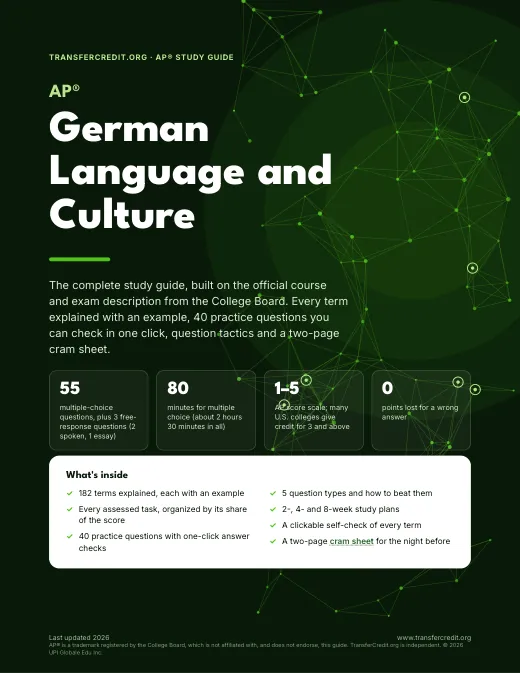
Page 1 of the TransferCredit.org Guide to AP® German Language and Culture: the cover
Page 1 The cover
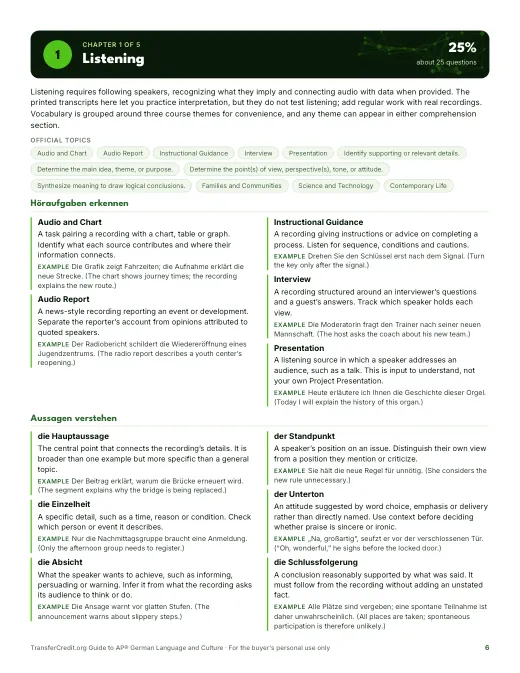
Page 6 of the TransferCredit.org Guide to AP® German Language and Culture: the Chapter 1 opener
Page 6 The Chapter 1 opener
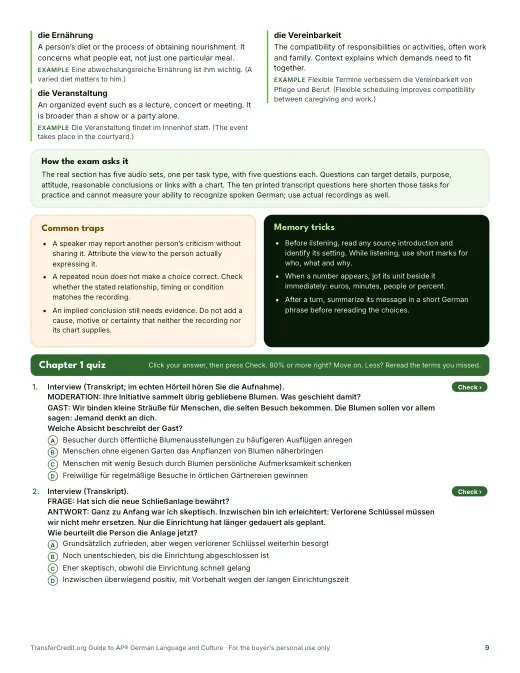
Page 9 of the TransferCredit.org Guide to AP® German Language and Culture: a chapter quiz
Page 9 A chapter quiz
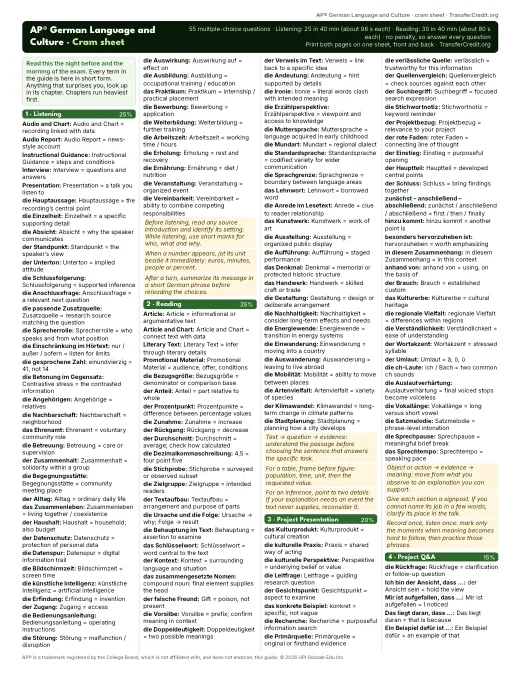
Page 36 of the TransferCredit.org Guide to AP® German Language and Culture: the 2-page cram sheet
Page 36 The 2-page cram sheet

What you get for $5

One chapter for each area of the official course and exam description, heaviest topics first.

  • 📘37pages, printable
  • 🧭5chapters
  • 🔑182terms with examples
  • ✍️40practice questions, answers explained
  • ⚠️15exam traps to avoid
  • 📄2page cram sheet

Try 10 free AP® German Language and Culture questions

Multiple-choice questions taken from the guide's chapter quizzes: 2 multiple-choice areas, heaviest first. About 15 minutes, with every answer explained and a score by area. The exam's free-response questions aren't in this quiz: see how the exam works.

10 questions  
  1. Question 1 · Listening
    Interview (Transkript; im echten Hörteil hören Sie die Aufnahme).
    MODERATION: Ihre Initiative sammelt übrig gebliebene Blumen. Was geschieht damit?
    GAST: Wir binden kleine Sträuße für Menschen, die selten Besuch bekommen. Die Blumen sollen vor allem sagen: Jemand denkt an dich.
    Welche Absicht beschreibt der Gast?
    Show the answer

    Answer: D. Menschen mit wenig Besuch durch Blumen persönliche Aufmerksamkeit schenken. The guest says the bouquets tell infrequently visited people that someone is thinking of them, emphasizing care and attention.

    The trap: Encouraging outings to public flower exhibitions adds a different activity; the guest describes bringing bouquets to people.

  2. Question 2 · Reading
    Article — Originaler Übungstext; erfundene Gemeinde
    In einer kleinen Gemeinde kennt kaum jemand unter dreißig noch die alten Flurnamen. Deshalb besucht ein Sprachverein ältere Bewohner und notiert ihre Erklärungen. Die Ergebnisse sollen auf einer gedruckten Karte erscheinen. „Wir wollen die Namen festhalten, bevor ihre Bedeutung verloren geht“, sagt eine Mitarbeiterin. Die Karte wird auch in den Schulen verteilt.

    Was ist das Hauptziel des Vereins?
    Show the answer

    Answer: A. Alte Ortsbezeichnungen und ihre Bedeutung zu bewahren. The association interviews older residents to record old place names and their meanings before that knowledge disappears. The printed map serves preservation.

    The trap: “Die örtliche Mundart als Pflichtfach …” mistakes distributing the map to schools for introducing a compulsory subject.

  3. Question 3 · Listening
    Interview (Transkript).
    FRAGE: Hat sich die neue Schließanlage bewährt?
    ANTWORT: Ganz zu Anfang war ich skeptisch. Inzwischen bin ich erleichtert: Verlorene Schlüssel müssen wir nicht mehr ersetzen. Nur die Einrichtung hat länger gedauert als geplant.
    Wie beurteilt die Person die Anlage jetzt?
    Show the answer

    Answer: B. Inzwischen überwiegend positiv, mit Vorbehalt wegen der langen Einrichtungszeit. Inzwischen bin ich erleichtert marks the current positive view, while the slow setup remains a limited criticism.

    The trap: Continued concern about replacing lost keys misses the stated advantage: replacements are no longer needed.

  4. Question 4 · Reading
    Article — Originaler Übungstext; erfundene Gemeinde
    In einer kleinen Gemeinde kennt kaum jemand unter dreißig noch die alten Flurnamen. Deshalb besucht ein Sprachverein ältere Bewohner und notiert ihre Erklärungen. Die Ergebnisse sollen auf einer gedruckten Karte erscheinen. „Wir wollen die Namen festhalten, bevor ihre Bedeutung verloren geht“, sagt eine Mitarbeiterin. Die Karte wird auch in den Schulen verteilt.

    Welche Bedeutung hat „festhalten“ in diesem Zusammenhang?
    Show the answer

    Answer: C. Schriftlich dokumentieren. The surrounding actions are interviewing, taking notes and producing a map. Here festhalten means to record or document information.

    The trap: “Mit den Händen greifen” is a possible literal sense, but it does not fit recording place names and explanations.

  5. Question 5 · Listening
    Interview (Transkript).
    FRAGE: Warum leiten Sie den offenen Nähtreff?
    ANTWORT: Viele haben eine Maschine im Keller, trauen sich aber nicht heran. Wir beginnen mit kleinen Reparaturen. Nach wenigen Treffen bringen manche schon eigene Ideen mit.
    Welche Anschlussfrage führt das Gespräch sinnvoll weiter?
    Show the answer

    Answer: D. Wie helfen Sie Anfängern, ihre Angst vor Fehlern zu überwinden?. The question develops the confidence problem by asking how the leader supports hesitant beginners, a point not yet answered.

    The trap: Asking whether the group starts with small repairs merely repeats information explicitly given in the answer.

  6. Question 6 · Reading
    Article — Originaler Übungstext; erfundene Gemeinde
    In einer kleinen Gemeinde kennt kaum jemand unter dreißig noch die alten Flurnamen. Deshalb besucht ein Sprachverein ältere Bewohner und notiert ihre Erklärungen. Die Ergebnisse sollen auf einer gedruckten Karte erscheinen. „Wir wollen die Namen festhalten, bevor ihre Bedeutung verloren geht“, sagt eine Mitarbeiterin. Die Karte wird auch in den Schulen verteilt.

    Wie ist der Text hauptsächlich aufgebaut?
    Show the answer

    Answer: C. Er nennt ein Problem und erläutert anschließend eine darauf gerichtete Maßnahme.. The problem is that few younger people know the old names. The interviews and map are the response to that problem.

    The trap: “Eine abgeschlossene Maßnahme …” treats the planned map and school distribution as completed and evaluated.

  7. Question 7 · Listening
    Audio Report (Transkript).
    Seit Montag stehen entlang eines stillgelegten Bahngleises neue Informationstafeln. Sie zeigen historische Fotos und erklären, welche Güter früher transportiert wurden. Spaziergänger erfahren so, warum die Strecke für die Entwicklung des Ortes wichtig war.
    Worum geht es hauptsächlich?
    Show the answer

    Answer: B. Um Informationstafeln zur früheren Bedeutung einer Bahnstrecke. The report describes new signs using photographs and explanations to present the railway’s earlier role in the town’s development.

    The trap: The report describes signs along a disused line, not a photograph exhibition inside a reopened station.

  8. Question 8 · Reading
    Article and Chart — Fiktive Befragung
    Ein kleines Theater befragt 200 erwachsene Besucher nach ihrer bevorzugten Anfangszeit. Jede Person darf genau eine Zeit wählen. Der Leiter vermutet: „Die meisten unserer Besucher möchten am Vormittag kommen.“

    Tabelle: Bevorzugte Anfangszeit unter den 200 Befragten
    Vormittag | 15 %
    Nachmittag | 35 %
    Abend | 50 %

    Wie viele Befragte bevorzugen den Abend?
    Show the answer

    Answer: A. 100 Personen. Half of the 200 respondents chose evening: 0.50 × 200 = 100. The percentage refers to respondents, not to all residents.

    The trap: “50 Personen” treats the percentage value as a count without applying it to 200 people.

  9. Question 9 · Listening
    Audio Report (Transkript).
    Die mobile Beratung kommt künftig zweimal im Monat statt einmal. Die Termine am Dienstag bleiben bestehen; hinzu kommt der zweite Samstag. Damit sollen auch Personen erreicht werden, die werktags keine Zeit haben.
    Was ändert sich?
    Show the answer

    Answer: D. Ein Samstagstermin kommt ergänzend hinzu.. The Tuesday appointments continue and a second-Saturday visit is added, increasing the monthly frequency from once to twice.

    The trap: Replacing Tuesday visits conflicts with the statement that the Tuesday appointments remain.

  10. Question 10 · Reading
    Article and Chart — Fiktive Befragung
    Ein Theaterleiter sagt: „Bei unserer Befragung lag der Vormittag vorne.“ 200 erwachsene Besucher wählten jeweils eine Anfangszeit.

    Tabelle: Bevorzugte Zeit
    Vormittag | 15 %
    Nachmittag | 35 %
    Abend | 50 %

    Wie verhält sich die Tabelle zu seiner Aussage?
    Show the answer

    Answer: B. Sie widerspricht ihr: Der Abend erhielt deutlich mehr Stimmen als der Vormittag.. The table gives evening 50% and morning 15%, so morning did not lead among the respondents. Both the population and the afternoon category are explicit.

    The trap: “Bei einer zweiten Befragung …” invents a second survey. The table describes the same 200 respondents.

The AP® German Language and Culture exam at a glance

The AP® German Language and Culture exam is from the College Board. It has 55 multiple-choice questions, plus 3 free-response questions (2 spoken, 1 essay). You get 80 minutes for multiple choice (about 2 hours 30 minutes in all). The score scale is 1–5 (AP® score scale; many U.S. colleges give credit for 3 and above). The guide has 5 chapters, one for each area of the official course and exam description; the heaviest is Listening at 25%.

Questions
55multiple-choice questions, plus 3 free-response questions (2 spoken, 1 essay)
Time
80 minfor the 55 multiple-choice questions, in 2 parts timed separately
Score
1–5AP® score scale; many U.S. colleges give credit for 3 and above
Fee
$99per exam in the U.S. and Canada in 2026-27; your school may charge more
Calculator
Nonot allowed
Wrong answers
No penaltya wrong answer costs nothing
  • The revised exam begins with free response: three questions in 65–70 minutes for half of your AP® score. The Project Presentation contributes 20%, the Project Q&A 15%, and the Argumentative Essay 15%. Speaking takes about 15 minutes altogether; the essay has 55 minutes.
  • Multiple choice comes second: 55 questions in 80 minutes for the other half of your score. Listening is 25 questions in 40 minutes, and Reading is 30 in 40 minutes; each contributes 25% of the total AP® score. Each question set contains five questions.
  • Before exam day, research the project topic announced in January. Submit your Personalized Project Reference through the AP® Digital Portfolio by April 30, 2027, at 11:59 p.m. ET. A printed copy of this outline supports your presentation on exam day. The essay uses a different topic.
  • Bluebook delivers the entire exam. Record both spoken tasks and type the essay in the app. The exam is Friday, May 7, 2027, Session 1; your coordinator confirms the room and start time.
  • Multiple-choice scoring counts correct responses. Answer every question: wrong answers do not subtract points.
  • This guide organizes the exam by its five weighted tasks, with cultural themes and language skills distributed among them. Listening and Reading questions use cultural or interdisciplinary sources; speaking and writing directly assess cultural understanding. Older exam practice has a different format.

Source: official AP® German Language and Culture page and the official course and exam description. Last updated 2026.

What the exam covers

5 chapters, heaviest first, with each area's official weight. The guide's chapters follow this order.

  1. Listening25% · ~25 Q
  2. Reading25% · ~30 Q
  3. Project Presentation20% · 1 of 3 free-response
  4. Project Q&A15% · 1 of 3 free-response
  5. Argumentative Essay15% · 1 of 3 free-response

Where to start: the 3 heaviest areas (marked in the map) carry about 70% of your score. The guide puts them first, so working front to back covers the most points earliest.

AP® German Language and Culture study guide by area

The heaviest area is open to read now. The full guide has a chapter for every area, each with all its terms, a quiz and an answer key.

1 of 5 chapters open  ·  in the guide's order
25% · about 25 questions · free preview Listening Chapter 1 of the guide

Listening requires following speakers, recognizing what they imply and connecting audio with data when provided. The printed transcripts here let you practice interpretation, but they do not test listening; add regular work with real recordings. Vocabulary is grouped around three course themes for convenience, and any theme can appear in either comprehension section.

Key terms, with examples

Audio and Chart
A task pairing a recording with a chart, table or graph. Identify what each source contributes and where their information connects.
Example: Die Grafik zeigt Fahrzeiten; die Aufnahme erklärt die neue Strecke. (The chart shows journey times; the recording explains the new route.)
die Hauptaussage
The central point that connects the recording’s details. It is broader than one example but more specific than a general topic.
Example: Der Beitrag erklärt, warum die Brücke erneuert wird. (The segment explains why the bridge is being replaced.)
die Angehörigen
Relatives or family members, often mentioned in contexts of care and support. The singular is der Angehörige or die Angehörige.
Example: Die Angehörigen besuchen sie regelmäßig. (Her relatives visit her regularly.)
der Datenschutz
Protection of personal data, including how it is collected, used and shared. It is not the same as making a backup copy.
Example: Aus Datenschutzgründen werden die Namen nicht veröffentlicht. (The names are not published for data-protection reasons.)
die Ausbildung
Training for an occupation or a person’s educational preparation. The term does not automatically mean a university degree.
Example: Nach der Schule beginnt sie eine Ausbildung zur Bäckerin. (After school, she begins training as a baker.)
Audio Report
A news-style recording reporting an event or development. Separate the reporter’s account from opinions attributed to quoted speakers.
Example: Der Radiobericht schildert die Wiedereröffnung eines Jugendzentrums. (The radio report describes a youth center’s reopening.)
die Einzelheit
A specific detail, such as a time, reason or condition. Check which person or event it describes.
Example: Nur die Nachmittagsgruppe braucht eine Anmeldung. (Only the afternoon group needs to register.)
die Nachbarschaft
A neighborhood or the people living nearby. Context shows whether the word refers to the place or its social relationships.
Example: Die Nachbarschaft organisiert einen gemeinsamen Hofverkauf. (The neighborhood organizes a joint yard sale.)
die Datenspur
Information left behind by digital activity. Several small records can reveal patterns when combined.
Example: Jeder Klick kann eine Datenspur hinterlassen. (Every click can leave a digital trace.)
das Praktikum
A placement providing practical experience in a workplace or field of study. Context determines its length and conditions.
Example: Im Praktikum lernt er die Abläufe im Labor kennen. (During his internship, he learns the laboratory’s procedures.)
Instructional Guidance
A recording giving instructions or advice on completing a process. Listen for sequence, conditions and cautions.
Example: Drehen Sie den Schlüssel erst nach dem Signal. (Turn the key only after the signal.)
die Absicht
What the speaker wants to achieve, such as informing, persuading or warning. Infer it from what the recording asks its audience to think or do.
Example: Die Ansage warnt vor glatten Stufen. (The announcement warns about slippery steps.)

What this area covers

Höraufgaben erkennenAussagen verstehenFamilie und ZusammenlebenTechnik im AlltagGegenwart und Lebenswege

How the exam asks it

The real section has five audio sets, one per task type, with five questions each. Questions can target details, purpose, attitude, reasonable conclusions or links with a chart. The ten printed transcript questions here shorten those tasks for practice and cannot measure your ability to recognize spoken German; use actual recordings as well.

Common traps

Trap 1. A speaker may report another person’s criticism without sharing it. Attribute the view to the person actually expressing it.

Trap 2. A repeated noun does not make a choice correct. Check whether the stated relationship, timing or condition matches the recording.

Trap 3. An implied conclusion still needs evidence. Do not add a cause, motive or certainty that neither the recording nor its chart supplies.

Memory trick

Before listening, read any source introduction and identify its setting. While listening, use short marks for who, what and why.

When a number appears, jot its unit beside it immediately: euros, minutes, people or percent.

How AP® German Language and Culture questions are written

The exam has 55 multiple-choice questions, plus 3 free-response questions (2 spoken, 1 essay). The guide sorts the questions into 5 types; spot the type and you'll know what the question wants before you read the choices.

Type 1

A single audio source

Five German questions follow an Audio Report, Instructional Guidance, Interview or Presentation recording. The introductory information identifies its subject and context. This paper example gives an original transcript instead of sound.

  • Read the source introduction before the recording begins; identify who speaks and for what purpose.
  • Listen for reasons, contrasts and qualifications as well as facts.
  • Choose the answer the recording supports; a repeated keyword alone is not enough.
Type 2

A source paired with a chart

Audio and Chart and Article and Chart combine a spoken or written source with a data display. Some questions use one source; others connect the two. Check the chart’s population and units before interpreting its figures.

  • Summarize each source separately in a few words.
  • Compare the same group, quantity and time period across the sources.
  • Decide whether the figures support, qualify or contradict the precise statement in the question.
Type 3

An article

A written informational or argumentative text with five questions. Tasks may ask about audience, organization, meaning in context or an inference supported by the source.

  • Identify what the writer wants the reader to understand or consider.
  • For a vocabulary item, substitute the proposed meaning in the sentence.
  • For an inference, find supporting details without importing outside assumptions.
Type 4

A literary text

Five questions on an excerpt from imaginative writing. The narrator’s access to events, a character’s actions and the text’s details can imply more than the words say directly.

  • Identify whose perceptions the passage follows.
  • Connect physical actions or images with their immediate context.
  • Reject an inference that requires a new event or unsupported motive.
Type 5

Promotional material

An advertisement, announcement or flyer combining text with an image, followed by five questions. This text-only exercise practices audience and conditions; the real exam may also ask about visual information.

  • Find the action or event being promoted and whom it addresses.
  • Underline conditions such as age, deadline, equipment and meeting place.
  • Read captions and image details on the real exam; do not invent conditions that are absent.

Test-day habits that add points

  1. Answer every question. There's no penalty for a wrong answer. A blank is always worth zero, so never leave one.
  2. Predict, then look. Name the answer before reading the choices. It protects you from distractors written to sound right.
  3. Eliminate. Cross out choices you know are wrong. Every choice you rule out raises your odds on a guess.
  4. Mark and move on. For a difficult multiple-choice item, choose your best answer and mark it. Review within the current timed part if the interface permits; do not plan to borrow time from another part.
  5. Watch absolute words. Choices with "always", "never" or "only" are often wrong, because most rules and findings have exceptions. Treat this as a tiebreaker, not a rule.
  6. Change answers for a reason. Switch an answer only when you can say why the new one is better, such as a detail you missed.
  7. The three free-response tasks. Section I comes first and lasts 65–70 minutes. For the Project Presentation (20%; 11 rubric points), prepare for 3 minutes, then speak for 3 minutes using your Personalized Project Reference. Address the prompt with three or more explained factors and specific researched cultural examples. In the Project Q&A (15%; 9 points), hear four prerecorded questions twice each and respond for 40 seconds each. The Argumentative Essay (15%; 10 points) has 55 minutes and three sources, including audio played twice. Take a clear position, support it with evidence from all three sources and explain your reasoning. These are distinct tasks; the essay is independent of your project.
  8. Use the project reference responsibly. The project topic arrives in January of the exam year. Submit the Personalized Project Reference through AP® Digital Portfolio by 11:59 p.m. ET on April 30, 2027. It is an outline within the official template’s word or character limit, not a complete script. Read the current College Board rules on outside help, translation and AI. Several presentation rubric rows list fully plagiarized content or content largely produced through electronic translation or generative AI among responses earning zero in that row.
  9. Add actual listening to this paper guide. A printed transcript cannot practice hearing. Choose short German recordings such as reports, interviews, talks and instructions, including different German-speaking communities. Listen without pausing, state the main point, then listen again to check the details and the speaker’s attitude. Occasionally pair a recording with a related chart. Use the current Bluebook preview to practice the actual audio and recording interface.

Pacing: Part A, Listening: 25 questions in 40 minutes, about 96 seconds a question. Part B, Reading: 30 questions in 40 minutes, about 80 seconds a question.

AP® German Language and Culture flashcards

Try the first 8 cards free. Read the term, say the definition out loud, then select the card to check yourself. Arrow keys move between cards.

Free card 1 of 8 (deck total: 182)

How to study for AP® German Language and Culture: a 5-step plan

Follow the steps, then enter your test date. The planner gives you a dated plan that starts with the heaviest areas and saves the last days for review.

  1. Take the 10 free questionsSee which AP® German Language and Culture areas you already know.
  2. Study the heaviest areas firstStart with Listening, Reading and Project Presentation, then work down the exam map.
  3. Learn each term with an exampleSay the definition out loud, then check it with the flashcards. A term you can't use in an example isn't learned yet.
  4. Quiz yourself and study the trapsAfter each area, answer its quiz and read why the tempting wrong answer is wrong.
  5. Plan backwards from your exam dateBuild a dated plan, keep the last days for a full review, and read the cram sheet the night before.

How it works

  1. 1Check outSelect Get the guide · $5 and pay on TransferCredit.org's secure checkout.
  2. 2Download the PDFFrom your TransferCredit.org account.
  3. 3Study the heaviest areas firstFollow the 2-, 4- or 8-week plan, then read the cram sheet the night before.

This page or the full guide

Everything on this page is free with no account. The full guide is a PDF you keep.

What's on this page and in the full study guide
Study toolThis pageFull study guide ($5)
ChaptersA preview of 1 of 5All 5
Terms explainedA sample from the open chaptersAll 182, each with an example
Practice questions10 free questions40, with an answer key
Flashcards8 cardsAll 182 terms on the self-check list
Study planDated planner2-, 4- and 8-week plans
Cram sheet—2 pages, for the night before
FormatWeb page37-page PDF, printable

Questions students ask

What's in the full AP® German Language and Culture study guide?
37 pages: 5 chapters, one for each area of the College Board's official course and exam description, heaviest topics first. 182 terms, each with a plain-English definition and an example, common traps and memory tricks, 40 practice questions with an answer key that explains every answer, question tactics, 2-, 4- and 8-week study plans and a 2-page cram sheet.
How much is the full AP® German Language and Culture study guide?
The full 37-page PDF is $5. The 10 practice questions on this page are free.
How do I get the full guide?
Select Get the guide · $5 and check out on TransferCredit.org. Then sign in to your TransferCredit.org account to download the PDF.
Can I print the guide or use it on my phone?
Yes. It's a PDF, so it opens on phones, tablets and computers, and printing is allowed. Its tick boxes and answer bubbles work in PDF readers that support forms. Copying and editing are turned off.
Can I try the AP® German Language and Culture guide before I buy it?
Yes. This page has 10 questions from the guide's own chapter quizzes, a preview of the heaviest area, 8 flashcards and a study planner. No account needed.
Is this an official AP® study guide?
No. AP® is a trademark registered by the College Board, which is not affiliated with, and does not endorse, this guide. TransferCredit.org is independent. We built the guide from the College Board's official course and exam description, and the exam details were checked against the College Board's published exam information in 2026.
How was this study guide made?
One chapter for each area of the official course and exam description, using its published weights. Each chapter was written, then fact-checked against the official exam information in a separate review. The practice questions are original: none are copied from the College Board's released questions.
How up to date is this AP® German Language and Culture guide?
Last updated 2026. The exam details were checked against the College Board's published exam information in 2026. Exams change, so confirm the details on the official AP® German Language and Culture page before you test.
More questions about the AP® German Language and Culture exam (16)
What is the AP® German Language and Culture exam?
The AP® German Language and Culture exam is from the College Board. It has 55 multiple-choice questions, plus 3 free-response questions (2 spoken, 1 essay). You get 80 minutes for multiple choice (about 2 hours 30 minutes in all). The score scale is 1–5 (AP® score scale; many U.S. colleges give credit for 3 and above). The guide has 5 chapters, one for each area of the official course and exam description; the heaviest is Listening at 25%.
How many questions are on the AP® German Language and Culture exam, and how long is it?
The revised exam begins with free response: three questions in 65–70 minutes for half of your AP® score. The Project Presentation contributes 20%, the Project Q&A 15%, and the Argumentative Essay 15%. Speaking takes about 15 minutes altogether; the essay has 55 minutes. Multiple choice comes second: 55 questions in 80 minutes for the other half of your score. Listening is 25 questions in 40 minutes, and Reading is 30 in 40 minutes; each contributes 25% of the total AP® score. Each question set contains five questions.
How is the AP® German Language and Culture exam scored?
The score scale is 1–5: AP® score scale; many U.S. colleges give credit for 3 and above. Multiple-choice scoring counts correct responses.
What AP® German Language and Culture score do I need for college credit?
Many U.S. colleges give credit for 3 and above. Each college sets its own credit policy, so check the one at your college before you count on the credit.
How much does the AP® German Language and Culture exam cost?
The fee is $99: per exam in the U.S. and Canada in 2026-27; your school may charge more. Fees can change, so check the official page when you register.
Can I use a calculator on the AP® German Language and Culture exam?
No. A calculator isn't allowed.
Is there a penalty for guessing on AP® German Language and Culture?
No. There's no penalty for a wrong answer. A blank is always worth zero, so never leave one.
What topics are on the AP® German Language and Culture exam?
5 areas, from the official course and exam description: Listening (25%); Reading (25%); Project Presentation (20%); Project Q&A (15%); Argumentative Essay (15%).
Which AP® German Language and Culture topics should I study first?
The 3 heaviest areas (marked in the map) carry about 70% of your score. The guide puts them first, so working front to back covers the most points earliest.
Is the AP® German Language and Culture exam hard?
It depends on what you already know. The largest area, Listening, is 25%, and the smallest, Argumentative Essay, is 15%. Try the 10 free questions above to see where you stand in about 15 minutes.
What kinds of questions are on the AP® German Language and Culture exam?
The exam has 55 multiple-choice questions, plus 3 free-response questions (2 spoken, 1 essay). The guide sorts the questions into 5 types: “A single audio source”, “A source paired with a chart”, “An article”, “A literary text” and “Promotional material”. Multiple-choice questions have 4 answer choices. See how each type is written.
What are the free-response questions on the AP® German Language and Culture exam?
Section I comes first and lasts 65–70 minutes. For the Project Presentation (20%; 11 rubric points), prepare for 3 minutes, then speak for 3 minutes using your Personalized Project Reference. Address the prompt with three or more explained factors and specific researched cultural examples. In the Project Q&A (15%; 9 points), hear four prerecorded questions twice each and respond for 40 seconds each. The Argumentative Essay (15%; 10 points) has 55 minutes and three sources, including audio played twice. Take a clear position, support it with evidence from all three sources and explain your reasoning. These are distinct tasks; the essay is independent of your project.
How should I pace myself on the AP® German Language and Culture exam?
Part A, Listening: 25 questions in 40 minutes, about 96 seconds a question. Part B, Reading: 30 questions in 40 minutes, about 80 seconds a question. For a difficult multiple-choice item, choose your best answer and mark it. Review within the current timed part if the interface permits; do not plan to borrow time from another part.
How long should I study for AP® German Language and Culture?
Take the 10 free questions to see where you stand. The full guide has 2-, 4- and 8-week plans built from the exam weights, and the planner on this page builds a dated plan from your exam date.
How do I know I'm ready for the AP® German Language and Culture exam?
The guide's readiness checklist: You can identify main ideas, details and supported inferences in genuine German audio and written sources. You can support your researched project presentation in German with relevant cultural evidence, using your permitted Personalized Project Reference. You can answer project questions aloud in German with relevant, organized responses. You can write an argumentative essay in German that integrates the supplied sources and considers relevant alternative viewpoints. You have completed separately timed Listening and Reading practice, plus full spoken and written responses; these compact quizzes alone do not establish exam readiness. You have rehearsed Bluebook recording and German input, followed project submission instructions, and confirmed exam arrangements.
What should I do the night before?
Read the 2-page cram sheet once, slowly. Confirm your room and start time with your AP® coordinator. Practice German keyboard input and recording in Bluebook. You receive a printed Personalized Project Reference for the presentation. In the morning, skim the traps, then stop studying.

How we built this guide

We built one chapter for each area of the College Board's official course and exam description for AP® German Language and Culture, using its published weights to order the chapters and size the quizzes. Each chapter was written, then fact-checked against the official exam information in a separate review. The exam details were checked against the College Board's published exam information in 2026.

Sources: official AP® German Language and Culture page, official course and exam description. Last updated 2026.

AP® is a trademark registered by the College Board, which is not affiliated with, and does not endorse, this guide. TransferCredit.org is independent and not affiliated with the College Board. © 2026 UPI Globale Edu Inc.

Ready for the full AP® German Language and Culture guide? 37 pages, 182 terms, 40 practice questions and a 2-page cram sheet, $5.

Get the guide · $5

In the full guide

TransferCredit.org Guide to AP® German Language and Culture

  • All 5 chapters
  • 182 terms with examples
  • 40 practice questions with an answer key
  • A 2-page cram sheet and 2-, 4- and 8-week plans
Get the guide · $5