← All AP® study guides
AP® Study Guide Printable PDF · 47 pages

TransferCredit.org Guide to AP® Spanish Literature and Culture

AP® Spanish Literature and Culture study guide: a printable PDF built from the College Board's official course and exam description, heaviest topics first.

  • 184 key terms, each with an example
  • 45 practice questions with every answer explained
  • A 2-page cram sheet for the night before
  • 2-, 4- and 8-week study plans built from the exam weights
Not sure yet? Try 10 free questions

Last updated 2026 · exam details checked against the College Board's published exam information in 2026

Look inside the guide

Real pages from the 47-page PDF.

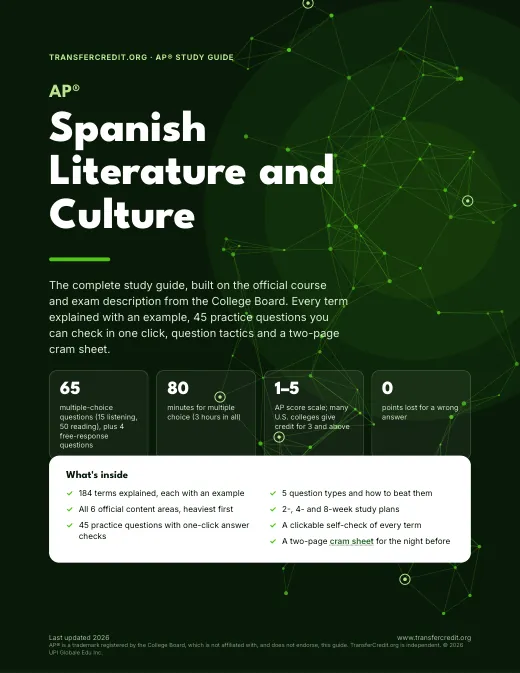
Page 1 of the TransferCredit.org Guide to AP® Spanish Literature and Culture: the cover
Page 1 The cover
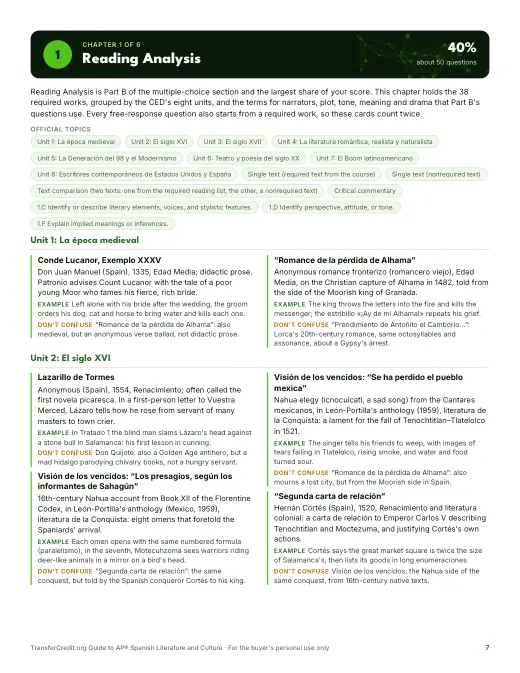
Page 7 of the TransferCredit.org Guide to AP® Spanish Literature and Culture: the Chapter 1 opener
Page 7 The Chapter 1 opener
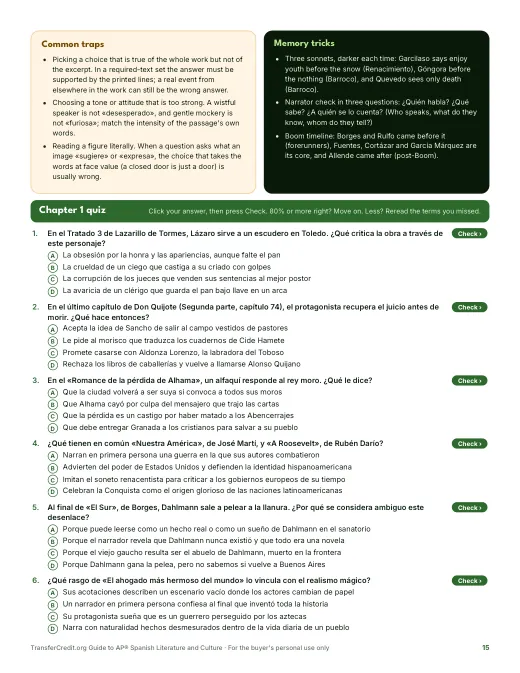
Page 15 of the TransferCredit.org Guide to AP® Spanish Literature and Culture: a chapter quiz
Page 15 A chapter quiz
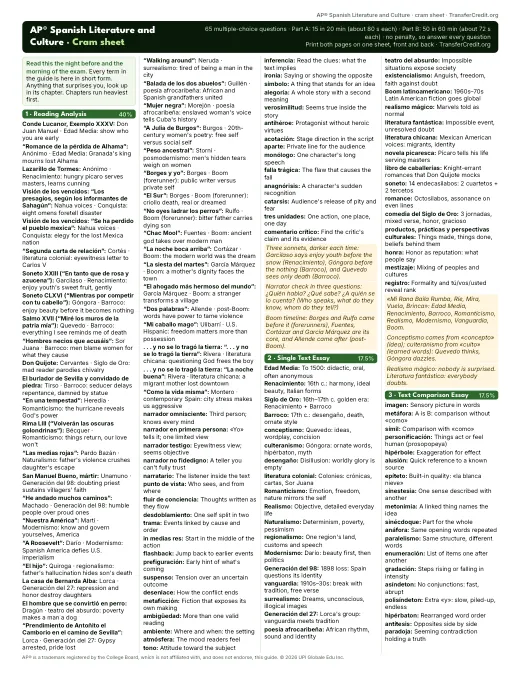
Page 46 of the TransferCredit.org Guide to AP® Spanish Literature and Culture: the 2-page cram sheet
Page 46 The 2-page cram sheet

What you get for $5

One chapter for each area of the official course and exam description, heaviest topics first.

  • 📘47pages, printable
  • 🧭6chapters
  • 🔑184terms with examples
  • ✍️45practice questions, answers explained
  • ⚠️18exam traps to avoid
  • 📄2page cram sheet

Try 10 free AP® Spanish Literature and Culture questions

Multiple-choice questions taken from the guide's chapter quizzes: 2 multiple-choice areas, heaviest first. About 10 minutes, with every answer explained and a score by area. The exam's free-response questions aren't in this quiz: see how the exam works.

10 questions  
  1. Question 1 · Reading Analysis
    En el Tratado 3 de Lazarillo de Tormes, Lázaro sirve a un escudero en Toledo. ¿Qué critica la obra a través de este personaje?
    Show the answer

    Answer: C. La obsesión por la honra y las apariencias, aunque falte el pan. The squire dresses well and talks of his honor while he and Lázaro go hungry; he even left his homeland over a question of courtesy. The Tratado mocks a society that values appearance over substance.

    The trap: The miserly priest who locks bread in a chest is Lázaro's master in Tratado 2, not the squire.

  2. Question 2 · Interpretive Listening
    ¿Cuántas sílabas métricas tiene este verso?

    «Canta el agua en el balcón»
    Show the answer

    Answer: B. Ocho: es un octosílabo. Can-tael-a-guaen-el-bal-cón: the sinalefas ta-el and gua-en give 7 syllables (en and el don't join, because en ends in a consonant). Balcón is agudo, so add 1: 7 + 1 = 8.

    The trap: Seven counts the sinalefas but forgets that a line ending in an agudo word (balcón) adds one syllable.

  3. Question 3 · Reading Analysis
    En el último capítulo de Don Quijote (Segunda parte, capítulo 74), el protagonista recupera el juicio antes de morir. ¿Qué hace entonces?
    Show the answer

    Answer: D. Rechaza los libros de caballerías y vuelve a llamarse Alonso Quijano. After a fever and a long sleep he wakes sane, says he is no longer don Quijote but Alonso Quijano, known as the Good, calls the chivalry books harmful, makes his will and dies.

    The trap: Sancho does beg him to go off to the fields dressed as shepherds, but the dying man answers that he was mad and is now sane.

  4. Question 4 · Interpretive Listening
    ¿Qué rima tienen los versos pares de esta estrofa?
    [Estrofa original escrita para esta guía.]

    Bajaba la niña al puerto
    con su cántaro de plata;
    el viento le hablaba bajo,
    la luna la acompañaba.
    Show the answer

    Answer: A. Rima asonante en á-a. The even lines end in plata and acompañaba. From the stressed á on, the vowels match (a-a) but the consonants don't (t, b), so the rhyme is asonante in á-a, the romance's pattern. Every line has 8 syllables (ba-ja-ba-la-ni-ñaal-puer-to), so it isn't verso libre.

    The trap: Rima consonante en -ata would need acompañaba to end in -ata too; only the vowels match.

  5. Question 5 · Reading Analysis
    En el «Romance de la pérdida de Alhama», un alfaquí responde al rey moro. ¿Qué le dice?
    Show the answer

    Answer: D. Que la pérdida es un castigo por haber matado a los Abencerrajes. The old alfaquí tells the king he deserves the loss («Bien se te emplea») because he killed the Abencerrajes, the flower of Granada, and took in renegades from Córdoba.

    The trap: The king does kill the messenger who brings the letters, but no one in the poem blames the messenger for the loss.

  6. Question 6 · Interpretive Listening
    Presentación sobre un tema literario (transcripción; en el examen la escuchas)
    [Transcripción original escrita para esta guía.]

    CONFERENCIANTE: Cuando Rubén Darío publicó Azul... en 1888, muchos lectores sintieron que la poesía en español había cambiado. Darío buscaba la música del verso, el color y la elegancia de mundos lejanos: cisnes, princesas, jardines. Pero no se quedó allí. A principios del siglo XX, ante el poder creciente de Estados Unidos en América Latina, escribió poemas de tono político, como «A Roosevelt», en los que defiende la cultura de la América hispana.

    Según el conferenciante, ¿cómo cambió la poesía de Darío?
    Show the answer

    Answer: B. Pasó de la belleza pura al comentario político. The speaker describes a first stage of music, color and elegance (swans, princesses, gardens), then, in the early 20th century, political poems such as «A Roosevelt» that defend Spanish America's culture.

    The trap: The choice that goes from social criticism to love poetry reverses the order the speaker gives: beauty came first and politics later.

  7. Question 7 · Reading Analysis
    ¿Qué tienen en común «Nuestra América», de José Martí, y «A Roosevelt», de Rubén Darío?
    Show the answer

    Answer: C. Advierten del poder de Estados Unidos y defienden la identidad hispanoamericana. Martí warns that the disdain of the formidable neighbor that does not know «our America» is its greatest danger; Darío calls Roosevelt the future invader of an America that still prays to Christ and speaks Spanish. Both defend Spanish American identity against U.S. power.

    The trap: Neither text is a sonnet: «Nuestra América» is a prose essay and «A Roosevelt» is a free-verse poem.

  8. Question 8 · Interpretive Listening
    Las preguntas 4–5 se refieren al siguiente poema (en el examen lo escuchas).
    [Poema original escrito para esta guía.]

    Mi madre cose junto a la ventana
    y la tarde se apaga sin ruido.
    «Ya volverá», le dice
    el hilo entre los dedos.
    Pasan el tren, la lluvia, los vecinos.
    «Ya volverá», le dice
    la aguja bajo la lámpara.

    ¿Qué efecto tiene la repetición de las palabras «Ya volverá»?
    Show the answer

    Answer: A. Subraya la esperanza de la madre en un regreso. The same line returns, said first by the thread and then by the needle, while time passes (the train, the rain, the neighbors). Like an estribillo, it keeps the mother's hope that someone will come back at the center of the poem.

    The trap: Nobody arrives in the poem: «volverá» is in the future, so the choice saying the absent person comes back at the end turns a hope into a fact.

  9. Question 9 · Reading Analysis
    Al final de «El Sur», de Borges, Dahlmann sale a pelear a la llanura. ¿Por qué se considera ambiguo este desenlace?
    Show the answer

    Answer: A. Porque puede leerse como un hecho real o como un sueño de Dahlmann en el sanatorio. Borges himself wrote that the story can be read as a direct narration of events and also in another way. The text never shows the fight, and details of the trip echo the sanatorium, so the duel may be what the dying Dahlmann dreams.

    The trap: Dahlmann never wins a fight on the page: the story ends as he walks out onto the plain with the dagger.

  10. Question 10 · Interpretive Listening
    Mismo poema que la pregunta 4.
    En «le dice / el hilo entre los dedos», ¿qué ocurre en el paso de un verso al otro?
    Show the answer

    Answer: C. Hay un encabalgamiento entre los dos versos. The sentence «le dice el hilo entre los dedos» is cut after «le dice», and its subject, «el hilo», waits on the next line. A sentence that runs past the line break is an encabalgamiento; it makes the listener wait to learn who speaks.

    The trap: The agudo choice fails: «dice» is llano (stress on dí), so no syllable is added, and a syllable count doesn't describe what happens at a line break.

The AP® Spanish Literature and Culture exam at a glance

The AP® Spanish Literature and Culture exam is from the College Board. It has 65 multiple-choice questions (15 listening, 50 reading), plus 4 free-response questions. You get 80 minutes for multiple choice (3 hours in all). The score scale is 1–5 (AP® score scale; many U.S. colleges give credit for 3 and above). The guide has 6 chapters, one for each area of the official course and exam description; the heaviest is Reading Analysis at 40%.

Questions
65multiple-choice questions (15 listening, 50 reading), plus 4 free-response questions
Time
80 minfor the 65 multiple-choice questions, in 2 parts timed separately
Score
1–5AP® score scale; many U.S. colleges give credit for 3 and above
Fee
$99per exam in the U.S. and Canada in 2026-27; your school may charge more
Calculator
Nonot allowed
Wrong answers
No penaltya wrong answer costs nothing
  • Section I is multiple choice, 80 minutes, 50% of your score. Part A (Section IA), Interpretive Listening: 15 questions in 20 minutes (10%), in 3 audio sets: an interview with an author (4 questions), a recited poem that is not on the required reading list (4) and a presentation on a literary topic (7). You can skim each set's questions before the audio; the poem is played twice, the interview and the presentation once.
  • Part B (Section IB), Reading Analysis: 50 questions in 60 minutes (40%), in 6 sets of 7–10 questions: 2 sets on required texts, 2 on texts outside the list, 1 comparing a required text with a nonrequired one, and 1 on a passage of literary criticism about a work or author from the list.
  • Section II is 4 free-response questions in 1 hour 40 minutes (50%), all written in Spanish: Text Explanation (7.5%) and Text and Art Comparison (7.5%), about 15 minutes each, then Analysis of a Single Text (17.5%) and Text Comparison (17.5%), about 35 minutes each.
  • The course is built on 38 required texts, from medieval Spain to today's Latin American, Spanish and U.S. Hispanic writers, and on 6 themes. Every free-response question gives an excerpt from a required text; the Text Comparison pairs it with a text that is not on the list.
  • The exam is fully digital for the first time in May 2027, with no change to its structure: you hear the audio and answer every question in the Bluebook testing app. No calculator is allowed.
  • Your multiple-choice score is the number of questions you answer correctly, so a wrong answer costs nothing.
  • In this guide's exam map, Reading Analysis and Interpretive Listening are the 65 multiple-choice questions and the other four chapters are the free-response questions; every weight is a share of your AP® score. The course's 8 units have no exam weights, so they are the groups of the Reading Analysis chapter, where the 38 required works are.

Source: official AP® Spanish Literature and Culture page and the official course and exam description. Last updated 2026.

What the exam covers

6 chapters, heaviest first, with each area's official weight. The guide's chapters follow this order.

  1. Reading Analysis40% · ~50 Q
  2. Analysis of a Single Text17.5% · 1 of 4 free-response
  3. Text Comparison17.5% · 1 of 4 free-response
  4. Interpretive Listening10% · ~15 Q
  5. Text Explanation7.5% · 1 of 4 free-response
  6. Text and Art Comparison7.5% · 1 of 4 free-response

Where to start: the 3 heaviest areas (marked in the map) carry about 75% of your score. The guide puts them first, so working front to back covers the most points earliest.

AP® Spanish Literature and Culture study guide by area

The heaviest area is open to read now. The full guide has a chapter for every area, each with all its terms, a quiz and an answer key.

1 of 6 chapters open  ·  in the guide's order
40% · about 50 questions · free preview Reading Analysis Chapter 1 of the guide

Reading Analysis is Part B of the multiple-choice section and the largest share of your score. This chapter holds the 38 required works, grouped by the CED's eight units, and the terms for narrators, plot, tone, meaning and drama that Part B's questions use. Every free-response question also starts from a required work, so these cards count twice.

Key terms, with examples

Conde Lucanor, Exemplo XXXV
Don Juan Manuel (Spain), 1335, Edad Media; didactic prose. Patronio advises Count Lucanor with the tale of a poor young Moor who tames his fierce, rich bride.
Example: Left alone with his bride after the wedding, the groom orders his dog, cat and horse to bring water and kills each one.
Lazarillo de Tormes
Anonymous (Spain), 1554, Renacimiento; often called the first novela picaresca. In a first-person letter to Vuestra Merced, Lázaro tells how he rose from servant of many masters to town crier.
Example: In Tratado 1 the blind man slams Lázaro's head against a stone bull in Salamanca: his first lesson in cunning.
Soneto CLXVI (“Mientras por competir con tu cabello”)
Luis de Góngora (Spain), 1582, Barroco (culteranismo): a carpe diem sonnet; the lady's hair, forehead, lip and neck outshine gold, lily, carnation and crystal, but all will end in nothing.
Example: The final line is a gradación that shrinks everything to zero: «en tierra, en humo, en polvo, en sombra, en nada».
“En una tempestad”
José María Heredia (Cuba), 1822, Romanticismo: a poem that speaks to an approaching hurricane, finding in nature's terrifying power a sign of God's greatness.
Example: It opens with an apóstrofe to the storm, «Huracán, huracán, venir te siento»; later the frightened birds tremble and hide.
San Manuel Bueno, mártir
Miguel de Unamuno (Spain), 1931, Generación del 98: a short novel in which Ángela recalls Don Manuel, a village priest who hides his lack of faith in eternal life.
Example: Reciting the Creed with the village, Don Manuel falls silent at the line about the resurrection of the flesh and life everlasting.
La casa de Bernarda Alba
Federico García Lorca (Spain), 1936, Generación del 27: a tragedy in three acts where a tyrannical widow locks her five daughters into mourning, and repression ends in the youngest's suicide.
Example: Bernarda's cane stands for her power; Adela, the youngest, who secretly meets her sister's fiancé, breaks it in rebellion.
“Borges y yo”
Jorge Luis Borges (Argentina), El hacedor (1960), Boom era (a forerunner): a short prose text in which the private “yo” describes “Borges”, the famous writer who takes over his life.
Example: The final sentence says he doesn't know which of the two is writing the page: desdoblamiento and paradoja in one line.
“Mi caballo mago”
Sabine Ulibarrí (New Mexico, U.S.), Tierra Amarilla (1964), literatura hispana de Estados Unidos: an adult narrator recalls how, at fifteen, he captured a legendary wild white horse.
Example: The morning after the capture, tracks lead through the barbed-wire fence, whose barbs hold white hairs and blood; the boy weeps with joy.
narrador omnisciente
A third-person narrator who knows everything, including every character's thoughts and feelings. It lets readers see inside several minds and judge events from above.
Example: «Ana sonreía, pero por dentro temía que su hermano nunca volviera.» (The narrator reveals a fear Ana hides.)
trama
The chain of events in a story, linked by cause and effect and arranged in the order the author chooses. Questions on trama ask what happens and why.
Example: «Perdió el autobús, por eso llegó tarde, por eso no conoció a su futura esposa.» (Each event causes the next.)
ambigüedad
A word, image or ending that allows more than one valid reading. It invites interpretation; the best answer admits what the text leaves open.
Example: «Cuando abrió la puerta, ya no había nadie, o quizá nunca hubo nadie.» (Was the visitor real? The text won't say.)
acotación
A stage direction in a play's script, often in parentheses or italics, describing setting, movement or tone. It is the playwright's own voice and can carry symbols.
Example: Lorca's first acotación describes a very white room in Bernarda's house, a whiteness that hints at the purity she demands.

What this area covers

Unit 1: La época medievalUnit 2: El siglo XVIUnit 3: El siglo XVIIUnit 4: La literatura romántica, realista y naturalistaUnit 5: La Generación del 98 y el ModernismoUnit 6: Teatro y poesía del siglo XXUnit 7: El Boom latinoamericanoUnit 8: Escritores contemporáneos de Estados Unidos y EspañaNarrators and point of viewPlot and structureTone, meaning and inferenceDramaCritical commentary

How the exam asks it

Every set opens with a printed passage, and its questions and choices are in Spanish, such as «¿Qué revela…?», «¿Cuál es la función de…?» or «¿Qué se infiere…?». Expect to identify who speaks, explain what a detail suggests, name a device or the tone, link a text to its period or movement, compare two texts, and state a critic's claim.

Common traps

Trap 1. Picking a choice that is true of the whole work but not of the excerpt. In a required-text set the answer must be supported by the printed lines; a real event from elsewhere in the work can still be the wrong answer.

Trap 2. Choosing a tone or attitude that is too strong. A wistful speaker is not «desesperado», and gentle mockery is not «furiosa»; match the intensity of the passage's own words.

Trap 3. Reading a figure literally. When a question asks what an image «sugiere» or «expresa», the choice that takes the words at face value (a closed door is just a door) is usually wrong.

Memory trick

Three sonnets, darker each time: Garcilaso says enjoy youth before the snow (Renacimiento), Góngora before the nothing (Barroco), and Quevedo sees only death (Barroco).

Narrator check in three questions: ¿Quién habla? ¿Qué sabe? ¿A quién se lo cuenta? (Who speaks, what do they know, whom do they tell?)

How AP® Spanish Literature and Culture questions are written

The exam has 65 multiple-choice questions (15 listening, 50 reading), plus 4 free-response questions. The guide sorts the questions into 5 types; spot the type and you'll know what the question wants before you read the choices.

Type 1

Part A: interview with an author

An audio excerpt of an author talking about their work, their writing or their period, followed by 4 questions on what the author says, implies or feels. On the exam you hear it in Bluebook and no script is shown, so this guide's example is a printed transcript.

  • Skim the 4 questions first and listen for their answers.
  • Track the author's attitude words (me fascina, me preocupa, nunca quise…), not just the topic.
  • Pick the choice that matches what was said, not one that only repeats a word you heard.
Type 2

Part A: recited poem

A poem that isn't on the required list, read aloud, followed by 4 questions on its meaning, tone, images and sound devices. On the exam you hear it twice; the example below is printed.

  • First hearing: get the situation and the feeling.
  • Second hearing: listen for repeated lines, rhyme and striking images to confirm your answers.
  • Judge the tone by the voice's own words, not by the topic alone.
Type 3

Part B: required-text set

An excerpt from one of the 38 required works, then 7–10 questions. Some are answered from the excerpt; others draw on what you know of the work as a whole: what happens, who speaks, its themes, genre, period and context.

  • Recognize the work and place the excerpt in it: who is speaking and what has just happened.
  • Use what you know of the work: themes, devices, genre, period, context.
  • Answer questions about the excerpt from its lines, not from memory of other scenes.
Type 4

Part B: nonrequired text or text comparison set

A text you haven't read (prose, poetry or drama), or a required text paired with one that isn't on the list, followed by 7–10 questions on meaning, narrator, tone and devices, and, in the paired set, on how the two texts compare.

  • Read the introduction line and the title: they give the genre and often the author and period.
  • Settle the literal meaning before the figurative.
  • In the paired set, compare one thing at a time: theme, tone, point of view, structure.
Type 5

Part B: critical commentary set

A passage of literary criticism about a work or an author from the required list, followed by 7–10 questions on the critic's claims, evidence and attitude.

  • Find the critic's main claim, often in the first or the last sentence.
  • Separate what the critic claims from the evidence offered for it.
  • Check the claim against what you know of the work: a choice that misstates the work is wrong.

Test-day habits that add points

  1. Answer every question. There's no penalty for a wrong answer. A blank is always worth zero, so never leave one.
  2. Predict, then look. Name the answer before reading the choices. It protects you from distractors written to sound right.
  3. Eliminate. Cross out choices you know are wrong. Every choice you rule out raises your odds on a guess.
  4. Mark and move on. If a question takes more than a minute, pick your best guess, mark it and come back if time allows.
  5. Watch absolute words. Choices with "always", "never" or "only" are often wrong, because most rules and findings have exceptions. Treat this as a tiebreaker, not a rule.
  6. Change answers for a reason. Switch an answer only when you can say why the new one is better, such as a detail you missed.
  7. The four free-response questions. Question 1, Text Explanation: read an excerpt from a required text, identify its author and period, and explain how a given theme develops in the excerpt in relation to the whole work; 6 points (Content 0–3, Language 0–3). Question 2, Text and Art Comparison: an excerpt from a required text and an image of a work of art related to it by theme; compare how both represent the theme, then connect it to the genre, period or movement of the text; 6 points (Content 0–3, Language 0–3). Question 3, Analysis of a Single Text: analyze how a required-text excerpt represents the characteristics of a genre and of a historical, cultural or social context; 10 points (Content 0–5, Language 0–5). Question 4, Text Comparison: two excerpts related by theme, one from the required list and one not; analyze the effect of the literary devices the authors use to develop the theme the prompt gives; 10 points (Content 0–5, Language 0–5). A response that isn't in Spanish, or that only restates the prompt or the excerpt, scores 0 in content and in language.
  8. Prepare for the listening part. A printed guide can't train your ear, so listen to Spanish about literature every week: interviews in which writers talk about their work, recordings of poets reading their own poems, and short talks on the periods, movements and works of the course. After each one, say in one sentence what the speaker's main point and attitude were. When you practice with a recorded poem, note every line that comes back and every sound that stands out, then check your notes against the printed text.
  9. Make a card for every required work. The CED expects you to do five things with every required work: explain its themes and compare them with other works; name its literary terms and the effect each one has; define the characteristics of its genre; show how it reflects its period or movement; and discuss the contexts that shaped it. Put those five on one card, or in a graphic organizer as the CED suggests, together with the author's name. Review the cards often, and compare each new work with the ones you studied before.

Pacing: Part A: Interpretive Listening: 15 questions in 20 minutes, about 80 seconds a question. Part B: Reading Analysis: 50 questions in 60 minutes, about 72 seconds a question.

AP® Spanish Literature and Culture flashcards

Try the first 8 cards free. Read the term, say the definition out loud, then select the card to check yourself. Arrow keys move between cards.

Free card 1 of 8 (deck total: 184)

How to study for AP® Spanish Literature and Culture: a 5-step plan

Follow the steps, then enter your test date. The planner gives you a dated plan that starts with the heaviest areas and saves the last days for review.

  1. Take the 10 free questionsSee which AP® Spanish Literature and Culture areas you already know.
  2. Study the heaviest areas firstStart with Reading Analysis, Analysis of a Single Text and Text Comparison, then work down the exam map.
  3. Learn each term with an exampleSay the definition out loud, then check it with the flashcards. A term you can't use in an example isn't learned yet.
  4. Quiz yourself and study the trapsAfter each area, answer its quiz and read why the tempting wrong answer is wrong.
  5. Plan backwards from your exam dateBuild a dated plan, keep the last days for a full review, and read the cram sheet the night before.

How it works

  1. 1Check outSelect Get the guide · $5 and pay on TransferCredit.org's secure checkout.
  2. 2Download the PDFFrom your TransferCredit.org account.
  3. 3Study the heaviest areas firstFollow the 2-, 4- or 8-week plan, then read the cram sheet the night before.

This page or the full guide

Everything on this page is free with no account. The full guide is a PDF you keep.

What's on this page and in the full study guide
Study toolThis pageFull study guide ($5)
ChaptersA preview of 1 of 6All 6
Terms explainedA sample from the open chaptersAll 184, each with an example
Practice questions10 free questions45, with an answer key
Flashcards8 cardsAll 184 terms on the self-check list
Study planDated planner2-, 4- and 8-week plans
Cram sheet—2 pages, for the night before
FormatWeb page47-page PDF, printable

Questions students ask

What's in the full AP® Spanish Literature and Culture study guide?
47 pages: 6 chapters, one for each area of the College Board's official course and exam description, heaviest topics first. 184 terms, each with a plain-English definition and an example, common traps and memory tricks, 45 practice questions with an answer key that explains every answer, question tactics, 2-, 4- and 8-week study plans and a 2-page cram sheet.
How much is the full AP® Spanish Literature and Culture study guide?
The full 47-page PDF is $5. The 10 practice questions on this page are free.
How do I get the full guide?
Select Get the guide · $5 and check out on TransferCredit.org. Then sign in to your TransferCredit.org account to download the PDF.
Can I print the guide or use it on my phone?
Yes. It's a PDF, so it opens on phones, tablets and computers, and printing is allowed. Its tick boxes and answer bubbles work in PDF readers that support forms. Copying and editing are turned off.
Can I try the AP® Spanish Literature and Culture guide before I buy it?
Yes. This page has 10 questions from the guide's own chapter quizzes, a preview of the heaviest area, 8 flashcards and a study planner. No account needed.
Is this an official AP® study guide?
No. AP® is a trademark registered by the College Board, which is not affiliated with, and does not endorse, this guide. TransferCredit.org is independent. We built the guide from the College Board's official course and exam description, and the exam details were checked against the College Board's published exam information in 2026.
How was this study guide made?
One chapter for each area of the official course and exam description, using its published weights. Each chapter was written, then fact-checked against the official exam information in a separate review. The practice questions are original: none are copied from the College Board's released questions.
How up to date is this AP® Spanish Literature and Culture guide?
Last updated 2026. The exam details were checked against the College Board's published exam information in 2026. Exams change, so confirm the details on the official AP® Spanish Literature and Culture page before you test.
More questions about the AP® Spanish Literature and Culture exam (16)
What is the AP® Spanish Literature and Culture exam?
The AP® Spanish Literature and Culture exam is from the College Board. It has 65 multiple-choice questions (15 listening, 50 reading), plus 4 free-response questions. You get 80 minutes for multiple choice (3 hours in all). The score scale is 1–5 (AP® score scale; many U.S. colleges give credit for 3 and above). The guide has 6 chapters, one for each area of the official course and exam description; the heaviest is Reading Analysis at 40%.
How many questions are on the AP® Spanish Literature and Culture exam, and how long is it?
Section I is multiple choice, 80 minutes, 50% of your score. Part A (Section IA), Interpretive Listening: 15 questions in 20 minutes (10%), in 3 audio sets: an interview with an author (4 questions), a recited poem that is not on the required reading list (4) and a presentation on a literary topic (7). You can skim each set's questions before the audio; the poem is played twice, the interview and the presentation once. Part B (Section IB), Reading Analysis: 50 questions in 60 minutes (40%), in 6 sets of 7–10 questions: 2 sets on required texts, 2 on texts outside the list, 1 comparing a required text with a nonrequired one, and 1 on a passage of literary criticism about a work or author from the list.
How is the AP® Spanish Literature and Culture exam scored?
The score scale is 1–5: AP® score scale; many U.S. colleges give credit for 3 and above. Your multiple-choice score is the number of questions you answer correctly, so a wrong answer costs nothing.
What AP® Spanish Literature and Culture score do I need for college credit?
Many U.S. colleges give credit for 3 and above. Each college sets its own credit policy, so check the one at your college before you count on the credit.
How much does the AP® Spanish Literature and Culture exam cost?
The fee is $99: per exam in the U.S. and Canada in 2026-27; your school may charge more. Fees can change, so check the official page when you register.
Can I use a calculator on the AP® Spanish Literature and Culture exam?
No calculator is allowed.
Is there a penalty for guessing on AP® Spanish Literature and Culture?
No. There's no penalty for a wrong answer. A blank is always worth zero, so never leave one.
What topics are on the AP® Spanish Literature and Culture exam?
6 areas, from the official course and exam description: Reading Analysis (40%); Analysis of a Single Text (17.5%); Text Comparison (17.5%); Interpretive Listening (10%); Text Explanation (7.5%); Text and Art Comparison (7.5%).
Which AP® Spanish Literature and Culture topics should I study first?
The 3 heaviest areas (marked in the map) carry about 75% of your score. The guide puts them first, so working front to back covers the most points earliest.
Is the AP® Spanish Literature and Culture exam hard?
It depends on what you already know. The largest area, Reading Analysis, is 40%, and the smallest, Text and Art Comparison, is 7.5%. Try the 10 free questions above to see where you stand in about 10 minutes.
What kinds of questions are on the AP® Spanish Literature and Culture exam?
The exam has 65 multiple-choice questions (15 listening, 50 reading), plus 4 free-response questions. The guide sorts the questions into 5 types: “Part A: interview with an author”, “Part A: recited poem”, “Part B: required-text set”, “Part B: nonrequired text or text comparison set” and “Part B: critical commentary set”. Multiple-choice questions have 4 answer choices. See how each type is written.
What are the free-response questions on the AP® Spanish Literature and Culture exam?
Question 1, Text Explanation: read an excerpt from a required text, identify its author and period, and explain how a given theme develops in the excerpt in relation to the whole work; 6 points (Content 0–3, Language 0–3). Question 2, Text and Art Comparison: an excerpt from a required text and an image of a work of art related to it by theme; compare how both represent the theme, then connect it to the genre, period or movement of the text; 6 points (Content 0–3, Language 0–3). Question 3, Analysis of a Single Text: analyze how a required-text excerpt represents the characteristics of a genre and of a historical, cultural or social context; 10 points (Content 0–5, Language 0–5). Question 4, Text Comparison: two excerpts related by theme, one from the required list and one not; analyze the effect of the literary devices the authors use to develop the theme the prompt gives; 10 points (Content 0–5, Language 0–5). A response that isn't in Spanish, or that only restates the prompt or the excerpt, scores 0 in content and in language.
How should I pace myself on the AP® Spanish Literature and Culture exam?
Part A: Interpretive Listening: 15 questions in 20 minutes, about 80 seconds a question. Part B: Reading Analysis: 50 questions in 60 minutes, about 72 seconds a question. If a question takes more than a minute, pick your best guess, mark it and come back if time allows.
How long should I study for AP® Spanish Literature and Culture?
Take the 10 free questions to see where you stand. The full guide has 2-, 4- and 8-week plans built from the exam weights, and the planner on this page builds a dated plan from your exam date.
How do I know I'm ready for the AP® Spanish Literature and Culture exam?
The guide's readiness checklist: You can explain every term on the checklist without notes. You score 80% or better on every chapter quiz. You can read the cram sheet and nothing on it surprises you. You know the AP® score your college gives credit for, and your exam date.
What should I do the night before?
Read the 2-page cram sheet once, slowly. Check your exam time and room with your AP® coordinator. The whole exam is taken in the Bluebook app: you hear the listening audio there and type your four free-response answers in Spanish. In the morning, skim the traps, then stop studying.

How we built this guide

We built one chapter for each area of the College Board's official course and exam description for AP® Spanish Literature and Culture, using its published weights to order the chapters and size the quizzes. Each chapter was written, then fact-checked against the official exam information in a separate review. The exam details were checked against the College Board's published exam information in 2026.

Sources: official AP® Spanish Literature and Culture page, official course and exam description. Last updated 2026.

AP® is a trademark registered by the College Board, which is not affiliated with, and does not endorse, this guide. TransferCredit.org is independent and not affiliated with the College Board. © 2026 UPI Globale Edu Inc.

Ready for the full AP® Spanish Literature and Culture guide? 47 pages, 184 terms, 45 practice questions and a 2-page cram sheet, $5.

Get the guide · $5

In the full guide

TransferCredit.org Guide to AP® Spanish Literature and Culture

  • All 6 chapters
  • 184 terms with examples
  • 45 practice questions with an answer key
  • A 2-page cram sheet and 2-, 4- and 8-week plans
Get the guide · $5