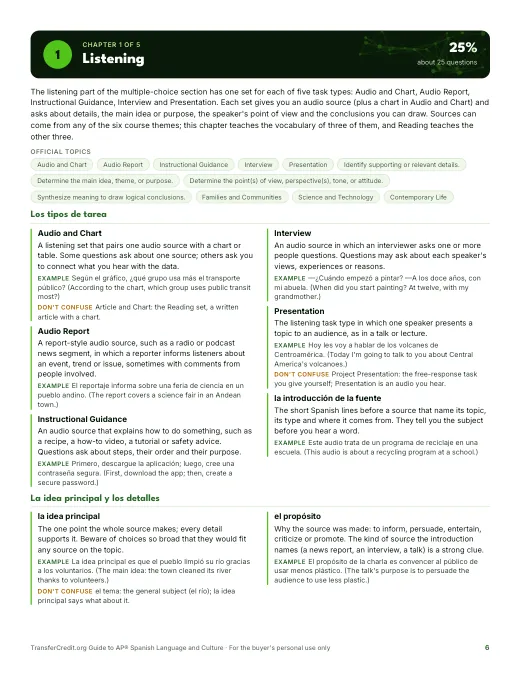
The listening part of the multiple-choice section has one set for each of five task types: Audio and Chart, Audio Report, Instructional Guidance, Interview and Presentation. Each set gives you an audio source (plus a chart in Audio and Chart) and asks about details, the main idea or purpose, the speaker's point of view and the conclusions you can draw. Sources can come from any of the six course themes; this chapter teaches the vocabulary of three of them, and Reading teaches the other three.
- Audio and Chart
- A listening set that pairs one audio source with a chart or table. Some questions ask about one source; others ask you to connect what you hear with the data.
- Example: Según el gráfico, ¿qué grupo usa más el transporte público? (According to the chart, which group uses public transit most?)
- la idea principal
- The one point the whole source makes; every detail supports it. Beware of choices so broad that they would fit any source on the topic.
- Example: La idea principal es que el pueblo limpió su río gracias a los voluntarios. (The main idea: the town cleaned its river thanks to volunteers.)
- el punto de vista
- The speaker's position or attitude toward the topic. Separate the speaker's own view from views the speaker only reports (según algunos…, hay quienes dicen…).
- Example: Para la entrevistada, el horario flexible es una ventaja, no un problema. (For the interviewee, flexible hours are an advantage, not a problem.)
- sacar una conclusión
- Combining several details to reach an idea the speaker implies but doesn't state. The right choice follows from what you heard; it doesn't add new facts.
- Example: Se agotaron las entradas: se puede concluir que el concierto tuvo éxito. (Tickets sold out: one can conclude the concert was a success.)
- el entrevistador / el entrevistado
- The interviewer (el entrevistador, la entrevistadora) asks the questions; the interviewee (el entrevistado, la entrevistada) answers them.
- Example: La entrevistadora le pregunta al entrevistado por qué volvió a su pueblo. (The interviewer asks the interviewee why he returned to his hometown.)
- la crianza
- Raising children: the care, values and habits parents and families pass on. The verb is criar.
- Example: En muchas familias, los abuelos participan en la crianza de los nietos. (In many families, grandparents take part in raising the grandchildren.)
- la brecha digital
- The digital divide: unequal access to the internet, devices and digital skills between groups, such as rural and urban areas.
- Example: La brecha digital afecta a los estudiantes sin internet en casa. (The digital divide affects students without internet at home.)
- el ocio
- Leisure, or free time, and the activities people enjoy in it. El tiempo libre is a near synonym.
- Example: Dedica su tiempo de ocio a la fotografía. (She spends her leisure time on photography.)
- Audio Report
- A report-style audio source, such as a radio or podcast news segment, in which a reporter informs listeners about an event, trend or issue, sometimes with comments from people involved.
- Example: El reportaje informa sobre una feria de ciencia en un pueblo andino. (The report covers a science fair in an Andean town.)
- el propósito
- Why the source was made: to inform, persuade, entertain, criticize or promote. The kind of source the introduction names (a news report, an interview, a talk) is a strong clue.
- Example: El propósito de la charla es convencer al público de usar menos plástico. (The talk's purpose is to persuade the audience to use less plastic.)
- el tono entusiasta
- An excited, positive tone: praise, exclamations and words like ¡increíble!, me encanta or una oportunidad única.
- Example: ¡Es una idea maravillosa y los niños están encantados! (It's a wonderful idea and the children are delighted!)
- ¿Qué recurso sería más útil…?
- The further-research question: which book, talk or article would help you learn more. Pick the one on the source's topic, even if broader, not one sharing only a keyword.
- Example: Audio sobre bancos de semillas → útil: «Cómo crear un banco de semillas comunitario». (Audio on seed banks → useful: How to start a community seed bank.)