← All AP® study guides
AP® Study Guide Printable PDF · 37 pages

TransferCredit.org Guide to AP® Japanese Language and Culture

AP® Japanese Language and Culture study guide: a printable PDF built from the College Board's official course and exam description, heaviest topics first.

  • 188 key terms, each with an example
  • 44 practice questions with every answer explained
  • A 2-page cram sheet for the night before
  • 2-, 4- and 8-week study plans built from the exam weights
Not sure yet? Try 10 free questions

Last updated 2026 · exam details checked against the College Board's published exam information in 2026

Look inside the guide

Real pages from the 37-page PDF.

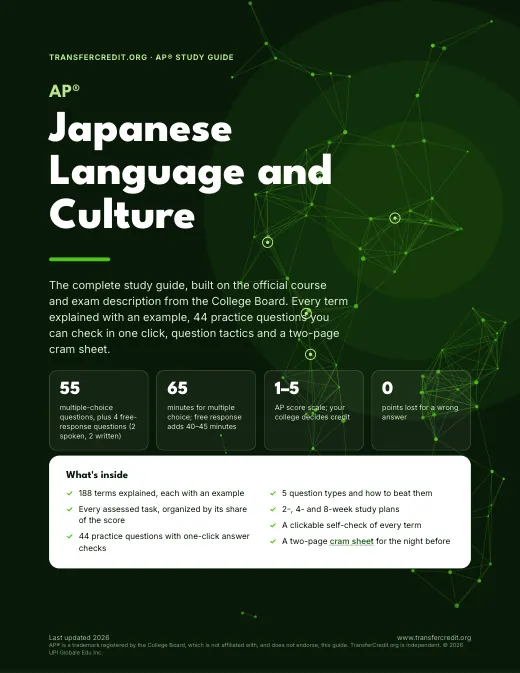
Page 1 of the TransferCredit.org Guide to AP® Japanese Language and Culture: the cover
Page 1 The cover
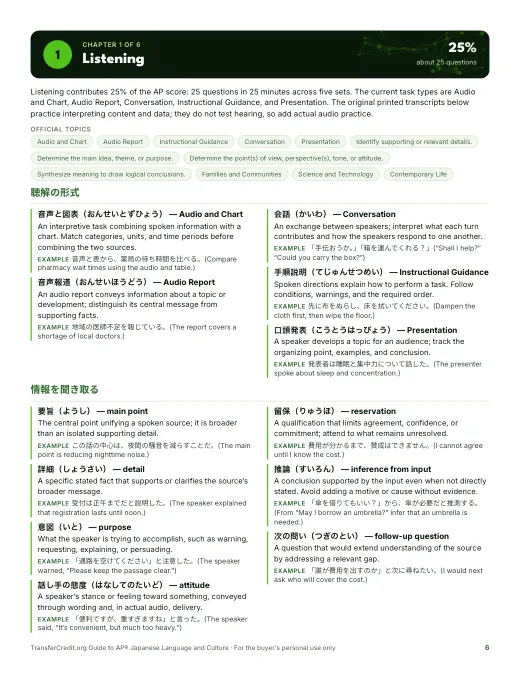
Page 6 of the TransferCredit.org Guide to AP® Japanese Language and Culture: the Chapter 1 opener
Page 6 The Chapter 1 opener
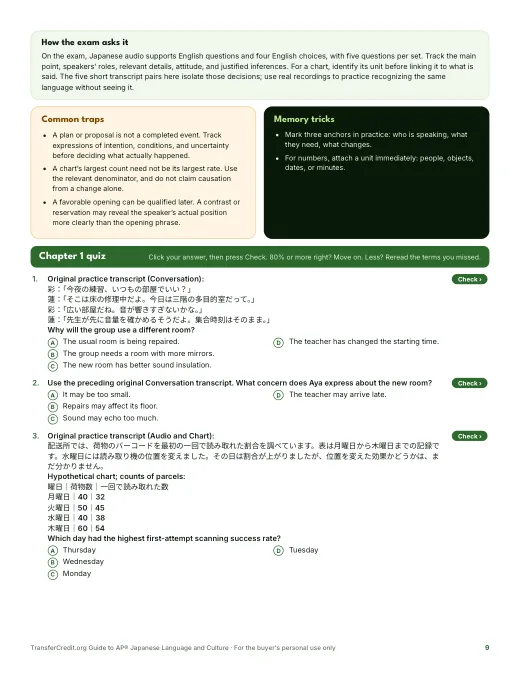
Page 9 of the TransferCredit.org Guide to AP® Japanese Language and Culture: a chapter quiz
Page 9 A chapter quiz
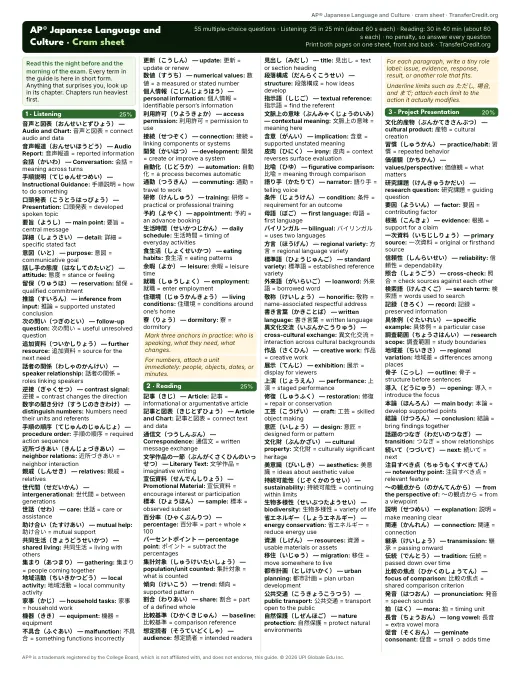
Page 36 of the TransferCredit.org Guide to AP® Japanese Language and Culture: the 2-page cram sheet
Page 36 The 2-page cram sheet

What you get for $5

One chapter for each area of the official course and exam description, heaviest topics first.

  • 📘37pages, printable
  • 🧭6chapters
  • 🔑188terms with examples
  • ✍️44practice questions, answers explained
  • ⚠️18exam traps to avoid
  • 📄2page cram sheet

Try 10 free AP® Japanese Language and Culture questions

Multiple-choice questions taken from the guide's chapter quizzes: 2 multiple-choice areas, heaviest first. About 10 minutes, with every answer explained and a score by area. The exam's free-response questions aren't in this quiz: see how the exam works.

10 questions  
  1. Question 1 · Listening
    Original practice transcript (Conversation):
    彩:「今夜の練習、いつもの部屋でいい?」
    蓮:「そこは床の修理中だよ。今日は三階の多目的室だって。」
    彩:「広い部屋だね。音が響きすぎないかな。」
    蓮:「先生が先に音量を確かめるそうだよ。集合時刻はそのまま。」
    Why will the group use a different room?
    Show the answer

    Answer: A. The usual room is being repaired.. Ren says the floor of the usual room is under repair. He specifically says the meeting time remains unchanged.

    The trap: “The teacher has changed the starting time” contradicts 「集合時刻はそのまま」.

  2. Question 2 · Reading
    Article: 「共同工房では、道具を返すとき、借りた人の名前だけを記録していた。しかし、どの道具が傷みやすいか分からなかった。そこで、返却時に刃や柄の状態も書くことにした。この記録を、修理の順番を決める際に使う。」 What is the new record intended to support?
    Show the answer

    Answer: D. Deciding which tools to repair first.. The added condition notes will be used to decide the order of repairs. The passage does not say they determine access or identify late returns.

    The trap: “People who have not returned tools” concerns return tracking, but the new information concerns tool condition and repair priorities.

  3. Question 3 · Listening
    Use the preceding original Conversation transcript. What concern does Aya express about the new room?
    Show the answer

    Answer: C. Sound may echo too much.. 「音が響きすぎないかな」 expresses concern about excessive reverberation in the spacious room.

    The trap: “It may be too small” reverses her description 「広い部屋」 and misses her concern about the sound.

  4. Question 4 · Reading
    Article and hypothetical chart: 「公園の管理で最も優先したいことを、回答者百人が一つずつ選んだ。」 Results: 樹木の点検40人/落ち葉の堆肥化30人/池の清掃20人/案内板の交換10人. Which summary fits these results?
    Show the answer

    Answer: B. Tree inspections received the largest share, but fewer than half the responses.. Forty of one hundred is 40%, the largest category but below 50%. The other categories together total sixty.

    The trap: “The other priorities combined” gives sixty responses, so tree inspections did not exceed them.

  5. Question 5 · Listening
    Original practice transcript (Audio and Chart):
    配送所では、荷物のバーコードを最初の一回で読み取れた割合を調べています。表は月曜日から木曜日までの記録です。水曜日には読み取り機の位置を変えました。その日は割合が上がりましたが、位置を変えた効果かどうかは、まだ分かりません。
    Hypothetical chart; counts of parcels:
    曜日|荷物数|一回で読み取れた数
    月曜日|40|32
    火曜日|50|45
    水曜日|40|38
    木曜日|60|54
    Which day had the highest first-attempt scanning success rate?
    Show the answer

    Answer: D. Wednesday. Wednesday’s rate is 38/40 = 95%. Monday is 80%; Tuesday and Thursday are each 90%. The denominator is parcels scanned that day.

    The trap: “Thursday” has the largest successful-scan count, 54, but 54/60 = 90% is below Wednesday’s rate.

  6. Question 6 · Reading
    Correspondence: 「布の修復記録に使う写真ですが、照明を変えると色が違って見えます。比較用の写真は同じ照明で撮ってください。布を動かすのは、担当者が状態を確認してからにしてください。確認は午後になります。」 What action should the recipient defer?
    Show the answer

    Answer: A. Moving the cloth.. The message makes moving the cloth conditional on a condition check by the responsible staff member, which will occur in the afternoon.

    The trap: “Selecting photographs” is not the action the message says must wait for the check.

  7. Question 7 · Listening
    Use the preceding original Audio and Chart transcript and hypothetical chart. Which conclusion do they support?
    Show the answer

    Answer: B. The rate rose on Wednesday, but the effect of moving the reader is uncertain.. Wednesday’s rate exceeds Monday’s and Tuesday’s, but the speaker explicitly withholds a causal conclusion about the reader’s location.

    The trap: “Moving the reader was the reason” turns an observed change into a cause the report says is still uncertain.

  8. Question 8 · Reading
    Literary passage: 「毎朝、工房では大きな機械の音がした。停電した日、針に糸を通す小さな音が聞こえた。私は手を止めた。静かになったのではない。今まで聞かなかった音が現れたのだ。」 What does the narrator realize?
    Show the answer

    Answer: C. Some workshop sounds had previously escaped notice.. The narrator distinguishes silence from noticing sounds previously unheard. The small threading sound is still present after the machines stop.

    The trap: “Stopped every kind of work” overlooks the continued threading and the narrator’s explicit rejection of complete silence.

  9. Question 9 · Listening
    Original practice transcript (Audio Report):
    市立高校の天文部は、街の明るさが星の見え方にどう関係するか調べています。同じ夜に校庭と川沿いで観察し、見えた星を記録しました。校庭では見える星が少なかったそうです。ただ、川沿いでは途中から雲が出たため、来月も観察を続けて記録を比べる予定です。
    What is the report mainly about?
    Show the answer

    Answer: B. A student investigation of stargazing conditions.. The report describes students comparing visible stars at two locations and planning further observations. These details develop the investigation of viewing conditions.

    The trap: “A public viewing event” mistakes the students’ research observations for an invitation to an event.

  10. Question 10 · Reading
    Promotional notice: 「二つの言語で工芸品の紹介文を読んでみませんか。翻訳の経験は問いません。短い説明を読み比べ、意味が伝わりにくい箇所を一緒に考えます。作品を作る講座ではありません。紹介文への意見を持ち寄ってください。」 Which reader best matches this invitation?
    Show the answer

    Answer: A. Someone interested in comparing how craft descriptions communicate meaning.. Participants compare short descriptions in two languages and discuss unclear meaning. No translation experience is required, and object making is excluded.

    The trap: “Limited to experienced specialists” contradicts the statement that translation experience is not required.

The AP® Japanese Language and Culture exam at a glance

The AP® Japanese Language and Culture exam is from the College Board. It has 55 multiple-choice questions, plus 4 free-response questions (2 spoken, 2 written). You get 65 minutes for multiple choice; free response adds 40–45 minutes. The score scale is 1–5 (AP® score scale; your college decides credit). The guide has 6 chapters, one for each area of the official course and exam description; the heaviest is Listening at 25%.

Questions
55multiple-choice questions, plus 4 free-response questions (2 spoken, 2 written)
Time
65 minfor the 55 multiple-choice questions, in 2 parts timed separately
Score
1–5AP® score scale; your college decides credit
Fee
$99per exam in the U.S. and Canada in 2026-27; your school may charge more
Calculator
Nonot allowed
Wrong answers
No penaltya wrong answer costs nothing
  • Section I is free response, worth half of the AP® score: four tasks in 40–45 minutes. Project Presentation contributes 20%, Project Q&A 15%, Story Narration 7.5% and Email Response 7.5%. Speaking takes about 15 minutes; the two written tasks share 30 minutes.
  • Section II gives you 65 minutes for 55 multiple-choice questions, worth the other half of the score. Listening is 25 questions in 25 minutes; Reading is 30 questions in 40 minutes. Each part contributes 25% of the entire AP® score, with 11 sets of 5 questions in all.
  • The two speaking tasks draw on your course research project, whose topic appears in January of the exam year. Submit the Personalized Project Reference in the AP® Digital Portfolio by April 30, 2027, 11:59 p.m. ET; it supports your presentation. Story Narration and Email Response are separate from that project.
  • The exam runs fully in Bluebook: record spoken responses and type Japanese for writing. The official input method is Google Japanese IME, supporting hiragana, katakana and kanji, with instructions on screen. Use current Bluebook practice rather than relying on this printed guide for keyboard preparation.
  • The exam date is Tuesday, May 11, 2027, Session 1. Your AP® coordinator tells you where and when to report. The separate section times above are the appropriate limits for timed practice.
  • Multiple-choice scoring counts correct responses, with no penalty for a wrong answer. Themes provide cultural and interdisciplinary contexts but have no separate percentages. Comprehension exercises in this guide match the current CED examples: Japanese sources with English questions and choices.

Source: official AP® Japanese Language and Culture page and the official course and exam description. Last updated 2026.

What the exam covers

6 chapters, heaviest first, with each area's official weight. The guide's chapters follow this order.

  1. Listening25% · ~25 Q
  2. Reading25% · ~30 Q
  3. Project Presentation20% · 1 of 4 free-response
  4. Project Q&A15% · 1 of 4 free-response
  5. Story Narration7.5% · 1 of 4 free-response
  6. Email Response7.5% · 1 of 4 free-response

Where to start: the 3 heaviest areas (marked in the map) carry about 70% of your score. The guide puts them first, so working front to back covers the most points earliest.

AP® Japanese Language and Culture study guide by area

The heaviest area is open to read now. The full guide has a chapter for every area, each with all its terms, a quiz and an answer key.

1 of 6 chapters open  ·  in the guide's order
25% · about 25 questions · free preview Listening Chapter 1 of the guide

Listening contributes 25% of the AP® score: 25 questions in 25 minutes across five sets. The current task types are Audio and Chart, Audio Report, Conversation, Instructional Guidance, and Presentation. The original printed transcripts below practice interpreting content and data; they do not test hearing, so add actual audio practice.

Key terms, with examples

音声と図表(おんせいとずひょう) — Audio and Chart
An interpretive task combining spoken information with a chart. Match categories, units, and time periods before combining the two sources.
Example: 音声と表から、薬局の待ち時間を比べる。(Compare pharmacy wait times using the audio and table.)
要旨(ようし) — main point
The central point unifying a spoken source; it is broader than an isolated supporting detail.
Example: この話の中心は、夜間の騒音を減らすことだ。(The main point is reducing nighttime noise.)
近所づきあい(きんじょづきあい) — neighbor relations
Relationships and everyday interaction with people living nearby; practices vary among particular communities.
Example: 引っ越した後、隣の人にあいさつした。(After moving, I greeted the person next door.)
機器(きき) — equipment
Devices or equipment used for a task; identify their function from context.
Example: 録音機器をケースに入れた。(I put the recording equipment in its case.)
通勤(つうきん) — commuting
Travel between home and the workplace; it differs from 通学, traveling to school.
Example: 橋の工事で通勤の経路を変えた。(Bridge construction made me change my commuting route.)
音声報道(おんせいほうどう) — Audio Report
An audio report conveys information about a topic or development; distinguish its central message from supporting facts.
Example: 地域の医師不足を報じている。(The report covers a shortage of local doctors.)
詳細(しょうさい) — detail
A specific stated fact that supports or clarifies the source’s broader message.
Example: 受付は正午までだと説明した。(The speaker explained that registration lasts until noon.)
親戚(しんせき) — relatives
People related through family connections, beyond or including the immediate household according to context.
Example: いとこも親戚の集まりに来た。(My cousin also came to the relatives’ gathering.)
不具合(ふぐあい) — malfunction
A fault or condition that prevents a device or system from working as intended.
Example: 画面が消える不具合が見つかった。(A malfunction causing the screen to go blank was found.)
研修(けんしゅう) — training
Structured training to develop knowledge or job-related skills; context specifies the trainees and purpose.
Example: 新人は商品の説明をする研修を受けた。(New employees received training in explaining the products.)
会話(かいわ) — Conversation
An exchange between speakers; interpret what each turn contributes and how the speakers respond to one another.
Example: 「手伝おうか。」「箱を運んでくれる?」(“Shall I help?” “Could you carry the box?”)
意図(いと) — purpose
What the speaker is trying to accomplish, such as warning, requesting, explaining, or persuading.
Example: 「通路を空けてください」と注意した。(The speaker warned, “Please keep the passage clear.”)

What this area covers

聴解の形式情報を聞き取る家族と地域社会科学技術の文脈現代の生活

How the exam asks it

On the exam, Japanese audio supports English questions and four English choices, with five questions per set. Track the main point, speakers’ roles, relevant details, attitude, and justified inferences. For a chart, identify its unit before linking it to what is said. The five short transcript pairs here isolate those decisions; use real recordings to practice recognizing the same language without seeing it.

Common traps

Trap 1. A plan or proposal is not a completed event. Track expressions of intention, conditions, and uncertainty before deciding what actually happened.

Trap 2. A chart’s largest count need not be its largest rate. Use the relevant denominator, and do not claim causation from a change alone.

Trap 3. A favorable opening can be qualified later. A contrast or reservation may reveal the speaker’s actual position more clearly than the opening phrase.

Memory trick

Mark three anchors in practice: who is speaking, what they need, what changes.

For numbers, attach a unit immediately: people, objects, dates, or minutes.

How AP® Japanese Language and Culture questions are written

The exam has 55 multiple-choice questions, plus 4 free-response questions (2 spoken, 2 written). The guide sorts the questions into 5 types; spot the type and you'll know what the question wants before you read the choices.

Type 1

Listening interpretation

Japanese audio paired with English questions; some sets also include a chart. This example is a printed transcript for skill rehearsal.

  • Listen for the speaker’s purpose and the detail the question targets.
  • Track conditions and contrasts, then connect any chart labels with the audio.
  • Choose the statement supported by what you heard.
Type 2

Reading interpretation

Japanese articles, correspondence, literary passages, or promotional texts, sometimes paired with data; English questions ask what the sources support.

  • Establish who wrote the source, its purpose, and the relevant part.
  • Read any chart’s units and comparison conditions.
  • Check that the answer does not add an unstated reason or certainty.
Type 3

Project Presentation and Project Q&A

A research presentation followed by recorded questions about your project. The choice exercise below rehearses answering a prompt; the exam requires spoken responses.

  • Build the presentation around the current project prompt and your own research evidence.
  • In Q&A, identify the specific information being requested.
  • Give a direct response with relevant development and clear delivery.
Type 4

Story Narration

Four pictures provide a sequence for a complete Japanese story. This text-only planning example requires separate practice with genuine picture sequences.

  • Find the people, setting, actions, and changes across all four pictures.
  • Plan a complete sequence with connecting language and relevant details.
  • Write and reread for coherence and consistency with the pictures.
Type 5

Email Response

An incoming Japanese email requests information. You type a complete reply; these choices rehearse identifying an adequate answer.

  • Mark both requests and the sender’s relationship to you.
  • Develop each answer with relevant details and examples.
  • Check organization, meaning, and contextual register.

Test-day habits that add points

  1. Answer from the source. For comprehension, locate support for each part of the proposed answer. Separate what the source states, what it reasonably implies, and what it leaves unknown. Answer every multiple-choice question; wrong answers carry no deduction.
  2. Use each timed part. Practice Listening as 25 questions in 25 minutes and Reading as 30 questions in 40 minutes. Follow the audio and on-screen timing in Bluebook practice. Use reading time to check targeted evidence rather than translating every word.
  3. Prepare with real audio. A printed transcript cannot train listening by itself. Practice Japanese recordings without a script, answer questions, then replay and inspect the transcript to find what you missed. Include audio paired with charts and rehearse with current Bluebook tools.
  4. Rehearse the four free-response tasks. Section I comes first: four tasks in 40–45 minutes. Speaking takes about 15 minutes: prepare for 3 minutes and present for 3 minutes, then answer four recorded Q&A prompts, each heard twice, with 40 seconds per response. Writing shares 30 minutes: a coherent four-picture story and an email addressing both requests. The analytic rubrics total 11 points for Project Presentation, 9 for Project Q&A, and 8 each for Story Narration and Email Response.
  5. Make project evidence usable. Use the actual January project prompt to focus your research. Explain at least three factors with relevant details, and connect cultural products or practices with perspectives using specific evidence. Rehearse speaking from your permitted Personalized Project Reference rather than reading a memorized script.
  6. Practice complete Japanese writing. Use Google Japanese IME in current Bluebook practice. Reread converted kanji for meaning, connect the story’s four scenes, and develop both email answers in a register that fits the recipient. Short choice exercises are preparation for producing complete responses.

Pacing: Part A, Listening: 25 questions in 25 minutes, about 60 seconds a question. Part B, Reading: 30 questions in 40 minutes, about 80 seconds a question.

AP® Japanese Language and Culture flashcards

Try the first 8 cards free. Read the term, say the definition out loud, then select the card to check yourself. Arrow keys move between cards.

Free card 1 of 8 (deck total: 188)

How to study for AP® Japanese Language and Culture: a 5-step plan

Follow the steps, then enter your test date. The planner gives you a dated plan that starts with the heaviest areas and saves the last days for review.

  1. Take the 10 free questionsSee which AP® Japanese Language and Culture areas you already know.
  2. Study the heaviest areas firstStart with Listening, Reading and Project Presentation, then work down the exam map.
  3. Learn each term with an exampleSay the definition out loud, then check it with the flashcards. A term you can't use in an example isn't learned yet.
  4. Quiz yourself and study the trapsAfter each area, answer its quiz and read why the tempting wrong answer is wrong.
  5. Plan backwards from your exam dateBuild a dated plan, keep the last days for a full review, and read the cram sheet the night before.

How it works

  1. 1Check outSelect Get the guide · $5 and pay on TransferCredit.org's secure checkout.
  2. 2Download the PDFFrom your TransferCredit.org account.
  3. 3Study the heaviest areas firstFollow the 2-, 4- or 8-week plan, then read the cram sheet the night before.

This page or the full guide

Everything on this page is free with no account. The full guide is a PDF you keep.

What's on this page and in the full study guide
Study toolThis pageFull study guide ($5)
ChaptersA preview of 1 of 6All 6
Terms explainedA sample from the open chaptersAll 188, each with an example
Practice questions10 free questions44, with an answer key
Flashcards8 cardsAll 188 terms on the self-check list
Study planDated planner2-, 4- and 8-week plans
Cram sheet—2 pages, for the night before
FormatWeb page37-page PDF, printable

Questions students ask

What's in the full AP® Japanese Language and Culture study guide?
37 pages: 6 chapters, one for each area of the College Board's official course and exam description, heaviest topics first. 188 terms, each with a plain-English definition and an example, common traps and memory tricks, 44 practice questions with an answer key that explains every answer, question tactics, 2-, 4- and 8-week study plans and a 2-page cram sheet.
How much is the full AP® Japanese Language and Culture study guide?
The full 37-page PDF is $5. The 10 practice questions on this page are free.
How do I get the full guide?
Select Get the guide · $5 and check out on TransferCredit.org. Then sign in to your TransferCredit.org account to download the PDF.
Can I print the guide or use it on my phone?
Yes. It's a PDF, so it opens on phones, tablets and computers, and printing is allowed. Its tick boxes and answer bubbles work in PDF readers that support forms. Copying and editing are turned off.
Can I try the AP® Japanese Language and Culture guide before I buy it?
Yes. This page has 10 questions from the guide's own chapter quizzes, a preview of the heaviest area, 8 flashcards and a study planner. No account needed.
Is this an official AP® study guide?
No. AP® is a trademark registered by the College Board, which is not affiliated with, and does not endorse, this guide. TransferCredit.org is independent. We built the guide from the College Board's official course and exam description, and the exam details were checked against the College Board's published exam information in 2026.
How was this study guide made?
One chapter for each area of the official course and exam description, using its published weights. Each chapter was written, then fact-checked against the official exam information in a separate review. The practice questions are original: none are copied from the College Board's released questions.
How up to date is this AP® Japanese Language and Culture guide?
Last updated 2026. The exam details were checked against the College Board's published exam information in 2026. Exams change, so confirm the details on the official AP® Japanese Language and Culture page before you test.
More questions about the AP® Japanese Language and Culture exam (16)
What is the AP® Japanese Language and Culture exam?
The AP® Japanese Language and Culture exam is from the College Board. It has 55 multiple-choice questions, plus 4 free-response questions (2 spoken, 2 written). You get 65 minutes for multiple choice; free response adds 40–45 minutes. The score scale is 1–5 (AP® score scale; your college decides credit). The guide has 6 chapters, one for each area of the official course and exam description; the heaviest is Listening at 25%.
How many questions are on the AP® Japanese Language and Culture exam, and how long is it?
Section II gives you 65 minutes for 55 multiple-choice questions, worth the other half of the score. Listening is 25 questions in 25 minutes; Reading is 30 questions in 40 minutes. Each part contributes 25% of the entire AP® score, with 11 sets of 5 questions in all.
How is the AP® Japanese Language and Culture exam scored?
The score scale is 1–5: AP® score scale; your college decides credit. Multiple-choice scoring counts correct responses, with no penalty for a wrong answer.
What AP® Japanese Language and Culture score do I need for college credit?
Your college decides credit. Each college sets its own credit policy, so check the one at your college before you count on the credit.
How much does the AP® Japanese Language and Culture exam cost?
The fee is $99: per exam in the U.S. and Canada in 2026-27; your school may charge more. Fees can change, so check the official page when you register.
Can I use a calculator on the AP® Japanese Language and Culture exam?
No. A calculator isn't allowed.
Is there a penalty for guessing on AP® Japanese Language and Culture?
No. Multiple-choice scoring counts correct responses, with no penalty for a wrong answer.
What topics are on the AP® Japanese Language and Culture exam?
6 areas, from the official course and exam description: Listening (25%); Reading (25%); Project Presentation (20%); Project Q&A (15%); Story Narration (7.5%); Email Response (7.5%).
Which AP® Japanese Language and Culture topics should I study first?
The 3 heaviest areas (marked in the map) carry about 70% of your score. The guide puts them first, so working front to back covers the most points earliest.
Is the AP® Japanese Language and Culture exam hard?
It depends on what you already know. The largest area, Listening, is 25%, and the smallest, Email Response, is 7.5%. Try the 10 free questions above to see where you stand in about 10 minutes.
What kinds of questions are on the AP® Japanese Language and Culture exam?
The exam has 55 multiple-choice questions, plus 4 free-response questions (2 spoken, 2 written). The guide sorts the questions into 5 types: “Listening interpretation”, “Reading interpretation”, “Project Presentation and Project Q&A”, “Story Narration” and “Email Response”. Multiple-choice questions have 4 answer choices. See how each type is written.
What are the free-response questions on the AP® Japanese Language and Culture exam?
Section I comes first: four tasks in 40–45 minutes. Speaking takes about 15 minutes: prepare for 3 minutes and present for 3 minutes, then answer four recorded Q&A prompts, each heard twice, with 40 seconds per response. Writing shares 30 minutes: a coherent four-picture story and an email addressing both requests. The analytic rubrics total 11 points for Project Presentation, 9 for Project Q&A, and 8 each for Story Narration and Email Response. Use Google Japanese IME in current Bluebook practice. Reread converted kanji for meaning, connect the story’s four scenes, and develop both email answers in a register that fits the recipient. Short choice exercises are preparation for producing complete responses.
How should I pace myself on the AP® Japanese Language and Culture exam?
Part A, Listening: 25 questions in 25 minutes, about 60 seconds a question. Part B, Reading: 30 questions in 40 minutes, about 80 seconds a question.
How long should I study for AP® Japanese Language and Culture?
Take the 10 free questions to see where you stand. The full guide has 2-, 4- and 8-week plans built from the exam weights, and the planner on this page builds a dated plan from your exam date.
How do I know I'm ready for the AP® Japanese Language and Culture exam?
The guide's readiness checklist: You can explain at least three researched factors relevant to the project prompt and support cultural connections with specific evidence. You can deliver a coherent three-minute Japanese presentation using your permitted Personalized Project Reference. You can answer practice project questions in forty seconds with relevant details, clear delivery, and appropriate language. You can write a complete Japanese story consistent with all four pictures in a genuine picture sequence. You can type a coherent email that develops both requests and fits the sender’s relationship to you. You can interpret complete Japanese audio sets without relying on a transcript and connect audio with chart labels. You can read Japanese sets for evidence, contextual meaning, and supported inferences while distinguishing percentages from percentage points. You have practiced recording and Japanese input in current Bluebook tools, know the PPR submission requirements, and have confirmed exam-day arrangements.
What should I do the night before?
Read the 2-page cram sheet once, slowly. Confirm your room and start time with the AP® coordinator. Practice recording and Japanese typing with the current Bluebook tools and Google Japanese IME. A printed Personalized Project Reference supports your presentation. In the morning, skim the traps, then stop studying.

How we built this guide

We built one chapter for each area of the College Board's official course and exam description for AP® Japanese Language and Culture, using its published weights to order the chapters and size the quizzes. Each chapter was written, then fact-checked against the official exam information in a separate review. The exam details were checked against the College Board's published exam information in 2026.

Sources: official AP® Japanese Language and Culture page, official course and exam description. Last updated 2026.

AP® is a trademark registered by the College Board, which is not affiliated with, and does not endorse, this guide. TransferCredit.org is independent and not affiliated with the College Board. © 2026 UPI Globale Edu Inc.

Ready for the full AP® Japanese Language and Culture guide? 37 pages, 188 terms, 44 practice questions and a 2-page cram sheet, $5.

Get the guide · $5

In the full guide

TransferCredit.org Guide to AP® Japanese Language and Culture

  • All 6 chapters
  • 188 terms with examples
  • 44 practice questions with an answer key
  • A 2-page cram sheet and 2-, 4- and 8-week plans
Get the guide · $5