← All AP® study guides
AP® Study Guide Printable PDF · 48 pages

TransferCredit.org Guide to AP® Latin

AP® Latin study guide: a printable PDF built from the College Board's official course and exam description, heaviest topics first.

  • 188 key terms, each with an example
  • 49 practice questions with every answer explained
  • A 2-page cram sheet for the night before
  • 2-, 4- and 8-week study plans built from the exam weights
Not sure yet? Try 10 free questions

Last updated 2026 · exam details checked against the College Board's published exam information in 2026

Look inside the guide

Real pages from the 48-page PDF.

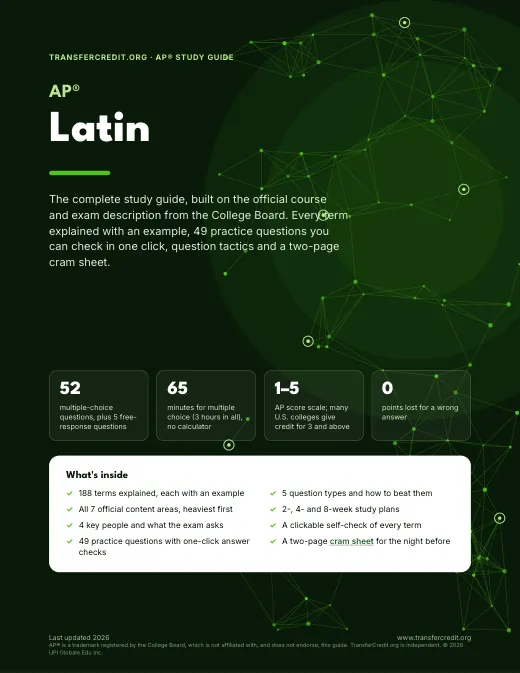
Page 1 of the TransferCredit.org Guide to AP® Latin: the cover
Page 1 The cover
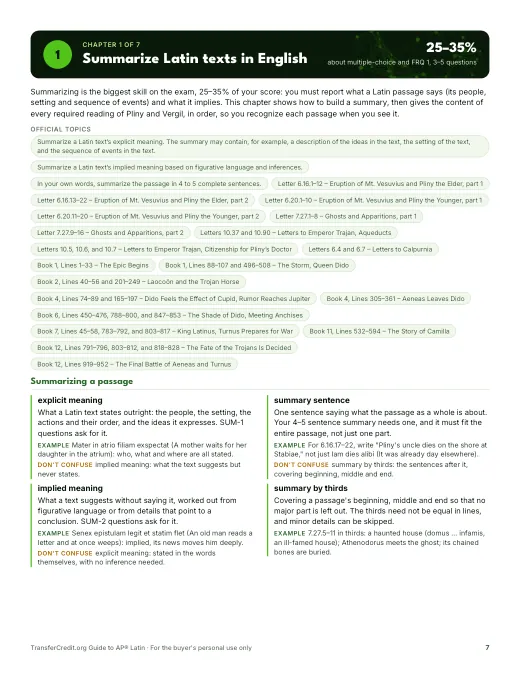
Page 7 of the TransferCredit.org Guide to AP® Latin: the Chapter 1 opener
Page 7 The Chapter 1 opener
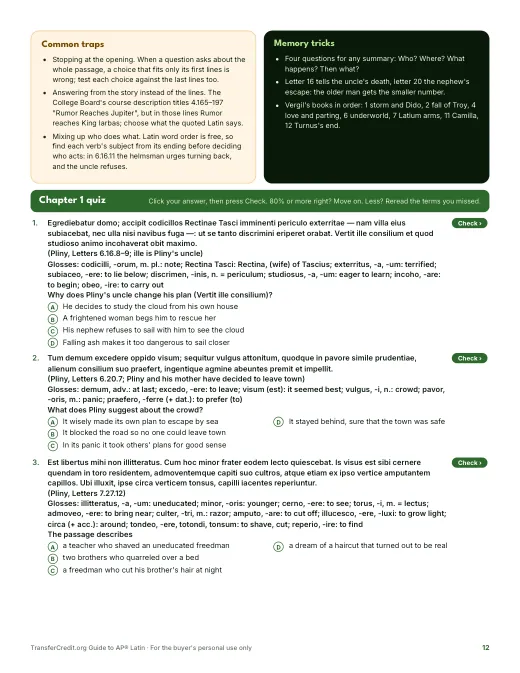
Page 12 of the TransferCredit.org Guide to AP® Latin: a chapter quiz
Page 12 A chapter quiz
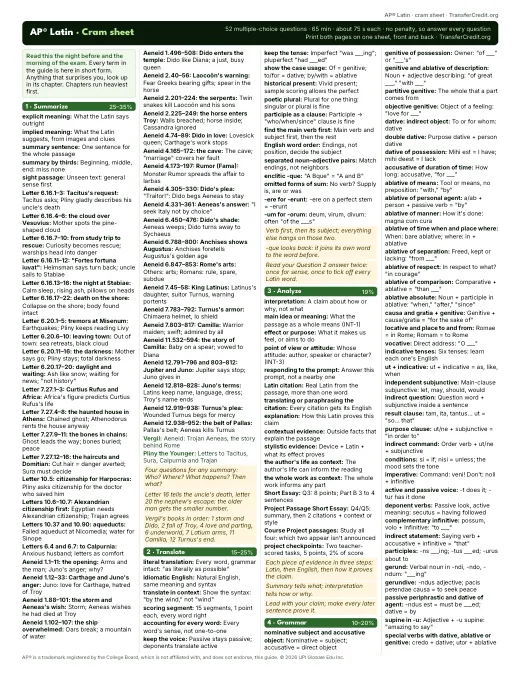
Page 47 of the TransferCredit.org Guide to AP® Latin: the 2-page cram sheet
Page 47 The 2-page cram sheet

What you get for $5

One chapter for each area of the official course and exam description, heaviest topics first.

  • 📘48pages, printable
  • 🧭7chapters
  • 🔑188terms with examples
  • ✍️49practice questions, answers explained
  • ⚠️21exam traps to avoid
  • 📄2page cram sheet

Try 10 free AP® Latin questions

Multiple-choice questions taken from the guide's chapter quizzes: 6 multiple-choice areas, heaviest first. About 10 minutes, with every answer explained and a score by area. The exam's free-response questions aren't in this quiz: see how the exam works.

10 questions  
  1. Question 1 · Summarize
    Egrediebatur domo; accipit codicillos Rectinae Tasci imminenti periculo exterritae — nam villa eius subiacebat, nec ulla nisi navibus fuga —: ut se tanto discrimini eriperet orabat. Vertit ille consilium et quod studioso animo incohaverat obit maximo.
    (Pliny, Letters 6.16.8–9; ille is Pliny's uncle)
    Glosses: codicilli, -orum, m. pl.: note; Rectina Tasci: Rectina, (wife) of Tascius; exterritus, -a, -um: terrified; subiaceo, -ere: to lie below; discrimen, -inis, n. = periculum; studiosus, -a, -um: eager to learn; incoho, -are: to begin; obeo, -ire: to carry out
    Why does Pliny's uncle change his plan (Vertit ille consilium)?
    Show the answer

    Answer: D. A frightened woman begs him to rescue her. Rectina's note says her villa lies below the mountain, with no escape except by ship, and she begs him to save her (ut se ... eriperet orabat). So the trip he began out of curiosity becomes a rescue, carried out with the greatest spirit (maximo).

    The trap: His nephew's refusal to come is in the letter (§7), but it isn't in these lines and it changes nothing; the plea in Rectina's note is what turns him.

  2. Question 2 · Translate
    Poeta ab omnibus civibus laudabatur.

    How is the sentence translated?
    Show the answer

    Answer: A. The poet was being praised by all the citizens.. Laudabatur is imperfect passive ("was being praised"), and ab omnibus civibus is the ablative of agent ("by all the citizens").

    The trap: The poet was praising all of the citizens turns the passive into an active verb. The -batur ending is passive, and ab marks who does the praising.

  3. Question 3 · Grammar
    Agricolae ad urbem venerunt ut cibum venderent.

    In the sentence, what does ut cibum venderent specify?
    Show the answer

    Answer: B. Why the farmers came to the city. Ut with a subjunctive (venderent) after a verb of motion is a purpose clause: the farmers came in order to sell food.

    The trap: What resulted from the farmers' trip reads it as a result clause, but nothing in the main clause signals a result (no tam, ita or tantus), and selling was their aim.

  4. Question 4 · Vocabulary
    Dux aciem in campo constituit; hostes iam appropinquabant.
    In the sentence, what does aciem mean?
    Show the answer

    Answer: C. Battle line. The leader sets up aciem on a plain as the enemy approaches: a battle scene, so acies means the battle line.

    The trap: "Sharp edge" is another listed meaning of acies, but a leader doesn't set up a sharp edge on a plain.

  5. Question 5 · Context
    miseri te si qua parentis / tangere cura potest, oro (fuit et tibi talis / Anchises genitor) Dauni miserere senectae
    (Vergil, Aeneid 12.932–934; Turnus is speaking to Aeneas)
    Glosses: si qua = if any; Anchises, -ae, m.: Anchises (Aeneas's father); genitor, -oris, m. = pater; Daunus, -i, m.: Daunus (Turnus's father); misereor, -eri (+ gen.): to pity; senecta, -ae, f.: old age
    Turnus's appeal is likely to move Aeneas because it calls on
    Show the answer

    Answer: B. his pietas, his devotion to his own father. Turnus reminds Aeneas that he too had a father, Anchises, and asks him to pity old Daunus: an appeal to pietas, which includes devotion to parents, the ideal Vergil marks by calling Aeneas pius.

    The trap: "His duty as a client to his patron, Daunus" doesn't fit: Daunus is Turnus's father, not Aeneas's patron, and nothing in the lines involves patronage.

  6. Question 6 · Style and Meter
    tela manu iam tum tenera puerilia torsit
    (Aeneid 11.578: Diana describes the young Camilla)

    Glosses: puerilis, -e: childish, a child's

    Which device does the word order tela manu ... tenera puerilia show?
    Show the answer

    Answer: C. Chiasmus: the pairs tela…puerilia and manu…tenera are arranged a-b-b-a. Tela and manu come first; then tenera (agreeing with manu) and puerilia (agreeing with tela) reverse them: a-b-b-a, a chiasmus. It draws attention to how young she was: even then, with a tender hand, she hurled a child's weapons.

    The trap: Synchysis would be a-b-a-b; here the second pair is reversed (tenera before puerilia), so the order mirrors rather than interlocks.

  7. Question 7 · Summarize
    Tum demum excedere oppido visum; sequitur vulgus attonitum, quodque in pavore simile prudentiae, alienum consilium suo praefert, ingentique agmine abeuntes premit et impellit.
    (Pliny, Letters 6.20.7; Pliny and his mother have decided to leave town)
    Glosses: demum, adv.: at last; excedo, -ere: to leave; visum (est): it seemed best; vulgus, -i, n.: crowd; pavor, -oris, m.: panic; praefero, -ferre (+ dat.): to prefer (to)
    What does Pliny suggest about the crowd?
    Show the answer

    Answer: D. In its panic it took others' plans for good sense. The dazed crowd follows them and prefers someone else's plan to its own (alienum consilium suo praefert), which in a panic looks like prudence (in pavore simile prudentiae). Pliny implies the crowd isn't thinking; it just copies.

    The trap: "It wisely made its own plan" reverses the Latin: the crowd prefers another's plan to its own (suo), and Pliny calls that only something that looks like prudence.

  8. Question 8 · Translate
    Cum ad urbem pervenissent, portas clausas invenerunt.

    How is the sentence translated?
    Show the answer

    Answer: A. When they had arrived at the city, they found the gates closed.. Pervenissent is pluperfect subjunctive in a cum clause ("when they had arrived"), invenerunt is perfect ("they found"), and clausas is a participle describing portas ("closed").

    The trap: When they had arrived at the city, they closed the gates makes clausas the main verb. It is a participle agreeing with portas; the main verb is invenerunt, "they found."

  9. Question 9 · Grammar
    Hostibus victis, cives laeti domum redierunt.

    In the sentence, hostibus victis is translated
    Show the answer

    Answer: B. after the enemies had been defeated. Hostibus victis is an ablative absolute: a noun and a perfect passive participle in the ablative, giving the time of the main action, "after the enemies had been defeated."

    The trap: by the enemies who had been defeated reads hostibus as an ablative of agent, but that needs a/ab and a passive verb; redierunt is active, and the citizens are the ones returning.

  10. Question 10 · Vocabulary
    Mater, in foro diu morata, tandem domum venit.
    In the sentence, what does morata mean?
    Show the answer

    Answer: D. Having delayed. morata comes from moror (delay, linger). It fits diu (for a long time) and tandem (at last): she lingered in the forum but finally came home.

    The trap: "Having died" confuses moror with the look-alike morior (die, perfect mortuus sum); a mother who had died couldn't then come home.

The AP® Latin exam at a glance

The AP® Latin exam is from the College Board. It has 52 multiple-choice questions, plus 5 free-response questions. You get 65 minutes for multiple choice (3 hours in all), no calculator. The score scale is 1–5 (AP® score scale; many U.S. colleges give credit for 3 and above). The guide has 7 chapters, one for each area of the official course and exam description; the heaviest is Summarize Latin texts in English at 25–35%.

Questions
52multiple-choice questions, plus 5 free-response questions
Time
65 minfor the 52 multiple-choice questions, about 75 seconds a question
Score
1–5AP® score scale; many U.S. colleges give credit for 3 and above
Fee
$99per exam in the U.S. and Canada in 2026-27; your school may charge more
Calculator
Nonot allowed
Wrong answers
No penaltya wrong answer costs nothing
  • Section I has 52 multiple-choice questions in 65 minutes (50% of your score): 20 discrete sight questions on short texts of up to 20 words, four short sets of 3 questions (sight Pliny or Vergil and syllabus Pliny or Vergil) and two long sets of 10 questions on syllabus Pliny (75–90 words) and syllabus Vergil (10–12 lines).
  • Section II has 5 free-response questions in 1 hour 55 minutes: Short Answer (10%), Translation (10%, 15 segments, as literally as possible) and Short Essay (10%) on syllabus passages, then two Project Passage Short Essays (9% each), one on a prose and one on a poetry passage of your Course Project.
  • Questions 1–3 always mix Vergil and Pliny: no exam uses only one author for all three. Your teacher scores two Course Project checkpoints in class (a summary and an interpretation), worth 2% of your AP® score.
  • Every Latin word that is not on the College Board's 1,000-word required vocabulary list is glossed on the exam, except proper names from the course framework in the nominative and the words of the two project passages.
  • The exam is fully digital: you answer every question in the Bluebook testing app, and you type scansion as D and S (or long and short marks, or L and S). No calculator is allowed.
  • Your multiple-choice score is the number of questions you answer correctly, so a wrong answer costs nothing. The course and exam were revised for 2025–26 (Vergil and Pliny, no Caesar), so older practice exams show an earlier format.
  • In this guide's exam map, each chapter is one of the College Board's exam skills; its weight is a share of your whole AP® score, and the last column says which questions test it (a "set" question is in a short or long set, never one of the 20 discrete questions).

Source: official AP® Latin page and the official course and exam description. Last updated 2026.

What the exam covers

7 chapters, heaviest first, with each area's official weight. The guide's chapters follow this order.

  1. Summarize Latin texts in English25–35% · multiple-choice and FRQ 1, 3–5
  2. Translate Latin texts into English15–25% · multiple-choice and FRQ 1–3
  3. Analyze Latin poetry and prose19% · FRQ 3–5 (essay)
  4. Describe how grammar contributes to the meaning and function of Latin words and phrases in context10–20% · multiple-choice and FRQ 1
  5. Identify the meaning of Latin words and phrases5–15% · multiple-choice and FRQ 1
  6. Describe historical and cultural contexts of Latin texts5–10% · multiple-choice set and FRQ 1
  7. Describe features and functions of stylistic elements in Latin texts2–10% · multiple-choice set and FRQ 1

Where to start: the 3 heaviest areas (marked in the map) carry about 69% of your score. The guide puts them first, so working front to back covers the most points earliest.

AP® Latin study guide by area

The heaviest area is open to read now. The full guide has a chapter for every area, each with all its terms, a quiz and an answer key.

1 of 7 chapters open  ·  in the guide's order
25–35% · multiple-choice and FRQ 1, 3–5 · free preview Summarize Latin texts in English Chapter 1 of the guide

Summarizing is the biggest skill on the exam, 25–35% of your score: you must report what a Latin passage says (its people, setting and sequence of events) and what it implies. This chapter shows how to build a summary, then gives the content of every required reading of Pliny and Vergil, in order, so you recognize each passage when you see it.

Key terms, with examples

explicit meaning
What a Latin text states outright: the people, the setting, the actions and their order, and the ideas it expresses. SUM-1 questions ask for it.
Example: Mater in atrio filiam exspectat (A mother waits for her daughter in the atrium): who, what and where are all stated.
Letter 6.16.1–3: Tacitus's request
Tacitus has asked how Pliny's uncle died. Pliny thanks him: Tacitus's writing will give the death undying glory; his uncle, who did and wrote memorable things, will be most blessed.
Example: Quo libentius suscipio, deposco etiam quod iniungis (§3: So I take on all the more gladly, and even demand, the task you set).
Letter 6.20.1–5: tremors at Misenum
Tacitus asks about Pliny's own ordeal. At Misenum, strong tremors send his mother rushing in. In the courtyard Pliny, in his eighteenth year, reads Livy; his uncle's friend scolds them.
Example: posco librum Titi Livi (§5: I ask for a book of Titus Livy)
Letter 7.27.1–3: Curtius Rufus and Africa
Pliny asks Sura if ghosts are real or born of fear. In Africa, a superhuman woman, Africa herself, foretold the still-unknown Curtius Rufus's career and death there. All came true.
Example: Facta sunt omnia (§3: Everything came to pass)
Letter 10.5: citizenship for Harpocras
A doctor, Harpocras, treated Pliny's near-fatal illness last year. To repay him, Pliny asks Trajan to make this foreign freedman a Roman citizen, and asks a favor for two freedwomen.
Example: Pliny later recalls writing only esse eum a peregrina manumissum (10.6.2: that he had been freed by a foreign woman).
Aeneid 1.1–11: the opening
Vergil sings of a man exiled by fate who, through Juno's anger, suffered on land, sea and in war to found a city in Italy. He asks the Muse why.
Example: Tantaene animis caelestibus irae? (1.11: Do heavenly minds have such great anger?)
Aeneid 4.74–89: Dido in love
Dido shows Aeneas her city, begs to hear his Trojan story again, and at night lies alone where he reclined, or holds his son. Building and training in Carthage stop.
Example: gremio Ascanium genitoris imagine capta / detinet (4.84–85: captivated by his father's likeness, she holds Ascanius in her lap)
Aeneid 6.450–476: Dido's shade
In the underworld Aeneas meets Dido, newly dead. Weeping, he swears he left her unwillingly, by the gods' orders. Unmoved as stone, she flees to her former husband, Sychaeus.
Example: illa solo fixos oculos aversa tenebat (6.469: She, turned away, kept her eyes fixed on the ground)
Aeneid 11.532–594: the story of Camilla
Diana tells Opis how exiled Metabus tied baby Camilla to a spear, vowed her to Diana and threw her over a flooding river. Opis must avenge any wound to her.
Example: infelix fugit in iaculo stridente Camilla (11.563: Unlucky Camilla flies on the whistling javelin)
implied meaning
What a text suggests without saying it, worked out from figurative language or from details that point to a conclusion. SUM-2 questions ask for it.
Example: Senex epistulam legit et statim flet (An old man reads a letter and at once weeps): implied, its news moves him deeply.
Letter 6.16.4–6: the cloud over Vesuvius
At Misenum, where the uncle commands the fleet, Pliny's mother points out a huge, strange cloud rising from a mountain (later found to be Vesuvius), shaped like a pine.
Example: non alia magis arbor quam pinus expresserit (§5: no other tree would have shown its shape better than a pine)
Letter 6.20.6–10: leaving town
At dawn, as buildings sway, they leave town with a panicked crowd. Carts slide, the sea retreats, flames split a black cloud. They won't flee without knowing the uncle's fate.
Example: mare in se resorberi ... videbamus (§9: we saw the sea sucked back into itself)

What this area covers

Summarizing a passagePliny, Letter 6.16: his uncle's deathPliny, Letter 6.20: his own escapePliny, Letter 7.27: ghostsPliny, Book 10 and the letters to CalpurniaVergil, Aeneid 1 and 2Vergil, Aeneid 4Vergil, Aeneid 6 and 7Vergil, Aeneid 11 and 12

Key people

VergilRoman poet (70–19 BCE) who wrote the Eclogues (or Bucolics), the Georgics and the Aeneid, which he was writing in 29–19 BCE. Most educated Romans knew his works in his lifetime.
Pliny the YoungerLawyer, magistrate and letter writer (61–c. 113 CE) who served under Emperor Trajan and governed Bithynia-Pontus from 110 to 113 CE. His hundreds of letters show everyday life, law and government.

How the exam asks it

In multiple choice, syllabus and sight sets ask what lines describe, what someone does or why, what happens in what order and what a passage implies; discrete sight questions can ask for the sense of a single sentence. In free response, Question 1 and part A of Question 3 check that you understood a syllabus passage, and part A of Questions 4 and 5 asks you to summarize a project passage in 4 to 5 complete sentences: a summary sentence for the whole passage, plus its beginning, middle and end. Names and facts must be accurate to earn the summary points.

Common traps

Trap 1. Stopping at the opening. When a question asks about the whole passage, a choice that fits only its first lines is wrong; test each choice against the last lines too.

Trap 2. Answering from the story instead of the lines. The College Board's course description titles 4.165–197 "Rumor Reaches Jupiter", but in those lines Rumor reaches King Iarbas; choose what the quoted Latin says.

Trap 3. Mixing up who does what. Latin word order is free, so find each verb's subject from its ending before deciding who acts: in 6.16.11 the helmsman urges turning back, and the uncle refuses.

Memory trick

Four questions for any summary: Who? Where? What happens? Then what?

Letter 16 tells the uncle's death, letter 20 the nephew's escape: the older man gets the smaller number.

How AP® Latin questions are written

The exam has 52 multiple-choice questions, plus 5 free-response questions. The guide sorts the questions into 5 types; spot the type and you'll know what the question wants before you read the choices.

Type 1

Discrete sight question

A short Latin text of at most 20 words (Pliny, Vergil, other prose or other poetry), with glosses for words off the list, and one question: what a word means, what a form does, how the Latin is translated, or what it says or suggests. These are 20 of the 52 questions, and they never test style or context.

  • Read the glosses, then the whole sentence; find the main verb and its subject.
  • Answer in your head before you read the choices.
  • Check your pick against every Latin word, especially the endings: wrong choices often fit all but one word.
Type 2

Translation-choice question

A sentence, or a line or two of a set passage, followed by "How is the sentence translated?" or "Line 2 is translated", with four English versions. The wrong versions usually keep most of the words but get one thing wrong: a tense, the voice, which noun an adjective goes with, or who does what to whom.

  • Before reading the choices, note each verb's tense and voice and each noun's case.
  • Pair adjectives with nouns by their endings, not by their position.
  • Cross out any version that changes a tense, the voice or the subject, even if it sounds natural.
Type 3

Grammar-in-context question

A question about what a form does in its sentence: "In the sentence, X is translated", "What is the case (or mood) of X?" or "What does X specify?" The answer depends on the job the form does here, so the choices are short English phrases or grammar terms.

  • Identify the form from its ending: case, number, tense, mood.
  • Ask what job it does in this sentence: place, time, means, purpose, result.
  • Pick the English that shows that job: in, to, from, by, so that, since, when.
Type 4

Comprehension question in a set

A short set (20–30 words of prose or 3–4 lines of poetry, 3 questions) or a long set (75–90 words of Pliny or 10–12 lines of Vergil, 10 questions), with line numbers and glosses. Syllabus sets come from the required readings; short sets can also be sight Pliny or Vergil. The questions ask what lines describe, why someone acts, what a pronoun refers to, what happens next.

  • Name the reading and recall its summary before you start.
  • Go to the lines each question names and reread them in the Latin.
  • Choose what these lines support, not what you remember from elsewhere in the story.
Type 5

Style, meter and context question

Part of every set, never a discrete question: name a stylistic device and its effect, scan a line of dactylic hexameter, identify a feature of epic or of letters, or explain a reference to Roman history, society or myth. Style and context together are about 15–20% of the multiple-choice questions.

  • For style, find the pattern in the Latin first (repeated words, word order, a comparison), then match its name and effect.
  • For scansion, mark syllables long by nature or by position, then fit dactyls and spondees; the fifth foot is usually a dactyl.
  • For context, decide who or what the name, custom or event is before you read the choices.

Test-day habits that add points

  1. Answer every question. There's no penalty for a wrong answer. A blank is always worth zero, so never leave one.
  2. Predict, then look. Name the answer before reading the choices. It protects you from distractors written to sound right.
  3. Eliminate. Cross out choices you know are wrong. Every choice you rule out raises your odds on a guess.
  4. Mark and move on. If a question takes more than a minute, pick your best guess, mark it and come back if time allows.
  5. Watch absolute words. Choices with "always", "never" or "only" are often wrong, because most rules and findings have exceptions. Treat this as a tiebreaker, not a rule.
  6. Change answers for a reason. Switch an answer only when you can say why the new one is better, such as a detail you missed.
  7. The five free-response questions. Section II has 5 questions in 1 hour 55 minutes; with the in-class checkpoints it is 50% of your score. Question 1, Short Answer (10%, about 15 minutes): 6–8 subquestions on about 5–10 lines of required Vergil or 50–75 words of required Pliny, covering reading, translation, scansion (if Vergil), style and context. Question 2, Translation (10%, about 15 minutes): about 35 words of Vergil or 40 words of Pliny, scored in 15 segments; keep your translation as literal as you can. Question 3, Short Essay (10%, about 25 minutes): about 35–55 words of Vergil or 40–60 words of Pliny; part A checks comprehension, and part B asks for an interpretation in 3 to 4 complete sentences with at least one Latin citation. Questions 1–3 always mix Vergil and Pliny. Questions 4 and 5, the Project Prose and Project Poetry Passage Short Essays (9% each, about 30 minutes each), use one of your two prose and one of your two poetry project passages, printed in Latin with no title, introduction, glosses or commentary: part A is a 4–5 sentence summary, and part B a 7–8 sentence essay with at least two Latin citations and one piece of contextual or stylistic information. Your teacher also scores two in-class project checkpoints, a summary and an interpretation, worth 2% of your AP® score.

Pacing: 52 questions in 65 minutes, about 75 seconds a question.

AP® Latin flashcards

Try the first 8 cards free. Read the term, say the definition out loud, then select the card to check yourself. Arrow keys move between cards.

Free card 1 of 8 (deck total: 188)

How to study for AP® Latin: a 5-step plan

Follow the steps, then enter your test date. The planner gives you a dated plan that starts with the heaviest areas and saves the last days for review.

  1. Take the 10 free questionsSee which AP® Latin areas you already know.
  2. Study the heaviest areas firstStart with Summarize Latin texts in English, Translate Latin texts into English and Analyze Latin poetry and prose, then work down the exam map.
  3. Learn each term with an exampleSay the definition out loud, then check it with the flashcards. A term you can't use in an example isn't learned yet.
  4. Quiz yourself and study the trapsAfter each area, answer its quiz and read why the tempting wrong answer is wrong.
  5. Plan backwards from your exam dateBuild a dated plan, keep the last days for a full review, and read the cram sheet the night before.

How it works

  1. 1Check outSelect Get the guide · $5 and pay on TransferCredit.org's secure checkout.
  2. 2Download the PDFFrom your TransferCredit.org account.
  3. 3Study the heaviest areas firstFollow the 2-, 4- or 8-week plan, then read the cram sheet the night before.

This page or the full guide

Everything on this page is free with no account. The full guide is a PDF you keep.

What's on this page and in the full study guide
Study toolThis pageFull study guide ($5)
ChaptersA preview of 1 of 7All 7
Terms explainedA sample from the open chaptersAll 188, each with an example
Practice questions10 free questions49, with an answer key
Flashcards8 cardsAll 188 terms on the self-check list
Study planDated planner2-, 4- and 8-week plans
Cram sheet—2 pages, for the night before
FormatWeb page48-page PDF, printable

Questions students ask

What's in the full AP® Latin study guide?
48 pages: 7 chapters, one for each area of the College Board's official course and exam description, heaviest topics first. 188 terms, each with a plain-English definition and an example, 4 key people, common traps and memory tricks, 49 practice questions with an answer key that explains every answer, question tactics, 2-, 4- and 8-week study plans and a 2-page cram sheet.
How much is the full AP® Latin study guide?
The full 48-page PDF is $5. The 10 practice questions on this page are free.
How do I get the full guide?
Select Get the guide · $5 and check out on TransferCredit.org. Then sign in to your TransferCredit.org account to download the PDF.
Can I print the guide or use it on my phone?
Yes. It's a PDF, so it opens on phones, tablets and computers, and printing is allowed. Its tick boxes and answer bubbles work in PDF readers that support forms. Copying and editing are turned off.
Can I try the AP® Latin guide before I buy it?
Yes. This page has 10 questions from the guide's own chapter quizzes, a preview of the heaviest area, 8 flashcards and a study planner. No account needed.
Is this an official AP® study guide?
No. AP® is a trademark registered by the College Board, which is not affiliated with, and does not endorse, this guide. TransferCredit.org is independent. We built the guide from the College Board's official course and exam description, and the exam details were checked against the College Board's published exam information in 2026.
How was this study guide made?
One chapter for each area of the official course and exam description, using its published weights. Each chapter was written, then fact-checked against the official exam information in a separate review. The practice questions are original: none are copied from the College Board's released questions.
How up to date is this AP® Latin guide?
Last updated 2026. The exam details were checked against the College Board's published exam information in 2026. Exams change, so confirm the details on the official AP® Latin page before you test.
More questions about the AP® Latin exam (16)
What is the AP® Latin exam?
The AP® Latin exam is from the College Board. It has 52 multiple-choice questions, plus 5 free-response questions. You get 65 minutes for multiple choice (3 hours in all), no calculator. The score scale is 1–5 (AP® score scale; many U.S. colleges give credit for 3 and above). The guide has 7 chapters, one for each area of the official course and exam description; the heaviest is Summarize Latin texts in English at 25–35%.
How many questions are on the AP® Latin exam, and how long is it?
Section I has 52 multiple-choice questions in 65 minutes (50% of your score): 20 discrete sight questions on short texts of up to 20 words, four short sets of 3 questions (sight Pliny or Vergil and syllabus Pliny or Vergil) and two long sets of 10 questions on syllabus Pliny (75–90 words) and syllabus Vergil (10–12 lines). Section II has 5 free-response questions in 1 hour 55 minutes: Short Answer (10%), Translation (10%, 15 segments, as literally as possible) and Short Essay (10%) on syllabus passages, then two Project Passage Short Essays (9% each), one on a prose and one on a poetry passage of your Course Project.
How is the AP® Latin exam scored?
The score scale is 1–5: AP® score scale; many U.S. colleges give credit for 3 and above. Your multiple-choice score is the number of questions you answer correctly, so a wrong answer costs nothing.
What AP® Latin score do I need for college credit?
Many U.S. colleges give credit for 3 and above. Each college sets its own credit policy, so check the one at your college before you count on the credit.
How much does the AP® Latin exam cost?
The fee is $99: per exam in the U.S. and Canada in 2026-27; your school may charge more. Fees can change, so check the official page when you register.
Can I use a calculator on the AP® Latin exam?
No calculator is allowed.
Is there a penalty for guessing on AP® Latin?
No. There's no penalty for a wrong answer. A blank is always worth zero, so never leave one.
What topics are on the AP® Latin exam?
7 areas, from the official course and exam description: Summarize Latin texts in English (25–35%); Translate Latin texts into English (15–25%); Analyze Latin poetry and prose (19%); Describe how grammar contributes to the meaning and function of Latin words and phrases in context (10–20%); Identify the meaning of Latin words and phrases (5–15%); Describe historical and cultural contexts of Latin texts (5–10%); Describe features and functions of stylistic elements in Latin texts (2–10%).
Which AP® Latin topics should I study first?
The 3 heaviest areas (marked in the map) carry about 69% of your score. The guide puts them first, so working front to back covers the most points earliest.
Is the AP® Latin exam hard?
It depends on what you already know. The largest area, Summarize Latin texts in English, is 25–35%, and the smallest, Describe features and functions of stylistic elements in Latin texts, is 2–10%. Try the 10 free questions above to see where you stand in about 10 minutes.
What kinds of questions are on the AP® Latin exam?
The exam has 52 multiple-choice questions, plus 5 free-response questions. The guide sorts the questions into 5 types: “Discrete sight question”, “Translation-choice question”, “Grammar-in-context question”, “Comprehension question in a set” and “Style, meter and context question”. Multiple-choice questions have 4 answer choices. See how each type is written.
What are the free-response questions on the AP® Latin exam?
Section II has 5 questions in 1 hour 55 minutes; with the in-class checkpoints it is 50% of your score. Question 1, Short Answer (10%, about 15 minutes): 6–8 subquestions on about 5–10 lines of required Vergil or 50–75 words of required Pliny, covering reading, translation, scansion (if Vergil), style and context. Question 2, Translation (10%, about 15 minutes): about 35 words of Vergil or 40 words of Pliny, scored in 15 segments; keep your translation as literal as you can. Question 3, Short Essay (10%, about 25 minutes): about 35–55 words of Vergil or 40–60 words of Pliny; part A checks comprehension, and part B asks for an interpretation in 3 to 4 complete sentences with at least one Latin citation. Questions 1–3 always mix Vergil and Pliny. Questions 4 and 5, the Project Prose and Project Poetry Passage Short Essays (9% each, about 30 minutes each), use one of your two prose and one of your two poetry project passages, printed in Latin with no title, introduction, glosses or commentary: part A is a 4–5 sentence summary, and part B a 7–8 sentence essay with at least two Latin citations and one piece of contextual or stylistic information. Your teacher also scores two in-class project checkpoints, a summary and an interpretation, worth 2% of your AP® score.
How should I pace myself on the AP® Latin exam?
52 questions in 65 minutes, about 75 seconds a question. If a question takes more than a minute, pick your best guess, mark it and come back if time allows.
How long should I study for AP® Latin?
Take the 10 free questions to see where you stand. The full guide has 2-, 4- and 8-week plans built from the exam weights, and the planner on this page builds a dated plan from your exam date.
How do I know I'm ready for the AP® Latin exam?
The guide's readiness checklist: You can explain every term on the checklist without notes. You score 80% or better on every chapter quiz. You can say what each person in the key people lists is known for. You can read the cram sheet and nothing on it surprises you. You know the AP® score your college gives credit for, and your exam date.
What should I do the night before?
Read the 2-page cram sheet once, slowly. Check your exam time and room with your AP® coordinator. The whole exam is taken in the Bluebook app, and the scansion instructions are shown to you there. In the morning, skim the traps, then stop studying.

How we built this guide

We built one chapter for each area of the College Board's official course and exam description for AP® Latin, using its published weights to order the chapters and size the quizzes. Each chapter was written, then fact-checked against the official exam information in a separate review. The exam details were checked against the College Board's published exam information in 2026.

Sources: official AP® Latin page, official course and exam description. Last updated 2026.

AP® is a trademark registered by the College Board, which is not affiliated with, and does not endorse, this guide. TransferCredit.org is independent and not affiliated with the College Board. © 2026 UPI Globale Edu Inc.

Ready for the full AP® Latin guide? 48 pages, 188 terms, 49 practice questions and a 2-page cram sheet, $5.

Get the guide · $5

In the full guide

TransferCredit.org Guide to AP® Latin

  • All 7 chapters
  • 188 terms with examples and 4 key people
  • 49 practice questions with an answer key
  • A 2-page cram sheet and 2-, 4- and 8-week plans
Get the guide · $5