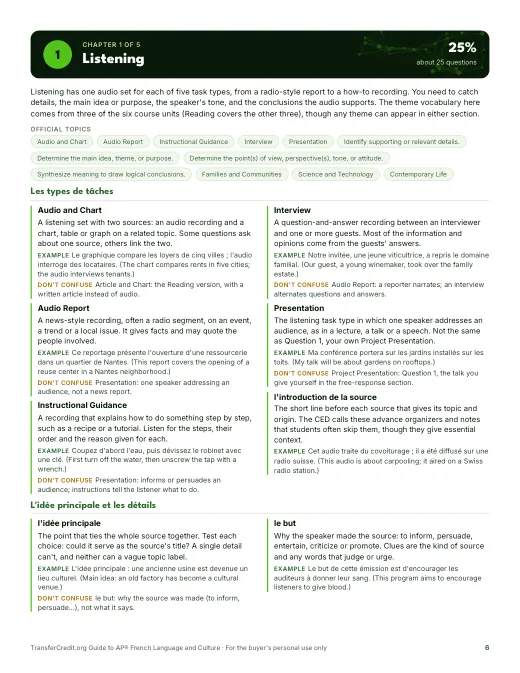
Listening has one audio set for each of five task types, from a radio-style report to a how-to recording. You need to catch details, the main idea or purpose, the speaker's tone, and the conclusions the audio supports. The theme vocabulary here comes from three of the six course units (Reading covers the other three), though any theme can appear in either section.
- Audio and Chart
- A listening set with two sources: an audio recording and a chart, table or graph on a related topic. Some questions ask about one source, others link the two.
- Example: Le graphique compare les loyers de cinq villes ; l'audio interroge des locataires. (The chart compares rents in five cities; the audio interviews tenants.)
- l'idée principale
- The point that ties the whole source together. Test each choice: could it serve as the source's title? A single detail can't, and neither can a vague topic label.
- Example: L'idée principale : une ancienne usine est devenue un lieu culturel. (Main idea: an old factory has become a cultural venue.)
- le point de vue (l'attitude du locuteur)
- What the speaker thinks or feels about the topic: for, against, mixed or unsure. Listen for judging words (heureusement, malheureusement, je regrette) and conditionals that hedge.
- Example: Heureusement, la mairie a enfin écouté les habitants. (Fortunately, city hall finally listened to residents.)
- tirer une conclusion (déduire)
- Putting several statements together to reach a point the speaker supports but doesn't say in so many words. Each part of the conclusion must trace back to something you heard.
- Example: Elle parle de ses « anciens collègues » : on en déduit qu'elle a changé de travail. (She mentions former colleagues: so she has changed jobs.)
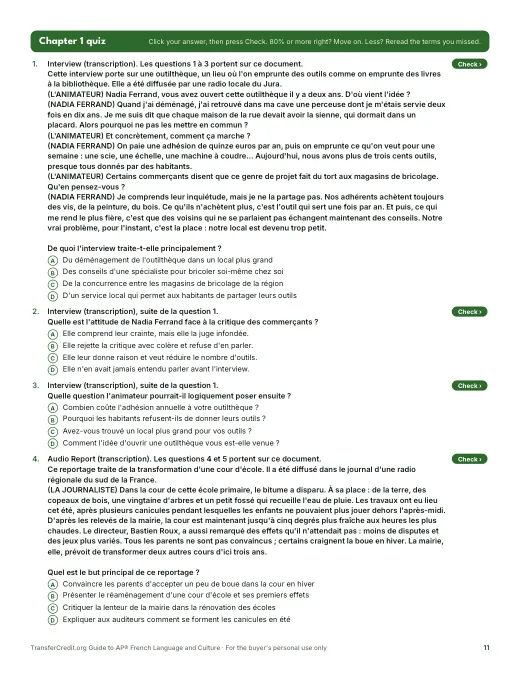
- l'animateur / l'invité
- In an interview or a radio show, l'animateur (l'animatrice) hosts and asks the questions; l'invité(e) is the guest who answers. A journalist can also lead an interview.
- Example: L'animatrice remercie son invité, un apiculteur de la Drôme. (The host thanks her guest, a beekeeper from the Drôme.)
- la famille monoparentale / recomposée
- Une famille monoparentale has one parent raising the children; une famille recomposée (blended family) joins a couple and children from earlier relationships.
- Example: Léa vit avec sa mère, son beau-père et ses demi-frères. (Léa lives with her mother, stepfather and half-brothers.)
- la fracture numérique
- The digital divide: the gap between people who have internet access and digital skills and those who don't, often older, poorer or rural residents.
- Example: Des ateliers gratuits aident les seniors à réduire la fracture numérique. (Free workshops help seniors bridge the digital divide.)
- les loisirs
- Leisure activities: what people do in their free time, such as sports, reading, games and outings. Usually plural in this sense; un loisir is one hobby.
- Example: Le week-end, mes loisirs préférés sont la randonnée et les jeux de société. (On weekends, my favorite pastimes are hiking and board games.)
- Audio Report
- A news-style recording, often a radio segment, on an event, a trend or a local issue. It gives facts and may quote the people involved.
- Example: Ce reportage présente l'ouverture d'une ressourcerie dans un quartier de Nantes. (This report covers the opening of a reuse center in a Nantes neighborhood.)
- le but
- Why the speaker made the source: to inform, persuade, entertain, criticize or promote. Clues are the kind of source and any words that judge or urge.
- Example: Le but de cette émission est d'encourager les auditeurs à donner leur sang. (This program aims to encourage listeners to give blood.)
- un ton enthousiaste
- Eager, excited and positive: lots of praise and exclamations (formidable, génial, quelle réussite !) and plans for more.
- Example: Quelle soirée géniale ! On a déjà hâte de recommencer l'an prochain ! (What a great evening! We can't wait to do it again next year!)
- la question la plus logique pour continuer
- A question type: which question would the interviewer most logically ask next? Choose the one that builds on the speaker's last point and asks something not yet answered.
- Example: Vous dites que le festival a perdu son mécène : comment le financerez-vous ? (You say the festival lost its sponsor: how will you fund it?)