
$5one-time
- 36-page printable PDF
- 186 terms with examples
- 40 practice questions, answers explained
- 2-page cram sheet and study plans
Everything the CLEP Biology exam tests, in one PDF you can print. Built from the College Board's official outline, heaviest topics first.
Last updated 2026 · exam details checked against the College Board's published exam information in 2026
Real pages from the 36-page PDF.
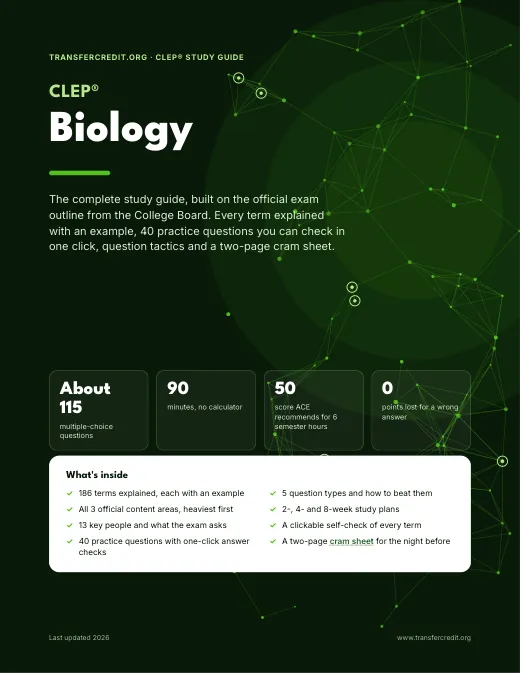
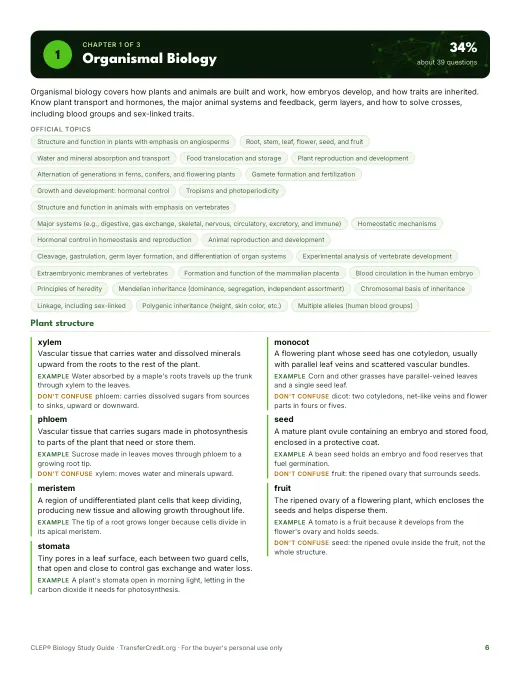
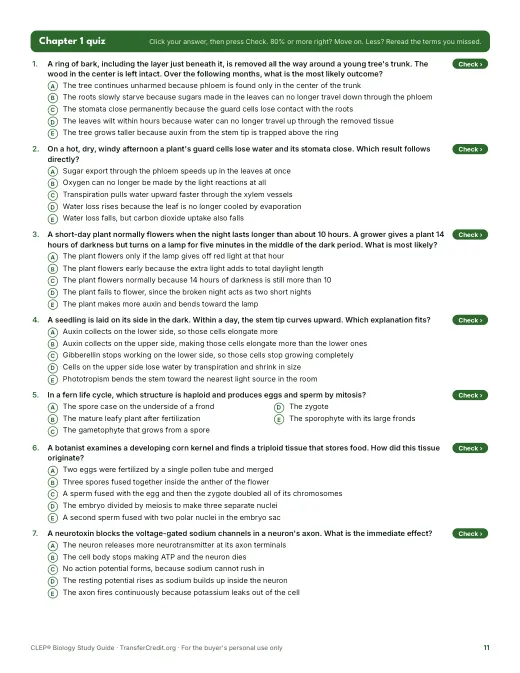
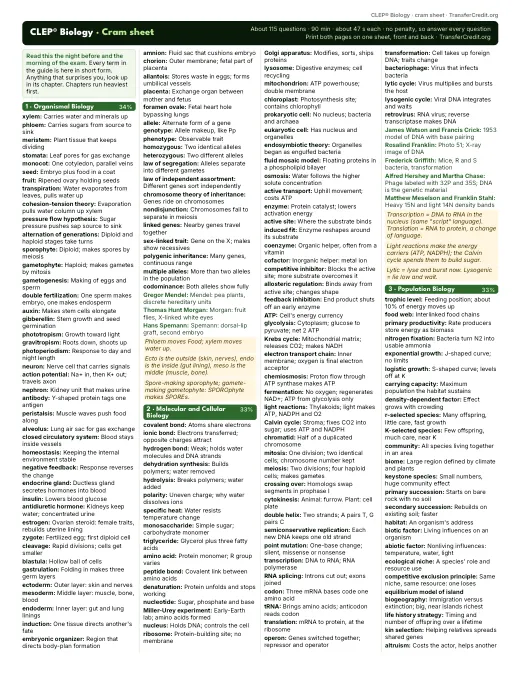
One chapter for each official content area, in the order the exam weighs them.
In the style of the real exam, from all 3 areas. About 10 minutes, with every answer explained and a score by area.
A ring of bark, including the layer just beneath it, is removed all the way around a young tree's trunk. The wood in the center is left intact. Over the following months, what is the most likely outcome?
Answer: A. The roots slowly starve because sugars made in the leaves can no longer travel down through the phloem. Phloem lies in the inner bark, so removing a ring cuts the sugar route to the roots, which eventually starve. The xylem in the central wood still carries water upward.
The trap: Leaves wilting quickly is wrong because xylem, which carries water up, is in the intact wood and is not removed.
Phloem lies in the inner bark, so removing a ring cuts the sugar route to the roots, which eventually starve. The xylem in the central wood still carries water upward.
The trap: Leaves wilting quickly is wrong because xylem, which carries water up, is in the intact wood and is not removed.
A lake stays much cooler than the surrounding land through a hot afternoon. Which property of water best explains this?
Answer: E. Its high specific heat, because hydrogen bonds absorb heat before molecules speed up. Water's high specific heat means it takes a lot of heat to raise its temperature. Much of the heat goes into breaking hydrogen bonds before molecules move faster.
The trap: Cohesion is a real property of water, but it explains surface tension and water movement in plants, not slow warming.
Water's high specific heat means it takes a lot of heat to raise its temperature. Much of the heat goes into breaking hydrogen bonds before molecules move faster.
The trap: Cohesion is a real property of water, but it explains surface tension and water movement in plants, not slow warming.
In a population at Hardy-Weinberg equilibrium, 16% of individuals show a recessive trait. What percentage of the population are heterozygous carriers?
Answer: D. 48%. q squared is 0.16, so q = 0.4 and p = 0.6. Carriers are 2pq = 2 x 0.6 x 0.4 = 0.48, or 48%.
The trap: The 40% choice is q, the frequency of the recessive allele. The question asks for carriers, which is 2pq.
q squared is 0.16, so q = 0.4 and p = 0.6. Carriers are 2pq = 2 x 0.6 x 0.4 = 0.48, or 48%.
The trap: The 40% choice is q, the frequency of the recessive allele. The question asks for carriers, which is 2pq.
On a hot, dry, windy afternoon a plant's guard cells lose water and its stomata close. Which result follows directly?
Answer: C. Water loss falls, but carbon dioxide uptake also falls. Closed stomata reduce transpiration, but the same pores admit carbon dioxide, so photosynthesis slows. It is a trade-off between saving water and taking in CO2.
The trap: Faster water movement in the xylem is wrong because closing stomata reduces the evaporation that drives upward pull.
Closed stomata reduce transpiration, but the same pores admit carbon dioxide, so photosynthesis slows. It is a trade-off between saving water and taking in CO2.
The trap: Faster water movement in the xylem is wrong because closing stomata reduces the evaporation that drives upward pull.
In a cell, the final product of a pathway accumulates, and the first enzyme of that pathway slows down. Which mechanism is this?
Answer: B. Feedback inhibition. The end product shuts off an earlier enzyme, so the cell stops making more than it needs. That is feedback inhibition.
The trap: Denaturation would unfold every enzyme in the pathway, not slow just the first one. Feedback inhibition is a reversible slowdown by a normal cell molecule.
The end product shuts off an earlier enzyme, so the cell stops making more than it needs. That is feedback inhibition.
The trap: Denaturation would unfold every enzyme in the pathway, not slow just the first one. Feedback inhibition is a reversible slowdown by a normal cell molecule.
A field's producers capture 20,000 kJ of energy. If about 10% of the energy passes to each higher trophic level, how much reaches the tertiary consumers?
Answer: C. 20 kJ. Primary consumers get 2,000 kJ, secondary consumers 200 kJ and tertiary consumers 20 kJ. Each step keeps about one tenth.
The trap: The 200 kJ choice is the amount reaching secondary consumers, one level too early.
Primary consumers get 2,000 kJ, secondary consumers 200 kJ and tertiary consumers 20 kJ. Each step keeps about one tenth.
The trap: The 200 kJ choice is the amount reaching secondary consumers, one level too early.
A short-day plant normally flowers when the night lasts longer than about 10 hours. A grower gives a plant 14 hours of darkness but turns on a lamp for five minutes in the middle of the dark period. What is most likely?
Answer: D. The plant fails to flower, since the broken night acts as two short nights. Flowering depends on the length of uninterrupted darkness. A brief flash splits the long night into two short ones, so the plant does not flower.
The trap: Flowering normally because there are still 14 hours of darkness is wrong because the total is irrelevant; the unbroken dark period is what the plant measures.
Flowering depends on the length of uninterrupted darkness. A brief flash splits the long night into two short ones, so the plant does not flower.
The trap: Flowering normally because there are still 14 hours of darkness is wrong because the total is irrelevant; the unbroken dark period is what the plant measures.
A pancreatic cell makes a digestive enzyme that it exports. Which sequence follows the enzyme's path?
Answer: B. Rough ER, then Golgi apparatus, then secretory vesicle. Proteins for export are built on ribosomes attached to the rough ER, modified and sorted at the Golgi, and carried to the membrane in vesicles.
The trap: Starting at the Golgi is tempting because it handles shipping, but the Golgi only receives proteins that ribosomes have already made.
Proteins for export are built on ribosomes attached to the rough ER, modified and sorted at the Golgi, and carried to the membrane in vesicles.
The trap: Starting at the Golgi is tempting because it handles shipping, but the Golgi only receives proteins that ribosomes have already made.
After a severe storm, most sparrows with medium-length wings survived, while those with very short or very long wings mostly died. Which process does this show?
Answer: A. Stabilizing selection. Individuals near the average survived and both extremes were removed. That is stabilizing selection.
The trap: Directional selection would favor one extreme, such as only the longest wings. Here both extremes were lost.
Individuals near the average survived and both extremes were removed. That is stabilizing selection.
The trap: Directional selection would favor one extreme, such as only the longest wings. Here both extremes were lost.
A seedling is laid on its side in the dark. Within a day, the stem tip curves upward. Which explanation fits?
Answer: E. Auxin collects on the lower side, so those cells elongate more. Gravitropism: auxin moves to the lower side of the stem, where it stimulates elongation, pushing the tip upward.
The trap: Phototropism is wrong because the seedling is in the dark, so light cannot be directing the bend.
Gravitropism: auxin moves to the lower side of the stem, where it stimulates elongation, pushing the tip upward.
The trap: Phototropism is wrong because the seedling is in the dark, so light cannot be directing the bend.
The CLEP Biology exam is a 90-minute, computer-based test from the College Board with about 115 multiple-choice questions. A score of 50 on the 20–80 scale earns an ACE credit recommendation of 6 semester hours, though each college sets its own policy. The exam covers 3 content areas; the heaviest is Organismal Biology at 34%.
Source: official CLEP Biology exam page.
3 areas, heaviest first. The guide's chapters follow this order.
Start with the guide, or get everything for CLEP in one plan.
CLEP® is a registered trademark of the College Board, which was not involved in producing this guide and does not endorse it. TransferCredit.org is independent and not affiliated with the College Board. © 2026 UPI Globale Edu Inc.