
$5one-time
- 41-page printable PDF
- 181 terms with examples
- 52 practice questions, answers explained
- 2-page cram sheet and study plans
Everything the CLEP Chemistry exam tests, in one PDF you can print. Built from the College Board's official outline, heaviest topics first.
Last updated 2026 · exam details checked against the College Board's published exam information in 2026
Real pages from the 41-page PDF.

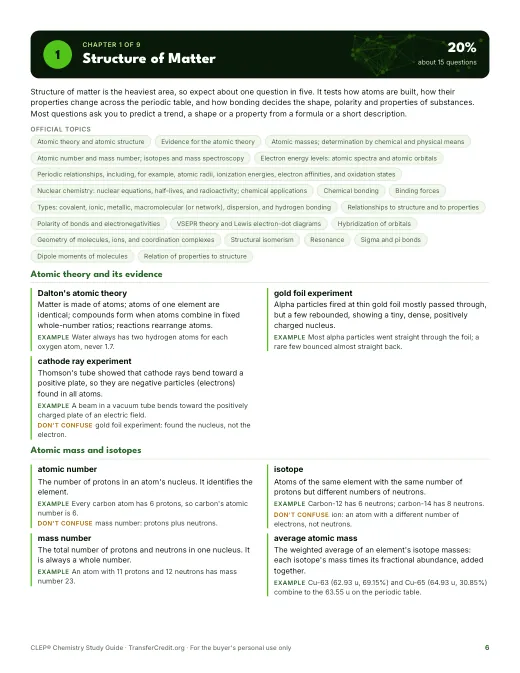
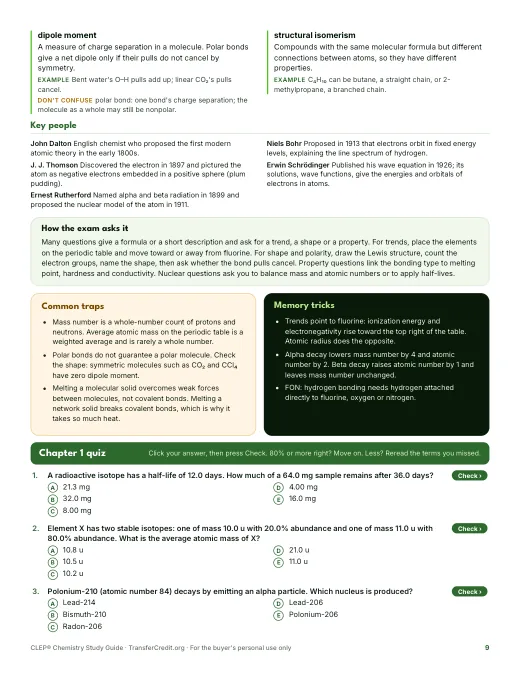
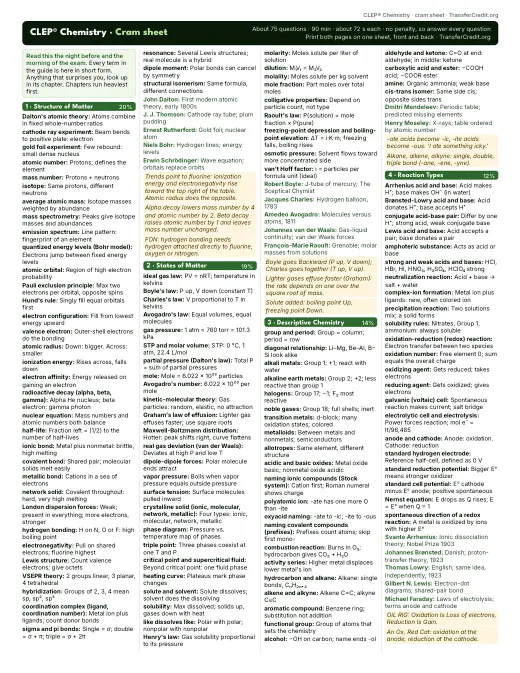
One chapter for each official content area, in the order the exam weighs them.
In the style of the real exam, from all 9 areas. About 10 minutes, with every answer explained and a score by area.
A radioactive isotope has a half-life of 12.0 days. How much of a 64.0 mg sample remains after 36.0 days?
Answer: B. 8.00 mg. 36.0 days is 3 half-lives (36.0 ÷ 12.0), so the sample is halved three times: 64.0 → 32.0 → 16.0 → 8.00 mg.
The trap: 21.3 mg comes from dividing 64.0 by 3, which treats decay as a steady loss. Each half-life halves whatever is left.
36.0 days is 3 half-lives (36.0 ÷ 12.0), so the sample is halved three times: 64.0 → 32.0 → 16.0 → 8.00 mg.
The trap: 21.3 mg comes from dividing 64.0 by 3, which treats decay as a steady loss. Each half-life halves whatever is left.
A rigid 8.21 L tank holds a gas at 2.00 atm and 400 K. How many moles of gas does it contain? (R = 0.08206 L·atm/(mol·K))
Answer: C. 0.500 mol. n = PV/RT = (2.00 × 8.21) / (0.08206 × 400) = 16.42 / 32.82 = 0.500 mol.
The trap: 0.125 mol comes from dividing by the pressure instead of multiplying by it; PV = nRT puts P in the numerator.
n = PV/RT = (2.00 × 8.21) / (0.08206 × 400) = 16.42 / 32.82 = 0.500 mol.
The trap: 0.125 mol comes from dividing by the pressure instead of multiplying by it; PV = nRT puts P in the numerator.
What is the name of the compound Fe₂(SO₄)₃?
Answer: D. Iron(III) sulfate. Three sulfate ions (2− each) total 6−, shared by two iron ions, so each iron is 3+. The name is iron(III) sulfate.
The trap: Iron(II) sulfate mistakes the subscript 2 on iron for its charge; the charge comes from balancing three sulfate ions.
Three sulfate ions (2− each) total 6−, shared by two iron ions, so each iron is 3+. The name is iron(III) sulfate.
The trap: Iron(II) sulfate mistakes the subscript 2 on iron for its charge; the charge comes from balancing three sulfate ions.
In the equilibrium HCO₃⁻ + H₂O ⇌ H₂CO₃ + OH⁻, which species is the conjugate acid of HCO₃⁻?
Answer: A. H₂CO₃. HCO₃⁻ acts as a base here by accepting a proton from water. The conjugate acid is the base plus one proton, which is H₂CO₃.
The trap: CO₃²⁻ is the conjugate base of HCO₃⁻, one proton fewer, not its conjugate acid.
HCO₃⁻ acts as a base here by accepting a proton from water. The conjugate acid is the base plus one proton, which is H₂CO₃.
The trap: CO₃²⁻ is the conjugate base of HCO₃⁻, one proton fewer, not its conjugate acid.
N₂ + 3H₂ → 2NH₃. A mixture of 28.0 g N₂ and 8.00 g H₂ reacts until one reactant runs out. What is the maximum mass of NH₃? (Molar masses: N₂ 28.0, H₂ 2.02, NH₃ 17.0 g/mol.)
Answer: E. 34.0 g. 28.0 g N₂ is 1.00 mol and would need 3.00 mol H₂. The 8.00 g of H₂ is 3.96 mol, so N₂ is limiting. 1.00 mol N₂ gives 2.00 mol NH₃ × 17.0 g/mol = 34.0 g.
The trap: 44.9 g is based on hydrogen as if it were limiting. It would need more nitrogen than the mixture contains.
28.0 g N₂ is 1.00 mol and would need 3.00 mol H₂. The 8.00 g of H₂ is 3.96 mol, so N₂ is limiting. 1.00 mol N₂ gives 2.00 mol NH₃ × 17.0 g/mol = 34.0 g.
The trap: 44.9 g is based on hydrogen as if it were limiting. It would need more nitrogen than the mixture contains.
A 0.5106 g sample of potassium hydrogen phthalate (KHP, KHC₈H₄O₄, 204.22 g/mol) is titrated with NaOH, and 25.00 mL of base reaches the endpoint. What is the molarity of the NaOH?
Answer: B. 0.1000 M. Moles KHP = 0.5106 g / 204.22 g/mol = 0.002500 mol. KHP has one acidic hydrogen, so it reacts 1:1 with NaOH. M = 0.002500 mol / 0.02500 L = 0.1000 M.
The trap: 0.2000 M assumes each KHP gives two H⁺, but only the one carboxylic acid hydrogen in KHC₈H₄O₄ is acidic.
Moles KHP = 0.5106 g / 204.22 g/mol = 0.002500 mol. KHP has one acidic hydrogen, so it reacts 1:1 with NaOH. M = 0.002500 mol / 0.02500 L = 0.1000 M.
The trap: 0.2000 M assumes each KHP gives two H⁺, but only the one carboxylic acid hydrogen in KHC₈H₄O₄ is acidic.
For 2SO₂(g) + O₂(g) ⇌ 2SO₃(g), the forward reaction is exothermic. Which change shifts the equilibrium toward more SO₃?
Answer: D. Decreasing the container volume. The reactants are 3 mol of gas and the product is 2 mol. A smaller volume raises the pressure, and the system shifts toward fewer gas moles, which means more SO₃.
The trap: Raising the temperature favors the endothermic direction. Here that is the reverse reaction, so SO₃ would decrease.
The reactants are 3 mol of gas and the product is 2 mol. A smaller volume raises the pressure, and the system shifts toward fewer gas moles, which means more SO₃.
The trap: Raising the temperature favors the endothermic direction. Here that is the reverse reaction, so SO₃ would decrease.
N₂(g) + O₂(g) → 2 NO(g) has ΔH = +180.5 kJ. 2 NO(g) + O₂(g) → 2 NO₂(g) has ΔH = −114.1 kJ. What is ΔH for N₂(g) + 2 O₂(g) → 2 NO₂(g)?
Answer: E. +66.4 kJ. Adding the two steps cancels 2 NO and gives the overall equation. ΔH = +180.5 + (−114.1) = +66.4 kJ.
The trap: +294.6 kJ comes from adding the magnitudes and dropping the negative sign of the second step.
Adding the two steps cancels 2 NO and gives the overall equation. ΔH = +180.5 + (−114.1) = +66.4 kJ.
The trap: +294.6 kJ comes from adding the magnitudes and dropping the negative sign of the second step.
Initial rates were measured for A + B → products. Run 1: [A] = 0.10 M, [B] = 0.10 M, rate = 2.0 × 10⁻³ M/s. Run 2: [A] = 0.20 M, [B] = 0.10 M, rate = 8.0 × 10⁻³ M/s. Run 3: [A] = 0.20 M, [B] = 0.30 M, rate = 2.4 × 10⁻² M/s. What is the rate law?
Answer: C. rate = k[A]²[B]. From run 1 to 2, [A] doubles and the rate quadruples, so second order in A. From run 2 to 3, [B] triples and the rate triples, so first order in B.
The trap: rate = k[A][B] would fit only if doubling [A] doubled the rate; the data show it quadrupled.
From run 1 to 2, [A] doubles and the rate quadruples, so second order in A. From run 2 to 3, [B] triples and the rate triples, so first order in B.
The trap: rate = k[A][B] would fit only if doubling [A] doubled the rate; the data show it quadrupled.
Element X has two stable isotopes: one of mass 10.0 u with 20.0% abundance and one of mass 11.0 u with 80.0% abundance. What is the average atomic mass of X?
Answer: A. 10.8 u. (10.0 × 0.200) + (11.0 × 0.800) = 2.00 + 8.80 = 10.8 u. The heavier isotope is more abundant, so the average lies closer to 11.0.
The trap: 10.5 u is the simple average of 10.0 and 11.0. It ignores the abundances, which must weight each mass.
(10.0 × 0.200) + (11.0 × 0.800) = 2.00 + 8.80 = 10.8 u. The heavier isotope is more abundant, so the average lies closer to 11.0.
The trap: 10.5 u is the simple average of 10.0 and 11.0. It ignores the abundances, which must weight each mass.
The CLEP Chemistry exam is a 90-minute, computer-based test from the College Board with about 75 multiple-choice questions. A score of 50 on the 20–80 scale earns an ACE credit recommendation of 6 semester hours, though each college sets its own policy. The exam covers 9 content areas; the heaviest is Structure of Matter at 20%.
Source: official CLEP Chemistry exam page.
9 areas, heaviest first. The guide's chapters follow this order.
Start with the guide, or get everything for CLEP in one plan.
CLEP® is a registered trademark of the College Board, which was not involved in producing this guide and does not endorse it. TransferCredit.org is independent and not affiliated with the College Board. © 2026 UPI Globale Edu Inc.