
$5one-time
- 34-page printable PDF
- 180 terms with examples
- 43 practice questions, answers explained
- 2-page cram sheet and study plans
Everything the CLEP College Mathematics exam tests, in one PDF you can print. Built from the College Board's official outline, heaviest topics first.
Last updated 2026 · exam details checked against the College Board's published exam information in 2026
Real pages from the 34-page PDF.
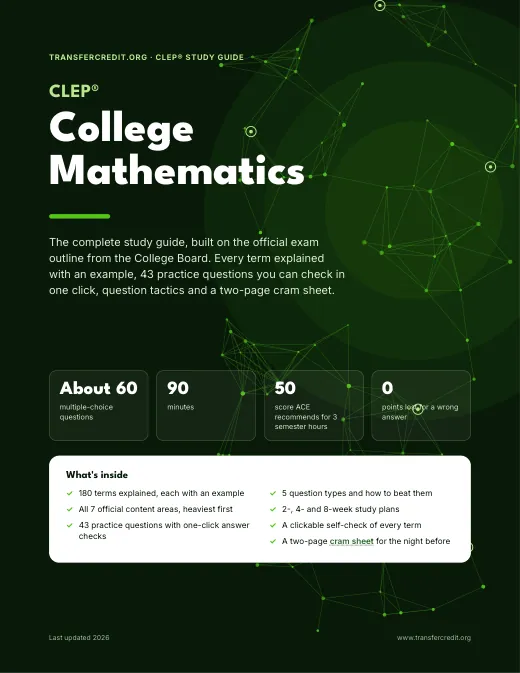
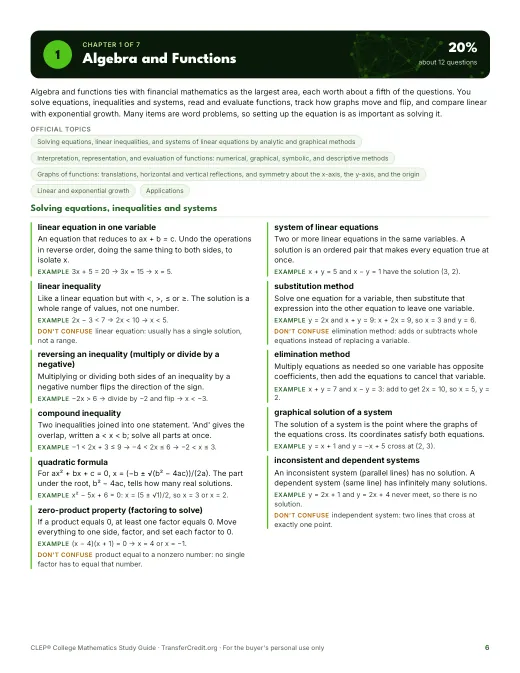
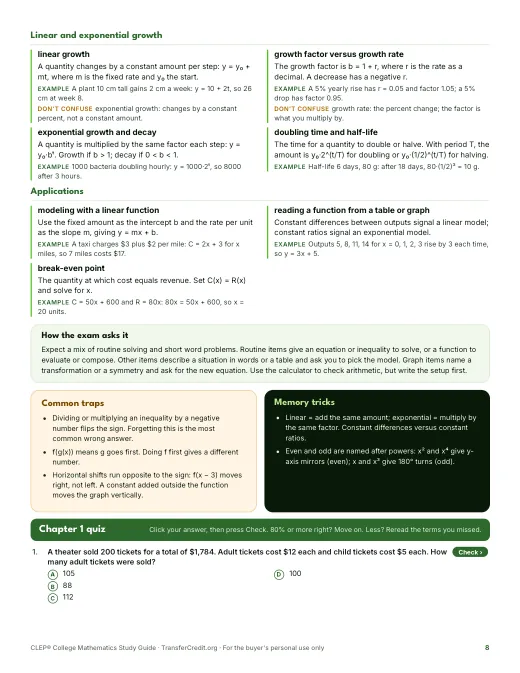
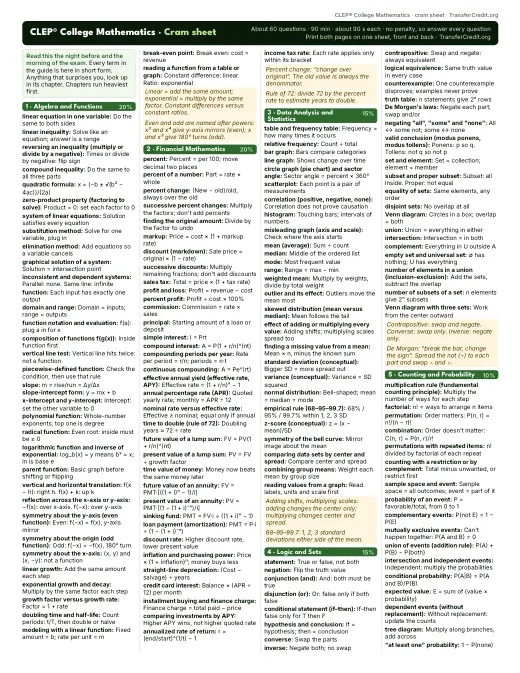
One chapter for each official content area, in the order the exam weighs them.
In the style of the real exam, from all 7 areas. About 15 minutes, with every answer explained and a score by area.
A theater sold 200 tickets for a total of $1,784. Adult tickets cost $12 each and child tickets cost $5 each. How many adult tickets were sold?
Answer: B. 112. Let a + c = 200 and 12a + 5c = 1,784. Substituting c = 200 − a gives 7a + 1,000 = 1,784, so a = 112 adult tickets. Check: 12(112) + 5(88) = 1,344 + 440 = 1,784.
The trap: 88 is the number of child tickets, which answers a different question. 105 comes from dividing the total by the sum of the prices, which ignores the 200-ticket count.
Let a + c = 200 and 12a + 5c = 1,784. Substituting c = 200 − a gives 7a + 1,000 = 1,784, so a = 112 adult tickets. Check: 12(112) + 5(88) = 1,344 + 440 = 1,784.
The trap: 88 is the number of child tickets, which answers a different question. 105 comes from dividing the total by the sum of the prices, which ignores the 200-ticket count.
A share's price rises 15% one year and then falls 15% the next year. Compared with the start, the price is
Answer: A. 2.25% lower. Multiply the factors: 1.15 × 0.85 = 0.9775, which is 2.25% below the start.
The trap: Unchanged is tempting because +15% and −15% look like they cancel, but the 15% decrease applies to the larger, increased amount.
Multiply the factors: 1.15 × 0.85 = 0.9775, which is 2.25% below the start.
The trap: Unchanged is tempting because +15% and −15% look like they cancel, but the 15% decrease applies to the larger, increased amount.
Every value in a data set is multiplied by 2 and then increased by 5. The original set had mean 12, median 11 and range 9. Which describes the new set?
Answer: C. Mean 29, median 27, range 18. Multiply then add: mean 2(12) + 5 = 29 and median 2(11) + 5 = 27. The added 5 does not change spread, but multiplying by 2 doubles it: range 18.
The trap: Range 23 applies both operations to the range. Adding a constant shifts every value equally, so the gap between largest and smallest does not change.
Multiply then add: mean 2(12) + 5 = 29 and median 2(11) + 5 = 27. The added 5 does not change spread, but multiplying by 2 doubles it: range 18.
The trap: Range 23 applies both operations to the range. Adding a constant shifts every value equally, so the gap between largest and smallest does not change.
A professor says: "If a student passes the final, then the student earns credit." Which statement is logically equivalent to it?
Answer: D. If a student does not earn credit, then the student did not pass the final.. The contrapositive swaps and negates both parts, so it always has the same truth value as the original.
The trap: "If a student earns credit, then the student passed the final" is the converse, which can be false (credit might come another way).
The contrapositive swaps and negates both parts, so it always has the same truth value as the original.
The trap: "If a student earns credit, then the student passed the final" is the converse, which can be false (credit might come another way).
A password has 3 different letters from A–Z, followed by 2 digits, where the digits may repeat. How many passwords are possible?
Answer: C. 1,560,000. Letters cannot repeat: 26 · 25 · 24 = 15,600. Digits may repeat: 10 · 10 = 100. By the multiplication rule, 15,600 · 100 = 1,560,000.
The trap: 1,757,600 lets letters repeat (26³ · 100), but the stem says the letters are different. 260,000 uses a combination for the letters, treating their order as unimportant.
Letters cannot repeat: 26 · 25 · 24 = 15,600. Digits may repeat: 10 · 10 = 100. By the multiplication rule, 15,600 · 100 = 1,560,000.
The trap: 1,757,600 lets letters repeat (26³ · 100), but the stem says the letters are different. 260,000 uses a combination for the letters, treating their order as unimportant.
A 13-foot ladder leans against a wall with its base 5 feet from the wall. How high up the wall does the ladder reach?
Answer: D. 12 feet. The ladder is the hypotenuse: height = √(13² − 5²) = √144 = 12 feet.
The trap: 8 feet subtracts the lengths (13 − 5); sides of a right triangle are related through their squares.
The ladder is the hypotenuse: height = √(13² − 5²) = √144 = 12 feet.
The trap: 8 feet subtracts the lengths (13 − 5); sides of a right triangle are related through their squares.
Which of the following numbers is irrational?
Answer: B. √20. 20 is not a perfect square, so √20 ≈ 4.4721… has a decimal that never ends or repeats. The others are rational: √0.25 = 0.5, the repeating decimal equals 4/33, and 22/7 is a fraction.
The trap: 22/7 is tempting because it approximates π. But it is a quotient of integers, so it is rational.
20 is not a perfect square, so √20 ≈ 4.4721… has a decimal that never ends or repeats. The others are rational: √0.25 = 0.5, the repeating decimal equals 4/33, and 22/7 is a fraction.
The trap: 22/7 is tempting because it approximates π. But it is a quotient of integers, so it is rational.
Which of the following is the solution set of −3(x − 2) ≥ 12?
Answer: A. x ≤ −2. Distribute: −3x + 6 ≥ 12, so −3x ≥ 6. Dividing by −3 reverses the inequality, giving x ≤ −2.
The trap: x ≥ −2 results from dividing by −3 without reversing the inequality sign.
Distribute: −3x + 6 ≥ 12, so −3x ≥ 6. Dividing by −3 reverses the inequality, giving x ≤ −2.
The trap: x ≥ −2 results from dividing by −3 without reversing the inequality sign.
A shop buys a lamp for $80 and marks it up 40% of cost. In a sale it sells the lamp for 25% off the marked price. What is the sale price?
Answer: C. $84.00. The marked price is 80 × 1.40 = $112. The sale price is 112 × 0.75 = $84.
The trap: $92.00 nets the percents (40% − 25% = 15% over cost), but the 25% discount applies to the marked price, not to cost.
The marked price is 80 × 1.40 = $112. The sale price is 112 × 0.75 = $84.
The trap: $92.00 nets the percents (40% − 25% = 15% over cost), but the 25% discount applies to the marked price, not to cost.
A circle graph shows how 480 students are divided among majors. The Science sector has a central angle of 90°. How many students are in Science?
Answer: D. 120. The sector is 90°/360° = 1/4 of the circle, and 1/4 of 480 = 120 students.
The trap: 432 treats 90° as 90%, taking 90% of 480. The angle is out of 360°, not out of 100.
The sector is 90°/360° = 1/4 of the circle, and 1/4 of 480 = 120 students.
The trap: 432 treats 90° as 90%, taking 90% of 480. The angle is out of 360°, not out of 100.
The CLEP College Mathematics exam is a 90-minute, computer-based test from the College Board with about 60 multiple-choice questions. A score of 50 on the 20–80 scale earns an ACE credit recommendation of 3 semester hours, though each college sets its own policy. The exam covers 7 content areas; the heaviest is Algebra and Functions at 20%.
7 areas, heaviest first. The guide's chapters follow this order.
Start with the guide, or get everything for CLEP in one plan.
CLEP® is a registered trademark of the College Board, which was not involved in producing this guide and does not endorse it. TransferCredit.org is independent and not affiliated with the College Board. © 2026 UPI Globale Edu Inc.