← CLEP Precalculus course
CLEP® Study Guide Printable PDF · 34 pages

CLEP Precalculus Study Guide

Everything the CLEP Precalculus exam tests, in one PDF you can print. Built from the College Board's official outline, heaviest topics first.

  • 182 key terms, each with an example
  • 42 practice questions with every answer explained
  • A 2-page cram sheet for the night before
  • 2-, 4- and 8-week study plans built from the exam weights
Not sure yet? Try 10 free questions

Last updated 2026 · exam details checked against the College Board's published exam information in 2026

Look inside the guide

Real pages from the 34-page PDF.

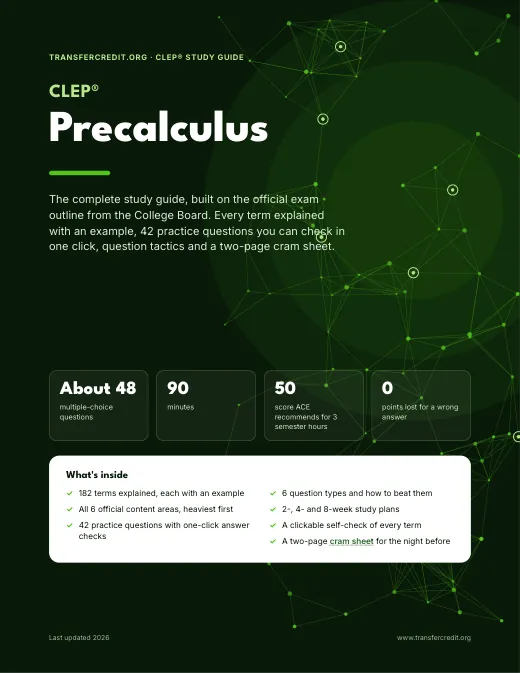
Page 1 of the CLEP Precalculus Study Guide: the cover
Page 1 The cover
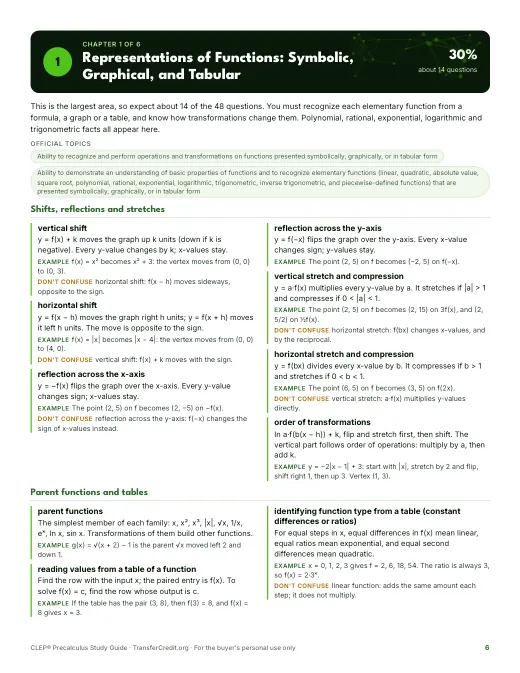
Page 6 of the CLEP Precalculus Study Guide: the Chapter 1 opener
Page 6 The Chapter 1 opener
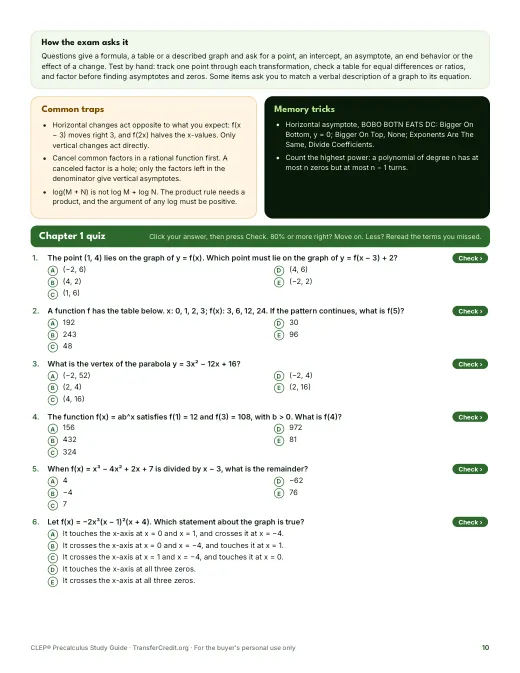
Page 10 of the CLEP Precalculus Study Guide: a chapter quiz
Page 10 A chapter quiz
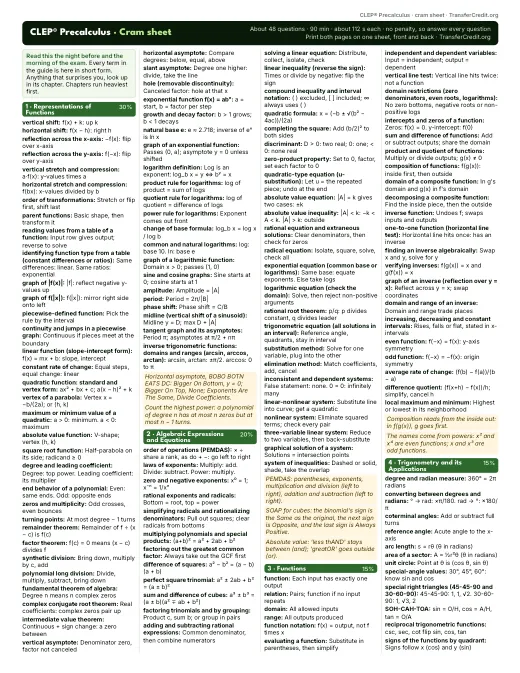
Page 33 of the CLEP Precalculus Study Guide: the 2-page cram sheet
Page 33 The 2-page cram sheet

What you get for $5

One chapter for each official content area, in the order the exam weighs them.

  • 📘34pages, printable
  • 🧭6chapters, heaviest first
  • 🔑182terms with examples
  • ✍️42practice questions, answers explained
  • ⚠️18exam traps to avoid
  • 📄2page cram sheet

Try 10 free Precalculus questions

In the style of the real exam, from all 6 areas. About 20 minutes, with every answer explained and a score by area.

10 questions  
  1. Question 1 · Representations of Functions: Symbolic, Graphical, and Tabular

    The point (1, 4) lies on the graph of y = f(x). Which point must lie on the graph of y = f(x − 3) + 2?

    Show the answer

    Answer: A. (4, 6). Replacing x with x − 3 moves the graph right 3, so x goes from 1 to 4. The + 2 outside moves it up 2, so y goes from 4 to 6.

    The trap: (−2, 6) is tempting because x − 3 looks like subtracting 3 from the x-value. Inside changes act opposite: x − 3 shifts right.

  2. Question 2 · Algebraic Expressions, Equations, and Inequalities

    For which positive value of k does x² + kx + 9 = 0 have exactly one real solution?

    Show the answer

    Answer: C. 6. One repeated real root needs a discriminant of 0: k² − 4(1)(9) = 0, so k² = 36 and k = 6 (the positive value).

    The trap: The choice 36 is k², the value you get just before taking the square root. The equation asks for k itself.

  3. Question 3 · Functions: Concept, Properties, and Operations

    What is the domain of g(x) = ln(4 − x)/(x + 2)?

    Show the answer

    Answer: B. (−∞, −2) ∪ (−2, 4). The logarithm needs 4 − x > 0, so x < 4. The denominator needs x ≠ −2. Together the domain is all x < 4 except −2.

    The trap: The interval (−∞, 4) respects the logarithm but forgets that x = −2 makes the denominator zero.

  4. Question 4 · Trigonometry and its Applications

    What is the exact value of cos(7π/6)?

    Show the answer

    Answer: E. −√3/2. 7π/6 is 210°, in quadrant III, with reference angle π/6. Cosine there is negative, and cos π/6 = √3/2, so the value is −√3/2.

    The trap: −1/2 uses the right sign but swaps the special values: cos π/6 is √3/2, while 1/2 is cos π/3.

  5. Question 5 · Analytic Geometry

    The circle x² + y² − 8x + 6y + 9 = 0 has which center and radius?

    Show the answer

    Answer: D. Center (4, −3), radius 4. Complete the squares: (x − 4)² + (y + 3)² = −9 + 16 + 9 = 16. The center is (4, −3) and the radius is √16 = 4.

    The trap: Radius 5 comes from adding 16 and 9 but forgetting to move the constant 9 to the other side. Radius 16 forgets the square root.

  6. Question 6 · Functions as Models

    A company's cost is C = 12x + 900 dollars and its revenue is R = 30x dollars for x units. How many units are needed to break even?

    Show the answer

    Answer: A. 50. Break even when C = R: 12x + 900 = 30x, so 900 = 18x and x = 50 units.

    The trap: The value 75 comes from dividing 900 by the cost per unit, 12. Revenue must be subtracted first: 30 − 12 = 18 dollars of profit per unit.

  7. Question 7 · Representations of Functions: Symbolic, Graphical, and Tabular

    A function f has the table below. x: 0, 1, 2, 3; f(x): 3, 6, 12, 24. If the pattern continues, what is f(5)?

    Show the answer

    Answer: B. 96. The outputs double each time, so f(x) = 3·2ˣ. Then f(5) = 3·32 = 96.

    The trap: 48 is f(4), one step short. The table is exponential with ratio 2; 48 comes from stopping a step early.

  8. Question 8 · Algebraic Expressions, Equations, and Inequalities

    Which set is the solution of |2x − 3| ≥ 7?

    Show the answer

    Answer: C. x ≤ −2 or x ≥ 5. Greater-than-or-equal splits into two outside cases: 2x − 3 ≥ 7 gives x ≥ 5, and 2x − 3 ≤ −7 gives x ≤ −2.

    The trap: The between-interval −2 ≤ x ≤ 5 uses the right endpoints but the wrong shape. A 'greater than' absolute value inequality is satisfied outside them.

  9. Question 9 · Functions: Concept, Properties, and Operations

    Let f(x) = 3x − 1 and g(x) = x² + 2. What is g(f(2))?

    Show the answer

    Answer: E. 27. Work inside out: f(2) = 3(2) − 1 = 5, then g(5) = 25 + 2 = 27.

    The trap: The choice 17 is f(g(2)), the composition in the opposite order. Here f is applied first.

  10. Question 10 · Trigonometry and its Applications

    A circle has radius 12 cm. What is the length of the arc cut off by a central angle of 150°?

    Show the answer

    Answer: D. 10π cm. Convert: 150° = 5π/6 radians. Then s = rθ = 12·5π/6 = 10π cm.

    The trap: 1800 comes from multiplying 12 by 150 directly. The formula s = rθ requires radians, so the degrees must be converted first.

The CLEP Precalculus exam at a glance

The CLEP Precalculus exam is a computer-based test from the College Board. The exam has approximately 48 questions in two sections, to be answered in approximately 90 minutes. A score of 50 on the 20–80 scale earns an ACE credit recommendation of 3 semester hours, though each college sets its own policy. The exam covers 6 content areas; the heaviest is Representations of Functions: Symbolic, Graphical, and Tabular at 30%.

Questions
About 48mostly multiple choice
Time
90 minseparately timed sections
Passing score
50on a 20–80 scale
ACE credit
3semester hours
Exam fee
$97paid to College Board
Calculator
Section 1 onlyon-screen graphing calculator

Source: official CLEP Precalculus exam page.

What the exam covers

6 areas, heaviest first. The guide's chapters follow this order.

  1. Representations of Functions: Symbolic, Graphical, and Tabular30%
  2. Algebraic Expressions, Equations, and Inequalities20%
  3. Functions: Concept, Properties, and Operations15%
  4. Trigonometry and its Applications15%
  5. Analytic Geometry10%
  6. Functions as Models10%

How it works

  1. 1Buy once, $5Secure checkout. No subscription needed.
  2. 2Download the PDFFrom your TransferCredit.org account, right away and any time later.
  3. 3Study the heaviest areas firstFollow the 2-, 4- or 8-week plan, then read the cram sheet the night before.

Questions students ask

What's in the full CLEP Precalculus study guide?
34 pages: 6 chapters, one per official content area, heaviest first. 182 terms, each with a plain-English definition and an example, common traps and memory tricks, 42 practice questions with an answer key that explains every answer, question tactics, 2-, 4- and 8-week study plans and a 2-page cram sheet.
How much is the full CLEP Precalculus study guide?
The full 34-page PDF is $5, a one-time payment. The 10 practice questions on this page are free, with no account.
What does the $29 plan include?
$29 a month gives you all 28 CLEP subjects: every CLEP study guide plus the full prep course for each subject, and you can cancel anytime. If you only need this exam, the guide on its own is a one-time $5.
How do I get the full guide?
Choose Buy this guide ($5) and check out. Then sign in to your TransferCredit.org account, then open the course and its Download Your Study Guide lesson. The PDF is yours to keep, and you can download it again from your account at any time.
Can I print the guide or use it on my phone?
Yes. It's a PDF, so it opens on phones, tablets and computers, and printing is allowed. Its tick boxes and answer bubbles work in PDF readers that support forms. Copying and editing are turned off.
Is this an official CLEP study guide?
No. CLEP® is a registered trademark of the College Board, which was not involved in producing this guide and does not endorse it. TransferCredit.org is independent. We built the guide from the official exam outline, and the exam details were checked against the College Board's published exam information in 2026.
Why is this study guide better than a generic review?
It follows the official outline area by area and spends the most pages on what the exam weighs most. Every term comes with an example, each chapter names the traps the exam sets, and the answer key explains why the most tempting wrong answer is wrong, not just which answer is right. It ends with a 2-page cram sheet for the night before.
What is the CLEP Precalculus exam?
The CLEP Precalculus exam is a computer-based test from the College Board. The exam has approximately 48 questions in two sections, to be answered in approximately 90 minutes. A score of 50 on the 20–80 scale earns an ACE credit recommendation of 3 semester hours, though each college sets its own policy. The exam covers 6 content areas; the heaviest is Representations of Functions: Symbolic, Graphical, and Tabular at 30%.
More questions about the CLEP Precalculus exam (22)
How many questions are on the CLEP Precalculus exam, and how long is it?
The exam has approximately 48 questions in two sections, to be answered in approximately 90 minutes. Section 1 has 25 questions in about 50 minutes and allows an online graphing calculator (non-CAS), the TI-84 Plus CE; only some questions require it. Section 2 has 23 questions in about 40 minutes and allows no calculator.
What is the passing score for CLEP Precalculus?
The passing score is 50 on a 20–80 scale. At 50 or above, the American Council on Education (ACE) recommends 3 semester hours. Each college sets its own passing score and credit award, so check your school's policy before you book.
How much does the CLEP Precalculus exam cost?
The exam fee is $97, paid to the College Board. Test centers may add their own administration fee. Eligible U.S. military service members can usually test for free through DANTES.
How many college credits is CLEP Precalculus worth?
ACE recommends 3 semester hours for a passing score of 50. Your college decides how many credits it awards and which course they replace. Check your college's policy.
Can I use a calculator on the CLEP Precalculus exam?
Section 1 has 25 questions in about 50 minutes and allows an online graphing calculator (non-CAS), the TI-84 Plus CE; only some questions require it.
Is there a penalty for guessing on CLEP Precalculus?
No. Your score counts only correct answers, so a wrong answer costs nothing. Never leave a question blank: rule out what you can and pick your best guess.
What topics are on the CLEP Precalculus exam?
6 content areas, from the official outline: Representations of Functions: Symbolic, Graphical, and Tabular (30%); Algebraic Expressions, Equations, and Inequalities (20%); Functions: Concept, Properties, and Operations (15%); Trigonometry and its Applications (15%); Analytic Geometry (10%); Functions as Models (10%).
Which CLEP Precalculus topics should I study first?
Start with the three heaviest: Representations of Functions: Symbolic, Graphical, and Tabular (30%), Algebraic Expressions, Equations, and Inequalities (20%) and Functions: Concept, Properties, and Operations (15%). Together they are about 65% of the exam, roughly 31 of 48 questions. The guide's chapters run in that order, heaviest first.
Is the CLEP Precalculus exam hard?
It depends on what you already know. A few big areas decide most of your score: Representations of Functions: Symbolic, Graphical, and Tabular alone is 30% of the exam, while Functions as Models is 10%. Take the free diagnostic above to see where you stand in about 20 minutes.
What kinds of questions are on the CLEP Precalculus exam?
The guide sorts them into 6 types: “Solve and select”, “Transform a graph or formula”, “Operate on functions”, “Build or read a model”, “Reason through a nonroutine problem” and “Read a property off a graph”. Multiple-choice questions have 5 answer choices, and some items use other formats. Try the 10 free questions above to see the style.
How long should I study for CLEP Precalculus?
Use the diagnostic to decide. If you already know most areas, two weeks of daily review is often enough; if the subject is new to you, plan on eight. The full guide has 2-, 4- and 8-week plans built from the exam weights.
How should I pace myself on the CLEP Precalculus exam?
On average you have about 2 minutes per question (90 minutes for 48 questions). The sections are timed separately, so pace each one on its own: divide its minutes by its questions and check your place halfway through. If a question takes more than about 4 minutes, pick your best guess, mark it and come back.
What happens if I don't pass CLEP Precalculus?
You can retake a CLEP exam after three months. Use the wait to work through the areas the score report and the diagnostic show you missed.
Do colleges accept CLEP Precalculus for credit?
CLEP exams are accepted at more than 2,900 U.S. colleges and universities, but each school decides which exams it accepts, the score it requires and the credit it gives. Look up your college's CLEP policy before you book.
How is the guide different from the CLEP Precalculus course?
The guide is a 34-page PDF for review and self-testing. The CLEP Precalculus course is a full online course with lessons, quizzes and a practice exam, for $19 with lifetime access. Many students use the guide first, then take the course for the areas the diagnostic flags.
How up to date is this CLEP Precalculus guide?
Last updated 2026. The exam details were checked against the College Board's published exam information in 2026. Exams change, so confirm the details on the official exam page before you register.
What should I do the night before the exam?
Read the cram sheet once, slowly. Check your test time, the location or remote-proctoring setup, and the ID you need. Then sleep: a rested brain recalls more than a crammed one. In the morning, skim the memory tricks and common traps, then stop studying.
Do I need to memorize the unit circle for CLEP Precalculus?
Yes. Section 2's 23 questions allow no calculator, so you need exact trig values for angles such as π/6, π/4 and π/3 and the basic identities by heart. The built-in TI-84 Plus CE in Section 1 can compute trig values, but you won't have it in Section 2.
Does CLEP Precalculus include conic sections?
Yes. Analytic geometry is 10% of the exam and covers lines, circles, parabolas, ellipses and hyperbolas, so know each conic's standard equation and how to read its center, vertices or radius from it.
How much trigonometry is on CLEP Precalculus?
More than the 15% trigonometry area suggests. The College Board says trigonometry permeates most topics, and about 30–40% of questions require right-triangle trigonometry or the properties of trigonometric functions.
Should I take CLEP College Algebra or Precalculus?
Check which your program requires. College Algebra is narrower and has a calculator throughout; Precalculus adds trigonometry and analytic geometry and prepares you for calculus. Some programs accept either for a general math requirement.
Are there fill-in questions on CLEP Precalculus?
Yes. Most questions are multiple choice, but some ask you to enter a numerical answer, so you can't rely on working backward from the choices.

Choose how you want to study

Start with the guide, or get everything for CLEP in one plan.

This study guide
$5one-time
  • 34-page printable PDF
  • 182 terms with examples
  • 42 practice questions, answers explained
  • 2-page cram sheet and study plans
Get the guide · $5
Best value Get it all
$29/month
  • Every CLEP study guide
  • Prep courses for all 28 CLEP subjects
  • Cancel anytime
Get it all · $29/mo

CLEP® is a registered trademark of the College Board, which was not involved in producing this guide and does not endorse it. TransferCredit.org is independent and not affiliated with the College Board. © 2026 UPI Globale Edu Inc.