
$5one-time
- 29-page printable PDF
- 181 terms with examples
- 40 practice questions, answers explained
- 2-page cram sheet and study plans
Everything the CLEP College Algebra exam tests, in one PDF you can print. Built from the College Board's official outline, heaviest topics first.
Last updated 2026 · exam details checked against the College Board's published exam information in 2026
Real pages from the 29-page PDF.

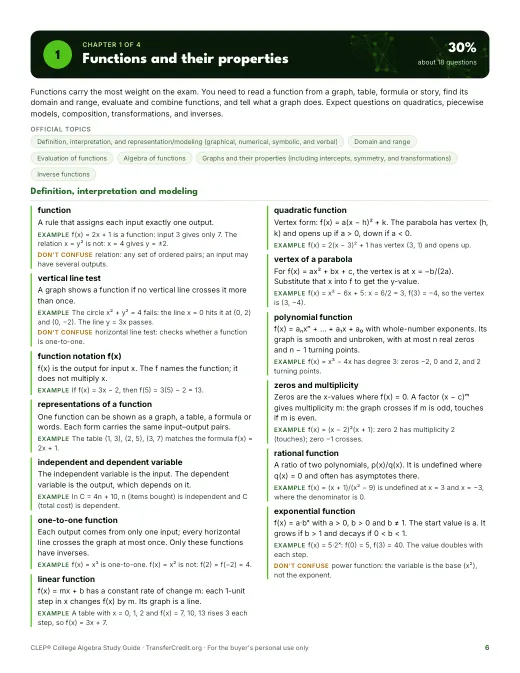
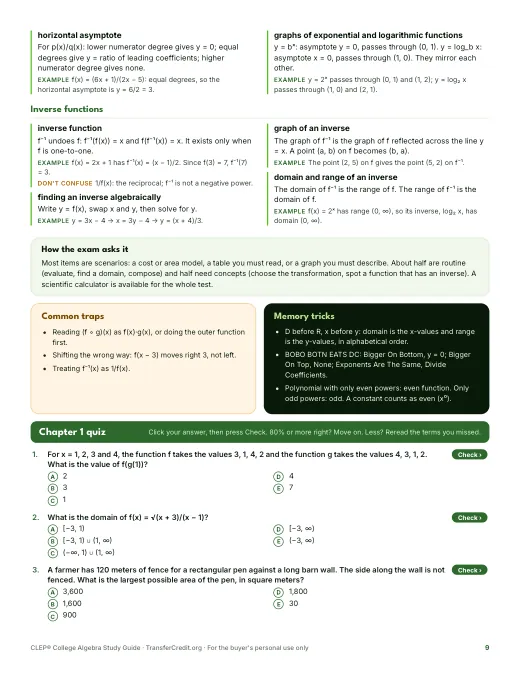
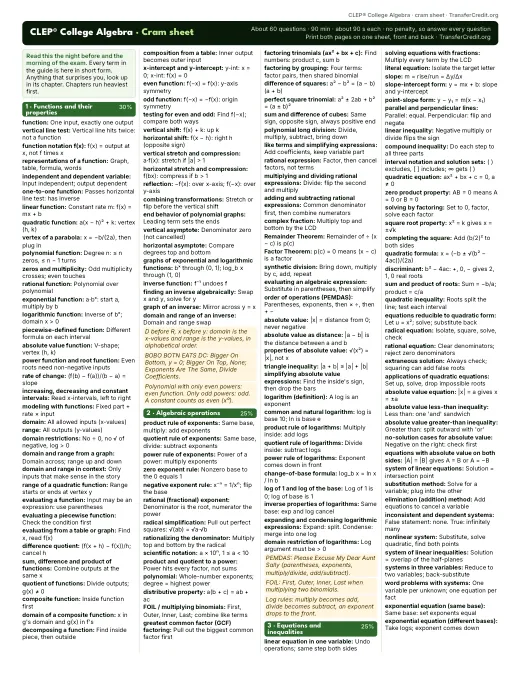
One chapter for each official content area, in the order the exam weighs them.
In the style of the real exam, from all 4 areas. About 15 minutes, with every answer explained and a score by area.
For x = 1, 2, 3 and 4, the function f takes the values 3, 1, 4, 2 and the function g takes the values 4, 3, 1, 2. What is the value of f(g(1))?
Answer: A. 2. g(1) = 4, and then f(4) = 2. The inner function is evaluated first.
The trap: 1 is g(f(1)): f(1) = 3, then g(3) = 1. That runs the composition in the wrong order.
g(1) = 4, and then f(4) = 2. The inner function is evaluated first.
The trap: 1 is g(f(1)): f(1) = 3, then g(3) = 1. That runs the composition in the wrong order.
What is the remainder when p(x) = 2x³ − 5x² + x − 4 is divided by x − 3?
Answer: C. 8. By the Remainder Theorem the remainder is p(3) = 54 − 45 + 3 − 4 = 8.
The trap: −106 is p(−3), which is the remainder for division by x + 3, not x − 3. The divisor x − 3 means c = 3.
By the Remainder Theorem the remainder is p(3) = 54 − 45 + 3 − 4 = 8.
The trap: −106 is p(−3), which is the remainder for division by x + 3, not x − 3. The divisor x − 3 means c = 3.
For which positive value of k does the equation 2x² − kx + 8 = 0 have exactly one real solution?
Answer: B. 8. One real solution requires a discriminant of 0: k² − 4(2)(8) = k² − 64 = 0, so k = 8 (the positive value).
The trap: 64 sets k² − 64 = 0 but stops there. It is k², so a square root is still needed.
One real solution requires a discriminant of 0: k² − 4(2)(8) = k² − 64 = 0, so k = 8 (the positive value).
The trap: 64 sets k² − 64 = 0 but stops there. It is k², so a square root is still needed.
What is the value of (4 + 3i)(2 − i)?
Answer: D. 11 + 2i. Expand: 8 − 4i + 6i − 3i². Since i² = −1, −3i² = +3. The sum is 11 + 2i.
The trap: 5 + 2i comes from treating i² as +1, which gives 8 − 3 = 5.
Expand: 8 − 4i + 6i − 3i². Since i² = −1, −3i² = +3. The sum is 11 + 2i.
The trap: 5 + 2i comes from treating i² as +1, which gives 8 − 3 = 5.
What is the domain of f(x) = √(x + 3)/(x − 1)?
Answer: E. [−3, 1) ∪ (1, ∞). The root needs x + 3 ≥ 0, so x ≥ −3. The denominator excludes x = 1. Together: [−3, 1) ∪ (1, ∞).
The trap: [−3, ∞) keeps x = 1, where the denominator is zero.
The root needs x + 3 ≥ 0, so x ≥ −3. The denominator excludes x = 1. Together: [−3, 1) ∪ (1, ∞).
The trap: [−3, ∞) keeps x = 1, where the denominator is zero.
Which expression is equivalent to (3x²y⁻¹)³ / (9x⁻¹y²), for x and y not 0?
Answer: E. 3x⁷/y⁵. The numerator is 27x⁶y⁻³. Dividing: 27/9 = 3, x⁶ − (−1) = x⁷, and y⁻³ − 2 = y⁻⁵, so the result is 3x⁷/y⁵.
The trap: 3x⁵/y⁵ subtracts 6 − 1 instead of 6 − (−1). Subtracting a negative exponent adds 1.
The numerator is 27x⁶y⁻³. Dividing: 27/9 = 3, x⁶ − (−1) = x⁷, and y⁻³ − 2 = y⁻⁵, so the result is 3x⁷/y⁵.
The trap: 3x⁵/y⁵ subtracts 6 − 1 instead of 6 − (−1). Subtracting a negative exponent adds 1.
A ball thrown upward from a height of 4 feet has height h = −16t² + 48t + 4 feet after t seconds. To the nearest hundredth of a second, when does it hit the ground?
Answer: C. 3.08. Set −16t² + 48t + 4 = 0, or 16t² − 48t − 4 = 0. The quadratic formula gives t = (48 ± √2560)/32, about 3.08 or −0.08. Time cannot be negative, so t ≈ 3.08.
The trap: 6.16 divides by 16 instead of 2a = 32. The denominator is twice the leading coefficient.
Set −16t² + 48t + 4 = 0, or 16t² − 48t − 4 = 0. The quadratic formula gives t = (48 ± √2560)/32, about 3.08 or −0.08. Time cannot be negative, so t ≈ 3.08.
The trap: 6.16 divides by 16 instead of 2a = 32. The denominator is twice the leading coefficient.
Which expression equals (7 + 4i)/(1 + 2i)?
Answer: D. 3 − 2i. Multiply top and bottom by 1 − 2i: (7 + 4i)(1 − 2i) = 15 − 10i, and (1 + 2i)(1 − 2i) = 5. The result is 3 − 2i.
The trap: 15 − 10i is the numerator alone. The denominator 5 must also be divided out.
Multiply top and bottom by 1 − 2i: (7 + 4i)(1 − 2i) = 15 − 10i, and (1 + 2i)(1 − 2i) = 5. The result is 3 − 2i.
The trap: 15 − 10i is the numerator alone. The denominator 5 must also be divided out.
A farmer has 120 meters of fence for a rectangular pen against a long barn wall. The side along the wall is not fenced. What is the largest possible area of the pen, in square meters?
Answer: B. 1,800. Let w be each side that meets the wall, so the far side is 120 − 2w. A = w(120 − 2w) = −2w² + 120w has its vertex at w = 30, giving 30 · 60 = 1,800.
The trap: 1,600 splits the fence into three equal 40-meter sides. The vertex shows the best width is 30, not 40.
Let w be each side that meets the wall, so the far side is 120 − 2w. A = w(120 − 2w) = −2w² + 120w has its vertex at w = 30, giving 30 · 60 = 1,800.
The trap: 1,600 splits the fence into three equal 40-meter sides. The vertex shows the best width is 30, not 40.
What is the value of 16^(3/4) · 27^(−2/3)?
Answer: A. 8/9. 16^(3/4) = (⁴√16)³ = 2³ = 8 and 27^(−2/3) = 1/(∛27)² = 1/9, so the product is 8/9.
The trap: 72 ignores the negative sign on the second exponent and multiplies by 9 instead of 1/9.
16^(3/4) = (⁴√16)³ = 2³ = 8 and 27^(−2/3) = 1/(∛27)² = 1/9, so the product is 8/9.
The trap: 72 ignores the negative sign on the second exponent and multiplies by 9 instead of 1/9.
The CLEP College Algebra exam is a computer-based test from the College Board. The exam has approximately 60 questions to be answered in 90 minutes, and some are pretest questions that will not be scored. A score of 50 on the 20–80 scale earns an ACE credit recommendation of 3 semester hours, though each college sets its own policy. The exam covers 4 content areas; the heaviest is Functions and their properties at 30%.
4 areas, heaviest first. The guide's chapters follow this order.
Start with the guide, or get everything for CLEP in one plan.
CLEP® is a registered trademark of the College Board, which was not involved in producing this guide and does not endorse it. TransferCredit.org is independent and not affiliated with the College Board. © 2026 UPI Globale Edu Inc.