
$5one-time
- 30-page printable PDF
- 180 terms with examples
- 41 practice questions, answers explained
- 2-page cram sheet and study plans
Everything the CLEP Calculus exam tests, in one PDF you can print. Built from the College Board's official outline, heaviest topics first.
Last updated 2026 · exam details checked against the College Board's published exam information in 2026
Real pages from the 30-page PDF.

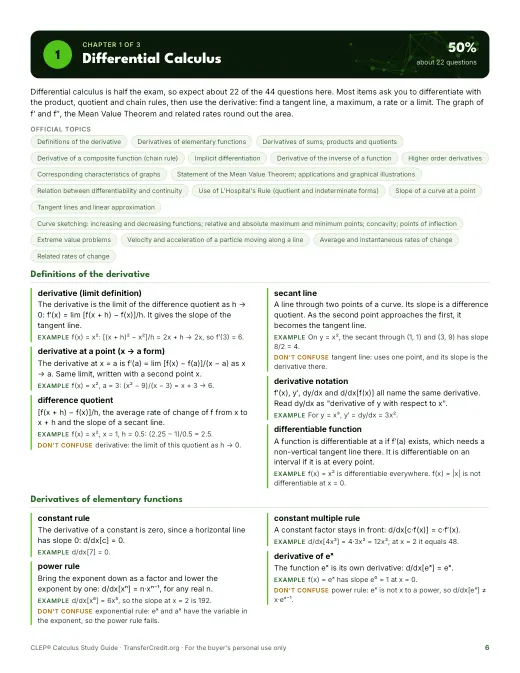
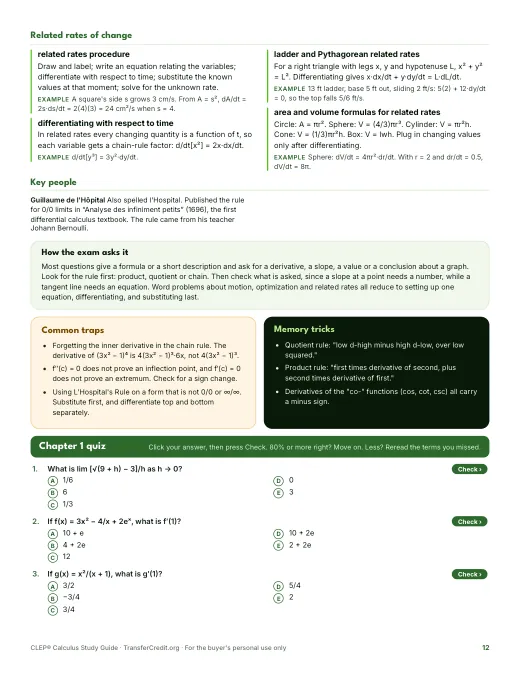
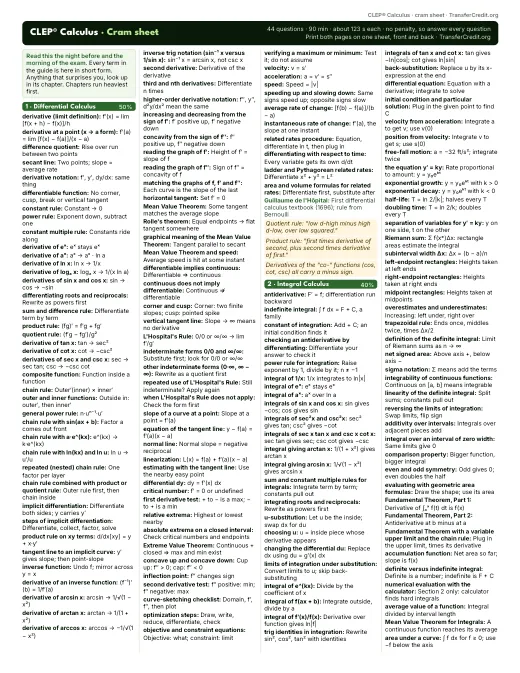
One chapter for each official content area, in the order the exam weighs them.
In the style of the real exam, from all 3 areas. About 20 minutes, with every answer explained and a score by area.
What is lim [√(9 + h) − 3]/h as h → 0?
Answer: C. 1/6. This is the limit definition of the derivative of √x at x = 9. The derivative is 1/(2√x), which equals 1/6 at x = 9.
The trap: The answer 1/3 comes from using 1/√x instead of 1/(2√x), dropping the factor 2 from the power rule.
This is the limit definition of the derivative of √x at x = 9. The derivative is 1/(2√x), which equals 1/6 at x = 9.
The trap: The answer 1/3 comes from using 1/√x instead of 1/(2√x), dropping the factor 2 from the power rule.
A function f satisfies f′(x) = 6x² − 2 and f(1) = 5. What is f(2)?
Answer: D. 17. An antiderivative is f(x) = 2x³ − 2x + C. From f(1) = 2 − 2 + C = 5, C = 5. Then f(2) = 16 − 4 + 5 = 17.
The trap: 12 leaves out the constant C = 5. 22 is f′(2), the derivative, not f(2).
An antiderivative is f(x) = 2x³ − 2x + C. From f(1) = 2 − 2 + C = 5, C = 5. Then f(2) = 16 − 4 + 5 = 17.
The trap: 12 leaves out the constant C = 5. 22 is f′(2), the derivative, not f(2).
What is lim x→3 (x² − 9)/(x² − 5x + 6)?
Answer: B. 6. Substitution gives 0/0. Factor to (x − 3)(x + 3)/((x − 2)(x − 3)), cancel x − 3, and substitute 3 into (x + 3)/(x − 2) to get 6/1 = 6.
The trap: A limit of 0 comes from noticing only the zero in the numerator. A 0/0 form is indeterminate, so the expression must be simplified.
Substitution gives 0/0. Factor to (x − 3)(x + 3)/((x − 2)(x − 3)), cancel x − 3, and substitute 3 into (x + 3)/(x − 2) to get 6/1 = 6.
The trap: A limit of 0 comes from noticing only the zero in the numerator. A 0/0 form is indeterminate, so the expression must be simplified.
If f(x) = 3x² − 4/x + 2eˣ, what is f′(1)?
Answer: A. 10 + 2e. Rewrite 4/x as 4x⁻¹. Then f′(x) = 6x + 4/x² + 2eˣ, and at x = 1 this is 6 + 4 + 2e = 10 + 2e.
The trap: The answer 2 + 2e comes from differentiating −4/x as −4/x², which has the wrong sign. The derivative of −4x⁻¹ is +4x⁻².
Rewrite 4/x as 4x⁻¹. Then f′(x) = 6x + 4/x² + 2eˣ, and at x = 1 this is 6 + 4 + 2e = 10 + 2e.
The trap: The answer 2 + 2e comes from differentiating −4/x as −4/x², which has the wrong sign. The derivative of −4x⁻¹ is +4x⁻².
What is ∫₁⁹ 3/√x dx?
Answer: E. 12. Write 3x^(−1/2). An antiderivative is 3·2x^(1/2) = 6√x. Then 6√9 − 6√1 = 18 − 6 = 12.
The trap: 9 is 3√9 evaluated only at the upper limit and missing the factor 2. The power rule divides by 1/2, which doubles the coefficient.
Write 3x^(−1/2). An antiderivative is 3·2x^(1/2) = 6√x. Then 6√9 − 6√1 = 18 − 6 = 12.
The trap: 9 is 3√9 evaluated only at the upper limit and missing the factor 2. The power rule divides by 1/2, which doubles the coefficient.
What is lim x→∞ (4x³ − 2x)/(2x³ + 7x²)?
Answer: D. 2. The numerator and denominator have the same degree, so the limit is the ratio of leading coefficients: 4/2 = 2.
The trap: A limit of 1/2 inverts the ratio of leading coefficients. The numerator's coefficient goes on top.
The numerator and denominator have the same degree, so the limit is the ratio of leading coefficients: 4/2 = 2.
The trap: A limit of 1/2 inverts the ratio of leading coefficients. The numerator's coefficient goes on top.
If g(x) = x²/(x + 1), what is g′(1)?
Answer: C. 3/4. By the quotient rule, g′(x) = [2x(x + 1) − x²]/(x + 1)². At x = 1 this is (4 − 1)/4 = 3/4.
The trap: The answer 3/2 comes from forgetting to square the denominator. The quotient rule divides by (x + 1)², which is 4 here.
By the quotient rule, g′(x) = [2x(x + 1) − x²]/(x + 1)². At x = 1 this is (4 − 1)/4 = 3/4.
The trap: The answer 3/2 comes from forgetting to square the denominator. The quotient rule divides by (x + 1)², which is 4 here.
What is ∫₀¹ 6x(x² + 1)² dx?
Answer: A. 7. Let u = x² + 1, so 6x dx = 3 du. The limits become u = 1 to 2. Then 3∫₁² u² du = [u³]₁² = 8 − 1 = 7.
The trap: 1 comes from keeping the old limits 0 and 1 after substituting u. Convert the limits or go back to x first.
Let u = x² + 1, so 6x dx = 3 du. The limits become u = 1 to 2. Then 3∫₁² u² du = [u³]₁² = 8 − 1 = 7.
The trap: 1 comes from keeping the old limits 0 and 1 after substituting u. Convert the limits or go back to x first.
Let f(x) = (x² − 4)/(x − 2) for x ≠ 2, and f(2) = 1. What kind of discontinuity does f have at x = 2?
Answer: B. Removable, because the limit is 4 but f(2) = 1. For x ≠ 2, f(x) = x + 2, so the limit as x → 2 is 4. It exists but differs from f(2) = 1, which is a removable discontinuity.
The trap: "None, because f(2) is defined" is wrong: continuity also needs the limit to equal f(2), and 4 ≠ 1.
For x ≠ 2, f(x) = x + 2, so the limit as x → 2 is 4. It exists but differs from f(2) = 1, which is a removable discontinuity.
The trap: "None, because f(2) is defined" is wrong: continuity also needs the limit to equal f(2), and 4 ≠ 1.
If f(x) = x·e^(3x), then f′(x) =
Answer: E. (1 + 3x)e^(3x). Use the product rule with the chain rule on e^(3x): f′ = 1·e^(3x) + x·3e^(3x) = (1 + 3x)e^(3x).
The trap: The choice (1 + x)e^(3x) forgets the chain-rule factor 3 when differentiating e^(3x).
Use the product rule with the chain rule on e^(3x): f′ = 1·e^(3x) + x·3e^(3x) = (1 + 3x)e^(3x).
The trap: The choice (1 + x)e^(3x) forgets the chain-rule factor 3 when differentiating e^(3x).
The CLEP Calculus exam is a computer-based test from the College Board. It has 44 questions in two sections, to be answered in approximately 90 minutes. A score of 50 on the 20–80 scale earns an ACE credit recommendation of 4 semester hours, though each college sets its own policy. The exam covers 3 content areas; the heaviest is Differential Calculus at 50%.
Source: official CLEP Calculus exam page.
3 areas, heaviest first. The guide's chapters follow this order.
Start with the guide, or get everything for CLEP in one plan.
CLEP® is a registered trademark of the College Board, which was not involved in producing this guide and does not endorse it. TransferCredit.org is independent and not affiliated with the College Board. © 2026 UPI Globale Edu Inc.