← All study guides
CLEP® Study Guide Printable PDF · 43 pages

CLEP Natural Sciences Study Guide

Everything the CLEP Natural Sciences exam tests, in one PDF you can print. Built from the College Board's official outline, heaviest topics first.

  • 184 key terms, each with an example
  • 53 practice questions with every answer explained
  • A 2-page cram sheet for the night before
  • 2-, 4- and 8-week study plans built from the exam weights
Not sure yet? Try 10 free questions

Last updated 2026 · exam details checked against the College Board's published exam information in 2026

Look inside the guide

Real pages from the 43-page PDF.

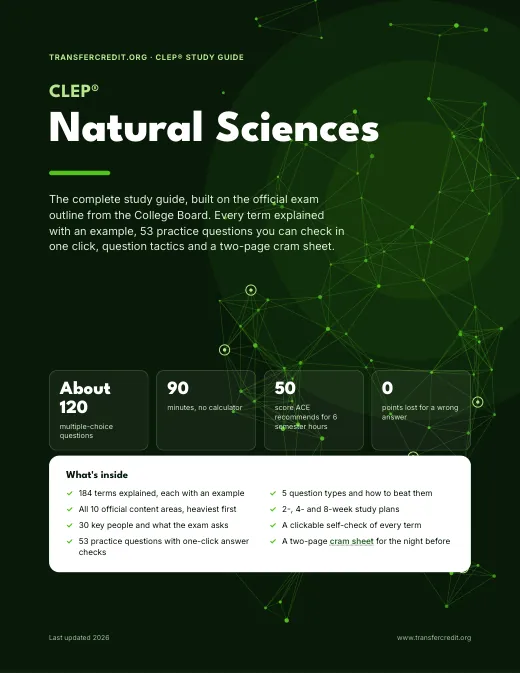
Page 1 of the CLEP Natural Sciences Study Guide: the cover
Page 1 The cover
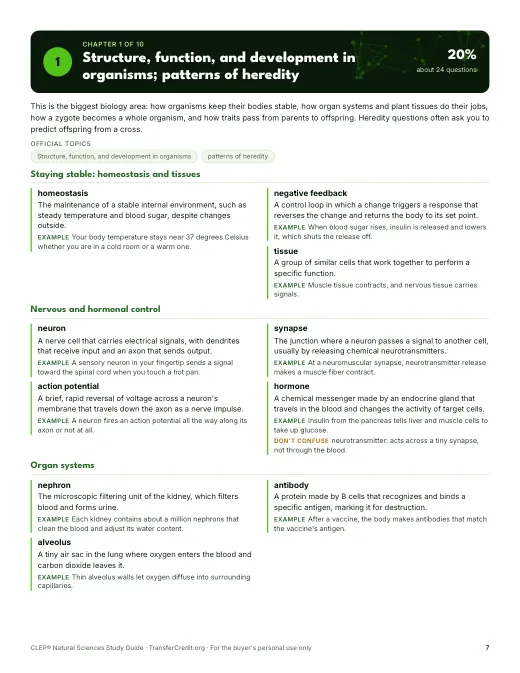
Page 7 of the CLEP Natural Sciences Study Guide: the Chapter 1 opener
Page 7 The Chapter 1 opener
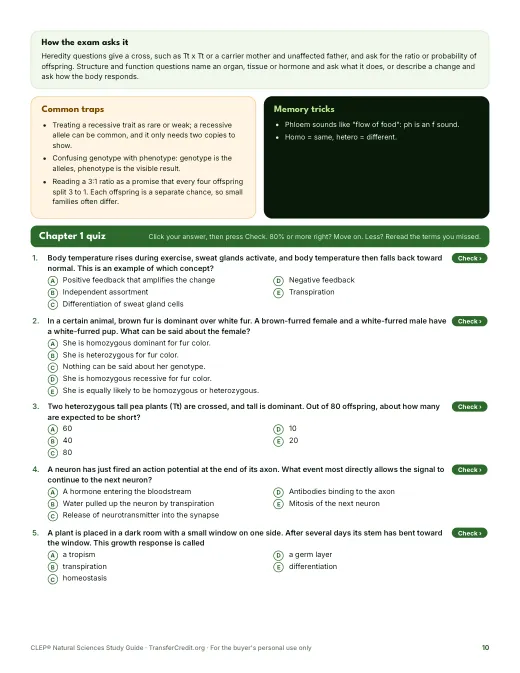
Page 10 of the CLEP Natural Sciences Study Guide: a chapter quiz
Page 10 A chapter quiz
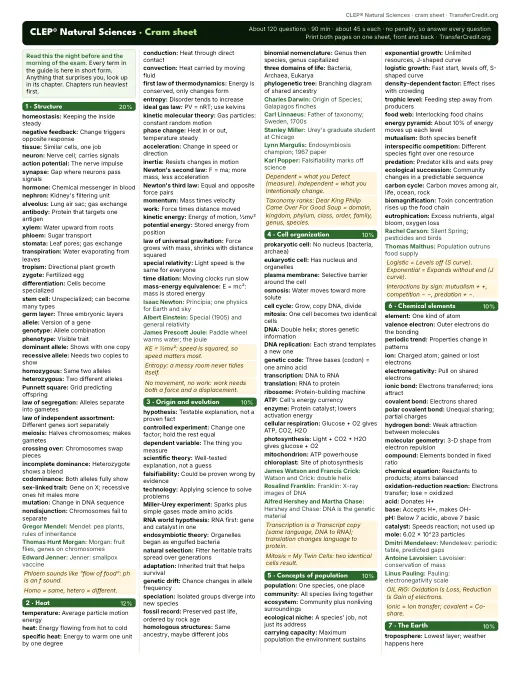
Page 42 of the CLEP Natural Sciences Study Guide: the 2-page cram sheet
Page 42 The 2-page cram sheet

What you get for $5

One chapter for each official content area, in the order the exam weighs them.

  • 📘43pages, printable
  • 🧭10chapters, heaviest first
  • 🔑184terms with examples
  • ✍️53practice questions, answers explained
  • ⚠️27exam traps to avoid
  • 📄2page cram sheet

Try 10 free Natural Sciences questions

In the style of the real exam, one from each of the ten heaviest areas. About 10 minutes, with every answer explained and a score by area.

10 questions  
  1. Question 1 · Structure, function, and development in organisms; patterns of heredity

    Body temperature rises during exercise, sweat glands activate, and body temperature then falls back toward normal. This is an example of which concept?

    Show the answer

    Answer: D. Negative feedback. Sweating reverses the temperature rise and returns the body toward its set point, which is negative feedback.

    The trap: Positive feedback that amplifies the change would push the temperature even higher instead of restoring it.

  2. Question 2 · Heat, thermodynamics, and states of matter; classical mechanics; relativity

    A 4 kg cart is pushed across a smooth floor with a net force of 12 newtons. What is the cart's acceleration?

    Show the answer

    Answer: E. 3 m/s². By Newton's second law, a = F/m = 12 N ÷ 4 kg = 3 m/s².

    The trap: 48 m/s² comes from multiplying force by mass instead of dividing.

  3. Question 3 · Origin and evolution of life; classification of organisms

    A class tests whether a plant food helps bean plants grow. Two groups get identical soil, water and light, but only one group receives the plant food. After three weeks, students measure each plant's height. What is the dependent variable?

    Show the answer

    Answer: B. Each plant's final height. The dependent variable is the factor that is measured, and it may change in response to the treatment. Here the students measure plant height.

    The trap: The presence or absence of plant food is the independent variable: the factor the experimenters deliberately change, not the one they measure.

  4. Question 4 · Cell organization, cell division, chemical nature of the gene, bioenergetics, and biosynthesis

    A student places an onion cell in a very salty solution and sees the cell's contents shrink away from the wall. Which process best explains this?

    Show the answer

    Answer: C. Water moves out of the cell toward the higher solute concentration.. The salty solution has more dissolved solute outside the cell, so water leaves by osmosis and the cell shrinks.

    The trap: Salt diffusing in and making the cell swell is backward: water would leave and the cell would shrink.

  5. Question 5 · Concepts of population biology with emphasis on ecology

    Thirty rabbits are released on an island with no predators. Their numbers rise quickly, then level off near 600 as food becomes scarce, and stay there for years. What does the value 600 represent?

    Show the answer

    Answer: A. The carrying capacity for rabbits. A population that levels off where resources run short has reached the environment's carrying capacity. The overall curve is logistic.

    The trap: Exponential growth is the fast early rise. Leveling off signals that resources now limit growth.

  6. Question 6 · Chemical elements, compounds and reactions, molecular structure and bonding

    Potassium (a metal) reacts with bromine (a nonmetal) to form potassium bromide. Which description of the bonding is correct?

    Show the answer

    Answer: E. Potassium transfers an electron to bromine, forming ions that attract each other.. A metal with low electronegativity gives an electron to a nonmetal, forming K+ and Br- ions held by ionic attraction.

    The trap: Unequal sharing in a polar covalent bond is tempting, but the electronegativity difference here is so large that the electron is transferred, not shared.

  7. Question 7 · The Earth: atmosphere, hydrosphere, structure features, geologic processes, and history

    Earth's average surface temperature is higher than it would be if the planet had no atmosphere. Which process best explains this?

    Show the answer

    Answer: A. Gases absorb outgoing infrared and send part of it back down. Greenhouse gases absorb infrared radiation leaving the surface and send some back down, warming the surface.

    The trap: Ozone does absorb ultraviolet light, but that is a different process from trapping the infrared heat that warms the surface.

  8. Question 8 · Atomic and nuclear structure and properties, elementary particles, and nuclear reactions

    An atom has 17 protons and 18 neutrons. Which statement correctly describes it?

    Show the answer

    Answer: C. Its atomic number is 17 and its mass number is 35.. Atomic number counts protons (17), and mass number counts protons plus neutrons (17 + 18 = 35).

    The trap: The choice with atomic number 17 and mass number 18 counts only neutrons as the mass number, leaving out the 17 protons.

  9. Question 9 · The universe: galaxies, stars, and the solar system

    An astronomer finds that spectral lines from a distant galaxy appear at longer wavelengths than the same lines measured in a laboratory. What does this indicate?

    Show the answer

    Answer: D. The galaxy is moving away from us. Longer wavelengths are a redshift, which means the source is receding.

    The trap: Moving toward us would shorten wavelengths, a blueshift, the opposite of what is seen.

  10. Question 10 · Electricity and magnetism, waves, light, and sound

    A 12-volt battery is connected across a resistor that obeys Ohm's law, and a current of 3 amperes flows. What is the resistance?

    Show the answer

    Answer: B. 4 ohms. Resistance is voltage divided by current: 12 volts / 3 amperes = 4 ohms.

    The trap: The choice "36 ohms" multiplies voltage by current instead of dividing them.

The CLEP Natural Sciences exam at a glance

The CLEP Natural Sciences exam is a 90-minute, computer-based test from the College Board with about 120 multiple-choice questions. A score of 50 on the 20–80 scale earns an ACE credit recommendation of 6 semester hours, though each college sets its own policy. The exam covers 10 content areas; the heaviest is Structure, function, and development in organisms; patterns of heredity at 20%.

Questions
About 120multiple choice
Time
90 minabout 45 seconds a question
Passing score
50on a 20–80 scale
ACE credit
6semester hours
Exam fee
$97paid to College Board
Calculator
Nonot allowed

Source: official CLEP Natural Sciences exam page.

What the exam covers

10 areas, heaviest first. The guide's chapters follow this order.

  1. Structure, function, and development in organisms; patterns of heredity20%
  2. Heat, thermodynamics, and states of matter; classical mechanics; relativity12%
  3. Origin and evolution of life; classification of organisms10%
  4. Cell organization, cell division, chemical nature of the gene, bioenergetics, and biosynthesis10%
  5. Concepts of population biology with emphasis on ecology10%
  6. Chemical elements, compounds and reactions, molecular structure and bonding10%
  7. The Earth: atmosphere, hydrosphere, structure features, geologic processes, and history10%
  8. Atomic and nuclear structure and properties, elementary particles, and nuclear reactions7%
  9. The universe: galaxies, stars, and the solar system7%
  10. Electricity and magnetism, waves, light, and sound4%

How it works

  1. 1Buy once, $5Secure checkout. No subscription needed.
  2. 2Download the PDFFrom your TransferCredit.org account, right away and any time later.
  3. 3Study the heaviest areas firstFollow the 2-, 4- or 8-week plan, then read the cram sheet the night before.

Questions students ask

What's in the full CLEP Natural Sciences study guide?
43 pages: 10 chapters, one per official content area, heaviest first. 184 terms, each with a plain-English definition and an example, 30 key people, common traps and memory tricks, 53 practice questions with an answer key that explains every answer, question tactics, 2-, 4- and 8-week study plans and a 2-page cram sheet.
How much is the full CLEP Natural Sciences study guide?
The full 43-page PDF is $5, a one-time payment. The 10 practice questions on this page are free, with no account.
What does the $29 plan include?
$29 a month gives you all 28 CLEP subjects: every CLEP study guide plus the full prep course for each subject, and you can cancel anytime. If you only need this exam, the guide on its own is a one-time $5.
How do I get the full guide?
Choose Buy this guide ($5) and check out. Then sign in to your TransferCredit.org account, then open the course and its Download Your Study Guide lesson. The PDF is yours to keep, and you can download it again from your account at any time.
Can I print the guide or use it on my phone?
Yes. It's a PDF, so it opens on phones, tablets and computers, and printing is allowed. Its tick boxes and answer bubbles work in PDF readers that support forms. Copying and editing are turned off.
Is this an official CLEP study guide?
No. CLEP® is a registered trademark of the College Board, which was not involved in producing this guide and does not endorse it. TransferCredit.org is independent. We built the guide from the official exam outline, and the exam details were checked against the College Board's published exam information in 2026.
Why is this study guide better than a generic review?
It follows the official outline area by area and spends the most pages on what the exam weighs most. Every term comes with an example, each chapter names the traps the exam sets, and the answer key explains why the most tempting wrong answer is wrong, not just which answer is right. It ends with a 2-page cram sheet for the night before.
What is the CLEP Natural Sciences exam?
The CLEP Natural Sciences exam is a 90-minute, computer-based test from the College Board with about 120 multiple-choice questions. A score of 50 on the 20–80 scale earns an ACE credit recommendation of 6 semester hours, though each college sets its own policy. The exam covers 10 content areas; the heaviest is Structure, function, and development in organisms; patterns of heredity at 20%.
More questions about the CLEP Natural Sciences exam (20)
How many questions are on the CLEP Natural Sciences exam, and how long is it?
About 120 multiple-choice questions in 90 minutes. Some of the approximately 120 questions are pretest questions that will not be scored.
What is the passing score for CLEP Natural Sciences?
The passing score is 50 on a 20–80 scale. At 50 or above, the American Council on Education (ACE) recommends 6 semester hours. Each college sets its own passing score and credit award, so check your school's policy before you book.
How much does the CLEP Natural Sciences exam cost?
The exam fee is $97, paid to the College Board. Test centers may add their own administration fee. Eligible U.S. military service members can usually test for free through DANTES.
How many college credits is CLEP Natural Sciences worth?
ACE recommends 6 semester hours for a passing score of 50. Your college decides how many credits it awards and which course they replace. Check your college's policy.
Can I use a calculator on the CLEP Natural Sciences exam?
No. This exam doesn't allow a calculator.
Is there a penalty for guessing on CLEP Natural Sciences?
No. Your score counts only correct answers, so a wrong answer costs nothing. Never leave a question blank: rule out what you can and pick your best guess.
What topics are on the CLEP Natural Sciences exam?
10 content areas, from the official outline: Structure, function, and development in organisms; patterns of heredity (20%); Heat, thermodynamics, and states of matter; classical mechanics; relativity (12%); Origin and evolution of life; classification of organisms (10%); Cell organization, cell division, chemical nature of the gene, bioenergetics, and biosynthesis (10%); Concepts of population biology with emphasis on ecology (10%); Chemical elements, compounds and reactions, molecular structure and bonding (10%); The Earth: atmosphere, hydrosphere, structure features, geologic processes, and history (10%); Atomic and nuclear structure and properties, elementary particles, and nuclear reactions (7%); The universe: galaxies, stars, and the solar system (7%); Electricity and magnetism, waves, light, and sound (4%).
Which CLEP Natural Sciences topics should I study first?
Start with the three heaviest: Structure, function, and development in organisms; patterns of heredity (20%), Heat, thermodynamics, and states of matter; classical mechanics; relativity (12%) and Origin and evolution of life; classification of organisms (10%). Together they are about 42% of the exam, roughly 50 of 120 questions. The guide's chapters run in that order, heaviest first.
Is the CLEP Natural Sciences exam hard?
It depends on what you already know. No single area dominates: the largest, Structure, function, and development in organisms; patterns of heredity, is 20% and the smallest, Electricity and magnetism, waves, light, and sound, is 4%, so broad coverage matters more than deep expertise in one topic. Take the free diagnostic above to see where you stand in about 10 minutes.
What kinds of questions are on the CLEP Natural Sciences exam?
The guide sorts them into 5 types: “Recall a concept”, “Apply an idea to a scenario”, “Read a table, graph or diagram”, “Simple calculation” and “Judge an experiment”. Every question has 5 answer choices. Try the 10 free questions above to see the style.
How long should I study for CLEP Natural Sciences?
Use the diagnostic to decide. If you already know most areas, two weeks of daily review is often enough; if the subject is new to you, plan on eight. The full guide has 2-, 4- and 8-week plans built from the exam weights.
How should I pace myself on the CLEP Natural Sciences exam?
On average you have about 45 seconds per question (90 minutes for 120 questions). Be past question 40 a third of the way through and past question 80 two-thirds through. If a question takes more than a minute, pick your best guess, mark it and come back.
What happens if I don't pass CLEP Natural Sciences?
You can retake a CLEP exam after three months. Use the wait to work through the areas the score report and the diagnostic show you missed.
Do colleges accept CLEP Natural Sciences for credit?
CLEP exams are accepted at more than 2,900 U.S. colleges and universities, but each school decides which exams it accepts, the score it requires and the credit it gives. Look up your college's CLEP policy before you book.
How up to date is this CLEP Natural Sciences guide?
Last updated 2026. The exam details were checked against the College Board's published exam information in 2026. Exams change, so confirm the details on the official exam page before you register.
What should I do the night before the exam?
Read the cram sheet once, slowly. Check your test time, the location or remote-proctoring setup, and the ID you need. Then sleep: a rested brain recalls more than a crammed one. In the morning, skim the memory tricks and common traps, then stop studying.
How much math is on CLEP Natural Sciences?
Some. About 40% of questions apply scientific principles, including simple quantitative problems such as half-life or Newton's second law, but the math stays at a basic level.
Is CLEP Natural Sciences more biology or physical science?
It's split evenly: biological science is 50% of the exam and physical science is 50%. The largest single area is structure, function and development in organisms with patterns of heredity at 20%, and the smallest is electricity and magnetism, waves, light and sound at 4%.
Do I need to memorize a lot of facts for CLEP Natural Sciences?
Less than you might expect. The College Board says the exam doesn't stress retention of factual details: about 40% of questions test fundamental facts and principles, 20% ask you to interpret graphs, diagrams, tables or passages, and 40% ask you to apply scientific principles.
Does CLEP Natural Sciences include a lab?
No. There's no lab component, and some colleges require a separate lab if they count the credit as a lab science.

Choose how you want to study

Start with the guide, or get everything for CLEP in one plan.

This study guide
$5one-time
  • 43-page printable PDF
  • 184 terms with examples
  • 53 practice questions, answers explained
  • 2-page cram sheet and study plans
Get the guide · $5
Best value Get it all
$29/month
  • Every CLEP study guide
  • Prep courses for all 28 CLEP subjects
  • Cancel anytime
Get it all · $29/mo

CLEP® is a registered trademark of the College Board, which was not involved in producing this guide and does not endorse it. TransferCredit.org is independent and not affiliated with the College Board. © 2026 UPI Globale Edu Inc.