
$5one-time
- 40-page printable PDF
- 183 terms with examples
- 42 practice questions, answers explained
- 2-page cram sheet and study plans
Everything the CLEP Social Sciences and History exam tests, in one PDF you can print. Built from the College Board's official outline, heaviest topics first.
Last updated 2026 · exam details checked against the College Board's published exam information in 2026
Real pages from the 40-page PDF.
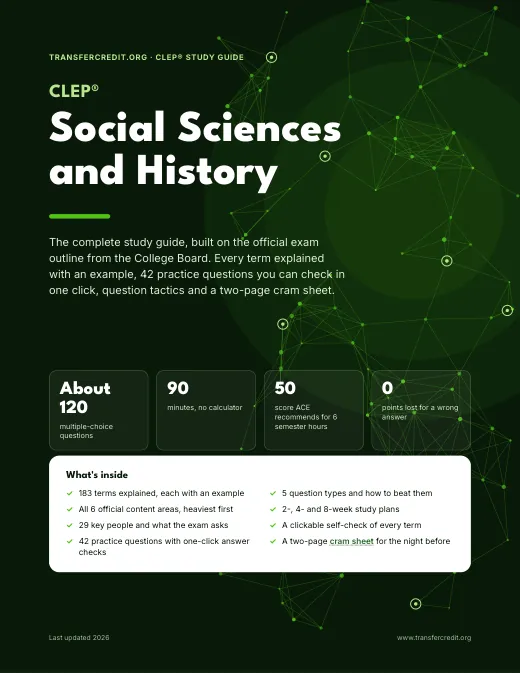
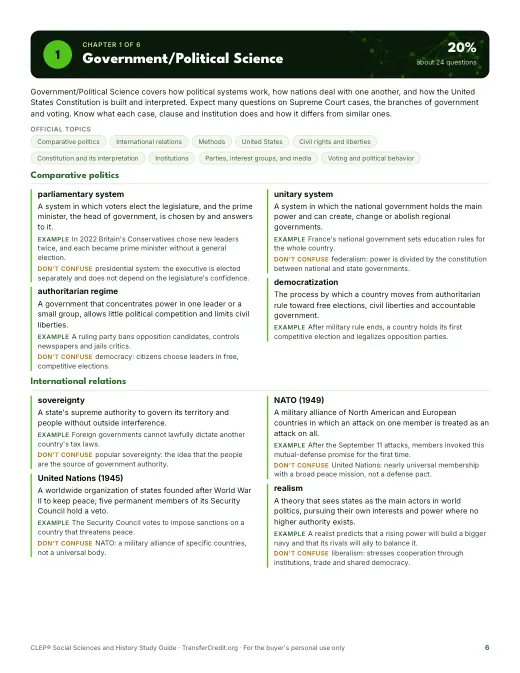
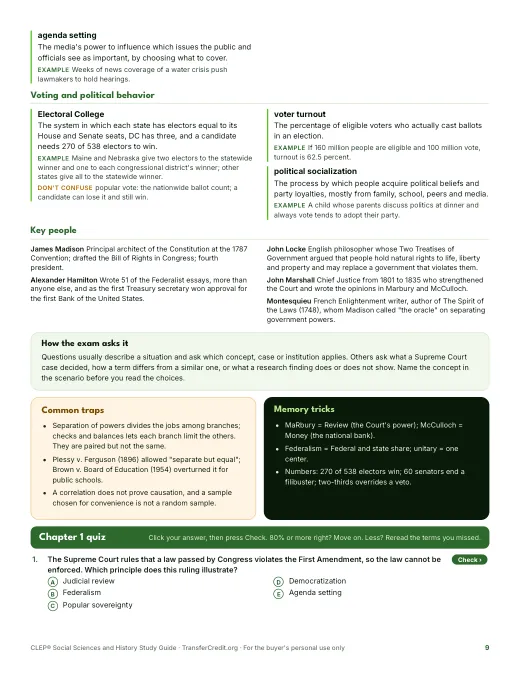
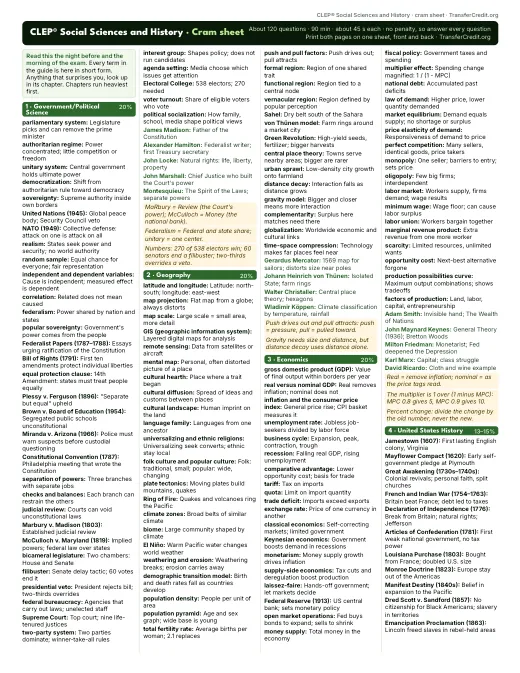
One chapter for each official content area, in the order the exam weighs them.
In the style of the real exam, from all 6 areas. About 10 minutes, with every answer explained and a score by area.
The Supreme Court rules that a law passed by Congress violates the First Amendment, so the law cannot be enforced. Which principle does this ruling illustrate?
Answer: C. Judicial review. Judicial review is the power of courts to declare laws unconstitutional and therefore invalid.
The trap: Popular sovereignty is tempting because Congress is elected by the people, but it is about where authority comes from, not a court voiding a law.
Judicial review is the power of courts to declare laws unconstitutional and therefore invalid.
The trap: Popular sovereignty is tempting because Congress is elected by the people, but it is about where authority comes from, not a court voiding a law.
Map 1 has a scale of 1:10,000, and Map 2 has a scale of 1:5,000,000. Which statement is correct?
Answer: B. Map 1 is the larger scale and shows more detail of a smaller area. The fraction 1/10,000 is larger than 1/5,000,000, so Map 1 is large-scale: a small area with more detail.
The trap: Larger numbers in the ratio can look like "larger scale", but the bigger denominator means a smaller scale and less detail.
The fraction 1/10,000 is larger than 1/5,000,000, so Map 1 is large-scale: a small area with more detail.
The trap: Larger numbers in the ratio can look like "larger scale", but the bigger denominator means a smaller scale and less detail.
A farmer can plant a field with corn, which would earn $8,000, or with soybeans, which would earn $6,500. He plants corn. What is his opportunity cost?
Answer: A. $6,500. The opportunity cost is the value of the next-best alternative given up, which is the $6,500 soybeans would have earned.
The trap: The $1,500 difference is his profit advantage over soybeans; it is not what he gave up.
The opportunity cost is the value of the next-best alternative given up, which is the $6,500 soybeans would have earned.
The trap: The $1,500 difference is his profit advantage over soybeans; it is not what he gave up.
A newspaper in 1823 reports that the president has told Europe that any attempt to set up new colonies in the Americas will be treated as a threat to the United States. This policy is known as the
Answer: E. Monroe Doctrine. The president warned European powers away from the Western Hemisphere. That is the Monroe Doctrine.
The trap: The Truman Doctrine is also a presidential doctrine, but it came in 1947 and dealt with aid to countries resisting communism.
The president warned European powers away from the Western Hemisphere. That is the Monroe Doctrine.
The trap: The Truman Doctrine is also a presidential doctrine, but it came in 1947 and dealt with aid to countries resisting communism.
After 27 years of fighting, a city-state surrendered in 404 BCE, losing its fleet and its long walls to a rival league led by Sparta. This describes the end of the
Answer: D. Peloponnesian War. Athens lost to Sparta in 404 BCE, ending the Peloponnesian War, which left Greece weakened.
The trap: The Persian Wars also involved Athens and Sparta, but they fought on the same side against Persia.
Athens lost to Sparta in 404 BCE, ending the Peloponnesian War, which left Greece weakened.
The trap: The Persian Wars also involved Athens and Sparta, but they fought on the same side against Persia.
A historian studies how maize, potatoes, horses and smallpox crossed the Atlantic after 1492. Which concept does this describe?
Answer: B. Columbian Exchange. After Columbus's voyages, plants, animals and diseases moved between the Americas and the Old World, which is the Columbian Exchange.
The trap: The Atlantic slave trade also crossed the ocean, but it describes the forced movement of Africans, not the spread of crops, animals and diseases.
After Columbus's voyages, plants, animals and diseases moved between the Americas and the Old World, which is the Columbian Exchange.
The trap: The Atlantic slave trade also crossed the ocean, but it describes the forced movement of Africans, not the spread of crops, animals and diseases.
A pollster wants to estimate the opinion of all registered voters in a state. Which method is most likely to produce a representative result?
Answer: E. Contacting voters chosen by chance from the official registration list. Choosing voters by chance gives everyone an equal chance of selection, so the sample can fairly represent the whole group.
The trap: An online poll that anyone can answer collects many responses, but people choose themselves, which biases the results.
Choosing voters by chance gives everyone an equal chance of selection, so the sample can fairly represent the whole group.
The trap: An online poll that anyone can answer collects many responses, but people choose themselves, which biases the results.
A county planner places layers showing roads, flood zones and hospitals on one computer map to choose the best site for a new clinic. This tool is best described as
Answer: C. a geographic information system. Combining layered data about places on one digital map for analysis is what GIS does.
The trap: Remote sensing supplies images, but the planner is analyzing layers of data rather than collecting images.
Combining layered data about places on one digital map for analysis is what GIS does.
The trap: Remote sensing supplies images, but the planner is analyzing layers of data rather than collecting images.
A basket of consumer goods cost $250 last year and costs $265 this year. What was the inflation rate over the year?
Answer: A. 6 percent. Inflation is the price change divided by the earlier price: $15 divided by $250 equals 0.06, or 6 percent.
The trap: Dividing $15 by the new price of $265 gives 5.7 percent, but inflation is measured against the earlier price.
Inflation is the price change divided by the earlier price: $15 divided by $250 equals 0.06, or 6 percent.
The trap: Dividing $15 by the new price of $265 gives 5.7 percent, but inflation is measured against the earlier price.
The Supreme Court's decision in Dred Scott v. Sandford (1857) most directly increased tensions between North and South because it
Answer: D. ruled that Congress could not ban slavery in the territories. By striking down limits on slavery in the territories, the Court sided with slaveholders and angered the North.
The trap: The ruling did not touch secession, and it did not free anyone. The freeing of enslaved people in rebel states came later with the Emancipation Proclamation.
By striking down limits on slavery in the territories, the Court sided with slaveholders and angered the North.
The trap: The ruling did not touch secession, and it did not free anyone. The freeing of enslaved people in rebel states came later with the Emancipation Proclamation.
The CLEP Social Sciences and History exam is a 90-minute, computer-based test from the College Board with about 120 multiple-choice questions. A score of 50 on the 20–80 scale earns an ACE credit recommendation of 6 semester hours, though each college sets its own policy. The exam covers 6 content areas; the heaviest is Government/Political Science at 20%.
Source: official CLEP Social Sciences and History exam page.
6 areas, heaviest first. The guide's chapters follow this order.
Start with the guide, or get everything for CLEP in one plan.
CLEP® is a registered trademark of the College Board, which was not involved in producing this guide and does not endorse it. TransferCredit.org is independent and not affiliated with the College Board. © 2026 UPI Globale Edu Inc.