← CLEP U.S. History I course
CLEP® Study Guide Printable PDF · 36 pages

CLEP U.S. History I Study Guide

Official exam name: History of the United States I: Early Colonization to 1877

Everything the CLEP U.S. History I exam tests, in one PDF you can print. Built from the College Board's official outline, heaviest topics first.

  • 180 key terms, each with an example
  • 40 practice questions with every answer explained
  • A 2-page cram sheet for the night before
  • 2-, 4- and 8-week study plans built from the exam weights
Not sure yet? Try 10 free questions

Last updated 2026 · exam details checked against the College Board's published exam information in 2026

Look inside the guide

Real pages from the 36-page PDF.

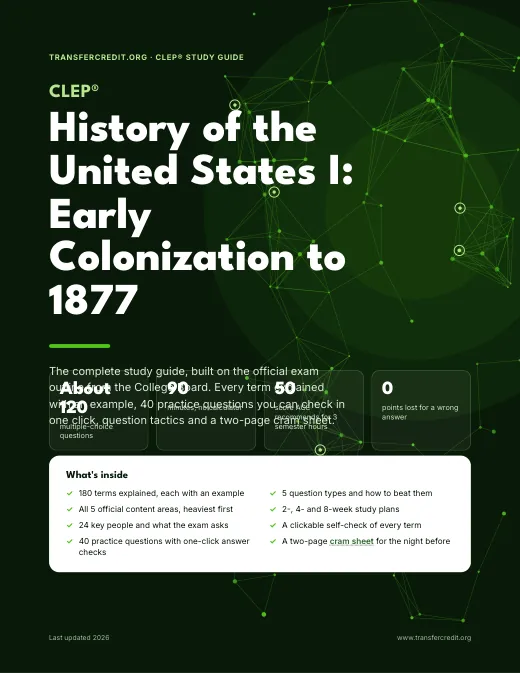
Page 1 of the CLEP U.S. History I Study Guide: the cover
Page 1 The cover
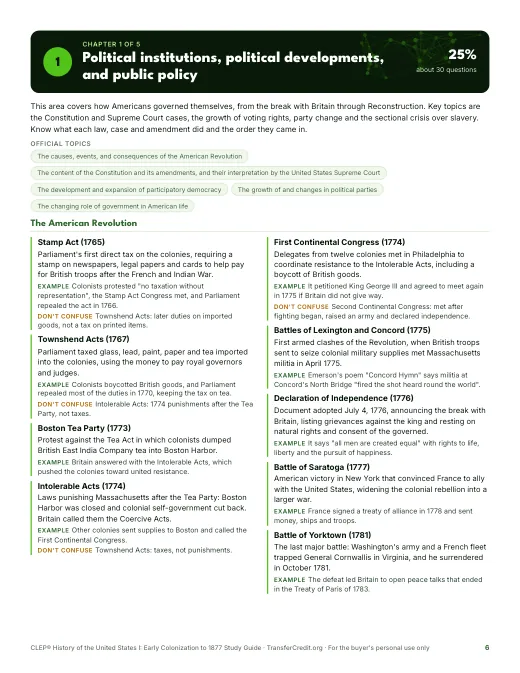
Page 6 of the CLEP U.S. History I Study Guide: the Chapter 1 opener
Page 6 The Chapter 1 opener
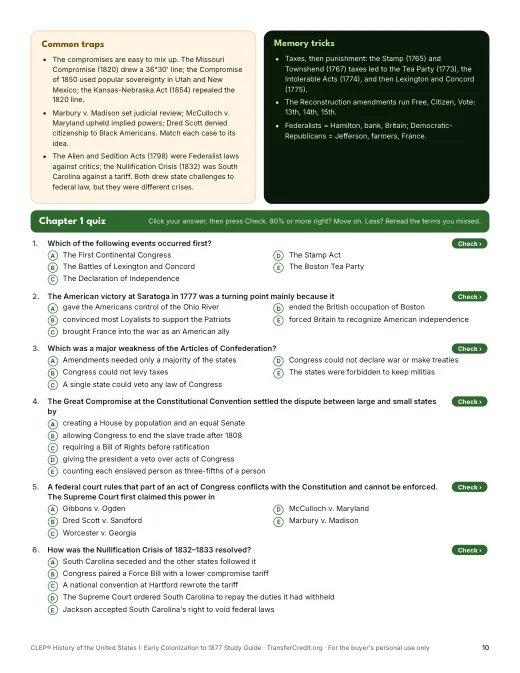
Page 10 of the CLEP U.S. History I Study Guide: a chapter quiz
Page 10 A chapter quiz
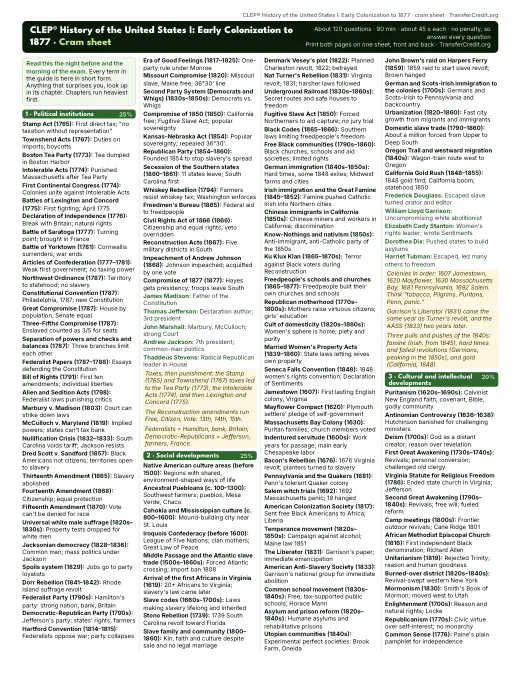
Page 35 of the CLEP U.S. History I Study Guide: the 2-page cram sheet
Page 35 The 2-page cram sheet

What you get for $5

One chapter for each official content area, in the order the exam weighs them.

  • 📘36pages, printable
  • 🧭5chapters, heaviest first
  • 🔑180terms with examples
  • ✍️40practice questions, answers explained
  • ⚠️15exam traps to avoid
  • 📄2page cram sheet

Try 10 free U.S. History I questions

In the style of the real exam, from all 5 areas. About 10 minutes, with every answer explained and a score by area.

10 questions  
  1. Question 1 · Political institutions, political developments, and public policy

    Which of the following events occurred first?

    Show the answer

    Answer: A. The Stamp Act. The Stamp Act (1765) was the earliest. The Tea Party came in 1773, the First Continental Congress in 1774, Lexington and Concord in 1775 and the Declaration in 1776.

    The trap: The Boston Tea Party is the best-known protest, but it came eight years after the Stamp Act.

  2. Question 2 · Social developments

    Which best describes Cahokia?

    Show the answer

    Answer: D. A Mississippian mound city near present-day St. Louis. Cahokia was the largest Mississippian city, famous for Monks Mound, and a trading center on the Mississippi River.

    The trap: The cliff-dwelling choice describes the Ancestral Puebloans of the Southwest, not the Mississippian mound-builders of the Midwest.

  3. Question 3 · Cultural and intellectual developments

    The Antinomian Controversy in Massachusetts in the 1630s centered on

    Show the answer

    Answer: E. a woman's claims of direct revelation from God. Anne Hutchinson criticized ministers and claimed direct revelation from God, which Puritan authorities treated as a threat; the court banished her in 1637.

    The trap: Spectral evidence belongs to the Salem witch trials of 1692, not the 1630s controversy.

  4. Question 4 · Economic developments

    Which statement best describes the economic theory of mercantilism?

    Show the answer

    Answer: C. Colonies exist to enrich the mother country with raw materials and markets. Mercantilists sought a favorable balance of trade, so colonies were meant to supply raw materials and buy the mother country's goods.

    The trap: Importing more than you export is the opposite of mercantilism, which wanted exports to exceed imports.

  5. Question 5 · Diplomacy and transnational interactions

    Spanish success against the Aztec Empire in 1519–1521 depended heavily on

    Show the answer

    Answer: B. Native allies and the spread of smallpox. A small Spanish force allied with groups that resented Aztec rule, and smallpox weakened Tenochtitlan.

    The trap: Spanish numbers were small, so they did not win by overwhelming force.

  6. Question 6 · Political institutions, political developments, and public policy

    The American victory at Saratoga in 1777 was a turning point mainly because it

    Show the answer

    Answer: C. brought France into the war as an American ally. Saratoga showed that the Americans could win, and France signed an alliance in 1778, providing money, ships and troops.

    The trap: Britain did not recognize independence until the Treaty of Paris in 1783, after Yorktown.

  7. Question 7 · Social developments

    Which of the following occurred earliest?

    Show the answer

    Answer: B. The first Africans brought to Virginia. The first Africans reached Virginia in 1619, before the Mayflower Compact (1620), Massachusetts Bay (1630), Pennsylvania (1681) and the Stono Rebellion (1739).

    The trap: The Mayflower Compact is only one year later (1620), so it is easy to place first by mistake.

  8. Question 8 · Cultural and intellectual developments

    Which was a lasting effect of the First Great Awakening?

    Show the answer

    Answer: E. It weakened deference to established clergy. Itinerant preachers led emotional revivals that challenged established ministers and promoted competition among churches.

    The trap: The Awakening challenged the authority of ministers, so claiming it strengthened their power is backward.

  9. Question 9 · Economic developments

    Which development most directly increased demand for enslaved labor in the Deep South in the early 1800s?

    Show the answer

    Answer: D. The invention of the cotton gin. The cotton gin made short-staple cotton profitable to grow, so planters expanded cotton farming and bought many more enslaved workers.

    The trap: The Erie Canal helped Northern trade and had little effect on Southern cotton farming.

  10. Question 10 · Diplomacy and transnational interactions

    In 1838 federal troops forced the Cherokee to leave their Southeastern homelands for land west of the Mississippi, and thousands died on the journey. This was carried out under the authority of

    Show the answer

    Answer: A. the Indian Removal Act of 1830. The Indian Removal Act of 1830 let the president exchange eastern Native lands for land west of the Mississippi, leading to the Trail of Tears.

    The trap: The Louisiana Purchase is tempting because the Cherokee were sent to land it had added, but it did not authorize removal.

The CLEP U.S. History I exam at a glance

The CLEP History of the United States I: Early Colonization to 1877 exam is a 90-minute, computer-based test from the College Board with about 120 multiple-choice questions. A score of 50 on the 20–80 scale earns an ACE credit recommendation of 3 semester hours, though each college sets its own policy. The exam covers 5 content areas; the heaviest is Political institutions, political developments, and public policy at 25%.

Questions
About 120multiple choice
Time
90 minabout 45 seconds a question
Passing score
50on a 20–80 scale
ACE credit
3semester hours
Exam fee
$97paid to College Board
Calculator
Nonot allowed

Source: official CLEP History of the United States I: Early Colonization to 1877 exam page.

What the exam covers

5 areas, heaviest first. The guide's chapters follow this order.

  1. Political institutions, political developments, and public policy25%
  2. Social developments25%
  3. Cultural and intellectual developments20%
  4. Economic developments15%
  5. Diplomacy and transnational interactions15%

How it works

  1. 1Buy once, $5Secure checkout. No subscription needed.
  2. 2Download the PDFFrom your TransferCredit.org account, right away and any time later.
  3. 3Study the heaviest areas firstFollow the 2-, 4- or 8-week plan, then read the cram sheet the night before.

Questions students ask

What's in the full CLEP U.S. History I study guide?
36 pages: 5 chapters, one per official content area, heaviest first. 180 terms, each with a plain-English definition and an example, 24 key people, common traps and memory tricks, 40 practice questions with an answer key that explains every answer, question tactics, 2-, 4- and 8-week study plans and a 2-page cram sheet.
How much is the full CLEP U.S. History I study guide?
The full 36-page PDF is $5, a one-time payment. The 10 practice questions on this page are free, with no account.
What does the $29 plan include?
$29 a month gives you all 28 CLEP subjects: every CLEP study guide plus the full prep course for each subject, and you can cancel anytime. If you only need this exam, the guide on its own is a one-time $5.
How do I get the full guide?
Choose Buy this guide ($5) and check out. Then sign in to your TransferCredit.org account, then open the course and its Download Your Study Guide lesson. The PDF is yours to keep, and you can download it again from your account at any time.
Can I print the guide or use it on my phone?
Yes. It's a PDF, so it opens on phones, tablets and computers, and printing is allowed. Its tick boxes and answer bubbles work in PDF readers that support forms. Copying and editing are turned off.
Is this an official CLEP study guide?
No. CLEP® is a registered trademark of the College Board, which was not involved in producing this guide and does not endorse it. TransferCredit.org is independent. We built the guide from the official exam outline, and the exam details were checked against the College Board's published exam information in 2026.
Why is this study guide better than a generic review?
It follows the official outline area by area and spends the most pages on what the exam weighs most. Every term comes with an example, each chapter names the traps the exam sets, and the answer key explains why the most tempting wrong answer is wrong, not just which answer is right. It ends with a 2-page cram sheet for the night before.
What is the CLEP U.S. History I exam?
The CLEP History of the United States I: Early Colonization to 1877 exam is a 90-minute, computer-based test from the College Board with about 120 multiple-choice questions. A score of 50 on the 20–80 scale earns an ACE credit recommendation of 3 semester hours, though each college sets its own policy. The exam covers 5 content areas; the heaviest is Political institutions, political developments, and public policy at 25%.
More questions about the CLEP U.S. History I exam (22)
How many questions are on the CLEP U.S. History I exam, and how long is it?
It has approximately 120 questions to be answered in 90 minutes. Some questions are pretest questions that will not be scored.
What is the passing score for CLEP U.S. History I?
The passing score is 50 on a 20–80 scale. At 50 or above, the American Council on Education (ACE) recommends 3 semester hours. Each college sets its own passing score and credit award, so check your school's policy before you book.
How much does the CLEP U.S. History I exam cost?
The exam fee is $97, paid to the College Board. Test centers may add their own administration fee. Eligible U.S. military service members can usually test for free through DANTES.
How many college credits is CLEP U.S. History I worth?
ACE recommends 3 semester hours for a passing score of 50. Your college decides how many credits it awards and which course they replace. Check your college's policy.
Is there a penalty for guessing on CLEP U.S. History I?
No. Your score counts only correct answers, so a wrong answer costs nothing. Never leave a question blank: rule out what you can and pick your best guess.
What topics are on the CLEP U.S. History I exam?
5 content areas, from the official outline: Political institutions, political developments, and public policy (25%); Social developments (25%); Cultural and intellectual developments (20%); Economic developments (15%); Diplomacy and transnational interactions (15%).
Which CLEP U.S. History I topics should I study first?
Start with the three heaviest: Political institutions, political developments, and public policy (25%), Social developments (25%) and Cultural and intellectual developments (20%). Together they are about 70% of the exam, roughly 84 of 120 questions. The guide's chapters run in that order, heaviest first.
Is the CLEP U.S. History I exam hard?
It depends on what you already know. No single area dominates: the largest, Political institutions, political developments, and public policy, is 25% and the smallest, Diplomacy and transnational interactions, is 15%, so broad coverage matters more than deep expertise in one topic. Take the free diagnostic above to see where you stand in about 10 minutes.
What kinds of questions are on the CLEP U.S. History I exam?
The guide sorts them into 5 types: “Identify and describe”, “Analyze and interpret: documents and quotations”, “Compare and contrast”, “Chronology” and “Cause and effect”. Every question has 5 answer choices. Try the 10 free questions above to see the style.
How long should I study for CLEP U.S. History I?
Use the diagnostic to decide. If you already know most areas, two weeks of daily review is often enough; if the subject is new to you, plan on eight. The full guide has 2-, 4- and 8-week plans built from the exam weights.
How should I pace myself on the CLEP U.S. History I exam?
On average you have about 45 seconds per question (90 minutes for 120 questions). Be past question 40 a third of the way through and past question 80 two-thirds through. If a question takes more than a minute, pick your best guess, mark it and come back.
What happens if I don't pass CLEP U.S. History I?
You can retake a CLEP exam after three months. Use the wait to work through the areas the score report and the diagnostic show you missed.
Do colleges accept CLEP U.S. History I for credit?
CLEP exams are accepted at more than 2,900 U.S. colleges and universities, but each school decides which exams it accepts, the score it requires and the credit it gives. Look up your college's CLEP policy before you book.
How is the guide different from the CLEP U.S. History I course?
The guide is a 36-page PDF for review and self-testing. The CLEP U.S. History I course is a full online course with lessons, quizzes and a practice exam, for $19 with lifetime access. Many students use the guide first, then take the course for the areas the diagnostic flags.
How up to date is this CLEP U.S. History I guide?
Last updated 2026. The exam details were checked against the College Board's published exam information in 2026. Exams change, so confirm the details on the official exam page before you register.
What should I do the night before the exam?
Read the cram sheet once, slowly. Check your test time, the location or remote-proctoring setup, and the ID you need. Then sleep: a rested brain recalls more than a crammed one. In the morning, skim the memory tricks and common traps, then stop studying.
What time period does CLEP History of the United States I cover?
Early European colonization to the end of Reconstruction in 1877, with a small number of questions on the Americas before 1500. For the 17th and 18th centuries, the emphasis is on the English colonies.
Which wars should I know for CLEP U.S. History I?
The outline names conflicts with Native Americans, the Seven Years' War, the War of 1812, the Mexican-American War, and the Civil War and Reconstruction, along with the American Revolution. Focus on each war's causes and consequences, since questions ask you to analyze and compare events, not just date them.
Which Supreme Court cases should I know for CLEP U.S. History I?
The exam covers the Constitution, its amendments and how the Supreme Court interpreted them. Key cases include Marbury v. Madison (1803, judicial review), McCulloch v. Maryland (1819, implied powers), Gibbons v. Ogden (1824, interstate commerce), Worcester v. Georgia (1832, Cherokee sovereignty) and Dred Scott v. Sandford (1857, slavery in the territories).
What is the difference between CLEP U.S. History I and U.S. History II?
History of the United States I runs from early colonization to 1877. History of the United States II picks up in 1865 and runs to the present. They are separate exams, each worth 3 semester hours, and many colleges accept both.
Does CLEP U.S. History I have essays?
No. The exam is entirely multiple choice, about 120 questions in 90 minutes.
Which period should I study most for CLEP U.S. History I?
1790 to 1877. About 70% of the questions fall in that period, which covers the early republic, Jacksonian democracy, westward expansion, the sectional crisis, the Civil War and Reconstruction.

Choose how you want to study

Start with the guide, or get everything for CLEP in one plan.

This study guide
$5one-time
  • 36-page printable PDF
  • 180 terms with examples
  • 40 practice questions, answers explained
  • 2-page cram sheet and study plans
Get the guide · $5
Best value Get it all
$29/month
  • Every CLEP study guide
  • Prep courses for all 28 CLEP subjects
  • Cancel anytime
Get it all · $29/mo

CLEP® is a registered trademark of the College Board, which was not involved in producing this guide and does not endorse it. TransferCredit.org is independent and not affiliated with the College Board. © 2026 UPI Globale Edu Inc.