
$5one-time
- 37-page printable PDF
- 180 terms with examples
- 42 practice questions, answers explained
- 2-page cram sheet and study plans
Official exam name: History of the United States II: 1865 to the Present
Everything the CLEP U.S. History II exam tests, in one PDF you can print. Built from the College Board's official outline, heaviest topics first.
Last updated 2026 · exam details checked against the College Board's published exam information in 2026
Real pages from the 37-page PDF.
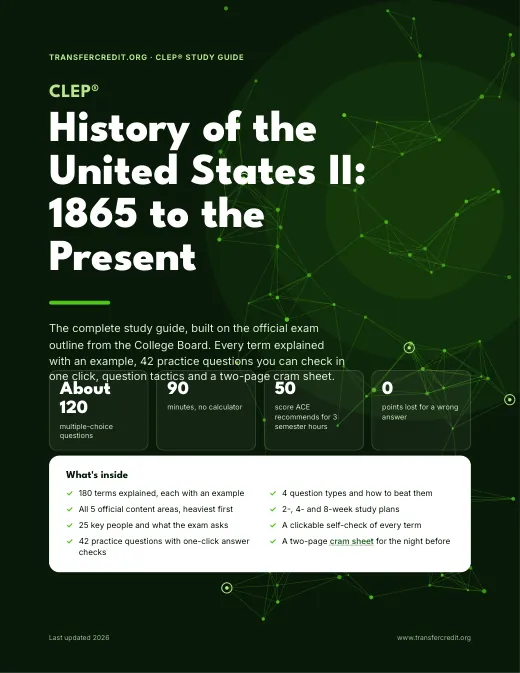
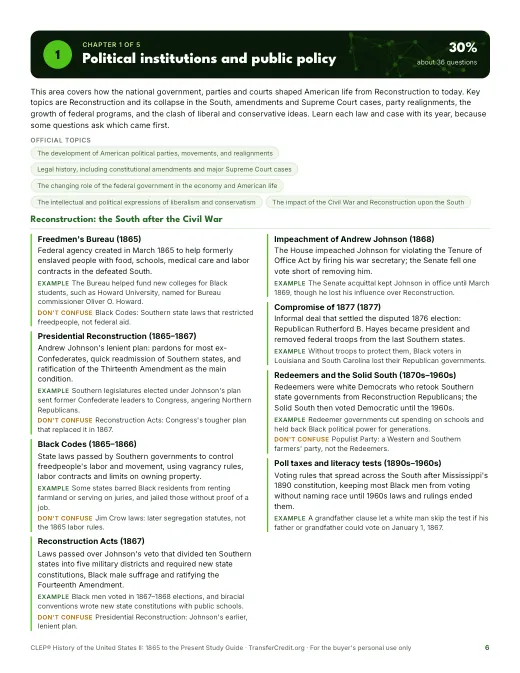
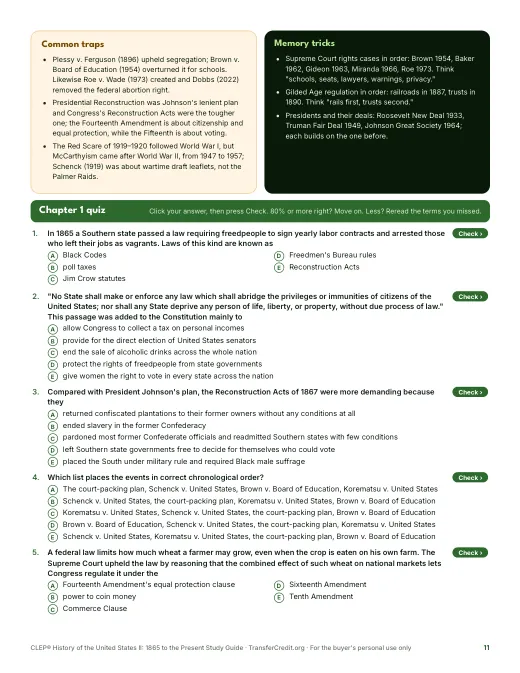
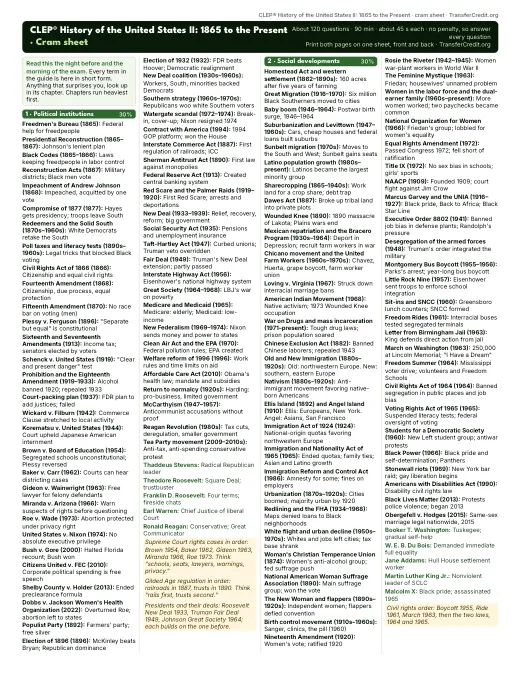
One chapter for each official content area, in the order the exam weighs them.
In the style of the real exam, from all 5 areas. About 10 minutes, with every answer explained and a score by area.
In 1865 a Southern state passed a law requiring freedpeople to sign yearly labor contracts and arrested those who left their jobs as vagrants. Laws of this kind are known as
Answer: E. Black Codes. Black Codes were 1865–1866 state laws that used vagrancy rules and labor contracts to keep freedpeople working for white landowners, and they angered Northern Republicans.
The trap: Jim Crow statutes were the later system of segregation laws that grew in the 1890s, not the 1865 labor controls.
Black Codes were 1865–1866 state laws that used vagrancy rules and labor contracts to keep freedpeople working for white landowners, and they angered Northern Republicans.
The trap: Jim Crow statutes were the later system of segregation laws that grew in the 1890s, not the 1865 labor controls.
A Black family leaves a Mississippi cotton farm in 1917 for a job in a Chicago meatpacking plant. Their move was part of which development?
Answer: D. The Great Migration out of the rural South. Wartime factory jobs and the wish to escape Jim Crow pulled about six million Black Southerners to Northern, Midwestern and Western cities between 1916 and 1970.
The trap: The Sunbelt migration of the 1970s moved people toward the South, the opposite direction from this family's move.
Wartime factory jobs and the wish to escape Jim Crow pulled about six million Black Southerners to Northern, Midwestern and Western cities between 1916 and 1970.
The trap: The Sunbelt migration of the 1970s moved people toward the South, the opposite direction from this family's move.
A 1925 trial in Dayton, Tennessee, in which a high school teacher was prosecuted for teaching evolution, is best understood as
Answer: B. a clash between religious fundamentalism and modern science. The Scopes Trial showed the conflict between fundamentalists, who defended a literal reading of the Bible, and defenders of teaching modern science.
The trap: Social Darwinism concerned competition in society and business, not the teaching of evolution in schools.
The Scopes Trial showed the conflict between fundamentalists, who defended a literal reading of the Bible, and defenders of teaching modern science.
The trap: Social Darwinism concerned competition in society and business, not the teaching of evolution in schools.
A steel company buys iron ore mines, coal fields, railroads and a shipping line so it controls every step from raw material to finished product. This strategy is called
Answer: A. vertical integration. Owning each stage of production, from supply to sales, is vertical integration. It cuts costs and cuts out middlemen.
The trap: Horizontal integration is tempting, but it means buying competing firms in the same business, not owning suppliers and transport.
Owning each stage of production, from supply to sales, is vertical integration. It cuts costs and cuts out middlemen.
The trap: Horizontal integration is tempting, but it means buying competing firms in the same business, not owning suppliers and transport.
In 1899 the secretary of state sends notes to Britain, Russia, Japan and other powers asking that every nation be allowed equal trade in China. This initiative is known as the
Answer: C. Open Door Policy. The Open Door notes protected American trade access in China without requiring the U.S. to claim territory there.
The trap: The Roosevelt Corollary is tempting because it concerns U.S. power abroad, but it was about Latin America and came in 1904.
The Open Door notes protected American trade access in China without requiring the U.S. to claim territory there.
The trap: The Roosevelt Corollary is tempting because it concerns U.S. power abroad, but it was about Latin America and came in 1904.
"No State shall make or enforce any law which shall abridge the privileges or immunities of citizens of the United States; nor shall any State deprive any person of life, liberty, or property, without due process of law." This passage was added to the Constitution mainly to
Answer: E. protect the rights of freedpeople from state governments. The passage is from the Fourteenth Amendment (1868), written to make freedpeople citizens and to stop states from denying them rights.
The trap: The income tax and direct election of senators came with the amendments of 1913, which are separate from this passage.
The passage is from the Fourteenth Amendment (1868), written to make freedpeople citizens and to stop states from denying them rights.
The trap: The income tax and direct election of senators came with the amendments of 1913, which are separate from this passage.
A leaflet circulated in a city in the 1910s warns: "These newcomers speak foreign tongues and keep foreign customs, and they will work for wages no native-born American can live on. Close the gates." The writer's view is best described as
Answer: B. nativism. The leaflet blames immigrants for threatening jobs and culture and calls for restriction. That is nativism, which grew strongest between the 1880s and the 1920s.
The trap: Assimilationism is tempting because it concerns immigrants, but it urges newcomers to adopt American ways rather than demanding that they be shut out.
The leaflet blames immigrants for threatening jobs and culture and calls for restriction. That is nativism, which grew strongest between the 1880s and the 1920s.
The trap: Assimilationism is tempting because it concerns immigrants, but it urges newcomers to adopt American ways rather than demanding that they be shut out.
A late-1800s writer argues that the rich are the fittest members of society and that government must not interfere with natural competition. This writer would most likely oppose
Answer: D. government programs to relieve poverty. The writer's view is Social Darwinism, which treated wealth as a sign of fitness and opposed government aid to the poor and economic regulation.
The trap: Competition among businesses is something Social Darwinists supported, so this writer would not oppose it.
The writer's view is Social Darwinism, which treated wealth as a sign of fitness and opposed government aid to the poor and economic regulation.
The trap: Competition among businesses is something Social Darwinists supported, so this writer would not oppose it.
A farmers' meeting in the 1890s declares: "We borrowed when crop prices were high and must repay now that they have fallen. Let the government coin silver freely so that money is plentiful and debts can be paid." Which policy are the farmers demanding?
Answer: C. Free and unlimited silver coinage. Free coinage of silver would increase the money supply and raise prices, which would help debtors. Many farmers backed it in the 1890s.
The trap: The gold standard is the opposite of what the farmers want, because it limited the money supply and kept prices falling.
Free coinage of silver would increase the money supply and raise prices, which would help debtors. Many farmers backed it in the 1890s.
The trap: The gold standard is the opposite of what the farmers want, because it limited the money supply and kept prices falling.
A president tells Congress that if a nation in the Western Hemisphere cannot keep order or pay its debts, the United States may step in so that European powers will not. This policy is the
Answer: A. Roosevelt Corollary. The Roosevelt Corollary extended the Monroe Doctrine by claiming a U.S. right to act as a police power in Latin America.
The trap: The Truman Doctrine also promised U.S. intervention, but it aimed to stop the spread of communism in Europe after 1947.
The Roosevelt Corollary extended the Monroe Doctrine by claiming a U.S. right to act as a police power in Latin America.
The trap: The Truman Doctrine also promised U.S. intervention, but it aimed to stop the spread of communism in Europe after 1947.
The CLEP History of the United States II: 1865 to the Present exam is a 90-minute, computer-based test from the College Board with about 120 multiple-choice questions. A score of 50 on the 20–80 scale earns an ACE credit recommendation of 3 semester hours, though each college sets its own policy. The exam covers 5 content areas; the heaviest is Political institutions and public policy at 30%.
Source: official CLEP History of the United States II: 1865 to the Present exam page.
5 areas, heaviest first. The guide's chapters follow this order.
Start with the guide, or get everything for CLEP in one plan.
CLEP® is a registered trademark of the College Board, which was not involved in producing this guide and does not endorse it. TransferCredit.org is independent and not affiliated with the College Board. © 2026 UPI Globale Edu Inc.