← All study guides
CLEP® Study Guide Printable PDF · 38 pages

CLEP Western Civilization I Study Guide

Official exam name: Western Civilization I: Ancient Near East to 1648

Everything the CLEP Western Civilization I exam tests, in one PDF you can print. Built from the College Board's official outline, heaviest topics first.

  • 168 key terms, each with an example
  • 38 practice questions with every answer explained
  • A 2-page cram sheet for the night before
  • 2-, 4- and 8-week study plans built from the exam weights
Not sure yet? Try 10 free questions

Last updated 2026 · exam details checked against the College Board's published exam information in 2026

Look inside the guide

Real pages from the 38-page PDF.

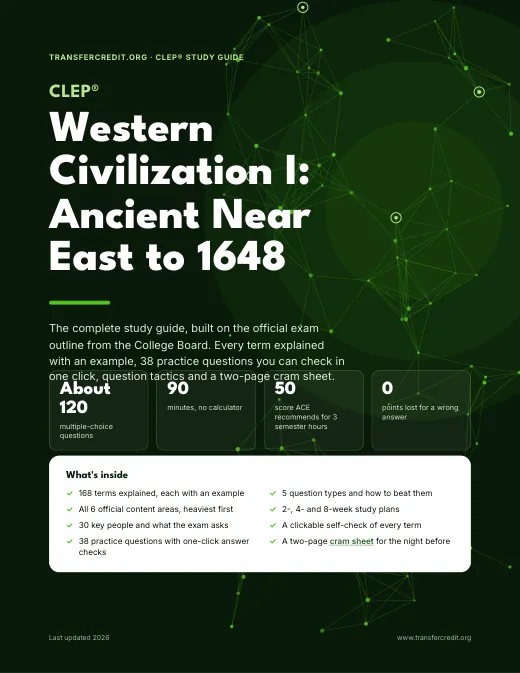
Page 1 of the CLEP Western Civilization I Study Guide: the cover
Page 1 The cover
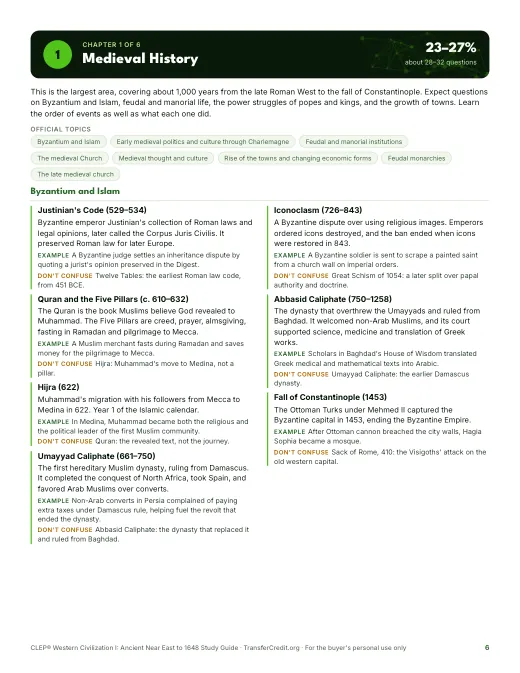
Page 6 of the CLEP Western Civilization I Study Guide: the Chapter 1 opener
Page 6 The Chapter 1 opener
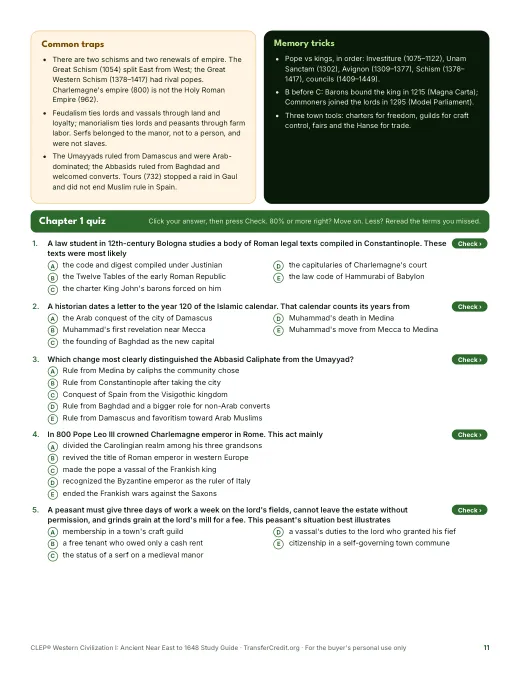
Page 11 of the CLEP Western Civilization I Study Guide: a chapter quiz
Page 11 A chapter quiz
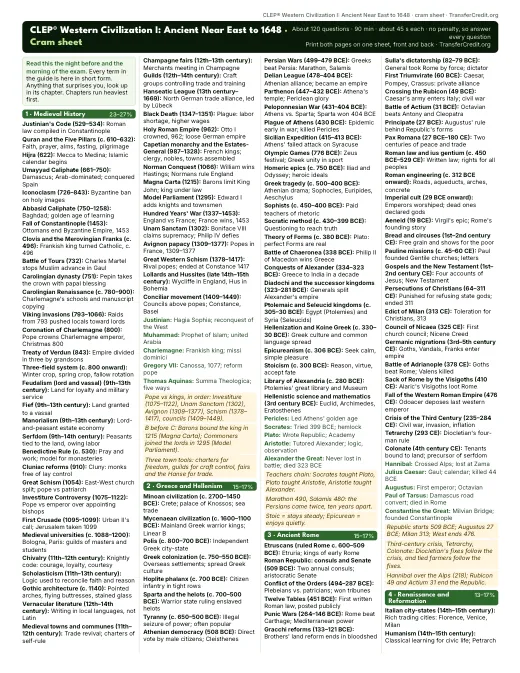
Page 37 of the CLEP Western Civilization I Study Guide: the 2-page cram sheet
Page 37 The 2-page cram sheet

What you get for $5

One chapter for each official content area, in the order the exam weighs them.

  • 📘38pages, printable
  • 🧭6chapters, heaviest first
  • 🔑168terms with examples
  • ✍️38practice questions, answers explained
  • ⚠️18exam traps to avoid
  • 📄2page cram sheet

Try 10 free Western Civilization I questions

In the style of the real exam, from all 6 areas. About 10 minutes, with every answer explained and a score by area.

10 questions  
  1. Question 1 · Medieval History

    A law student in 12th-century Bologna studies a body of Roman legal texts compiled in Constantinople. These texts were most likely

    Show the answer

    Answer: E. the code and digest compiled under Justinian. Justinian's Code (529–534) preserved Roman law, and medieval jurists revived it at Bologna.

    The trap: The Twelve Tables are much older, from 451 BCE, and were not the Constantinople compilation.

  2. Question 2 · Ancient Greece and Hellenistic Civilization

    In the 600s BCE, a Spartan citizen could devote himself to military training instead of farming mainly because

    Show the answer

    Answer: B. helots, an enslaved class, farmed the land for him. Spartan citizens relied on helots, enslaved Greeks who farmed the land, which freed the citizens for training and war.

    The trap: Spartans did not belong to the Delian League, which was an Athenian alliance.

  3. Question 3 · Ancient Rome

    In the early Republic, plebeians threatened to leave Rome unless they received protection from the patrician magistrates. Their struggle eventually won them

    Show the answer

    Answer: A. tribunes who could veto actions against plebeians. Plebeians gained tribunes with veto power, a written law code and, by 287 BCE, laws binding on all citizens, in the Conflict of the Orders.

    The trap: The Twelve Tables were a written code, but patrician decemvirs drew them up in 451 BCE, not plebeian judges.

  4. Question 4 · Renaissance and Reformation

    A scholar in 1470s Florence reads Cicero and urges young men to take part in civic government. This scholar is best described as

    Show the answer

    Answer: D. a humanist scholar. Humanists studied classical authors to guide public life, and Florence was a leading center.

    The trap: A scholastic theologian used Aristotle's logic in the universities, which is a medieval method, not this civic use of Cicero.

  5. Question 5 · Early Modern Europe, 1560-1648

    A Spanish king in the 1500s receives a large share of the silver mined in the Americas and uses it to pay for wars. A likely long-term European effect was

    Show the answer

    Answer: C. rising prices across Europe. Silver flowing into Europe, together with a growing population, produced the Price Revolution of the 1500s.

    The trap: Falling grain prices would be the opposite effect of the Price Revolution.

  6. Question 6 · Ancient Near East

    A scribe in a temple at Uruk presses a wedge-tipped reed into wet clay to record the grain stored in the granary. The scribe is using

    Show the answer

    Answer: D. cuneiform. Cuneiform, the wedge-shaped script made by pressing a stylus into clay, began in Sumer to record goods such as grain.

    The trap: Hieroglyphics are Egyptian and were carved on stone or written on papyrus, not pressed into clay.

  7. Question 7 · Medieval History

    A historian dates a letter to the year 120 of the Islamic calendar. That calendar counts its years from

    Show the answer

    Answer: B. Muhammad's move from Mecca to Medina. The Islamic calendar starts with the Hijra in 622, when Muhammad and his followers moved from Mecca to Medina.

    The trap: The first revelation (c. 610) came earlier and is not used to start the calendar.

  8. Question 8 · Ancient Greece and Hellenistic Civilization

    Which statement best describes the Athenian democracy set up by Cleisthenes in 508 BCE?

    Show the answer

    Answer: E. Adult male citizens took part directly in the Assembly and voted on laws.. Athens was a direct democracy, with male citizens voting for themselves. Women, slaves and foreign residents were excluded.

    The trap: Representative government did not exist in Athens, so the idea that elected delegates made laws does not fit.

  9. Question 9 · Ancient Rome

    Rome's victory over Carthage in the Punic Wars most directly gave Rome

    Show the answer

    Answer: C. control of Sicily, Spain and North Africa. After the wars, Rome held Sicily, Spain and North Africa and was the main power in the western Mediterranean.

    The trap: Rome's dealings with the Greek states came through separate wars in the east, not from defeating Carthage.

  10. Question 10 · Renaissance and Reformation

    The invention of movable-type printing in the mid-fifteenth century most directly helped Martin Luther because it

    Show the answer

    Answer: A. let his writings reach large audiences quickly and cheaply. Printers spread Luther's pamphlets and German Bible across Europe far faster than hand copying could.

    The trap: Printing did not end Latin in worship, and Catholic services stayed in Latin.

The CLEP Western Civilization I exam at a glance

The CLEP Western Civilization I: Ancient Near East to 1648 exam is a 90-minute, computer-based test from the College Board with about 120 multiple-choice questions. A score of 50 on the 20–80 scale earns an ACE credit recommendation of 3 semester hours, though each college sets its own policy. The exam covers 6 content areas; the heaviest is Medieval History at 23–27%.

Questions
About 120multiple choice
Time
90 minabout 45 seconds a question
Passing score
50on a 20–80 scale
ACE credit
3semester hours
Exam fee
$97paid to College Board
Calculator
Nonot allowed

Source: official CLEP Western Civilization I: Ancient Near East to 1648 exam page.

What the exam covers

6 areas, heaviest first. The guide's chapters follow this order.

  1. Medieval History23–27%
  2. Ancient Greece and Hellenistic Civilization15–17%
  3. Ancient Rome15–17%
  4. Renaissance and Reformation13–17%
  5. Early Modern Europe, 1560-164810–15%
  6. Ancient Near East8–10%

How it works

  1. 1Buy once, $5Secure checkout. No subscription needed.
  2. 2Download the PDFFrom your TransferCredit.org account, right away and any time later.
  3. 3Study the heaviest areas firstFollow the 2-, 4- or 8-week plan, then read the cram sheet the night before.

Questions students ask

What's in the full CLEP Western Civilization I study guide?
38 pages: 6 chapters, one per official content area, heaviest first. 168 terms, each with a plain-English definition and an example, 30 key people, common traps and memory tricks, 38 practice questions with an answer key that explains every answer, question tactics, 2-, 4- and 8-week study plans and a 2-page cram sheet.
How much is the full CLEP Western Civilization I study guide?
The full 38-page PDF is $5, a one-time payment. The 10 practice questions on this page are free, with no account.
What does the $29 plan include?
$29 a month gives you all 28 CLEP subjects: every CLEP study guide plus the full prep course for each subject, and you can cancel anytime. If you only need this exam, the guide on its own is a one-time $5.
How do I get the full guide?
Choose Buy this guide ($5) and check out. Then sign in to your TransferCredit.org account, then open the course and its Download Your Study Guide lesson. The PDF is yours to keep, and you can download it again from your account at any time.
Can I print the guide or use it on my phone?
Yes. It's a PDF, so it opens on phones, tablets and computers, and printing is allowed. Its tick boxes and answer bubbles work in PDF readers that support forms. Copying and editing are turned off.
Is this an official CLEP study guide?
No. CLEP® is a registered trademark of the College Board, which was not involved in producing this guide and does not endorse it. TransferCredit.org is independent. We built the guide from the official exam outline, and the exam details were checked against the College Board's published exam information in 2026.
Why is this study guide better than a generic review?
It follows the official outline area by area and spends the most pages on what the exam weighs most. Every term comes with an example, each chapter names the traps the exam sets, and the answer key explains why the most tempting wrong answer is wrong, not just which answer is right. It ends with a 2-page cram sheet for the night before.
What is the CLEP Western Civilization I exam?
The CLEP Western Civilization I: Ancient Near East to 1648 exam is a 90-minute, computer-based test from the College Board with about 120 multiple-choice questions. A score of 50 on the 20–80 scale earns an ACE credit recommendation of 3 semester hours, though each college sets its own policy. The exam covers 6 content areas; the heaviest is Medieval History at 23–27%.
More questions about the CLEP Western Civilization I exam (21)
How many questions are on the CLEP Western Civilization I exam, and how long is it?
It has approximately 120 questions to be answered in 90 minutes, and some are pretest questions that will not be scored.
What is the passing score for CLEP Western Civilization I?
The passing score is 50 on a 20–80 scale. At 50 or above, the American Council on Education (ACE) recommends 3 semester hours. Each college sets its own passing score and credit award, so check your school's policy before you book.
How much does the CLEP Western Civilization I exam cost?
The exam fee is $97, paid to the College Board. Test centers may add their own administration fee. Eligible U.S. military service members can usually test for free through DANTES.
How many college credits is CLEP Western Civilization I worth?
ACE recommends 3 semester hours for a passing score of 50. Your college decides how many credits it awards and which course they replace. Check your college's policy.
Is there a penalty for guessing on CLEP Western Civilization I?
No. Your score counts only correct answers, so a wrong answer costs nothing. Never leave a question blank: rule out what you can and pick your best guess.
What topics are on the CLEP Western Civilization I exam?
6 content areas, from the official outline: Medieval History (23–27%); Ancient Greece and Hellenistic Civilization (15–17%); Ancient Rome (15–17%); Renaissance and Reformation (13–17%); Early Modern Europe, 1560-1648 (10–15%); Ancient Near East (8–10%).
Which CLEP Western Civilization I topics should I study first?
Start with the three heaviest: Medieval History (23–27%), Ancient Greece and Hellenistic Civilization (15–17%) and Ancient Rome (15–17%). Together they are about 57% of the exam, roughly 73 of 120 questions. The guide's chapters run in that order, heaviest first.
Is the CLEP Western Civilization I exam hard?
It depends on what you already know. No single area dominates: the largest, Medieval History, is 23–27% and the smallest, Ancient Near East, is 8–10%, so broad coverage matters more than deep expertise in one topic. Take the free diagnostic above to see where you stand in about 10 minutes.
What kinds of questions are on the CLEP Western Civilization I exam?
The guide sorts them into 5 types: “Identify and describe”, “Cause and effect”, “Chronology and sequence”, “Compare and contrast” and “Interpret a source”. Every question has 5 answer choices. Try the 10 free questions above to see the style.
How long should I study for CLEP Western Civilization I?
Use the diagnostic to decide. If you already know most areas, two weeks of daily review is often enough; if the subject is new to you, plan on eight. The full guide has 2-, 4- and 8-week plans built from the exam weights.
How should I pace myself on the CLEP Western Civilization I exam?
On average you have about 45 seconds per question (90 minutes for 120 questions). Be past question 40 a third of the way through and past question 80 two-thirds through. If a question takes more than a minute, pick your best guess, mark it and come back.
What happens if I don't pass CLEP Western Civilization I?
You can retake a CLEP exam after three months. Use the wait to work through the areas the score report and the diagnostic show you missed.
Do colleges accept CLEP Western Civilization I for credit?
CLEP exams are accepted at more than 2,900 U.S. colleges and universities, but each school decides which exams it accepts, the score it requires and the credit it gives. Look up your college's CLEP policy before you book.
How up to date is this CLEP Western Civilization I guide?
Last updated 2026. The exam details were checked against the College Board's published exam information in 2026. Exams change, so confirm the details on the official exam page before you register.
What should I do the night before the exam?
Read the cram sheet once, slowly. Check your test time, the location or remote-proctoring setup, and the ID you need. Then sleep: a rested brain recalls more than a crammed one. In the morning, skim the memory tricks and common traps, then stop studying.
What's the difference between Western Civilization I and II?
Western Civilization I runs from the ancient Near East to 1648. Western Civilization II picks up in 1648 and runs to the present. They're separate exams, each worth 3 credits.
Which historical figures should I know for CLEP Western Civilization I?
Know Hammurabi, Pericles, Socrates, Plato, Aristotle, Alexander the Great, Julius Caesar, Augustus, Constantine, Justinian, Muhammad, Charlemagne, Thomas Aquinas, Machiavelli, Martin Luther and John Calvin, and what each is known for. Questions may describe a figure's viewpoint and ask you to name them, or ask you to spot a person wrongly paired with an event.
Does CLEP Western Civilization I use BCE and CE?
Yes. The exam uses BCE (before the common era) and CE (common era), which correspond to BC and AD in some textbooks. The year numbers don't change, so 44 BCE is the same year as 44 BC.
Does CLEP Western Civilization I cover the Thirty Years' War?
Yes. The exam ends in 1648, the year the Peace of Westphalia ended the Thirty Years' War, and dynastic and religious conflicts are part of Early Modern Europe, 1560–1648, which is 10–15% of the exam.
Does the exam use maps and images?
Yes. Some questions ask you to interpret maps, pictures and quotations from primary sources, so practice with historical visuals as you study.
Does CLEP Western Civilization I cover Islam and Byzantium?
Yes. Byzantium and Islam are part of medieval history, the largest area on the exam.

Choose how you want to study

Start with the guide, or get everything for CLEP in one plan.

This study guide
$5one-time
  • 38-page printable PDF
  • 168 terms with examples
  • 38 practice questions, answers explained
  • 2-page cram sheet and study plans
Get the guide · $5
Best value Get it all
$29/month
  • Every CLEP study guide
  • Prep courses for all 28 CLEP subjects
  • Cancel anytime
Get it all · $29/mo

CLEP® is a registered trademark of the College Board, which was not involved in producing this guide and does not endorse it. TransferCredit.org is independent and not affiliated with the College Board. © 2026 UPI Globale Edu Inc.