
$5one-time
- 49-page printable PDF
- 180 terms with examples
- 60 practice questions, answers explained
- 2-page cram sheet and study plans
Official exam name: Western Civilization II: 1648 to the Present
Everything the CLEP Western Civilization II exam tests, in one PDF you can print. Built from the College Board's official outline, heaviest topics first.
Last updated 2026 · exam details checked against the College Board's published exam information in 2026
Real pages from the 49-page PDF.
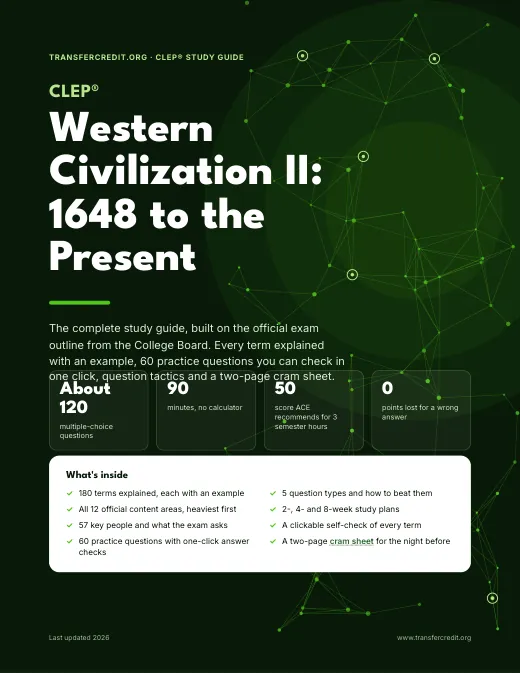
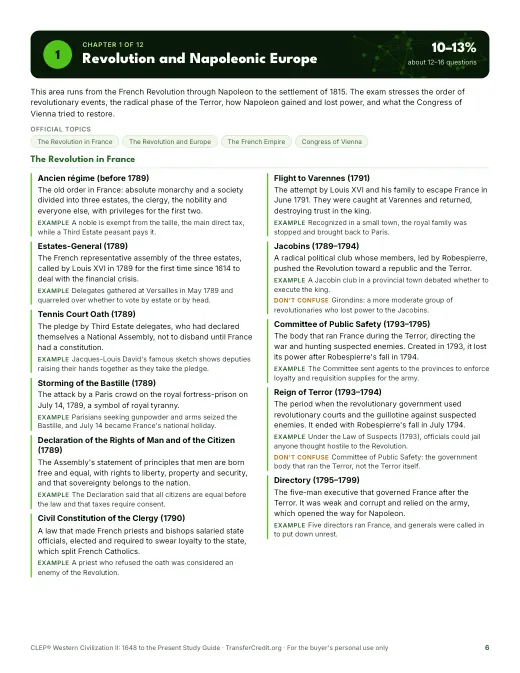
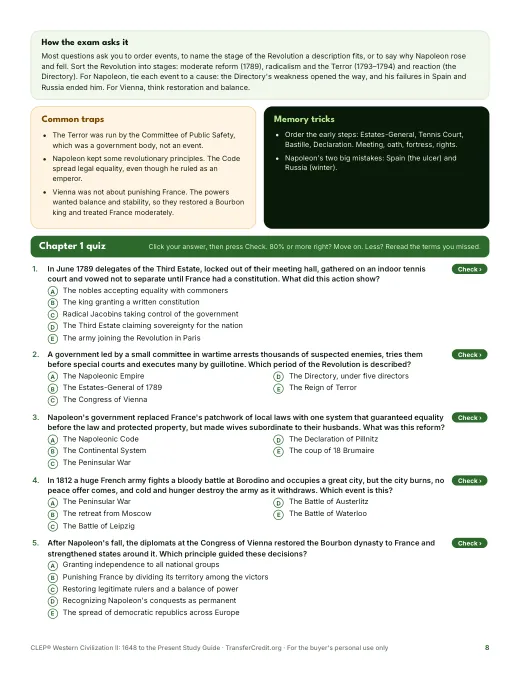
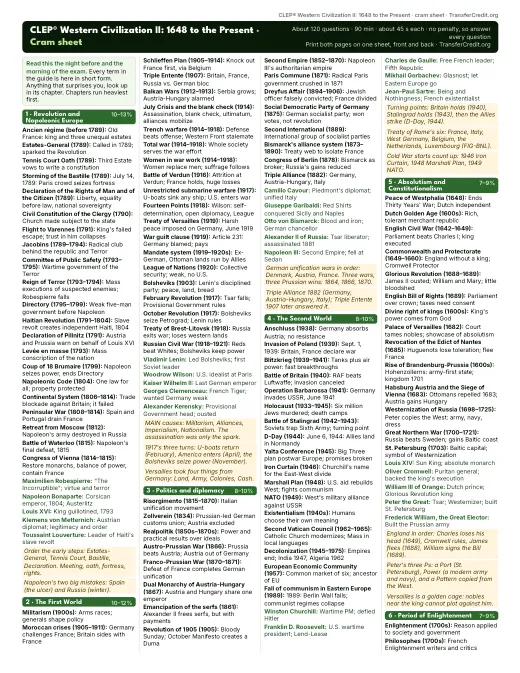
One chapter for each official content area, in the order the exam weighs them.
In the style of the real exam, one from each of the ten heaviest areas. About 10 minutes, with every answer explained and a score by area.
In June 1789 delegates of the Third Estate, locked out of their meeting hall, gathered on an indoor tennis court and vowed not to separate until France had a constitution. What did this action show?
Answer: B. The Third Estate claiming sovereignty for the nation. By vowing to continue as a National Assembly until a constitution existed, the delegates asserted that authority lay with the nation, not the king.
The trap: The Jacobins taking control is tempting because it is a revolutionary event, but they took control only in 1793, in the radical phase.
By vowing to continue as a National Assembly until a constitution existed, the delegates asserted that authority lay with the nation, not the king.
The trap: The Jacobins taking control is tempting because it is a revolutionary event, but they took control only in 1793, in the radical phase.
A German planner argues that France can be beaten within weeks by marching through Belgium, leaving Germany free to turn on Russia. In 1914 the plan's most important political consequence was that it
Answer: E. drew Britain in by violating Belgian neutrality. Britain had pledged to protect Belgian neutrality, so Germany's invasion turned a continental conflict into one involving the British Empire.
The trap: Giving the United States an immediate reason to join the war is wrong: America entered in 1917, mainly because of submarine attacks.
Britain had pledged to protect Belgian neutrality, so Germany's invasion turned a continental conflict into one involving the British Empire.
The trap: Giving the United States an immediate reason to join the war is wrong: America entered in 1917, mainly because of submarine attacks.
Which statement best explains how Germany was unified under Prussian leadership?
Answer: D. Bismarck's wars with Austria and France, using realpolitik. Prussia defeated Austria in 1866 and France in 1870–1871 under Bismarck, whose realpolitik emphasized power over ideals.
The trap: The Frankfurt convention is tempting because it aimed at unity, but that assembly failed in 1849 when the Prussian king refused its crown.
Prussia defeated Austria in 1866 and France in 1870–1871 under Bismarck, whose realpolitik emphasized power over ideals.
The trap: The Frankfurt convention is tempting because it aimed at unity, but that assembly failed in 1849 when the Prussian king refused its crown.
In 1940 German aircraft attack British airfields and cities for months, but Britain's fighters and radar prevent Germany from winning control of the air, and a planned invasion is canceled. Which event is this?
Answer: C. The Battle of Britain. The Luftwaffe's failure to defeat the RAF meant Germany could not safely cross the Channel, so Britain stayed in the war.
The trap: Blitzkrieg in France is wrong: that was a fast ground and air campaign that succeeded in six weeks, not an air campaign that failed.
The Luftwaffe's failure to defeat the RAF meant Germany could not safely cross the Channel, so Britain stayed in the war.
The trap: Blitzkrieg in France is wrong: that was a fast ground and air campaign that succeeded in six weeks, not an air campaign that failed.
A ruler tells his court that he answers only to God, requires leading nobles to live at his palace, and cancels religious toleration for a minority. This ruler is most likely
Answer: A. Louis XIV of France. Only Louis XIV matches all three clues: divine right, a court at Versailles that kept nobles close, and the revocation of the Edict of Nantes in 1685.
The trap: Oliver Cromwell is wrong: he ruled after Parliament executed a king who claimed divine right, and he did not run a court of nobles.
Only Louis XIV matches all three clues: divine right, a court at Versailles that kept nobles close, and the revocation of the Edict of Nantes in 1685.
The trap: Oliver Cromwell is wrong: he ruled after Parliament executed a king who claimed divine right, and he did not run a court of nobles.
An eighteenth-century writer argues that government should be divided into legislative, executive and judicial branches so that no single group can become a tyrant. Whose ideas does this reflect?
Answer: E. Baron de Montesquieu. Dividing government into three branches that limit one another is Montesquieu's separation of powers, set out in The Spirit of the Laws.
The trap: Rousseau is tempting because he also wrote about legitimate government, but his general will concerned popular sovereignty, not dividing government into branches.
Dividing government into three branches that limit one another is Montesquieu's separation of powers, set out in The Spirit of the Laws.
The trap: Rousseau is tempting because he also wrote about legitimate government, but his general will concerned popular sovereignty, not dividing government into branches.
A village in 1780 loses its shared pasture when Parliament approves fencing it into large farms, and many laborers soon leave for nearby towns. Which long-term effect does this illustrate?
Answer: D. A growing pool of wage workers available for factories. Enclosure helped landowners farm more efficiently and pushed villagers off the land, producing the labor force that mills and mines needed.
The trap: A sharp fall in food production is wrong: enclosure and new techniques raised output, which also fed growing cities.
Enclosure helped landowners farm more efficiently and pushed villagers off the land, producing the labor force that mills and mines needed.
The trap: A sharp fall in food production is wrong: enclosure and new techniques raised output, which also fed growing cities.
A speaker in the 1890s argues that European nations rule Africa because strong peoples naturally dominate weaker ones, as in nature's "survival of the fittest". Which idea is the speaker applying?
Answer: B. Social Darwinism. Applying survival of the fittest to nations and races to justify imperial rule is Social Darwinism, a misuse of Darwin's biology.
The trap: Natural selection is tempting because the language is Darwin's, but Darwin's theory described biological change and made no claim about ranking nations.
Applying survival of the fittest to nations and races to justify imperial rule is Social Darwinism, a misuse of Darwin's biology.
The trap: Natural selection is tempting because the language is Darwin's, but Darwin's theory described biological change and made no claim about ranking nations.
In 1930 a Soviet village is ordered to merge its private plots into one state-controlled farm, and the wealthier peasants are deported. This policy is
Answer: C. collectivization. Merging peasant plots into state farms and attacking kulaks defines collectivization, which aimed to control grain and feed industrial workers.
The trap: A five-year plan for steel is wrong: five-year plans set targets for heavy industry, not the structure of village farming.
Merging peasant plots into state farms and attacking kulaks defines collectivization, which aimed to control grain and feed industrial workers.
The trap: A five-year plan for steel is wrong: five-year plans set targets for heavy industry, not the structure of village farming.
A minister in a central European state argues that universities and newspapers should be closely watched because they spread dangerous liberal and nationalist ideas. Which development of the period put this argument into practice?
Answer: A. The Carlsbad Decrees. The Carlsbad Decrees imposed censorship and university supervision in the German states in 1819 to fight liberal and nationalist movements.
The trap: The Frankfurt Parliament is tempting because it involved German nationalism, but it came in 1848 and sought to promote unification, not to suppress these ideas.
The Carlsbad Decrees imposed censorship and university supervision in the German states in 1819 to fight liberal and nationalist movements.
The trap: The Frankfurt Parliament is tempting because it involved German nationalism, but it came in 1848 and sought to promote unification, not to suppress these ideas.
The CLEP Western Civilization II: 1648 to the Present exam is a 90-minute, computer-based test from the College Board with about 120 multiple-choice questions. A score of 50 on the 20–80 scale earns an ACE credit recommendation of 3 semester hours, though each college sets its own policy. The exam covers 12 content areas; the heaviest is Revolution and Napoleonic Europe at 10–13%.
Source: official CLEP Western Civilization II: 1648 to the Present exam page.
12 areas, heaviest first. The guide's chapters follow this order.
Start with the guide, or get everything for CLEP in one plan.
CLEP® is a registered trademark of the College Board, which was not involved in producing this guide and does not endorse it. TransferCredit.org is independent and not affiliated with the College Board. © 2026 UPI Globale Edu Inc.