← All study guides
DSST® Study Guide Printable PDF · 41 pages

DSST General Anthropology Study Guide

Everything the DSST General Anthropology exam tests, in one PDF you can print. Built from Prometric's official outline, heaviest topics first.

  • 181 key terms, each with an example
  • 46 practice questions with every answer explained
  • A 2-page cram sheet for the night before
  • 2-, 4- and 8-week study plans built from the exam weights
Not sure yet? Try 10 free questions

Last updated 2026 · exam details checked against Prometric's published exam information in 2026

Look inside the guide

Real pages from the 41-page PDF.

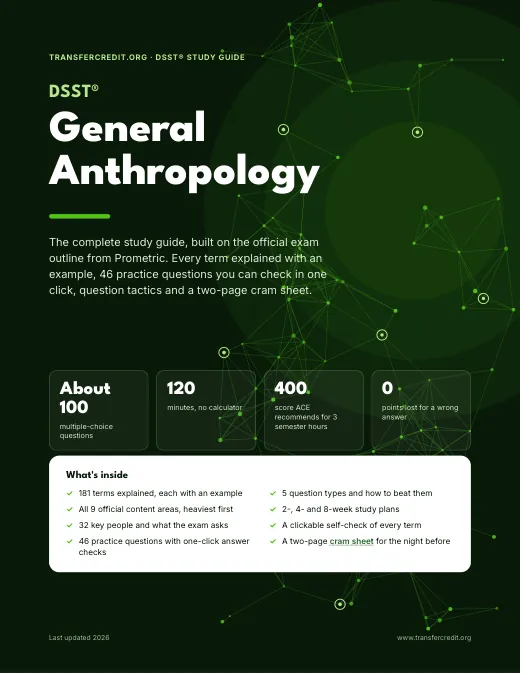
Page 1 of the DSST General Anthropology Study Guide: the cover
Page 1 The cover
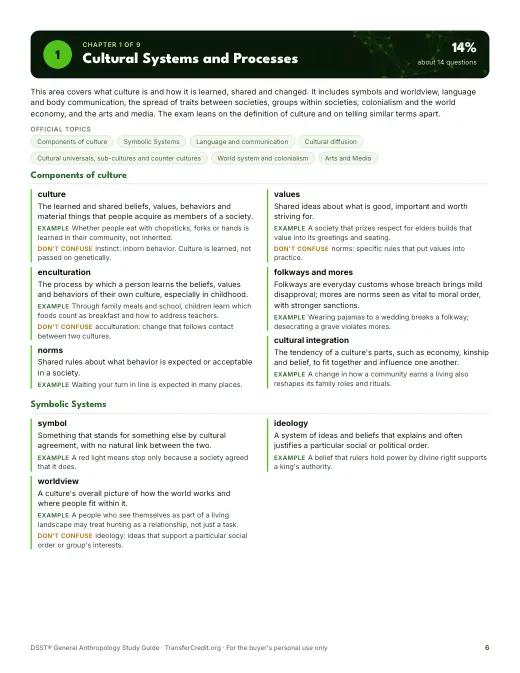
Page 6 of the DSST General Anthropology Study Guide: the Chapter 1 opener
Page 6 The Chapter 1 opener
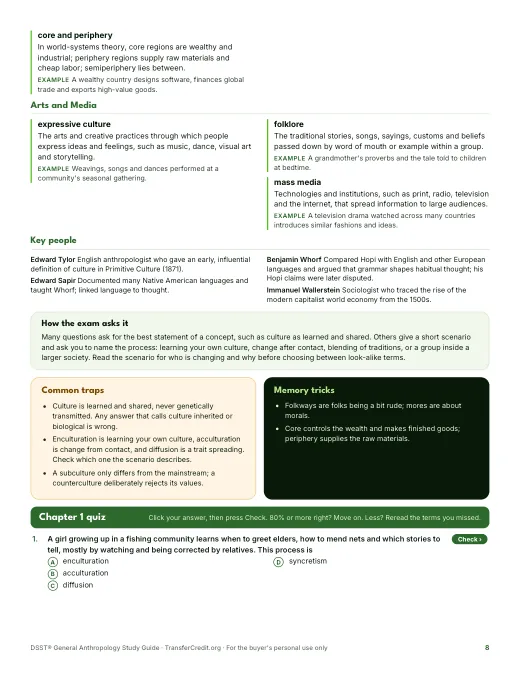
Page 8 of the DSST General Anthropology Study Guide: a chapter quiz
Page 8 A chapter quiz
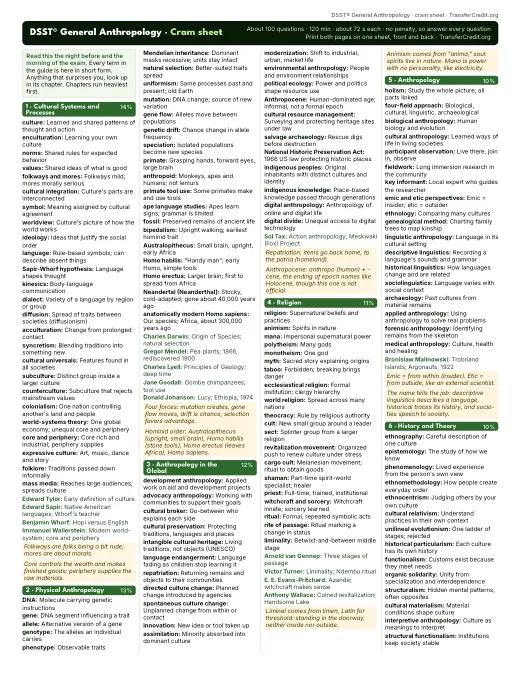
Page 40 of the DSST General Anthropology Study Guide: the 2-page cram sheet
Page 40 The 2-page cram sheet

What you get for $5

One chapter for each official content area, in the order the exam weighs them.

  • 📘41pages, printable
  • 🧭9chapters, heaviest first
  • 🔑181terms with examples
  • ✍️46practice questions, answers explained
  • ⚠️27exam traps to avoid
  • 📄2page cram sheet

Try 10 free General Anthropology questions

In the style of the real exam, from all 9 areas. About 10 minutes, with every answer explained and a score by area.

10 questions  
  1. Question 1 · Cultural Systems and Processes

    A girl growing up in a fishing community learns when to greet elders, how to mend nets and which stories to tell, mostly by watching and being corrected by relatives. This process is

    Show the answer

    Answer: B. enculturation. Learning the ways of one's own culture, mainly in childhood, is enculturation.

    The trap: Acculturation is change that follows contact between two different cultures, not learning one's own culture.

  2. Question 2 · Physical Anthropology

    Farmers from a river valley marry into a mountain community, and alleles once found only in the valley begin to appear among the mountain people. Which evolutionary force is at work?

    Show the answer

    Answer: C. Gene flow. Alleles moving from one population to another through interbreeding is gene flow.

    The trap: Genetic drift is tempting because allele frequencies change, but drift is chance change within a population. Here alleles arrive from outside.

  3. Question 3 · Anthropology in the Global Age

    An anthropologist is invited by a community to help gather maps and elders' testimony for its land claim, and follows the community's own goals throughout. This work is

    Show the answer

    Answer: D. advocacy anthropology. Working with a community, at its request, to support its own goals and rights is advocacy anthropology.

    The trap: Development anthropology helps plan projects to improve living conditions, not to back a group's own claim.

  4. Question 4 · Religion

    A woman is called whenever someone in the village is ill. She enters a trance, speaks with spirits and then names a remedy. She holds no full-time office in any religious hierarchy. Which specialist is she?

    Show the answer

    Answer: A. Shaman. A part-time specialist who contacts the spirit world through personal power, often to heal, is a shaman.

    The trap: A priest is tempting because both lead religious practice, but priests are full-time and trained within a formal institution.

  5. Question 5 · Anthropology: Methodologies and Disciplines

    A researcher moves into a mountain village for a year, helps with farm work, learns the dialect and writes notes each night. Which method is this?

    Show the answer

    Answer: D. Participant observation. Living in the community, joining daily life and recording it is participant observation, the core method of fieldwork.

    The trap: Ethnology is tempting because it sounds like fieldwork, but it compares many cultures. This researcher studies one village.

  6. Question 6 · History and Theory

    A visiting official tells villagers that sharing one bowl at meals is backward because her own country uses separate plates. Her judgment is an example of

    Show the answer

    Answer: B. ethnocentrism. She judges the villagers' custom by her own culture's standards and ranks it as inferior, which is ethnocentrism.

    The trap: Cultural relativism is the opposite: it seeks to understand a custom in its own context rather than rank it.

  7. Question 7 · Archaeology

    An undisturbed trench shows a layer containing painted pots lying beneath a layer containing glass beads. What can the archaeologist conclude from stratigraphy?

    Show the answer

    Answer: C. The pots were probably deposited before the beads. In undisturbed deposits, lower layers are older, so the pots were deposited first. Stratigraphy gives order, not a precise age.

    The trap: The 500-year figure is a trap. Stratigraphy is relative dating, which says older or younger but cannot give an exact number of years.

  8. Question 8 · Social Organization

    Custom in a community requires every person to marry someone from outside the home village. This rule is an example of

    Show the answer

    Answer: A. exogamy. Marrying outside a specified group, here the village, is exogamy.

    The trap: Endogamy requires marriage inside the group, the reverse of this rule.

  9. Question 9 · Economic and Political Organization

    A society has ranked kin groups, a hereditary leader who receives food from many villages, and large ceremonial feasts. Which type of political system is this?

    Show the answer

    Answer: C. Chiefdom. Ranked lineages and a hereditary leader who collects and redistributes goods mark a chiefdom.

    The trap: A tribe is tempting because it is also kin-based, but tribes have no permanent central ruler and little formal ranking.

  10. Question 10 · Cultural Systems and Processes

    In a village, arriving late to a feast draws only teasing, while betraying a sworn kin obligation brings banishment. Anthropologists would classify these two norms as

    Show the answer

    Answer: A. a folkway for the lateness, the mores for the betrayal. Mild disapproval marks a folkway; a norm seen as vital to the moral order, with severe punishment, marks the mores.

    The trap: Treating both as mores ignores the difference in sanctions: teasing signals a folkway, banishment signals the mores.

The DSST General Anthropology exam at a glance

The DSST General Anthropology exam is a 120-minute, computer-based test from Prometric with about 100 multiple-choice questions. A score of 400 on the 200–500 scale earns an ACE credit recommendation of 3 semester hours, though each college sets its own policy. The exam covers 9 content areas; the heaviest is Cultural Systems and Processes at 14%.

Questions
About 100multiple choice
Time
120 minabout 72 seconds a question
Passing score
400on a 200–500 scale
ACE credit
3semester hours
Exam fee
$100paid to Prometric
Calculator
Nonot allowed

Source: official DSST General Anthropology exam page.

What the exam covers

9 areas, heaviest first. The guide's chapters follow this order.

  1. Cultural Systems and Processes14%
  2. Physical Anthropology13%
  3. Anthropology in the Global Age12%
  4. Religion11%
  5. Anthropology: Methodologies and Disciplines10%
  6. History and Theory10%
  7. Archaeology10%
  8. Social Organization10%
  9. Economic and Political Organization10%

How it works

  1. 1Buy once, $5Secure checkout. No subscription needed.
  2. 2Download the PDFFrom your TransferCredit.org account, right away and any time later.
  3. 3Study the heaviest areas firstFollow the 2-, 4- or 8-week plan, then read the cram sheet the night before.

Questions students ask

What's in the full DSST General Anthropology study guide?
41 pages: 9 chapters, one per official content area, heaviest first. 181 terms, each with a plain-English definition and an example, 32 key people, common traps and memory tricks, 46 practice questions with an answer key that explains every answer, question tactics, 2-, 4- and 8-week study plans and a 2-page cram sheet.
How much is the full DSST General Anthropology study guide?
The full 41-page PDF is $5, a one-time payment. The 10 practice questions on this page are free, with no account.
What does the $29 plan include?
$29 a month gives you all DSST subjects: every DSST study guide plus the full prep course for each subject, and you can cancel anytime. If you only need this exam, the guide on its own is a one-time $5.
How do I get the full guide?
Choose Buy this guide ($5) and check out. Then sign in to your TransferCredit.org account, then open the course and its Download Your Study Guide lesson. The PDF is yours to keep, and you can download it again from your account at any time.
Can I print the guide or use it on my phone?
Yes. It's a PDF, so it opens on phones, tablets and computers, and printing is allowed. Its tick boxes and answer bubbles work in PDF readers that support forms. Copying and editing are turned off.
Is this an official DSST study guide?
No. DSST® is a registered trademark of Prometric, which was not involved in producing this guide and does not endorse it. TransferCredit.org is independent. We built the guide from the official exam outline, and the exam details were checked against Prometric's published exam information in 2026.
Why is this study guide better than a generic review?
It follows the official outline area by area and spends the most pages on what the exam weighs most. Every term comes with an example, each chapter names the traps the exam sets, and the answer key explains why the most tempting wrong answer is wrong, not just which answer is right. It ends with a 2-page cram sheet for the night before.
What is the DSST General Anthropology exam?
The DSST General Anthropology exam is a 120-minute, computer-based test from Prometric with about 100 multiple-choice questions. A score of 400 on the 200–500 scale earns an ACE credit recommendation of 3 semester hours, though each college sets its own policy. The exam covers 9 content areas; the heaviest is Cultural Systems and Processes at 14%.
More questions about the DSST General Anthropology exam (22)
How many questions are on the DSST General Anthropology exam, and how long is it?
It contains 100 questions to be answered in 2 hours.
What is the passing score for DSST General Anthropology?
The passing score is 400 on a 200–500 scale. At 400 or above, the American Council on Education (ACE) recommends 3 semester hours. Each college sets its own passing score and credit award, so check your school's policy before you book.
How much does the DSST General Anthropology exam cost?
The exam fee is $100, paid to Prometric. Test centers may add their own administration fee. Eligible U.S. military service members can usually test for free through DANTES.
How many college credits is DSST General Anthropology worth?
ACE recommends 3 semester hours for a passing score of 400. Your college decides how many credits it awards and which course they replace. Check your college's policy.
Is there a penalty for guessing on DSST General Anthropology?
No. Your score counts only correct answers, so a wrong answer costs nothing. Never leave a question blank: rule out what you can and pick your best guess.
What topics are on the DSST General Anthropology exam?
9 content areas, from the official outline: Cultural Systems and Processes (14%); Physical Anthropology (13%); Anthropology in the Global Age (12%); Religion (11%); Anthropology: Methodologies and Disciplines (10%); History and Theory (10%); Archaeology (10%); Social Organization (10%); Economic and Political Organization (10%).
Which DSST General Anthropology topics should I study first?
Start with the three heaviest: Cultural Systems and Processes (14%), Physical Anthropology (13%) and Anthropology in the Global Age (12%). Together they are about 39% of the exam, roughly 39 of 100 questions. The guide's chapters run in that order, heaviest first.
Is the DSST General Anthropology exam hard?
It depends on what you already know. No single area dominates: the largest, Cultural Systems and Processes, is 14% and the smallest, Economic and Political Organization, is 10%, so broad coverage matters more than deep expertise in one topic. Take the free diagnostic above to see where you stand in about 10 minutes.
What kinds of questions are on the DSST General Anthropology exam?
The guide sorts them into 5 types: “Best describes the concept”, “Name the term from a scenario”, “Who and what contribution”, “Compare two similar concepts” and “Which is an example of”. Every question has 4 answer choices. Try the 10 free questions above to see the style.
How long should I study for DSST General Anthropology?
Use the diagnostic to decide. If you already know most areas, two weeks of daily review is often enough; if the subject is new to you, plan on eight. The full guide has 2-, 4- and 8-week plans built from the exam weights.
How should I pace myself on the DSST General Anthropology exam?
On average you have about 72 seconds per question (120 minutes for 100 questions). Be past question 33 a third of the way through and past question 67 two-thirds through. If a question takes more than a minute, pick your best guess, mark it and come back.
What happens if I don't pass DSST General Anthropology?
You can retake a DSST exam after 30 days. Use the wait to work through the areas the score report and the diagnostic show you missed.
Do colleges accept DSST General Anthropology for credit?
DSST exams are accepted at more than 1,500 colleges and universities, but each school decides which exams it accepts, the score it requires and the credit it gives. Look up your college's DSST policy before you book.
How up to date is this DSST General Anthropology guide?
Last updated 2026. The exam details were checked against Prometric's published exam information in 2026. Exams change, so confirm the details on the official exam page before you register.
What should I do the night before the exam?
Read the cram sheet once, slowly. Check your test time, the location or remote-proctoring setup, and the ID you need. Then sleep: a rested brain recalls more than a crammed one. In the morning, skim the memory tricks and common traps, then stop studying.
Does DSST General Anthropology cover human evolution?
Yes. Physical anthropology is 13% of the exam and covers genetics, evolution, primates, paleontology and fossil hominids.
Which anthropologists should I know for DSST General Anthropology?
Know Franz Boas (cultural relativism and historical particularism), Bronisław Malinowski (participant observation and functionalism) and Margaret Mead (Coming of Age in Samoa). The official sample questions also draw on Charles Darwin's theory of natural selection and Jane Goodall's discovery that wild chimpanzees make and use tools.
Does DSST General Anthropology cover archaeology?
Yes. Archaeology is 10% of the exam and covers archaeological methods, the Paleolithic and Mesolithic, the Neolithic, the rise of civilization and cities, and material culture.
Which kinship terms should I know for DSST General Anthropology?
Social organization is 10% of the exam and covers marriage, family, kinship and descent groups. Know patrilineal, matrilineal and bilateral descent; endogamy and exogamy; polygyny and polyandry; and patrilocal, matrilocal and neolocal residence.
Is DSST General Anthropology multiple choice only?
Yes. Every question is multiple choice with one correct answer and three incorrect options, and there's no essay or written section.
How is anthropology different from sociology?
Both study society, but anthropology compares cultures worldwide and across time, and also includes human evolution, archaeology and language. The exam tests all four fields.
Can I take DSST General Anthropology online?
Yes. DSST exams can be taken at a test center or online with a remote Prometric proctor.

Choose how you want to study

Start with the guide, or get everything for DSST in one plan.

This study guide
$5one-time
  • 41-page printable PDF
  • 181 terms with examples
  • 46 practice questions, answers explained
  • 2-page cram sheet and study plans
Get the guide · $5
Best value Get it all
$29/month
  • Every DSST study guide
  • Prep courses for all DSST subjects
  • Cancel anytime
Get it all · $29/mo

DSST® is a registered trademark of Prometric, which was not involved in producing this guide and does not endorse it. TransferCredit.org is independent and not affiliated with Prometric. © 2026 UPI Globale Edu Inc.