
$5one-time
- 31-page printable PDF
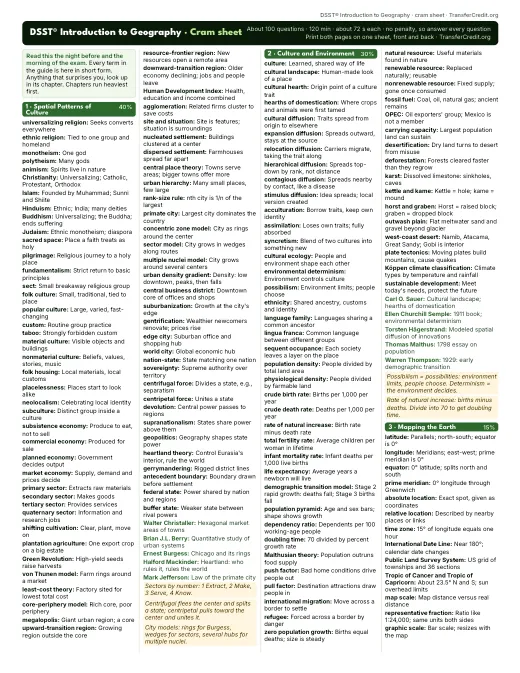
- 180 terms with examples
- 40 practice questions, answers explained
- 2-page cram sheet and study plans
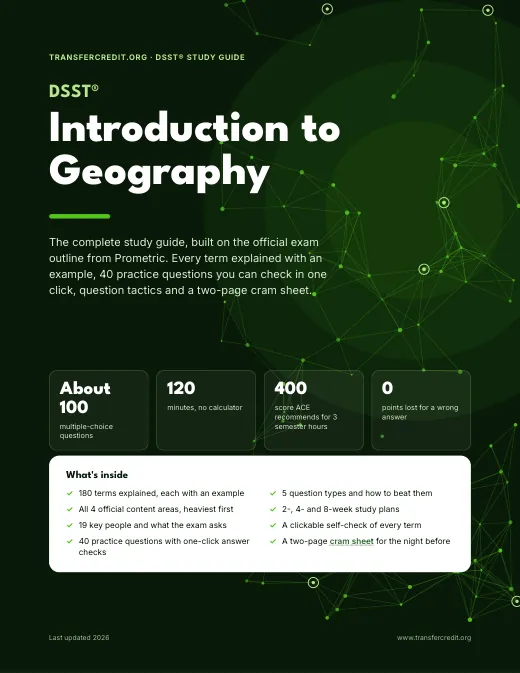
Everything the DSST Introduction to Geography exam tests, in one PDF you can print. Built from Prometric's official outline, heaviest topics first.
Last updated 2026 · exam details checked against Prometric's published exam information in 2026
Real pages from the 31-page PDF.
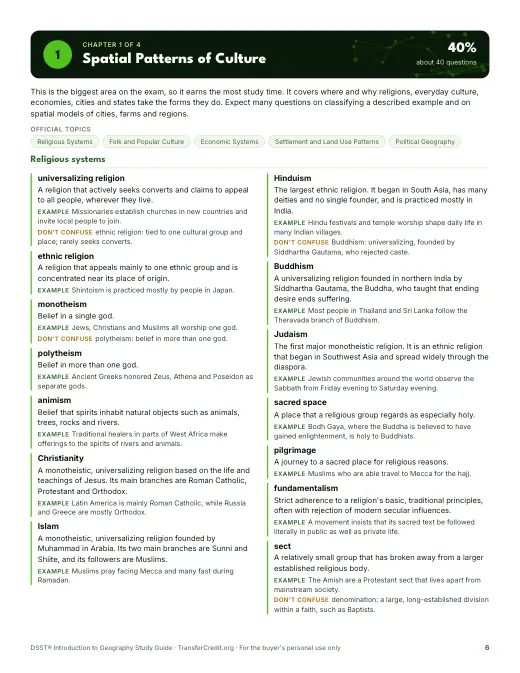
One chapter for each official content area, in the order the exam weighs them.
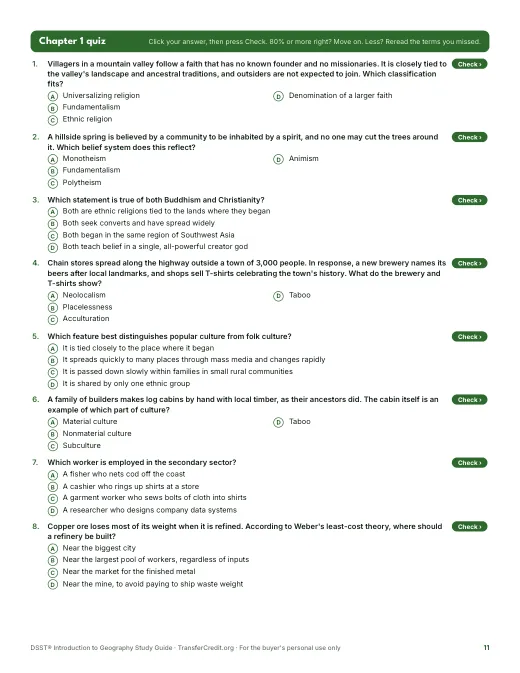
In the style of the real exam, from all 4 areas. About 10 minutes, with every answer explained and a score by area.
Villagers in a mountain valley follow a faith that has no known founder and no missionaries. It is closely tied to the valley's landscape and ancestral traditions, and outsiders are not expected to join. Which classification fits?
Answer: A. Ethnic religion. The faith belongs to one group and place, has no missionaries and does not seek converts. Those are the marks of an ethnic religion.
The trap: Universalizing religion is tempting because it is also a major classification, but universalizing religions actively seek converts everywhere.
The faith belongs to one group and place, has no missionaries and does not seek converts. Those are the marks of an ethnic religion.
The trap: Universalizing religion is tempting because it is also a major classification, but universalizing religions actively seek converts everywhere.
A country's birth rate is falling as more women attend school and move to cities, while its death rate stays low. Its population still grows, but more slowly each year. Which stage of the demographic transition model does this describe?
Answer: D. Stage 3, slowing growth. In Stage 3 the birth rate declines as education and urban life spread, while the death rate stays low, so growth slows but continues.
The trap: Stage 2, rapid growth, is tempting because the population is still growing. But in Stage 2 birth rates stay high; here they are falling.
In Stage 3 the birth rate declines as education and urban life spread, while the death rate stays low, so growth slows but continues.
The trap: Stage 2, rapid growth, is tempting because the population is still growing. But in Stage 2 birth rates stay high; here they are falling.
A hiker's map has a representative fraction of 1:24,000. How many feet of real ground does one inch on the map represent?
Answer: C. 2,000 feet. One inch represents 24,000 inches on the ground. Dividing by 12 inches per foot gives 2,000 feet.
The trap: 24,000 feet is wrong because 24,000 is the number of inches, not feet. The units must be converted before answering.
One inch represents 24,000 inches on the ground. Dividing by 12 inches per foot gives 2,000 feet.
The trap: 24,000 feet is wrong because 24,000 is the number of inches, not feet. The units must be converted before answering.
A daily newspaper is printed in one city and delivered to surrounding towns, with fewer copies sold as distance from the city grows. The area it serves is best called which type of region?
Answer: B. A functional region. The area is organized around one central node, the printing city, and tied to it by delivery flows. That makes it a functional region.
The trap: A formal region is wrong because formal regions are defined by a shared trait throughout, not by flows from a central place.
The area is organized around one central node, the printing city, and tied to it by delivery flows. That makes it a functional region.
The trap: A formal region is wrong because formal regions are defined by a shared trait throughout, not by flows from a central place.
A hillside spring is believed by a community to be inhabited by a spirit, and no one may cut the trees around it. Which belief system does this reflect?
Answer: B. Animism. Animism is the belief that spirits live in natural features such as springs, trees and rocks.
The trap: Polytheism is wrong because it means worshiping multiple gods, not spirits that inhabit natural objects.
Animism is the belief that spirits live in natural features such as springs, trees and rocks.
The trap: Polytheism is wrong because it means worshiping multiple gods, not spirits that inhabit natural objects.
A country has a crude birth rate of 28 and a crude death rate of 8, both per 1,000 people, with no migration. Using the rule of 70, about how many years will its population take to double?
Answer: A. 35 years. The natural increase is 28 minus 8 = 20 per 1,000, or 2.0 percent. Seventy divided by 2 is 35 years.
The trap: 70 years is wrong because 70 is the numerator of the rule. It must be divided by the 2.0 percent growth rate.
The natural increase is 28 minus 8 = 20 per 1,000, or 2.0 percent. Seventy divided by 2 is 35 years.
The trap: 70 years is wrong because 70 is the numerator of the rule. It must be divided by the 2.0 percent growth rate.
Two towns lie 45 degrees of longitude apart, and both keep standard time based on 15 degrees per hour. When it is noon in the eastern town, what time is it in the western town?
Answer: D. 9:00 a.m.. Forty-five divided by 15 is 3 hours. Clocks are earlier toward the west, so noon in the east is 9:00 a.m. in the west.
The trap: 3:00 p.m. gets the size of the difference right but the direction wrong. Time to the west is earlier, not later.
Forty-five divided by 15 is 3 hours. Clocks are earlier toward the west, so noon in the east is 9:00 a.m. in the west.
The trap: 3:00 p.m. gets the size of the difference right but the direction wrong. Time to the west is earlier, not later.
A person says she lives in "the Sun Belt." No government map marks its edges, and people disagree about which states belong. What kind of region is it?
Answer: C. Vernacular region. Its borders come from people's perceptions and common usage, not from official lines or a uniform trait. That makes it a vernacular region.
The trap: Formal region is wrong because a formal region has an exact, shared trait throughout, such as a legal boundary or a dominant crop.
Its borders come from people's perceptions and common usage, not from official lines or a uniform trait. That makes it a vernacular region.
The trap: Formal region is wrong because a formal region has an exact, shared trait throughout, such as a legal boundary or a dominant crop.
Which statement is true of both Buddhism and Christianity?
Answer: A. Both seek converts and have spread widely. Each seeks converts and has spread far beyond its hearth, so both are universalizing religions. Buddhism began in South Asia and Christianity in Southwest Asia.
The trap: Both teach belief in a single, all-powerful creator god is wrong because Buddhism does not center on one creator god.
Each seeks converts and has spread far beyond its hearth, so both are universalizing religions. Buddhism began in South Asia and Christianity in Southwest Asia.
The trap: Both teach belief in a single, all-powerful creator god is wrong because Buddhism does not center on one creator god.
A country has 10 million people, 100,000 square kilometers of total land and 20,000 square kilometers of arable land. What is its physiological density?
Answer: B. 500 people per square kilometer. Physiological density divides population by arable land: 10,000,000 divided by 20,000 equals 500.
The trap: 100 people per square kilometer is the arithmetic density, which divides by total land instead of arable land.
Physiological density divides population by arable land: 10,000,000 divided by 20,000 equals 500.
The trap: 100 people per square kilometer is the arithmetic density, which divides by total land instead of arable land.
The DSST Introduction to Geography exam is a 120-minute, computer-based test from Prometric with about 100 multiple-choice questions. A score of 400 on the 200–500 scale earns an ACE credit recommendation of 3 semester hours, though each college sets its own policy. The exam covers 4 content areas; the heaviest is Spatial Patterns of Culture at 40%.
4 areas, heaviest first. The guide's chapters follow this order.
Start with the guide, or get everything for DSST in one plan.
DSST® is a registered trademark of Prometric, which was not involved in producing this guide and does not endorse it. TransferCredit.org is independent and not affiliated with Prometric. © 2026 UPI Globale Edu Inc.