← All study guides
DSST® Study Guide Printable PDF · 40 pages

DSST Fundamentals of Counseling Study Guide

Everything the DSST Fundamentals of Counseling exam tests, in one PDF you can print. Built from Prometric's official outline, heaviest topics first.

  • 182 key terms, each with an example
  • 49 practice questions with every answer explained
  • A 2-page cram sheet for the night before
  • 2-, 4- and 8-week study plans built from the exam weights
Not sure yet? Try 10 free questions

Last updated 2026 · exam details checked against Prometric's published exam information in 2026

Look inside the guide

Real pages from the 40-page PDF.

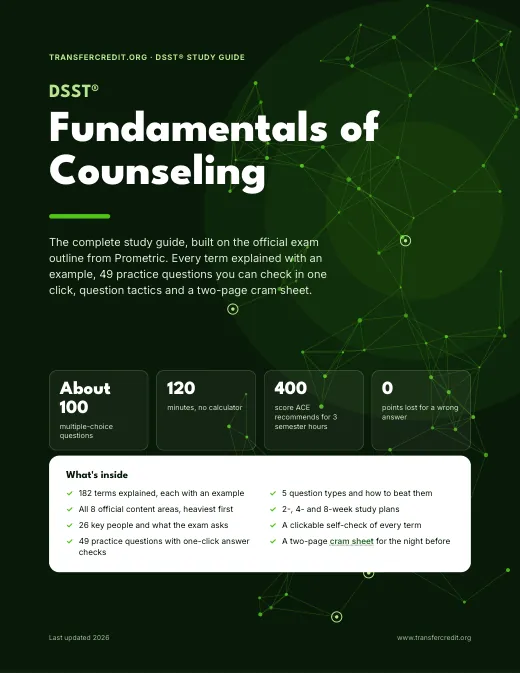
Page 1 of the DSST Fundamentals of Counseling Study Guide: the cover
Page 1 The cover
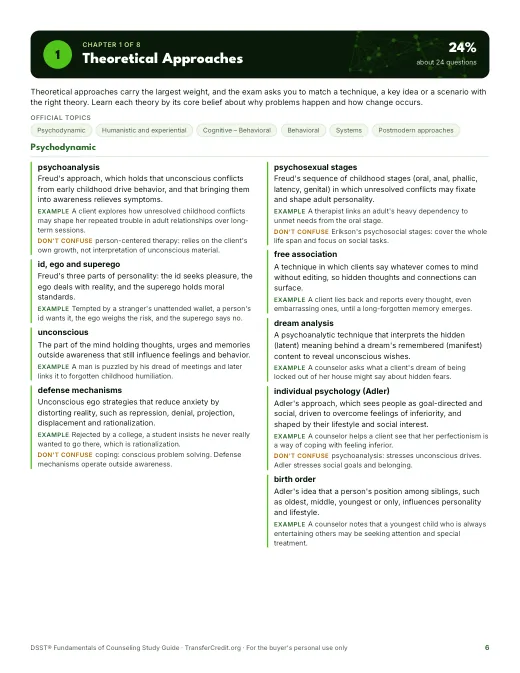
Page 6 of the DSST Fundamentals of Counseling Study Guide: the Chapter 1 opener
Page 6 The Chapter 1 opener
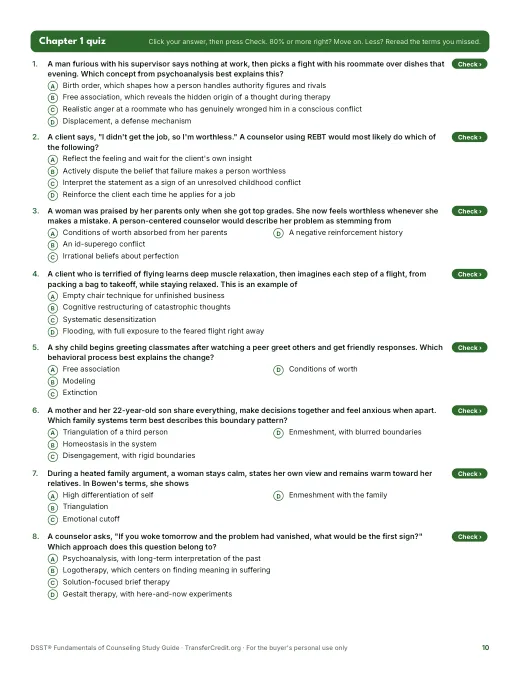
Page 10 of the DSST Fundamentals of Counseling Study Guide: a chapter quiz
Page 10 A chapter quiz
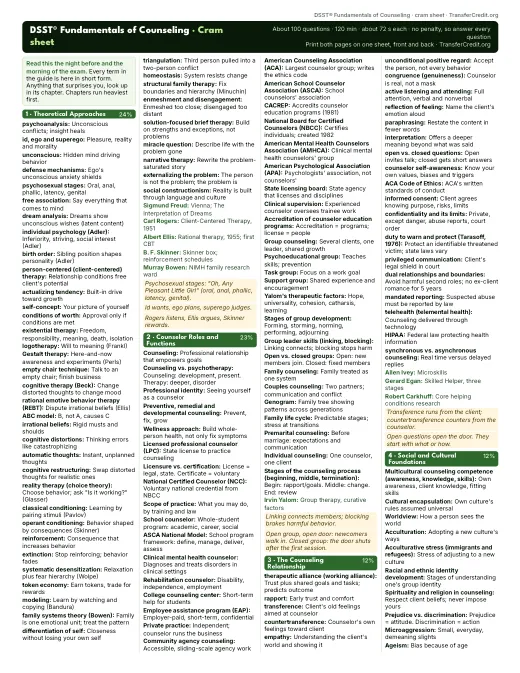
Page 39 of the DSST Fundamentals of Counseling Study Guide: the 2-page cram sheet
Page 39 The 2-page cram sheet

What you get for $5

One chapter for each official content area, in the order the exam weighs them.

  • 📘40pages, printable
  • 🧭8chapters, heaviest first
  • 🔑182terms with examples
  • ✍️49practice questions, answers explained
  • ⚠️22exam traps to avoid
  • 📄2page cram sheet

Try 10 free Fundamentals of Counseling questions

In the style of the real exam, from all 8 areas. About 10 minutes, with every answer explained and a score by area.

10 questions  
  1. Question 1 · Theoretical Approaches

    A man furious with his supervisor says nothing at work, then picks a fight with his roommate over dishes that evening. Which concept from psychoanalysis best explains this?

    Show the answer

    Answer: C. Displacement, a defense mechanism. Anger toward a threatening target is shifted onto a safer one, which is displacement, a defense mechanism that the ego uses to reduce anxiety.

    The trap: Free association is wrong because it is a counselor's technique for exploring hidden thoughts, not a way the man handled his anger.

  2. Question 2 · Counselor Roles and Functions

    A counselor completes a master's degree, finishes supervised hours and passes the state exam. Which credential has she earned that legally allows her to practice independently?

    Show the answer

    Answer: B. A state license. A state license gives legal permission to practice. The state requires degree, supervised experience and an exam.

    The trap: National certification is tempting because it also needs an exam, but it is voluntary and does not itself grant legal permission.

  3. Question 3 · The Counseling Relationship

    A client says, "I got passed over again, and everyone at work thinks I'm a joke." The counselor replies, "You feel humiliated and unappreciated." Which skill is the counselor using?

    Show the answer

    Answer: D. Reflection of feeling. The counselor names the emotion the client expressed, in fresh words. That is reflection of feeling.

    The trap: Interpretation is wrong because the counselor only names the feeling the client expressed and offers no hidden meaning or cause.

  4. Question 4 · Social and Cultural Foundations

    A counselor tells a Latino teen's parents that he should move out at 18, as her other clients do, and sees their wish that he stay as a problem. This counselor is showing

    Show the answer

    Answer: A. cultural encapsulation. She assumes her own culture's norm applies to everyone and misses the family's values, which is cultural encapsulation.

    The trap: Acculturation is wrong because it describes how people adapt to a new culture, not a counselor's biased assumptions.

  5. Question 5 · Assessment and Appraisal Techniques

    A counselor gives the same personality scale to a group of clients and, two weeks later, again to the same group. The scores are nearly identical. What has the counselor shown?

    Show the answer

    Answer: A. Test-retest reliability. Giving the same test twice and getting matching scores shows consistency over time, which is test-retest reliability.

    The trap: Predictive validity is wrong because that compares scores with a future outcome, not with a repeat of the same test.

  6. Question 6 · Human Growth and Development

    A parent worries that her 15-year-old now cares more about friends' opinions than hers. A counselor explains this is typical because adolescents mainly look for approval from

    Show the answer

    Answer: B. classmates and friends their age. Peer acceptance and recognition become central in adolescence, and teens turn to one another more than to adults.

    The trap: Teachers and coaches are tempting because teens spend school hours with them, but approval from peers matters most.

  7. Question 7 · Career Development

    A client enjoys helping people, volunteers as a tutor and wants a job working with others. According to Holland's theory, her interests most closely fit which type?

    Show the answer

    Answer: C. Social. Helping, teaching and working with people are the hallmarks of Holland's Social type.

    The trap: Conventional is wrong because that type prefers ordered, detail-focused, clerical work, not helping others.

  8. Question 8 · Historical Development

    A 1960s state closes a large psychiatric hospital and opens several neighborhood outpatient centers with federal funds. Which law most directly supported this shift?

    Show the answer

    Answer: D. Community Mental Health Act. The 1963 Community Mental Health Act funded local centers and moved care out of large state hospitals.

    The trap: National Defense Education Act is tempting because it is federal and 1950s-60s, but it funded school counseling and talent identification.

  9. Question 9 · Theoretical Approaches

    A client says, "I didn't get the job, so I'm worthless." A counselor using REBT would most likely do which of the following?

    Show the answer

    Answer: C. Actively dispute the belief that failure makes a person worthless. REBT teaches that irrational beliefs, not events, cause distress, and the counselor directly disputes those beliefs.

    The trap: Reflecting the feeling and waiting is person-centered, not REBT, which is active and directive.

  10. Question 10 · Counselor Roles and Functions

    A parent asks what a middle school counselor's job mainly involves. Which description is most accurate?

    Show the answer

    Answer: A. Running a program for all students' academic, career and social-emotional growth. School counselors deliver a program for all students, following the ASCA National Model.

    The trap: Diagnosing and treating disorders is wrong because that describes clinical mental health counselors, not the school setting.

The DSST Fundamentals of Counseling exam at a glance

The DSST Fundamentals of Counseling exam is a 120-minute, computer-based test from Prometric with about 100 multiple-choice questions. A score of 400 on the 200–500 scale earns an ACE credit recommendation of 3 semester hours, though each college sets its own policy. The exam covers 8 content areas; the heaviest is Theoretical Approaches at 24%.

Questions
About 100multiple choice
Time
120 minabout 72 seconds a question
Passing score
400on a 200–500 scale
ACE credit
3semester hours
Exam fee
$100paid to Prometric
Calculator
Nonot allowed

Source: official DSST Fundamentals of Counseling exam page.

What the exam covers

8 areas, heaviest first. The guide's chapters follow this order.

  1. Theoretical Approaches24%
  2. Counselor Roles and Functions23%
  3. The Counseling Relationship12%
  4. Social and Cultural Foundations12%
  5. Assessment and Appraisal Techniques10%
  6. Human Growth and Development8%
  7. Career Development6%
  8. Historical Development5%

How it works

  1. 1Buy once, $5Secure checkout. No subscription needed.
  2. 2Download the PDFFrom your TransferCredit.org account, right away and any time later.
  3. 3Study the heaviest areas firstFollow the 2-, 4- or 8-week plan, then read the cram sheet the night before.

Questions students ask

What's in the full DSST Fundamentals of Counseling study guide?
40 pages: 8 chapters, one per official content area, heaviest first. 182 terms, each with a plain-English definition and an example, 26 key people, common traps and memory tricks, 49 practice questions with an answer key that explains every answer, question tactics, 2-, 4- and 8-week study plans and a 2-page cram sheet.
How much is the full DSST Fundamentals of Counseling study guide?
The full 40-page PDF is $5, a one-time payment. The 10 practice questions on this page are free, with no account.
What does the $29 plan include?
$29 a month gives you all DSST subjects: every DSST study guide plus the full prep course for each subject, and you can cancel anytime. If you only need this exam, the guide on its own is a one-time $5.
How do I get the full guide?
Choose Buy this guide ($5) and check out. Then sign in to your TransferCredit.org account, then open the course and its Download Your Study Guide lesson. The PDF is yours to keep, and you can download it again from your account at any time.
Can I print the guide or use it on my phone?
Yes. It's a PDF, so it opens on phones, tablets and computers, and printing is allowed. Its tick boxes and answer bubbles work in PDF readers that support forms. Copying and editing are turned off.
Is this an official DSST study guide?
No. DSST® is a registered trademark of Prometric, which was not involved in producing this guide and does not endorse it. TransferCredit.org is independent. We built the guide from the official exam outline, and the exam details were checked against Prometric's published exam information in 2026.
Why is this study guide better than a generic review?
It follows the official outline area by area and spends the most pages on what the exam weighs most. Every term comes with an example, each chapter names the traps the exam sets, and the answer key explains why the most tempting wrong answer is wrong, not just which answer is right. It ends with a 2-page cram sheet for the night before.
What is the DSST Fundamentals of Counseling exam?
The DSST Fundamentals of Counseling exam is a 120-minute, computer-based test from Prometric with about 100 multiple-choice questions. A score of 400 on the 200–500 scale earns an ACE credit recommendation of 3 semester hours, though each college sets its own policy. The exam covers 8 content areas; the heaviest is Theoretical Approaches at 24%.
More questions about the DSST Fundamentals of Counseling exam (21)
How many questions are on the DSST Fundamentals of Counseling exam, and how long is it?
It has about 100 questions to be answered in 2 hours.
What is the passing score for DSST Fundamentals of Counseling?
The passing score is 400 on a 200–500 scale. At 400 or above, the American Council on Education (ACE) recommends 3 semester hours of upper-level baccalaureate credit. Each college sets its own passing score and credit award, so check your school's policy before you book.
How much does the DSST Fundamentals of Counseling exam cost?
The exam fee is $100, paid to Prometric. Test centers may add their own administration fee. Eligible U.S. military service members can usually test for free through DANTES.
How many college credits is DSST Fundamentals of Counseling worth?
ACE recommends 3 semester hours of upper-level baccalaureate credit for a passing score of 400. Your college decides how many credits it awards and which course they replace. Check your college's policy.
Is there a penalty for guessing on DSST Fundamentals of Counseling?
No. Your score counts only correct answers, so a wrong answer costs nothing. Never leave a question blank: rule out what you can and pick your best guess.
What topics are on the DSST Fundamentals of Counseling exam?
8 content areas, from the official outline: Theoretical Approaches (24%); Counselor Roles and Functions (23%); The Counseling Relationship (12%); Social and Cultural Foundations (12%); Assessment and Appraisal Techniques (10%); Human Growth and Development (8%); Career Development (6%); Historical Development (5%).
Which DSST Fundamentals of Counseling topics should I study first?
Start with the three heaviest: Theoretical Approaches (24%), Counselor Roles and Functions (23%) and the Counseling Relationship (12%). Together they are about 59% of the exam, roughly 59 of 100 questions. The guide's chapters run in that order, heaviest first.
Is the DSST Fundamentals of Counseling exam hard?
It depends on what you already know. No single area dominates: the largest, Theoretical Approaches, is 24% and the smallest, Historical Development, is 5%, so broad coverage matters more than deep expertise in one topic. Take the free diagnostic above to see where you stand in about 10 minutes.
What kinds of questions are on the DSST Fundamentals of Counseling exam?
The guide sorts them into 5 types: “Match the theory or approach”, “Best counselor response”, “Ethics and legal issues”, “Who or what came first (history and laws)” and “Testing and development basics”. Every question has 4 answer choices. Try the 10 free questions above to see the style.
How long should I study for DSST Fundamentals of Counseling?
Use the diagnostic to decide. If you already know most areas, two weeks of daily review is often enough; if the subject is new to you, plan on eight. The full guide has 2-, 4- and 8-week plans built from the exam weights.
How should I pace myself on the DSST Fundamentals of Counseling exam?
On average you have about 72 seconds per question (120 minutes for 100 questions). Be past question 33 a third of the way through and past question 67 two-thirds through. If a question takes more than a minute, pick your best guess, mark it and come back.
What happens if I don't pass DSST Fundamentals of Counseling?
You can retake a DSST exam after 30 days. Use the wait to work through the areas the score report and the diagnostic show you missed.
Do colleges accept DSST Fundamentals of Counseling for credit?
DSST exams are accepted at more than 1,500 colleges and universities, but each school decides which exams it accepts, the score it requires and the credit it gives. Look up your college's DSST policy before you book.
How up to date is this DSST Fundamentals of Counseling guide?
Last updated 2026. The exam details were checked against Prometric's published exam information in 2026. Exams change, so confirm the details on the official exam page before you register.
What should I do the night before the exam?
Read the cram sheet once, slowly. Check your test time, the location or remote-proctoring setup, and the ID you need. Then sleep: a rested brain recalls more than a crammed one. In the morning, skim the memory tricks and common traps, then stop studying.
Is DSST Fundamentals of Counseling upper-level credit?
Yes. ACE recommends it at the upper-level baccalaureate level, which some degree programs require for a portion of their credits.
Which counseling theorists should I know for DSST Fundamentals of Counseling?
Know each major founder and approach: Freud (psychoanalysis), Adler (individual psychology), Rogers (person-centered therapy), Perls (Gestalt therapy), Ellis (rational emotive behavior therapy), Beck (cognitive therapy) and Glasser (reality therapy). Theoretical approaches are 24% of the exam, the largest area.
Do I need to know counseling ethics and duty to warn for DSST Fundamentals of Counseling?
Yes. Ethical and legal issues are part of the counseling relationship area (12%). Know confidentiality and its limits, informed consent, dual relationships and the duty to warn, which comes from the Tarasoff case.
What textbooks should I use for DSST Fundamentals of Counseling?
The DSST fact sheet suggests Gerald Corey's Theory and Practice of Counseling and Psychotherapy, Samuel Gladding's Counseling: A Comprehensive Profession, and Erford's Orientation to the Counseling Profession. It recommends using more than one source and checking each against the content outline.
Does the exam cover telehealth?
Yes. Telehealth is listed under the counseling relationship, along with the therapeutic alliance, counselor skills and ethical and legal issues.
Can I take DSST Fundamentals of Counseling online?
Yes. DSST exams can be taken at a test center or online with a remote Prometric proctor.

Choose how you want to study

Start with the guide, or get everything for DSST in one plan.

This study guide
$5one-time
  • 40-page printable PDF
  • 182 terms with examples
  • 49 practice questions, answers explained
  • 2-page cram sheet and study plans
Get the guide · $5
Best value Get it all
$29/month
  • Every DSST study guide
  • Prep courses for all DSST subjects
  • Cancel anytime
Get it all · $29/mo

DSST® is a registered trademark of Prometric, which was not involved in producing this guide and does not endorse it. TransferCredit.org is independent and not affiliated with Prometric. © 2026 UPI Globale Edu Inc.