
$5one-time
- 40-page printable PDF
- 181 terms with examples
- 43 practice questions, answers explained
- 2-page cram sheet and study plans
Official exam name: The Civil War and Reconstruction
Everything the DSST Civil War and Reconstruction exam tests, in one PDF you can print. Built from Prometric's official outline, heaviest topics first.
Last updated 2026 · exam details checked against Prometric's published exam information in 2026
Real pages from the 40-page PDF.
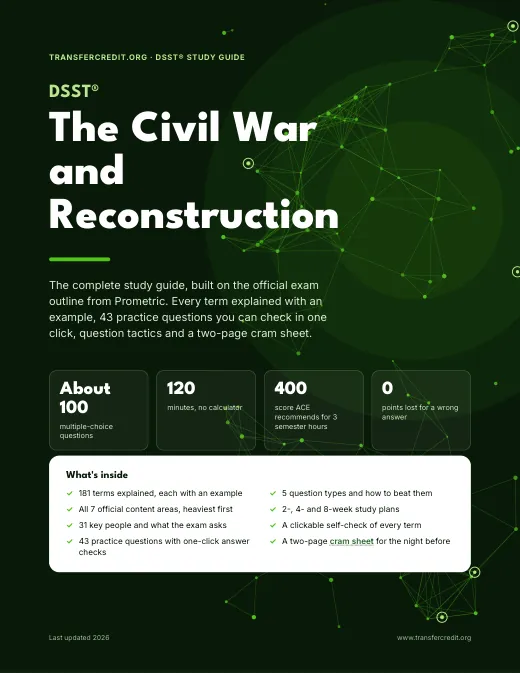
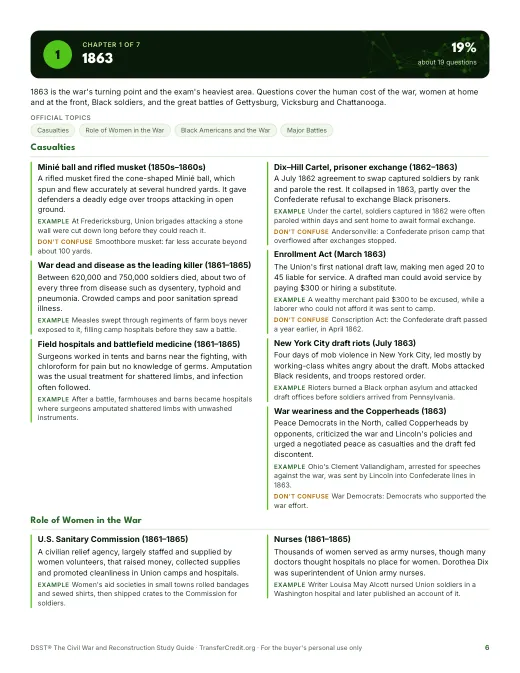
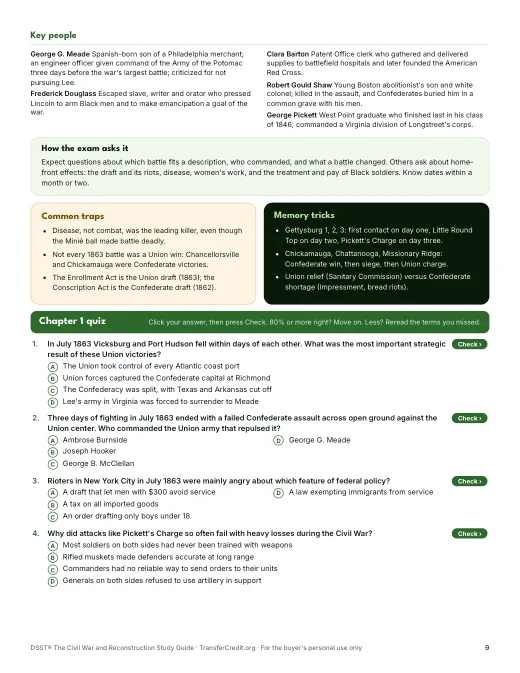
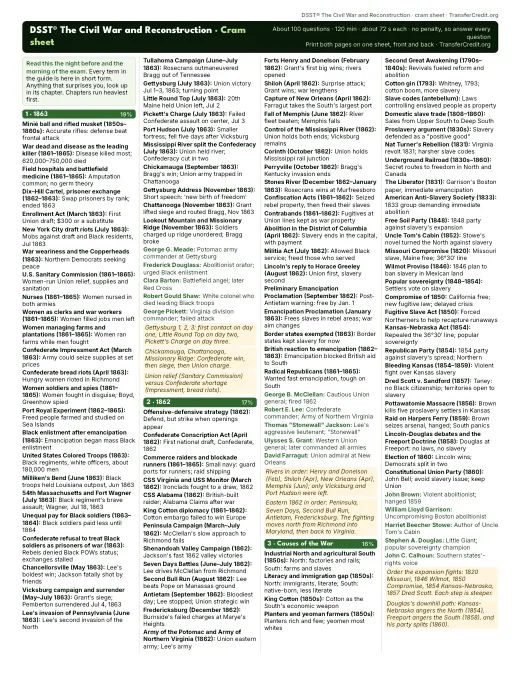
One chapter for each official content area, in the order the exam weighs them.
In the style of the real exam, from all 7 areas. About 10 minutes, with every answer explained and a score by area.
In July 1863 Vicksburg and Port Hudson fell within days of each other. What was the most important strategic result of these Union victories?
Answer: C. The Confederacy was split, with Texas and Arkansas cut off. Controlling the Mississippi River divided the Confederacy in two and gave the Union a river highway through the heartland.
The trap: Richmond did not fall until 1865. The Mississippi victories were in the West, not in Virginia.
Controlling the Mississippi River divided the Confederacy in two and gave the Union a river highway through the heartland.
The trap: Richmond did not fall until 1865. The Mississippi victories were in the West, not in Virginia.
Union victories in February 1862 on the Tennessee and Cumberland Rivers opened the Confederate heartland to invasion. They were
Answer: A. the capture of Forts Henry and Donelson. Grant and Navy gunboats took Henry and Donelson in February 1862, exposing Tennessee and north Alabama to Union armies.
The trap: Vicksburg fell in July 1863, well after these river forts, so it is a later event even though it was also on a river.
Grant and Navy gunboats took Henry and Donelson in February 1862, exposing Tennessee and north Alabama to Union armies.
The trap: Vicksburg fell in July 1863, well after these river forts, so it is a later event even though it was also on a river.
In May 1856, after proslavery raiders sacked the free-state town of Lawrence, John Brown responded by
Answer: D. killing five proslavery settlers at Pottawatomie Creek. Brown's Pottawatomie killings in Kansas came in 1856. His Harpers Ferry raid did not happen until October 1859.
The trap: The Harpers Ferry raid is a trap because it is Brown's most famous act, but it came three years after the Kansas killings.
Brown's Pottawatomie killings in Kansas came in 1856. His Harpers Ferry raid did not happen until October 1859.
The trap: The Harpers Ferry raid is a trap because it is Brown's most famous act, but it came three years after the Kansas killings.
In August 1864 Lincoln believed he might lose reelection. Which event most improved his prospects in the weeks that followed?
Answer: B. Sherman's capture of Atlanta, which lifted Northern morale. Atlanta fell on September 2, giving the North a clear victory and ending talk that the war could not be won.
The trap: Cold Harbor was a Union defeat; it did not help Lincoln. New Orleans fell in 1862.
Atlanta fell on September 2, giving the North a clear victory and ending talk that the war could not be won.
The trap: Cold Harbor was a Union defeat; it did not help Lincoln. New Orleans fell in 1862.
Which law answered the Black Codes by declaring persons born in the United States citizens with equal rights to make contracts and own property?
Answer: D. The Civil Rights Act of 1866. Congress passed the Civil Rights Act in April 1866 over Johnson's veto, aiming to overturn the Black Codes.
The trap: The Civil Rights Act of 1875 banned discrimination in public places and on juries; it came nine years later and did not define citizenship.
Congress passed the Civil Rights Act in April 1866 over Johnson's veto, aiming to overturn the Black Codes.
The trap: The Civil Rights Act of 1875 banned discrimination in public places and on juries; it came nine years later and did not define citizenship.
In May 1861 Kentucky declared itself neutral and refused to send troops to either side. How did that neutrality end?
Answer: C. Confederate troops invaded, and the legislature turned to the Union. Confederate forces seized Columbus, Kentucky, in September 1861. The legislature demanded their withdrawal and sided with the Union, though many Kentuckians fought for the South.
The trap: Mountain counties breaking away to form a new Union state describes West Virginia, not Kentucky.
Confederate forces seized Columbus, Kentucky, in September 1861. The legislature demanded their withdrawal and sided with the Union, though many Kentuckians fought for the South.
The trap: Mountain counties breaking away to form a new Union state describes West Virginia, not Kentucky.
Sherman's army treated South Carolina more harshly in early 1865 than it had treated Georgia. The main reason was that South Carolina was
Answer: B. seen as the cradle of secession. Union soldiers regarded South Carolina, the first state to secede, as the cradle of rebellion, and many wanted to punish it.
The trap: The Confederate government was in Richmond, Virginia, not South Carolina.
Union soldiers regarded South Carolina, the first state to secede, as the cradle of rebellion, and many wanted to punish it.
The trap: The Confederate government was in Richmond, Virginia, not South Carolina.
Three days of fighting in July 1863 ended with a failed Confederate assault across open ground against the Union center. Who commanded the Union army that repulsed it?
Answer: A. George G. Meade. Meade took command of the Army of the Potomac on June 28, 1863, and led it to victory at Gettysburg.
The trap: Hooker had commanded at Chancellorsville but was replaced days before Gettysburg.
Meade took command of the Army of the Potomac on June 28, 1863, and led it to victory at Gettysburg.
The trap: Hooker had commanded at Chancellorsville but was replaced days before Gettysburg.
In March 1862 a Confederate ironclad destroyed two wooden Union ships at Hampton Roads. The next day the USS Monitor arrived, and the battle between the two ironclads
Answer: B. ended in a draw, showing that wooden warships were becoming obsolete. The Virginia and the Monitor could not sink each other. The Union blockade stayed in place and wooden warships were seen as outdated.
The trap: The choice claiming a broken blockade is wrong: the Virginia never lifted it, and the ship was destroyed by its own crew in May 1862.
The Virginia and the Monitor could not sink each other. The Union blockade stayed in place and wooden warships were seen as outdated.
The trap: The choice claiming a broken blockade is wrong: the Virginia never lifted it, and the ship was destroyed by its own crew in May 1862.
At Freeport in 1858, Stephen Douglas argued that a territory could keep out slavery despite Dred Scott by not passing laws to protect it. This answer most hurt him with
Answer: A. Southern Democrats, who wanted slavery protected. Southern Democrats saw Freeport as a rejection of Dred Scott's promise that slavery could go anywhere. Their break with Douglas helped split the party in 1860.
The trap: Republicans already opposed Douglas, and Free Soilers had mostly joined the Republicans, so neither group was newly alienated by Freeport.
Southern Democrats saw Freeport as a rejection of Dred Scott's promise that slavery could go anywhere. Their break with Douglas helped split the party in 1860.
The trap: Republicans already opposed Douglas, and Free Soilers had mostly joined the Republicans, so neither group was newly alienated by Freeport.
The DSST The Civil War and Reconstruction exam is a 120-minute, computer-based test from Prometric with about 100 multiple-choice questions. A score of 400 on the 200–500 scale earns an ACE credit recommendation of 3 semester hours, though each college sets its own policy. The exam covers 7 content areas; the heaviest is 1863 at 19%.
Source: official DSST The Civil War and Reconstruction exam page.
7 areas, heaviest first. The guide's chapters follow this order.
Start with the guide, or get everything for DSST in one plan.
DSST® is a registered trademark of Prometric, which was not involved in producing this guide and does not endorse it. TransferCredit.org is independent and not affiliated with Prometric. © 2026 UPI Globale Edu Inc.