
$5one-time
- 41-page printable PDF
- 180 terms with examples
- 52 practice questions, answers explained
- 2-page cram sheet and study plans
Everything the DSST Art of the Western World exam tests, in one PDF you can print. Built from Prometric's official outline, heaviest topics first.
Last updated 2026 · exam details checked against Prometric's published exam information in 2026
Real pages from the 41-page PDF.
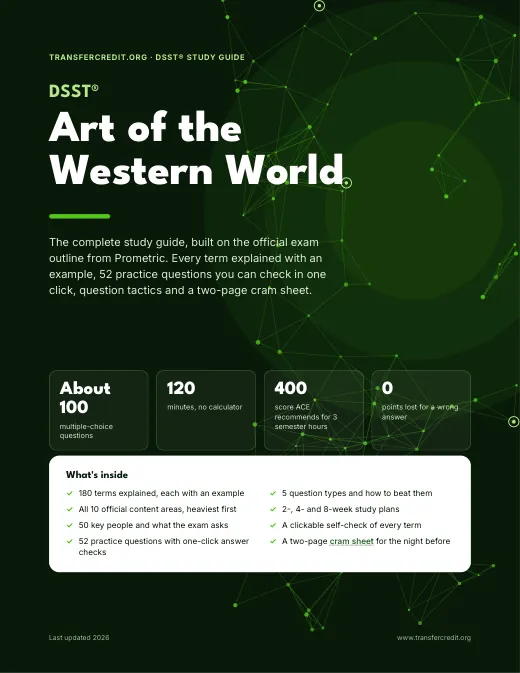
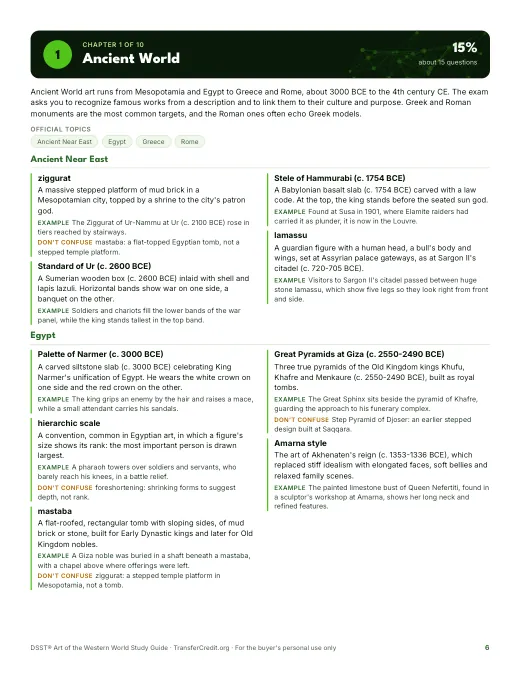
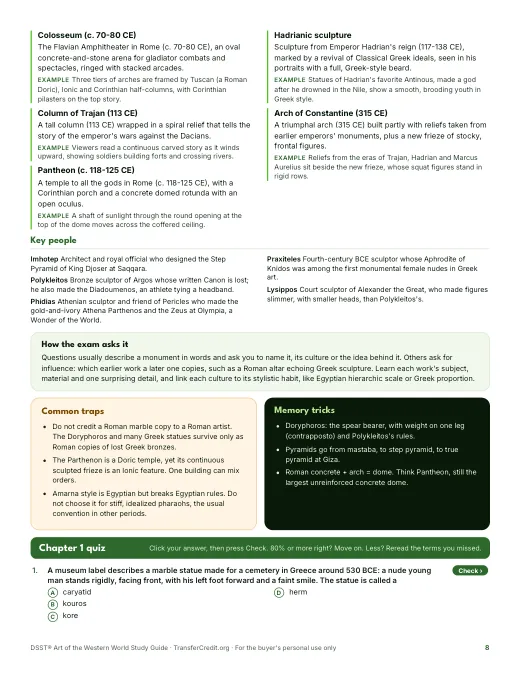
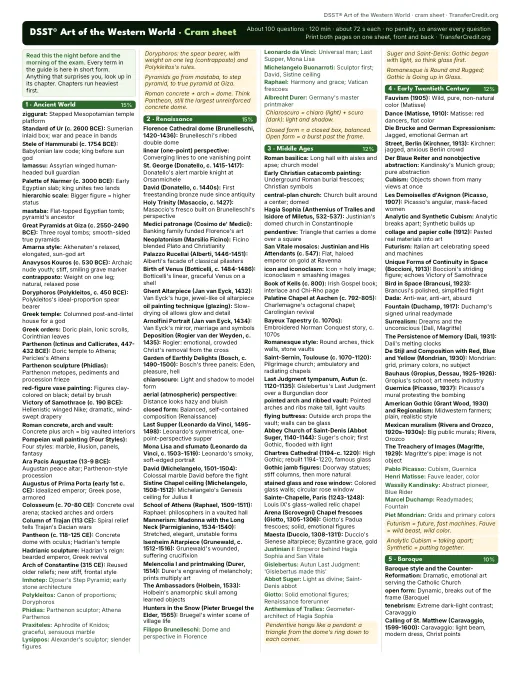
One chapter for each official content area, in the order the exam weighs them.
In the style of the real exam, one from each of the ten heaviest areas. About 10 minutes, with every answer explained and a score by area.
A museum label describes a marble statue made for a cemetery in Greece around 530 BCE: a nude young man stands rigidly, facing front, with his left foot forward and a faint smile. The statue is called a
Answer: D. kouros. A kouros is the Archaic Greek standing nude youth, stiff and frontal with an archaic smile, often used as a grave marker.
The trap: A kore is also Archaic, but it is a clothed standing young woman, not a nude youth.
A kouros is the Archaic Greek standing nude youth, stiff and frontal with an archaic smile, often used as a grave marker.
The trap: A kore is also Archaic, but it is a clothed standing young woman, not a nude youth.
A fresco in a Florentine church shows a crucified Christ inside a painted barrel-vaulted chapel whose coffered ceiling appears to recede into the wall. The painter was most influenced by the theories of which of the following?
Answer: C. Brunelleschi. Brunelleschi worked out the rules of linear perspective, and Masaccio used them in the Holy Trinity to build a believable chapel on a flat wall.
The trap: Ficino was a philosopher who shaped Neoplatonic ideas at the Medici court, not the mathematics of perspective.
Brunelleschi worked out the rules of linear perspective, and Masaccio used them in the Holy Trinity to build a believable chapel on a flat wall.
The trap: Ficino was a philosopher who shaped Neoplatonic ideas at the Medici court, not the mathematics of perspective.
An architect must place a circular dome over a square room, with no gap at the corners. Which Byzantine device carries the dome's weight to the corner piers?
Answer: B. Pendentives. Pendentives are curved triangles of masonry that bridge from a square plan to a round dome, as at Hagia Sophia.
The trap: Flying buttresses also carry weight, but they are Gothic exterior arches that brace walls, not a way to set a dome on a square.
Pendentives are curved triangles of masonry that bridge from a square plan to a round dome, as at Hagia Sophia.
The trap: Flying buttresses also carry weight, but they are Gothic exterior arches that brace walls, not a way to set a dome on a square.
A sculpture of a faceless striding figure, its flowing planes shaped as if by wind, has been compared most often to which ancient work?
Answer: A. Victory of Samothrace. Boccioni's Unique Forms of Continuity in Space shows motion through flowing, windswept forms, like the Hellenistic Victory of Samothrace.
The trap: The Doryphoros is a still, balanced standing figure, the opposite of the rushing motion described.
Boccioni's Unique Forms of Continuity in Space shows motion through flowing, windswept forms, like the Hellenistic Victory of Samothrace.
The trap: The Doryphoros is a still, balanced standing figure, the opposite of the rushing motion described.
A tavern painting shows figures emerging from near-black shadow, lit by one strong beam from the side that picks out faces and hands. The style is called
Answer: A. tenebrism. Tenebrism uses extreme contrast of dark and light, with figures lit sharply against deep shadow. It is Caravaggio's hallmark.
The trap: Sfumato is Leonardo's soft, smoky blending of edges; it avoids the hard contrast described here.
Tenebrism uses extreme contrast of dark and light, with figures lit sharply against deep shadow. It is Caravaggio's hallmark.
The trap: Sfumato is Leonardo's soft, smoky blending of edges; it avoids the hard contrast described here.
A 1787 painting shows a condemned Greek philosopher calmly reaching for poison while lecturing his weeping followers, in crisp outlines and a bare stone room. Which statement best explains the style?
Answer: D. It uses an ancient subject to teach reason and moral duty.. Neoclassical works such as David's Death of Socrates use ancient subjects and clear structure to praise reason, duty and self-sacrifice.
The trap: Aristocratic leisure and pastel color describe Rococo, the style Neoclassicism rejected.
Neoclassical works such as David's Death of Socrates use ancient subjects and clear structure to praise reason, duty and self-sacrifice.
The trap: Aristocratic leisure and pastel color describe Rococo, the style Neoclassicism rejected.
In 1814 Goya painted French soldiers executing Spanish civilians after the 1808 Madrid uprising. What does the picture emphasize?
Answer: B. Humanity's capacity for cruelty. Goya's The Third of May 1808 shows a faceless firing squad and terrified victims, stressing brutality and fear instead of heroism.
The trap: The glory of war is tempting because soldiers fill the scene, but Goya turns them into a faceless killing machine.
Goya's The Third of May 1808 shows a faceless firing squad and terrified victims, stressing brutality and fear instead of heroism.
The trap: The glory of war is tempting because soldiers fill the scene, but Goya turns them into a faceless killing machine.
An artist wants the viewer's eye, not the palette, to blend colors, so she places tiny dots of pure red and yellow side by side to suggest orange. Which technique is this?
Answer: C. Pointillism. Pointillism relies on optical mixing, as in Seurat's work, with dots of pure color blending in the viewer's eye at a distance.
The trap: Impasto means thick, textured paint and is typical of Van Gogh, not dots of pure color.
Pointillism relies on optical mixing, as in Seurat's work, with dots of pure color blending in the viewer's eye at a distance.
The trap: Impasto means thick, textured paint and is typical of Van Gogh, not dots of pure color.
An artist sews a giant, floppy hamburger out of painted canvas and sells plaster copies of supermarket food, poking fun at shoppers' tastes. Which movement is this?
Answer: B. Pop art. Pop art took everyday consumer goods and ads as subjects, often satirizing middle-class tastes, as in Claes Oldenburg's soft sculptures.
The trap: Minimalism also used ordinary industrial materials, but in plain geometric forms with no comment on consumer life.
Pop art took everyday consumer goods and ads as subjects, often satirizing middle-class tastes, as in Claes Oldenburg's soft sculptures.
The trap: Minimalism also used ordinary industrial materials, but in plain geometric forms with no comment on consumer life.
A poster pairs a black-and-white photograph of a woman's face, split into positive and negative, with bold white capital letters on red bands. The artist is best known for
Answer: A. pairing slogans with found images to challenge power. Barbara Kruger combines found photographs with direct text to confront viewers about power, gender and consumer culture.
The trap: Staining raw canvas is Frankenthaler's technique in color-field painting, which uses no words or photographic images.
Barbara Kruger combines found photographs with direct text to confront viewers about power, gender and consumer culture.
The trap: Staining raw canvas is Frankenthaler's technique in color-field painting, which uses no words or photographic images.
The DSST Art of the Western World exam is a 120-minute, computer-based test from Prometric with about 100 multiple-choice questions. A score of 400 on the 200–500 scale earns an ACE credit recommendation of 3 semester hours, though each college sets its own policy. The exam covers 10 content areas; the heaviest is Ancient World at 15%.
10 areas, heaviest first. The guide's chapters follow this order.
Start with the guide, or get everything for DSST in one plan.
DSST® is a registered trademark of Prometric, which was not involved in producing this guide and does not endorse it. TransferCredit.org is independent and not affiliated with Prometric. © 2026 UPI Globale Edu Inc.