
$5one-time
- 34-page printable PDF
- 182 terms with examples
- 40 practice questions, answers explained
- 2-page cram sheet and study plans
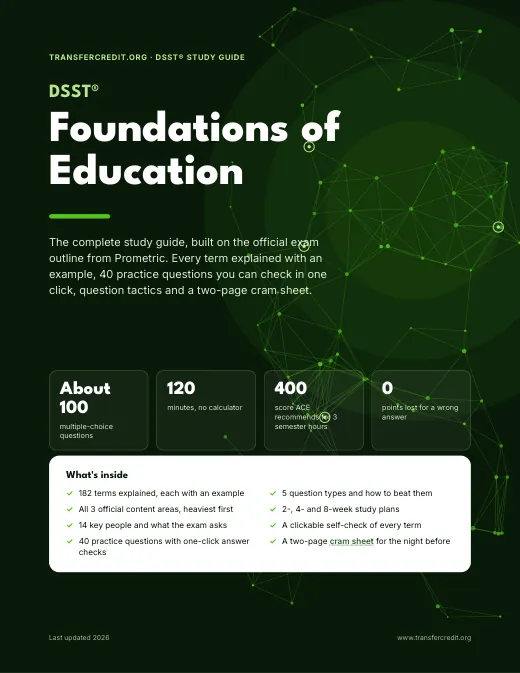
Everything the DSST Foundations of Education exam tests, in one PDF you can print. Built from Prometric's official outline, heaviest topics first.
Last updated 2026 · exam details checked against Prometric's published exam information in 2026
Real pages from the 34-page PDF.
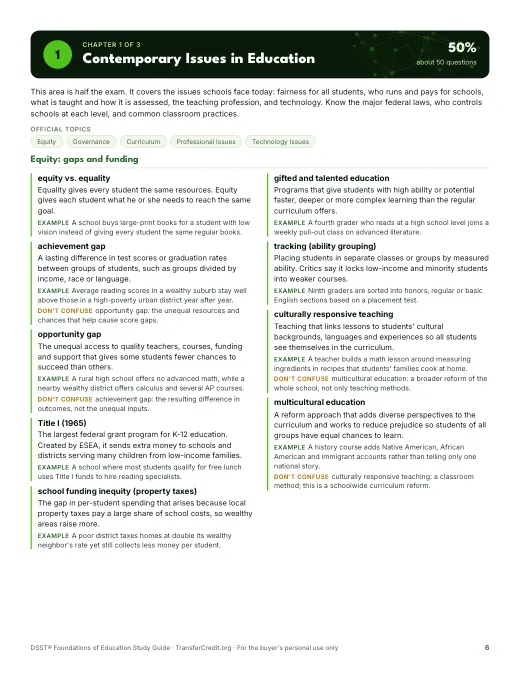
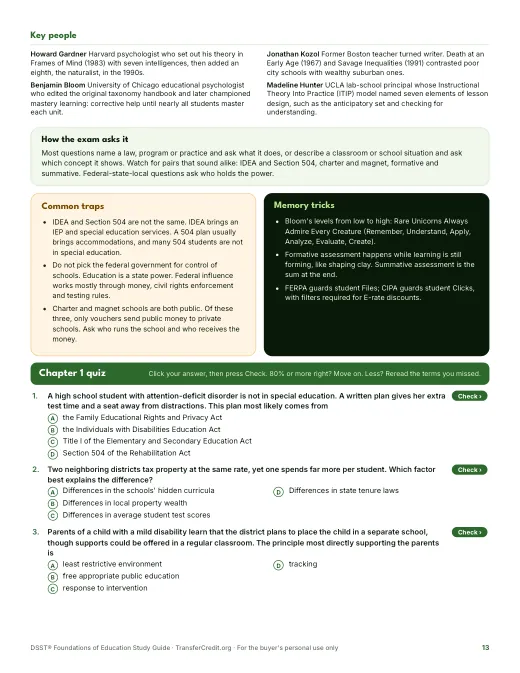
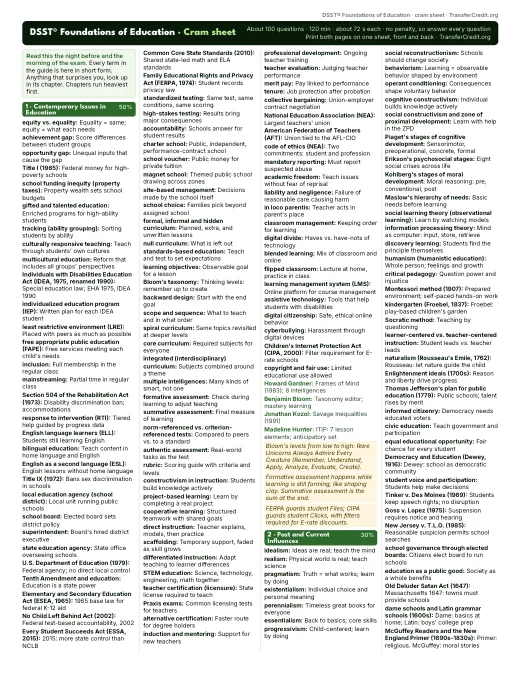
One chapter for each official content area, in the order the exam weighs them.
In the style of the real exam, from all 3 areas. About 10 minutes, with every answer explained and a score by area.
A high school student with attention-deficit disorder is not in special education. A written plan gives her extra test time and a seat away from distractions. This plan most likely comes from
Answer: A. Section 504 of the Rehabilitation Act. Section 504 requires accommodations for equal access for students with disabilities, even without special education.
The trap: Individuals with Disabilities Education Act is wrong because it requires an IEP and specialized instruction, which this student does not receive.
Section 504 requires accommodations for equal access for students with disabilities, even without special education.
The trap: Individuals with Disabilities Education Act is wrong because it requires an IEP and specialized instruction, which this student does not receive.
A school requires all students to read the same classic works, such as Homer and Shakespeare, because its leaders believe the great ideas of human history never go out of date. Which philosophy is shown?
Answer: C. Perennialism. Perennialism holds that the same timeless great ideas should be taught to everyone, usually through classic works.
The trap: Essentialism also sets a common curriculum, but it stresses basic skills, not a fixed list of classic works.
Perennialism holds that the same timeless great ideas should be taught to everyone, usually through classic works.
The trap: Essentialism also sets a common curriculum, but it stresses basic skills, not a fixed list of classic works.
For decades, courts judged laws aiding religious schools by asking whether each had a secular purpose, whether its main effect advanced religion, and whether it entangled government with religion. Which test was this?
Answer: B. The Lemon test. The Lemon test, from Lemon v. Kurtzman (1971), asked about purpose, primary effect and entanglement. The Court set it aside in 2022.
The trap: The Tinker test concerns when student speech may be limited because of disruption, not government support for religion.
The Lemon test, from Lemon v. Kurtzman (1971), asked about purpose, primary effect and entanglement. The Court set it aside in 2022.
The trap: The Tinker test concerns when student speech may be limited because of disruption, not government support for religion.
Two neighboring districts tax property at the same rate, yet one spends far more per student. Which factor best explains the difference?
Answer: D. Differences in local property wealth. Because property taxes fund much of school budgets, areas with more valuable property raise more money at the same rate.
The trap: Hidden curricula is wrong because it describes unplanned lessons about values and norms, not school finance.
Because property taxes fund much of school budgets, areas with more valuable property raise more money at the same rate.
The trap: Hidden curricula is wrong because it describes unplanned lessons about values and norms, not school finance.
A teacher's unit has students study pollution in their town, draft a cleanup plan and press the city council to adopt it. Her aim is for students to learn to reform their community. Which philosophy does she most clearly reflect?
Answer: B. Social reconstructionism. Social reconstructionism teaches students to find social problems and act to improve society, as this unit does by pressing the council for change.
The trap: Progressivism also uses real projects, but its aim is the child's growth through experience, not reforming the community.
Social reconstructionism teaches students to find social problems and act to improve society, as this unit does by pressing the council for change.
The trap: Progressivism also uses real projects, but its aim is the child's growth through experience, not reforming the community.
A public high school opens each day with a student reading ten Bible verses over the loudspeaker. Students may leave the room if their parents ask. Which Supreme Court case most directly makes this practice unconstitutional?
Answer: C. Abington v. Schempp (1963). Abington v. Schempp held that school-sponsored Bible reading violates the Establishment Clause, even when students may be excused.
The trap: Engel v. Vitale is tempting, but it struck down a prayer written by state officials; Bible reading was decided a year later.
Abington v. Schempp held that school-sponsored Bible reading violates the Establishment Clause, even when students may be excused.
The trap: Engel v. Vitale is tempting, but it struck down a prayer written by state officials; Bible reading was decided a year later.
Parents of a child with a mild disability learn that the district plans to place the child in a separate school, though supports could be offered in a regular classroom. The principle most directly supporting the parents is
Answer: A. least restrictive environment. IDEA requires placing students with peers without disabilities as much as is appropriate, so a separate setting needs strong justification.
The trap: Free appropriate public education is wrong because it guarantees services at no cost, not placement with peers.
IDEA requires placing students with peers without disabilities as much as is appropriate, so a separate setting needs strong justification.
The trap: Free appropriate public education is wrong because it guarantees services at no cost, not placement with peers.
A student cannot finish a multistep math problem alone, but she succeeds when a stronger classmate gives a few hints. Which concept best describes the problem's level of difficulty for her?
Answer: D. Zone of proximal development. The zone of proximal development is the range of tasks a learner cannot do alone but can do with help, as she does with her classmate's hints.
The trap: The concrete operational stage describes how children of about seven to eleven reason in general; it does not explain why she succeeds only with help.
The zone of proximal development is the range of tasks a learner cannot do alone but can do with help, as she does with her classmate's hints.
The trap: The concrete operational stage describes how children of about seven to eleven reason in general; it does not explain why she succeeds only with help.
A state requires Black and White children to attend separate public schools. It proves that the two schools have equal buildings, teachers and budgets. How would a federal court rule on this law?
Answer: C. It is invalid, since separate schools are inherently unequal. Brown v. Board of Education (1954) held that segregated public schools are inherently unequal, so equal buildings and budgets do not save the law.
The trap: The claim that equal facilities make segregation lawful is Plessy's "separate but equal" rule, which Brown overturned.
Brown v. Board of Education (1954) held that segregated public schools are inherently unequal, so equal buildings and budgets do not save the law.
The trap: The claim that equal facilities make segregation lawful is Plessy's "separate but equal" rule, which Brown overturned.
A fourth-grade class teaches math and science in Haitian Creole while students gradually take on more lessons in English. This program is best described as
Answer: D. bilingual education. Bilingual education uses the home language to teach content while English develops.
The trap: English as a second language is wrong because it teaches English without using the home language for content.
Bilingual education uses the home language to teach content while English develops.
The trap: English as a second language is wrong because it teaches English without using the home language for content.
The DSST Foundations of Education exam is a 120-minute, computer-based test from Prometric with about 100 multiple-choice questions. A score of 400 on the 200–500 scale earns an ACE credit recommendation of 3 semester hours, though each college sets its own policy. The exam covers 3 content areas; the heaviest is Contemporary Issues in Education at 50%.
3 areas, heaviest first. The guide's chapters follow this order.
Start with the guide, or get everything for DSST in one plan.
DSST® is a registered trademark of Prometric, which was not involved in producing this guide and does not endorse it. TransferCredit.org is independent and not affiliated with Prometric. © 2026 UPI Globale Edu Inc.