
$5one-time
- 35-page printable PDF
- 182 terms with examples
- 40 practice questions, answers explained
- 2-page cram sheet and study plans
Everything the DSST Criminal Justice exam tests, in one PDF you can print. Built from Prometric's official outline, heaviest topics first.
Last updated 2026 · exam details checked against Prometric's published exam information in 2026
Real pages from the 35-page PDF.
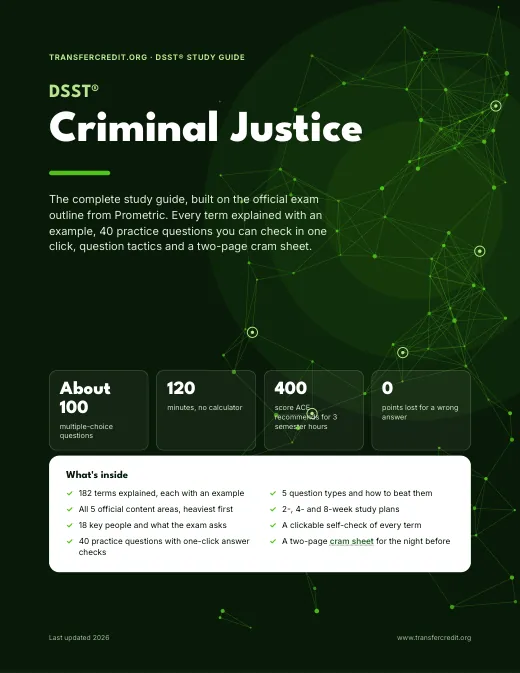
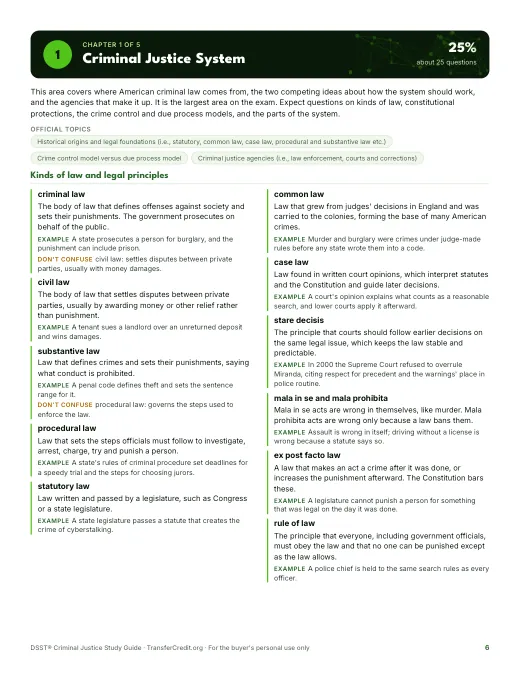
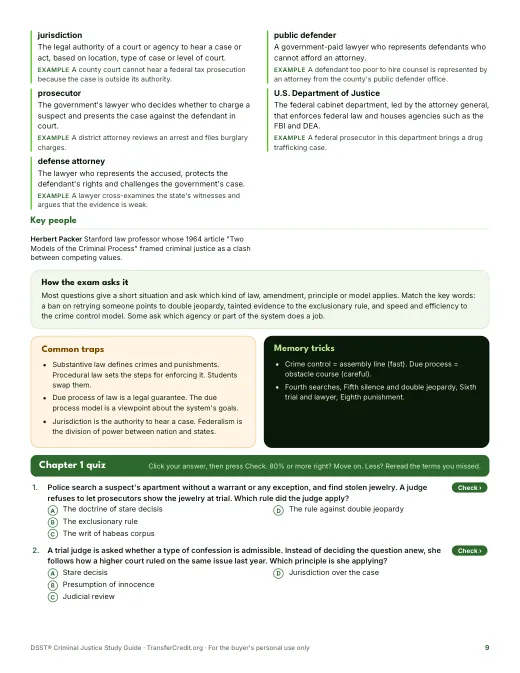
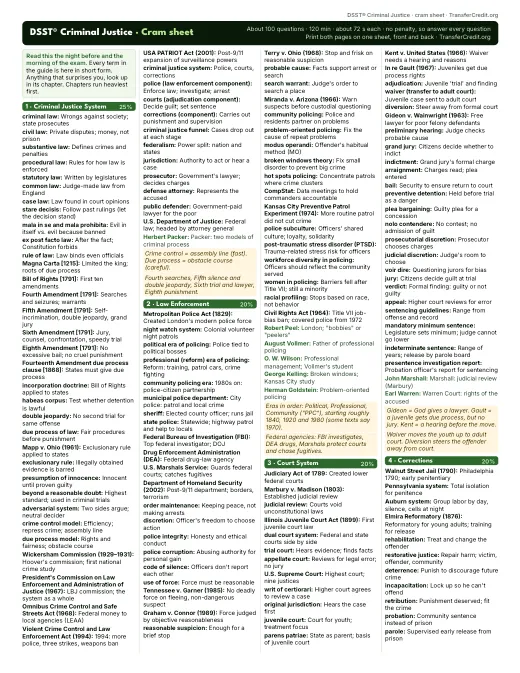
One chapter for each official content area, in the order the exam weighs them.
In the style of the real exam, from all 5 areas. About 10 minutes, with every answer explained and a score by area.
Police search a suspect's apartment without a warrant or any exception, and find stolen jewelry. A judge refuses to let prosecutors show the jewelry at trial. Which rule did the judge apply?
Answer: C. The exclusionary rule. The exclusionary rule keeps evidence gathered in violation of constitutional rights out of the trial. Mapp v. Ohio (1961) applied it to the states.
The trap: Double jeopardy is tempting because it is a Fifth Amendment protection, but it bars a second prosecution and does not affect evidence.
The exclusionary rule keeps evidence gathered in violation of constitutional rights out of the trial. Mapp v. Ohio (1961) applied it to the states.
The trap: Double jeopardy is tempting because it is a Fifth Amendment protection, but it bars a second prosecution and does not affect evidence.
An officer watches a man walk past a closed jewelry store six times, peer in and confer with two others. The officer stops him and pats down his jacket for weapons. What legal standard justified the stop?
Answer: D. Reasonable suspicion. Terry v. Ohio allows a brief stop and frisk on specific facts suggesting crime may be happening, which is reasonable suspicion.
The trap: Probable cause is tempting, but it is the higher standard for arrests and warrants, not for a brief stop.
Terry v. Ohio allows a brief stop and frisk on specific facts suggesting crime may be happening, which is reasonable suspicion.
The trap: Probable cause is tempting, but it is the higher standard for arrests and warrants, not for a brief stop.
In 1803 the Supreme Court refused to enforce part of a federal law because it conflicted with the Constitution. Which decision, and which power, does this describe?
Answer: A. Marbury v. Madison, establishing judicial review. Marbury v. Madison (1803) established the Supreme Court's power of judicial review, the power to strike down laws that violate the Constitution.
The trap: Gideon v. Wainwright is a landmark case, but it was decided in 1963 and concerns the right to a lawyer, not review of laws.
Marbury v. Madison (1803) established the Supreme Court's power of judicial review, the power to strike down laws that violate the Constitution.
The trap: Gideon v. Wainwright is a landmark case, but it was decided in 1963 and concerns the right to a lawyer, not review of laws.
In a 19th-century prison, each inmate eats, works at a craft and sleeps in his own cell and never meets other prisoners. Which model is this?
Answer: B. Pennsylvania system. Round-the-clock solitary confinement, with work done alone in the cell, defines the Pennsylvania (separate) system.
The trap: The Auburn system also used single cells and silence, but its inmates worked together in shops by day.
Round-the-clock solitary confinement, with work done alone in the cell, defines the Pennsylvania (separate) system.
The trap: The Auburn system also used single cells and silence, but its inmates worked together in shops by day.
A man carries home a bicycle he found chained to a fence, honestly believing it had been abandoned. Which element of a crime is most clearly missing?
Answer: B. Mens rea, because he had no guilty intent. He did take the bicycle, so the act exists. His honest belief that it was abandoned means he lacked the guilty mind needed for theft.
The trap: Actus reus is tempting, but he did physically carry the bicycle away. What is missing is the intent.
He did take the bicycle, so the act exists. His honest belief that it was abandoned means he lacked the guilty mind needed for theft.
The trap: Actus reus is tempting, but he did physically carry the bicycle away. What is missing is the intent.
A trial judge is asked whether a type of confession is admissible. Instead of deciding the question anew, she follows how a higher court ruled on the same issue last year. Which principle is she applying?
Answer: C. Stare decisis. Stare decisis means courts follow earlier decisions on the same legal issue, which keeps the law consistent and predictable.
The trap: Judicial review is tempting because it also involves a court weighing earlier law, but it is the power to strike down unconstitutional laws, not a duty to follow past rulings.
Stare decisis means courts follow earlier decisions on the same legal issue, which keeps the law consistent and predictable.
The trap: Judicial review is tempting because it also involves a court weighing earlier law, but it is the power to strike down unconstitutional laws, not a duty to follow past rulings.
In the 1950s a city police department stresses crime fighting, rapid response in radio-equipped patrol cars, strict chains of command and little contact with local politicians. Which era does this describe?
Answer: D. Professional (reform) era. Training, crime fighting, centralized management and independence from politicians mark the professional era.
The trap: The political era is wrong because police in that era were tied to local party bosses.
Training, crime fighting, centralized management and independence from politicians mark the professional era.
The trap: The political era is wrong because police in that era were tied to local party bosses.
A convicted defendant petitions the U.S. Supreme Court to hear his case, and the Court agrees. Which order does the Court issue to bring the case up for review?
Answer: A. A writ of certiorari. A writ of certiorari is the order by which a higher court agrees to review a lower court's decision, and it is how the Supreme Court takes most of its cases.
The trap: A writ of habeas corpus is tempting because it is also a writ, but it tests whether a person's detention is lawful. It is not how the Court agrees to review a lower court's decision.
A writ of certiorari is the order by which a higher court agrees to review a lower court's decision, and it is how the Supreme Court takes most of its cases.
The trap: A writ of habeas corpus is tempting because it is also a writ, but it tests whether a person's detention is lawful. It is not how the Court agrees to review a lower court's decision.
A judge gives a bank embezzler a long sentence, saying the penalty must send a message that discourages other bank employees from stealing. Which aim of punishment is the judge stressing?
Answer: B. General deterrence. Punishing one offender to discourage the public from similar crimes is general deterrence.
The trap: Specific deterrence also aims to prevent crime, but it targets the embezzler himself, not other employees.
Punishing one offender to discourage the public from similar crimes is general deterrence.
The trap: Specific deterrence also aims to prevent crime, but it targets the embezzler himself, not other employees.
Researchers want to learn how many households experienced a burglary last year, including those that never called police. Which source fits best?
Answer: D. National Crime Victimization Survey. The NCVS interviews households about victimization whether or not police were told, so it reaches crimes outside police records.
The trap: The UCR is the usual choice for crime statistics, but it counts only offenses known to police.
The NCVS interviews households about victimization whether or not police were told, so it reaches crimes outside police records.
The trap: The UCR is the usual choice for crime statistics, but it counts only offenses known to police.
The DSST Criminal Justice exam is a 120-minute, computer-based test from Prometric with about 100 multiple-choice questions. A score of 400 on the 200–500 scale earns an ACE credit recommendation of 3 semester hours, though each college sets its own policy. The exam covers 5 content areas; the heaviest is Criminal Justice System at 25%.
5 areas, heaviest first. The guide's chapters follow this order.
Start with the guide, or get everything for DSST in one plan.
DSST® is a registered trademark of Prometric, which was not involved in producing this guide and does not endorse it. TransferCredit.org is independent and not affiliated with Prometric. © 2026 UPI Globale Edu Inc.