
$5one-time
- 38-page printable PDF
- 182 terms with examples
- 45 practice questions, answers explained
- 2-page cram sheet and study plans
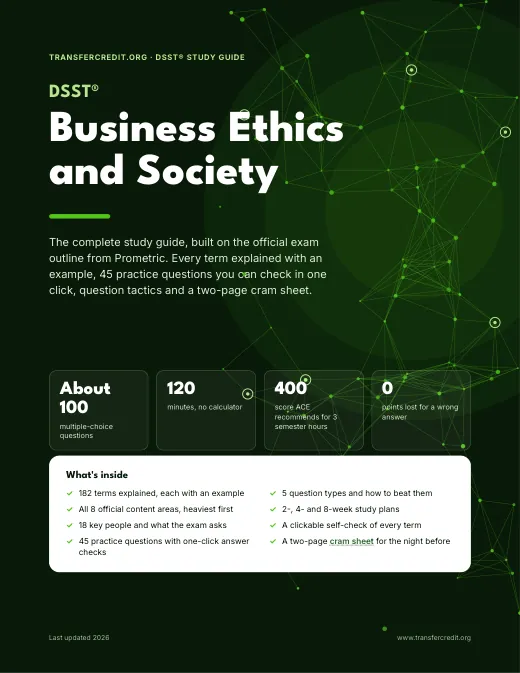
Everything the DSST Business Ethics and Society exam tests, in one PDF you can print. Built from Prometric's official outline, heaviest topics first.
Last updated 2026 · exam details checked against Prometric's published exam information in 2026
Real pages from the 38-page PDF.
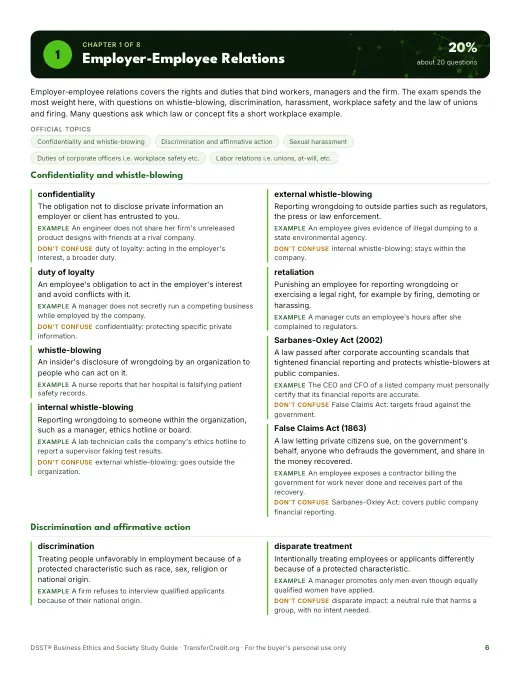
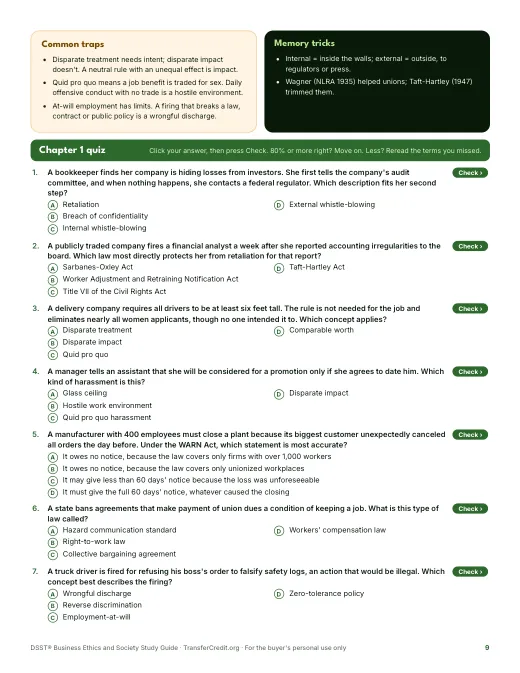
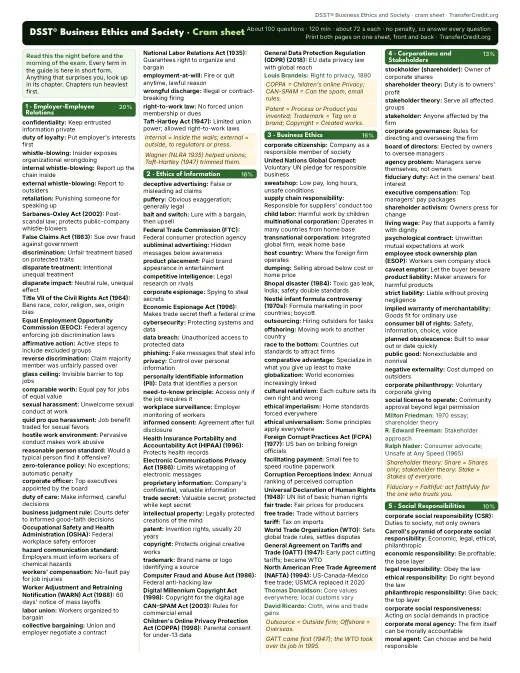
One chapter for each official content area, in the order the exam weighs them.
In the style of the real exam, from all 8 areas. About 10 minutes, with every answer explained and a score by area.
A bookkeeper finds her company is hiding losses from investors. She first tells the company's audit committee, and when nothing happens, she contacts a federal regulator. Which description fits her second step?
Answer: A. External whistle-blowing. Going to a government regulator outside the company is external whistle-blowing.
The trap: Breach of confidentiality sounds plausible, but protected disclosure of wrongdoing to a regulator is a whistle-blowing act, not a simple breach.
Going to a government regulator outside the company is external whistle-blowing.
The trap: Breach of confidentiality sounds plausible, but protected disclosure of wrongdoing to a regulator is a whistle-blowing act, not a simple breach.
A billboard for a hair salon reads, "Our stylists are the best in the entire world!" A competitor sues for deceptive advertising. The claim is most likely to be treated as
Answer: B. Puffery. Vague, exaggerated opinion that nobody takes as a measurable fact is puffery, which is generally legal.
The trap: Bait and switch needs a low-priced offer that the seller does not intend to honor, and no such offer appears here.
Vague, exaggerated opinion that nobody takes as a measurable fact is puffery, which is generally legal.
The trap: Bait and switch needs a low-priced offer that the seller does not intend to honor, and no such offer appears here.
A U.S. clothing company discovers that a supplier in another country has been employing children and forcing overtime. The company says that it cannot be blamed because it does not own the factory. Which concept shows why that excuse is weak?
Answer: D. Supply chain responsibility. Companies are increasingly expected to see that their suppliers meet ethical standards, even factories they do not own. That is supply chain responsibility.
The trap: Cultural relativism is tempting, but it would excuse local practice, not hold the buyer accountable for its supplier.
Companies are increasingly expected to see that their suppliers meet ethical standards, even factories they do not own. That is supply chain responsibility.
The trap: Cultural relativism is tempting, but it would excuse local practice, not hold the buyer accountable for its supplier.
A manager says, "My job is to use the company's resources to raise profits for the owners, while following the law. Charity is the owners' choice, not mine." Which view does she hold?
Answer: C. Shareholder theory. Limiting a manager's duty to raising owners' profit within the rules is shareholder theory.
The trap: Stakeholder theory is tempting because it also discusses social duties, but it would make her weigh all groups, not just owners.
Limiting a manager's duty to raising owners' profit within the rules is shareholder theory.
The trap: Stakeholder theory is tempting because it also discusses social duties, but it would make her weigh all groups, not just owners.
A mid-sized manufacturer is not required by any regulation to stop selling a cheap product that, though legal, is known to cause skin irritation. It withdraws the product anyway because selling it feels wrong. Which responsibility in Carroll's pyramid is it meeting?
Answer: B. Ethical. It acted because it was right, not because the law forced it or to give gifts. That is ethical responsibility.
The trap: Philanthropic is tempting because it sounds generous, but philanthropy means voluntary giving to society, not avoiding harm.
It acted because it was right, not because the law forced it or to give gifts. That is ethical responsibility.
The trap: Philanthropic is tempting because it sounds generous, but philanthropy means voluntary giving to society, not avoiding harm.
A sales rep says, "I don't pad my expense reports because the company would fire me and I could be sued." Which best describes her moral reasoning?
Answer: D. Preconventional level. Her reason is fear of punishment. Right and wrong based on avoiding punishment is the preconventional level.
The trap: Conventional level is tempting because she mentions company rules, but her motive is personal punishment, not loyalty to the group's expectations.
Her reason is fear of punishment. Right and wrong based on avoiding punishment is the preconventional level.
The trap: Conventional level is tempting because she mentions company rules, but her motive is personal punishment, not loyalty to the group's expectations.
A city's water agency has repeatedly approved rate increases requested by the private water companies it regulates, and its officials often take jobs with those companies. Which problem does this describe?
Answer: C. Regulatory capture. The agency serves the industry it is meant to oversee, which is regulatory capture.
The trap: Deregulation is tempting, but no rules were removed. The rules still exist and the agency simply favors the industry.
The agency serves the industry it is meant to oversee, which is regulatory capture.
The trap: Deregulation is tempting, but no rules were removed. The rules still exist and the agency simply favors the industry.
A vice president learns in a closed meeting that her firm will be acquired next week at a high price. Before the news is public, she buys a large block of its stock. Her action is best described as
Answer: A. insider trading. She traded securities using important nonpublic information, which is insider trading.
The trap: Embezzlement is wrong because she did not steal funds entrusted to her; she misused secret information to trade.
She traded securities using important nonpublic information, which is insider trading.
The trap: Embezzlement is wrong because she did not steal funds entrusted to her; she misused secret information to trade.
A publicly traded company fires a financial analyst a week after she reported accounting irregularities to the board. Which law most directly protects her from retaliation for that report?
Answer: D. Sarbanes-Oxley Act. Sarbanes-Oxley protects employees of public companies who report possible fraud from retaliation, including reports made inside the company, such as to the board.
The trap: Taft-Hartley concerns union activity, not whistle-blowers who report fraud.
Sarbanes-Oxley protects employees of public companies who report possible fraud from retaliation, including reports made inside the company, such as to the board.
The trap: Taft-Hartley concerns union activity, not whistle-blowers who report fraud.
A furniture store advertises a sofa for $199. When shoppers arrive, the salesperson says that sofa is "just sold out" and shows only $899 models, though the store never stocked the cheaper sofa. This is
Answer: B. bait and switch. The low price lured buyers into the store, and then the seller pushed a more expensive item. That is bait and switch.
The trap: Puffery is harmless exaggeration, while here a specific offer was made and never honored.
The low price lured buyers into the store, and then the seller pushed a more expensive item. That is bait and switch.
The trap: Puffery is harmless exaggeration, while here a specific offer was made and never honored.
The DSST Business Ethics and Society exam is a 120-minute, computer-based test from Prometric with about 100 multiple-choice questions. A score of 400 on the 200–500 scale earns an ACE credit recommendation of 3 semester hours, though each college sets its own policy. The exam covers 8 content areas; the heaviest is Employer-Employee Relations at 20%.
Source: official DSST Business Ethics and Society exam page.
8 areas, heaviest first. The guide's chapters follow this order.
Start with the guide, or get everything for DSST in one plan.
DSST® is a registered trademark of Prometric, which was not involved in producing this guide and does not endorse it. TransferCredit.org is independent and not affiliated with Prometric. © 2026 UPI Globale Edu Inc.