← All study guides
DSST® Study Guide Printable PDF · 42 pages

DSST Human Resource Management Study Guide

Everything the DSST Human Resource Management exam tests, in one PDF you can print. Built from Prometric's official outline, heaviest topics first.

  • 181 key terms, each with an example
  • 50 practice questions with every answer explained
  • A 2-page cram sheet for the night before
  • 2-, 4- and 8-week study plans built from the exam weights
Not sure yet? Try 10 free questions

Last updated 2026 · exam details checked against Prometric's published exam information in 2026

Look inside the guide

Real pages from the 42-page PDF.

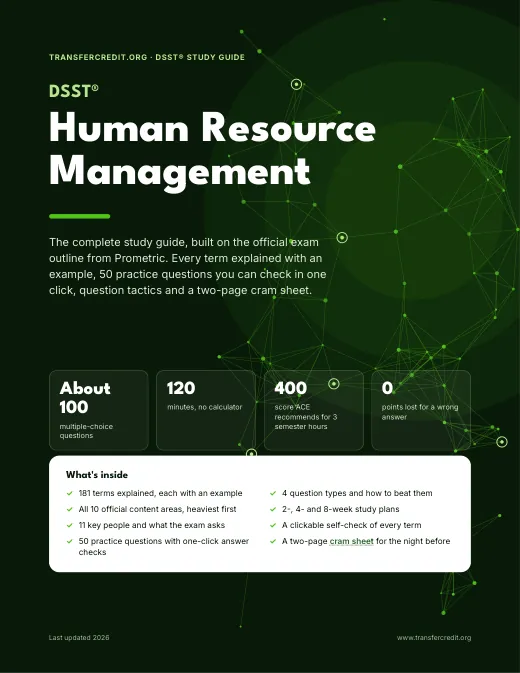
Page 1 of the DSST Human Resource Management Study Guide: the cover
Page 1 The cover
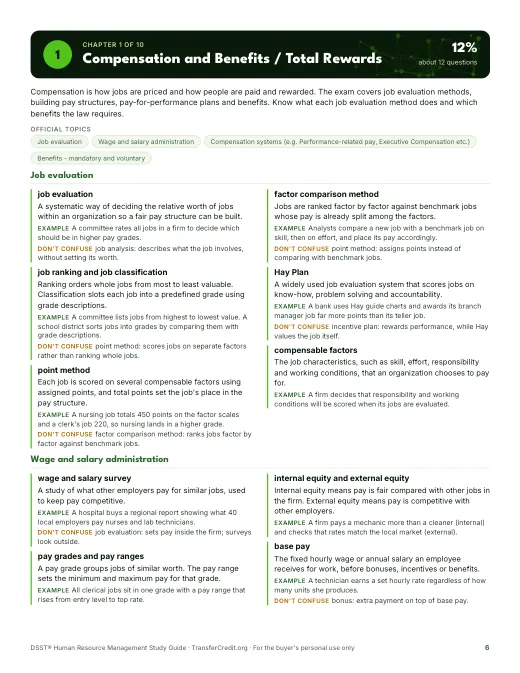
Page 6 of the DSST Human Resource Management Study Guide: the Chapter 1 opener
Page 6 The Chapter 1 opener
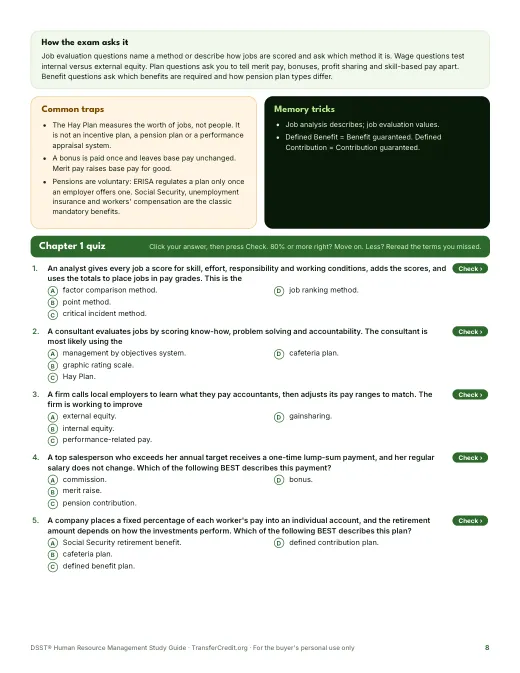
Page 8 of the DSST Human Resource Management Study Guide: a chapter quiz
Page 8 A chapter quiz
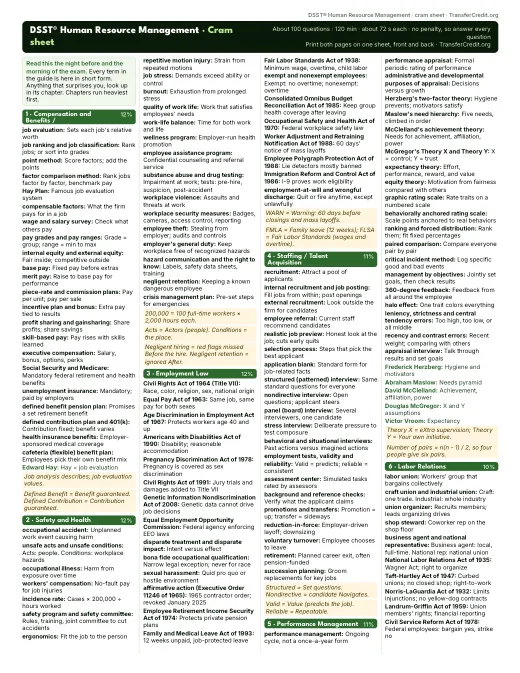
Page 41 of the DSST Human Resource Management Study Guide: the 2-page cram sheet
Page 41 The 2-page cram sheet

What you get for $5

One chapter for each official content area, in the order the exam weighs them.

  • 📘42pages, printable
  • 🧭10chapters, heaviest first
  • 🔑181terms with examples
  • ✍️50practice questions, answers explained
  • ⚠️30exam traps to avoid
  • 📄2page cram sheet

Try 10 free Human Resource Management questions

In the style of the real exam, one from each of the ten heaviest areas. About 10 minutes, with every answer explained and a score by area.

10 questions  
  1. Question 1 · Compensation and Benefits / Total Rewards

    An analyst gives every job a score for skill, effort, responsibility and working conditions, adds the scores, and uses the totals to place jobs in pay grades. This is the

    Show the answer

    Answer: A. point method.. The point method scores jobs on compensable factors and adds the points to decide pay levels.

    The trap: Job ranking is tempting because both order jobs, but ranking compares whole jobs without scoring separate factors.

  2. Question 2 · Safety and Health

    A plant recorded 5 injury and illness cases while its employees worked a total of 250,000 hours. Using the OSHA formula, what is its incidence rate?

    Show the answer

    Answer: C. 4.0. Rate = cases × 200,000 ÷ hours worked, so 5 × 200,000 ÷ 250,000 = 4.0.

    The trap: The 2.0 comes from using 100,000 as the base instead of the 200,000 OSHA uses for 100 full-time workers.

  3. Question 3 · Employment Law

    An employer ends a worker's employment shortly after she announces that she is pregnant, although her work has been excellent. Which law does this action most clearly violate?

    Show the answer

    Answer: B. Pregnancy Discrimination Act of 1978. The Pregnancy Discrimination Act makes firing a worker because of pregnancy a form of sex discrimination under Title VII.

    The trap: The Equal Pay Act is wrong because it addresses unequal pay for equal work, not firing.

  4. Question 4 · Staffing / Talent Acquisition

    A call center lets job applicants sit with a current agent for an hour and warns them about the angry callers and rotating shifts. Which of the following BEST describes this practice?

    Show the answer

    Answer: D. realistic job preview.. Showing applicants the favorable and unfavorable sides of a job before they accept is a realistic job preview. It helps applicants decide whether they fit.

    The trap: New-hire orientation is wrong because orientation happens after hiring, to help new employees adjust.

  5. Question 5 · Performance Management (Appraisals)

    An employee says her pay and comfortable office keep her from being unhappy, but only challenging projects and recognition make her excited about work. Which theory does she illustrate?

    Show the answer

    Answer: B. Herzberg's two-factor theory. Herzberg separated hygiene factors, which prevent dissatisfaction, from motivators, which create satisfaction. Her comments fit exactly this split.

    The trap: Maslow's need hierarchy is tempting because both theories list needs, but Maslow describes five levels, not two kinds of factors.

  6. Question 6 · Labor Relations

    A machinist is chosen by coworkers in her department to be their first point of contact in complaints against supervisors. She keeps her regular job on the line. Which of the following BEST describes her role?

    Show the answer

    Answer: D. shop steward. A union member who works in the unit and represents coworkers at the workplace is a shop steward.

    The trap: A business agent is a full-time paid official of the local union, not a worker who stays on the production line.

  7. Question 7 · Human Resource Planning

    A human resource manager reviews a job posting that lists a bachelor's degree, three years of experience and good communication skills. This part of the posting is the

    Show the answer

    Answer: C. job specification.. A job specification lists the knowledge, skills and abilities a person needs to do the job. Degree, experience and skills are personal requirements.

    The trap: A job description is tempting because it appears in the same posting, but it lists duties and responsibilities, not qualifications.

  8. Question 8 · Training and Development

    A bank trains new tellers in a classroom set up with copies of real teller stations and practice customers, away from live transactions. This is

    Show the answer

    Answer: A. vestibule training. Training on replica equipment away from the work floor is vestibule training. Errors cost nothing real.

    The trap: On-the-job training takes place at the actual workstation during real work, which is not the case here.

  9. Question 9 · An Overview of the Human Resource Management Field

    Researchers at a manufacturing plant changed the lighting for a test group. Output rose, and it rose again when the lights were dimmed. They concluded that the workers responded mainly to the attention they were getting. This describes the findings of the

    Show the answer

    Answer: D. Hawthorne studies. Output rose whatever the physical change, so attention and social factors explained it. That is the central finding of the Hawthorne studies.

    The trap: Time-and-motion studies measure how long motions take to find the best method. They do not explain output rising for reasons of attention.

  10. Question 10 · Current Issues and Trends

    A team of eight machinists at a plant schedules its own shifts, assigns tasks and inspects its own output, with no supervisor on the floor. This team is a(n)

    Show the answer

    Answer: B. autonomous work group.. A team that manages its own tasks, schedules and quality with little supervision is an autonomous work group.

    The trap: A contingent workforce is wrong because 'contingent' describes temporary or contract workers, not how a team is managed.

The DSST Human Resource Management exam at a glance

The DSST Human Resource Management exam is a 120-minute, computer-based test from Prometric with about 100 multiple-choice questions. A score of 400 on the 200–500 scale earns an ACE credit recommendation of 3 semester hours, though each college sets its own policy. The exam covers 10 content areas; the heaviest is Compensation and Benefits / Total Rewards at 12%.

Questions
About 100multiple choice
Time
120 minabout 72 seconds a question
Passing score
400on a 200–500 scale
ACE credit
3semester hours
Exam fee
$100paid to Prometric
Calculator
Nonot allowed

Source: official DSST Human Resource Management exam page.

What the exam covers

10 areas, heaviest first. The guide's chapters follow this order.

  1. Compensation and Benefits / Total Rewards12%
  2. Safety and Health12%
  3. Employment Law12%
  4. Staffing / Talent Acquisition11%
  5. Performance Management (Appraisals)11%
  6. Labor Relations10%
  7. Human Resource Planning9%
  8. Training and Development9%
  9. An Overview of the Human Resource Management Field8%
  10. Current Issues and Trends6%

How it works

  1. 1Buy once, $5Secure checkout. No subscription needed.
  2. 2Download the PDFFrom your TransferCredit.org account, right away and any time later.
  3. 3Study the heaviest areas firstFollow the 2-, 4- or 8-week plan, then read the cram sheet the night before.

Questions students ask

What's in the full DSST Human Resource Management study guide?
42 pages: 10 chapters, one per official content area, heaviest first. 181 terms, each with a plain-English definition and an example, 11 key people, common traps and memory tricks, 50 practice questions with an answer key that explains every answer, question tactics, 2-, 4- and 8-week study plans and a 2-page cram sheet.
How much is the full DSST Human Resource Management study guide?
The full 42-page PDF is $5, a one-time payment. The 10 practice questions on this page are free, with no account.
What does the $29 plan include?
$29 a month gives you all DSST subjects: every DSST study guide plus the full prep course for each subject, and you can cancel anytime. If you only need this exam, the guide on its own is a one-time $5.
How do I get the full guide?
Choose Buy this guide ($5) and check out. Then sign in to your TransferCredit.org account, then open the course and its Download Your Study Guide lesson. The PDF is yours to keep, and you can download it again from your account at any time.
Can I print the guide or use it on my phone?
Yes. It's a PDF, so it opens on phones, tablets and computers, and printing is allowed. Its tick boxes and answer bubbles work in PDF readers that support forms. Copying and editing are turned off.
Is this an official DSST study guide?
No. DSST® is a registered trademark of Prometric, which was not involved in producing this guide and does not endorse it. TransferCredit.org is independent. We built the guide from the official exam outline, and the exam details were checked against Prometric's published exam information in 2026.
Why is this study guide better than a generic review?
It follows the official outline area by area and spends the most pages on what the exam weighs most. Every term comes with an example, each chapter names the traps the exam sets, and the answer key explains why the most tempting wrong answer is wrong, not just which answer is right. It ends with a 2-page cram sheet for the night before.
What is the DSST Human Resource Management exam?
The DSST Human Resource Management exam is a 120-minute, computer-based test from Prometric with about 100 multiple-choice questions. A score of 400 on the 200–500 scale earns an ACE credit recommendation of 3 semester hours, though each college sets its own policy. The exam covers 10 content areas; the heaviest is Compensation and Benefits / Total Rewards at 12%.
More questions about the DSST Human Resource Management exam (22)
How many questions are on the DSST Human Resource Management exam, and how long is it?
It contains 100 questions to be answered in 2 hours, all multiple choice with one correct answer and three incorrect options.
What is the passing score for DSST Human Resource Management?
The passing score is 400 on a 200–500 scale. At 400 or above, the American Council on Education (ACE) recommends 3 semester hours. Each college sets its own passing score and credit award, so check your school's policy before you book.
How much does the DSST Human Resource Management exam cost?
The exam fee is $100, paid to Prometric. Test centers may add their own administration fee. Eligible U.S. military service members can usually test for free through DANTES.
How many college credits is DSST Human Resource Management worth?
ACE recommends 3 semester hours for a passing score of 400. Your college decides how many credits it awards and which course they replace. Check your college's policy.
Can I use a calculator on the DSST Human Resource Management exam?
No. This exam doesn't allow a calculator.
Is there a penalty for guessing on DSST Human Resource Management?
No. Your score counts only correct answers, so a wrong answer costs nothing. Never leave a question blank: rule out what you can and pick your best guess.
What topics are on the DSST Human Resource Management exam?
10 content areas, from the official outline: Compensation and Benefits / Total Rewards (12%); Safety and Health (12%); Employment Law (12%); Staffing / Talent Acquisition (11%); Performance Management (Appraisals) (11%); Labor Relations (10%); Human Resource Planning (9%); Training and Development (9%); An Overview of the Human Resource Management Field (8%); Current Issues and Trends (6%).
Which DSST Human Resource Management topics should I study first?
Start with the three heaviest: Compensation and Benefits / Total Rewards (12%), Safety and Health (12%) and Employment Law (12%). Together they are about 36% of the exam, roughly 36 of 100 questions. The guide's chapters run in that order, heaviest first.
Is the DSST Human Resource Management exam hard?
It depends on what you already know. No single area dominates: the largest, Compensation and Benefits / Total Rewards, is 12% and the smallest, Current Issues and Trends, is 6%, so broad coverage matters more than deep expertise in one topic. Take the free diagnostic above to see where you stand in about 10 minutes.
What kinds of questions are on the DSST Human Resource Management exam?
The guide sorts them into 4 types: “Name the term from its key feature”, “Pick the definition of a named term”, “Match a theory, person or law” and “Apply the idea to a workplace case”. Every question has 4 answer choices. Try the 10 free questions above to see the style.
How long should I study for DSST Human Resource Management?
Use the diagnostic to decide. If you already know most areas, two weeks of daily review is often enough; if the subject is new to you, plan on eight. The full guide has 2-, 4- and 8-week plans built from the exam weights.
How should I pace myself on the DSST Human Resource Management exam?
On average you have about 72 seconds per question (120 minutes for 100 questions). Be past question 33 a third of the way through and past question 67 two-thirds through. If a question takes more than a minute, pick your best guess, mark it and come back.
What happens if I don't pass DSST Human Resource Management?
You can retake a DSST exam after 30 days. Use the wait to work through the areas the score report and the diagnostic show you missed.
Do colleges accept DSST Human Resource Management for credit?
DSST exams are accepted at more than 1,500 colleges and universities, but each school decides which exams it accepts, the score it requires and the credit it gives. Look up your college's DSST policy before you book.
How up to date is this DSST Human Resource Management guide?
Last updated 2026. The exam details were checked against Prometric's published exam information in 2026. Exams change, so confirm the details on the official exam page before you register.
What should I do the night before the exam?
Read the cram sheet once, slowly. Check your test time, the location or remote-proctoring setup, and the ID you need. Then sleep: a rested brain recalls more than a crammed one. In the morning, skim the memory tricks and common traps, then stop studying.
Which employment laws are on DSST HRM?
The outline names Title VII, the ADA, ADEA, ERISA, FMLA, FLSA, OSHA and WARN, plus the NLRA, Taft-Hartley and Civil Service Reform Acts in labor relations.
What textbooks does DSST recommend for Human Resource Management?
The DSST fact sheet lists Valentine's Human Resource Management, Snell and Bohlander's Managing Human Resources, and Mondy and Martocchio's Human Resource Management. DSST suggests checking any textbook against the content outline and studying from more than one.
Which performance appraisal methods should I know for DSST HRM?
Performance management is 11% of the exam, covering why organizations evaluate, appraisal techniques and common challenges. Know graphic rating scales, BARS, MBO, forced distribution, critical incidents and 360-degree feedback, plus rater errors such as the halo effect and leniency.
Which motivation theories should I know for DSST HRM?
Herzberg's two-factor theory, which separates satisfiers from dissatisfiers, appears in an official DSST sample question. Know Maslow's hierarchy of needs, McClelland's achievement theory and McGregor's Theory X and Theory Y as well, since they appear alongside it as answer choices.
Does DSST HRM cover artificial intelligence?
Yes, at an awareness level. AI is listed under current issues and trends, alongside HR information systems, virtual work, global HR and social media.
Can I take DSST Human Resource Management online?
Yes. DSST exams can be taken at a test center or online with a remote Prometric proctor.

Choose how you want to study

Start with the guide, or get everything for DSST in one plan.

This study guide
$5one-time
  • 42-page printable PDF
  • 181 terms with examples
  • 50 practice questions, answers explained
  • 2-page cram sheet and study plans
Get the guide · $5
Best value Get it all
$29/month
  • Every DSST study guide
  • Prep courses for all DSST subjects
  • Cancel anytime
Get it all · $29/mo

DSST® is a registered trademark of Prometric, which was not involved in producing this guide and does not endorse it. TransferCredit.org is independent and not affiliated with Prometric. © 2026 UPI Globale Edu Inc.