
$5one-time
- 35-page printable PDF
- 184 terms with examples
- 44 practice questions, answers explained
- 2-page cram sheet and study plans
Everything the DSST Money and Banking exam tests, in one PDF you can print. Built from Prometric's official outline, heaviest topics first.
Last updated 2026 · exam details checked against Prometric's published exam information in 2026
Real pages from the 35-page PDF.
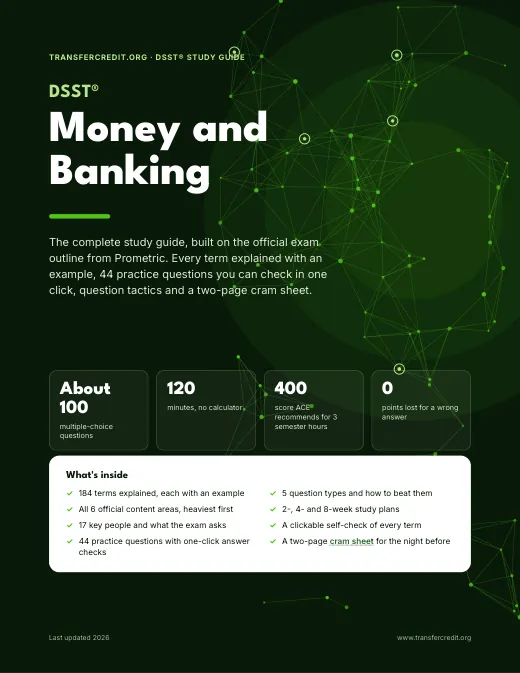
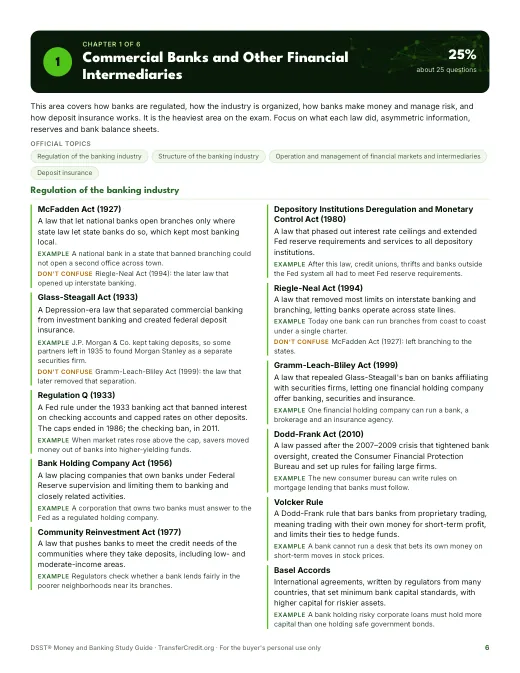
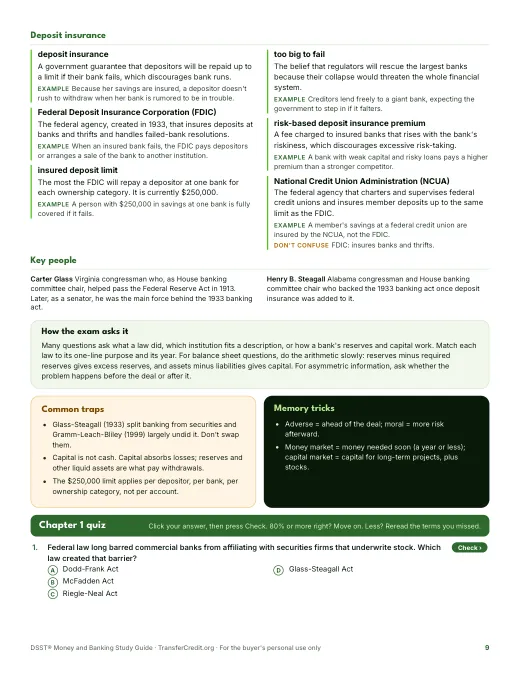
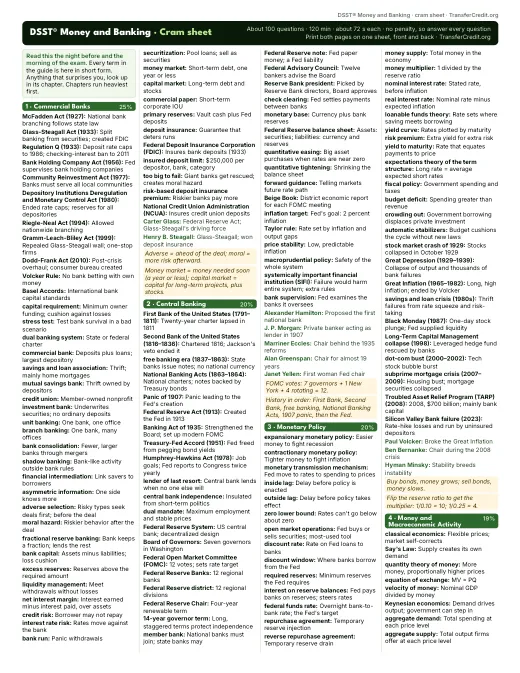
One chapter for each official content area, in the order the exam weighs them.
In the style of the real exam, from all 6 areas. About 10 minutes, with every answer explained and a score by area.
Federal law long barred commercial banks from affiliating with securities firms that underwrite stock. Which law created that barrier?
Answer: C. Glass-Steagall Act. The 1933 Glass-Steagall Act separated commercial banking from investment banking, keeping deposit-taking banks apart from securities underwriting.
The trap: The McFadden Act is tempting because it is also an early banking law, but it dealt with branching, not securities activities.
The 1933 Glass-Steagall Act separated commercial banking from investment banking, keeping deposit-taking banks apart from securities underwriting.
The trap: The McFadden Act is tempting because it is also an early banking law, but it dealt with branching, not securities activities.
The National Banking Acts of 1863–1864 created a new kind of bank charter. Which agency issued these charters?
Answer: A. The Comptroller of the Currency. National banks were chartered and supervised by the Comptroller of the Currency, in the Treasury Department.
The trap: State banking commissions chartered state banks, which is the other half of the dual banking system, not national banks.
National banks were chartered and supervised by the Comptroller of the Currency, in the Treasury Department.
The trap: State banking commissions chartered state banks, which is the other half of the dual banking system, not national banks.
Assume banks hold only the required 20% of deposits as reserves and lend out the rest, and no cash is held outside banks. If the Fed buys $10 million of securities from dealers who deposit the proceeds, the maximum increase in total deposits is
Answer: D. $50 million. The simple multiplier is 1 divided by 0.20, or 5. Five times $10 million is $50 million.
The trap: The $2 million choice multiplies by the reserve ratio instead of dividing by it.
The simple multiplier is 1 divided by 0.20, or 5. Five times $10 million is $50 million.
The trap: The $2 million choice multiplies by the reserve ratio instead of dividing by it.
A nation's central bank expands the money supply by 10 percent. Real output and velocity are unchanged. According to the quantity theory of money, the price level will
Answer: B. rise by about 10 percent. With V and Q fixed, MV = PQ means P changes in proportion to M, so prices rise about 10 percent.
The trap: Staying the same is tempting because output is unchanged, but constant output with more money forces the price level up.
With V and Q fixed, MV = PQ means P changes in proportion to M, so prices rise about 10 percent.
The trap: Staying the same is tempting because output is unchanged, but constant output with more money forces the price level up.
A low-income country wants a 20-year loan to build roads and irrigation. Which institution is the most likely source of such development financing?
Answer: C. The World Bank. The World Bank makes long-term loans for development projects such as roads and irrigation.
The trap: The IMF is tempting, but it lends short-term to countries with balance-of-payments problems, not for development projects.
The World Bank makes long-term loans for development projects such as roads and irrigation.
The trap: The IMF is tempting, but it lends short-term to countries with balance-of-payments problems, not for development projects.
A shopper compares a $30 jacket with a $45 pair of shoes by looking at their dollar prices. Which function of money is she using?
Answer: A. Unit of account. Stating and comparing prices in one common measure is the unit of account function.
The trap: Medium of exchange is tempting because she is shopping, but she has not paid yet; she is only comparing prices.
Stating and comparing prices in one common measure is the unit of account function.
The trap: Medium of exchange is tempting because she is shopping, but she has not paid yet; she is only comparing prices.
A bank sets a very high interest rate on loans. The borrowers most willing to accept it tend to be those with the riskiest projects, so the bank's loan pool gets worse. This problem is called
Answer: B. adverse selection. High rates attract the riskiest borrowers before the loan is made. Asymmetric information that causes this problem before the deal is adverse selection.
The trap: Moral hazard is tempting because it also involves risk, but it describes behavior after the loan is made, not who applies.
High rates attract the riskiest borrowers before the loan is made. Asymmetric information that causes this problem before the deal is adverse selection.
The trap: Moral hazard is tempting because it also involves risk, but it describes behavior after the loan is made, not who applies.
Congress created the Federal Reserve in 1913 mainly in response to which weakness revealed by the Panic of 1907?
Answer: D. No institution could supply emergency cash to banks during a panic. The panic showed that the country lacked a lender of last resort, and the Fed was designed to fill that role.
The trap: The claim that state banks were forbidden to take deposits is false; state banks have always taken deposits.
The panic showed that the country lacked a lender of last resort, and the Fed was designed to fill that role.
The trap: The claim that state banks were forbidden to take deposits is false; state banks have always taken deposits.
The economy is sliding into recession, and the Fed wants to stimulate spending. Which action fits that goal?
Answer: D. Buying government securities in the open market. Buying securities adds reserves, lowers the federal funds rate and encourages lending and spending.
The trap: Selling securities is tempting but drains reserves and raises rates, which would slow the economy.
Buying securities adds reserves, lowers the federal funds rate and encourages lending and spending.
The trap: Selling securities is tempting but drains reserves and raises rates, which would slow the economy.
The money supply is $1,000 billion, velocity is 4 and real output is 2,000 billion units. Using the equation of exchange, the price level is
Answer: A. 2.0. MV = 1,000 x 4 = 4,000. Then P = 4,000 / 2,000 = 2.0.
The trap: A price level of 0.5 comes from dividing output by 4,000, flipping the equation upside down.
MV = 1,000 x 4 = 4,000. Then P = 4,000 / 2,000 = 2.0.
The trap: A price level of 0.5 comes from dividing output by 4,000, flipping the equation upside down.
The DSST Money and Banking exam is a 120-minute, computer-based test from Prometric with about 100 multiple-choice questions. A score of 400 on the 200–500 scale earns an ACE credit recommendation of 3 semester hours, though each college sets its own policy. The exam covers 6 content areas; the heaviest is Commercial Banks and Other Financial Intermediaries at 25%.
6 areas, heaviest first. The guide's chapters follow this order.
Start with the guide, or get everything for DSST in one plan.
DSST® is a registered trademark of Prometric, which was not involved in producing this guide and does not endorse it. TransferCredit.org is independent and not affiliated with Prometric. © 2026 UPI Globale Edu Inc.