← DSST Computing and Information Technology course
DSST® Study Guide Printable PDF · 36 pages

DSST Computing and Information Technology Study Guide

Everything the DSST Computing and Information Technology exam tests, in one PDF you can print. Built from Prometric's official outline, heaviest topics first.

  • 184 key terms, each with an example
  • 42 practice questions with every answer explained
  • A 2-page cram sheet for the night before
  • 2-, 4- and 8-week study plans built from the exam weights
Not sure yet? Try 10 free questions

Last updated 2026 · exam details checked against Prometric's published exam information in 2026

Look inside the guide

Real pages from the 36-page PDF.

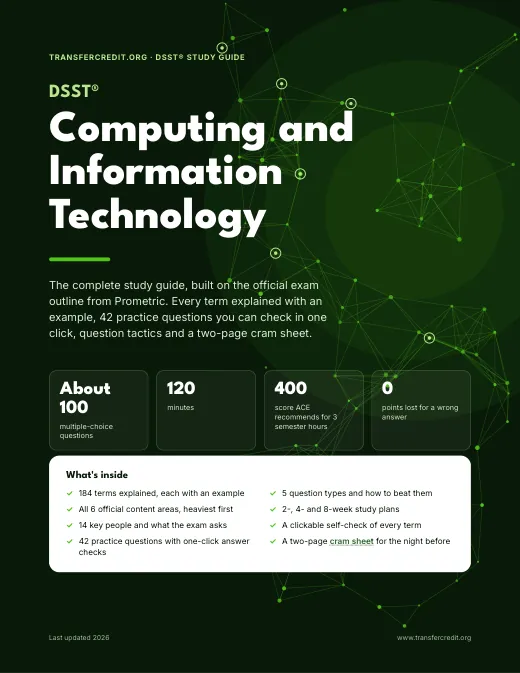
Page 1 of the DSST Computing and Information Technology Study Guide: the cover
Page 1 The cover
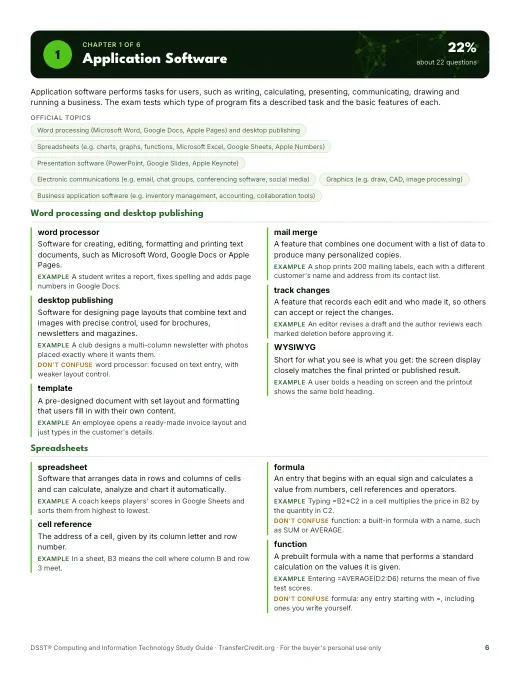
Page 6 of the DSST Computing and Information Technology Study Guide: the Chapter 1 opener
Page 6 The Chapter 1 opener
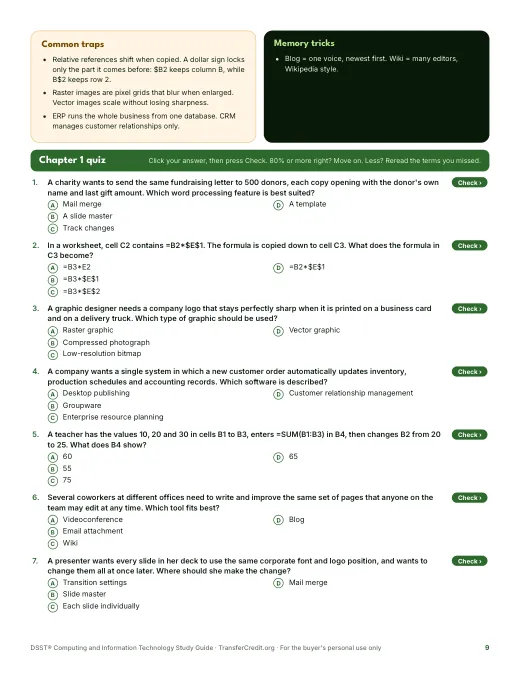
Page 9 of the DSST Computing and Information Technology Study Guide: a chapter quiz
Page 9 A chapter quiz
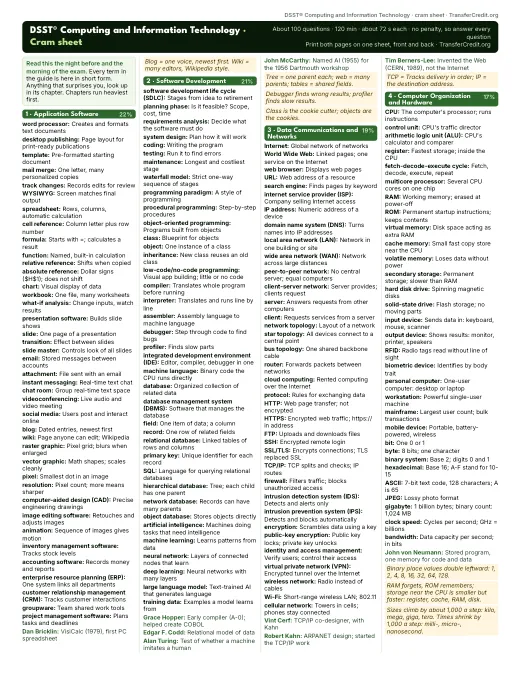
Page 35 of the DSST Computing and Information Technology Study Guide: the 2-page cram sheet
Page 35 The 2-page cram sheet

What you get for $5

One chapter for each official content area, in the order the exam weighs them.

  • 📘36pages, printable
  • 🧭6chapters, heaviest first
  • 🔑184terms with examples
  • ✍️42practice questions, answers explained
  • ⚠️18exam traps to avoid
  • 📄2page cram sheet

Try 10 free Computing and Information Technology questions

In the style of the real exam, from all 6 areas. About 10 minutes, with every answer explained and a score by area.

10 questions  
  1. Question 1 · Application Software

    A charity wants to send the same fundraising letter to 500 donors, each copy opening with the donor's own name and last gift amount. Which word processing feature is best suited?

    Show the answer

    Answer: C. Mail merge. Mail merge combines one document with a data list so every copy is personalized automatically.

    The trap: A template gives a reusable layout, but it would still require typing each donor's details by hand.

  2. Question 2 · Software Development

    A business has run the same inventory program for ten years, fixing errors, adding reports and adapting to new tax rules. Which life-cycle stage has this program spent most of its life in?

    Show the answer

    Answer: B. Maintenance. After release, a program spends most of its life being fixed and updated. Over its lifetime, maintenance usually takes the most time and money.

    The trap: Coding is tempting because programmers write code, but writing the first version is a small part of a program's total lifetime effort.

  3. Question 3 · Data Communications and Networks

    A user types a website's name into a browser. Before the page can be requested, which service turns that name into the numeric address of the server?

    Show the answer

    Answer: A. Domain Name System. DNS looks up a domain name and returns the matching IP address so the browser can reach the server.

    The trap: A search engine finds pages that match keywords. It does not turn a domain name into an IP address.

  4. Question 4 · Computer Organization and Hardware

    During the fetch-decode-execute cycle, what happens right after the control unit fetches an instruction from memory?

    Show the answer

    Answer: D. The instruction is decoded to determine what operation it requires. Fetch brings the instruction into the CPU, decode works out what it means, and execute carries it out. Decoding is the second step.

    The trap: Writing the result to secondary storage is wrong: the cycle works with memory and registers, not disks, and it happens after execution.

  5. Question 5 · Social Impact and History

    Which development of 1971 put an entire CPU on one chip and made the personal computer practical?

    Show the answer

    Answer: C. The microprocessor. The Intel 4004 of 1971 was the first commercial microprocessor, a complete CPU on a single chip.

    The trap: The transistor is tempting because it is a basic building block, but it came in 1947 and is only one switch, not a whole CPU.

  6. Question 6 · Systems Software

    A systems administrator needs one server to run a Linux database and a Windows web application at the same time, without buying a second machine. Which technology does this?

    Show the answer

    Answer: B. Virtual machines. A virtual machine imitates a complete computer, so each guest operating system runs on shared physical hardware.

    The trap: Job scheduling is tempting because it shares the processor, but it orders tasks within one operating system. It does not run a second operating system.

  7. Question 7 · Application Software

    In a worksheet, cell C2 contains =B2*$E$1. The formula is copied down to cell C3. What does the formula in C3 become?

    Show the answer

    Answer: A. =B3*$E$1. The relative reference B2 shifts to B3 when copied one row down. The absolute reference $E$1 stays locked.

    The trap: $E$2 is wrong because the dollar signs keep both the column and the row fixed, so nothing moves.

  8. Question 8 · Software Development

    A developer wants her finished program translated into machine language ahead of time, so that the resulting file can run without the source code or the translator. Which tool does this?

    Show the answer

    Answer: D. Compiler. A compiler translates the whole program ahead of time and produces a separate executable file.

    The trap: An interpreter translates as the program runs, so the source and the interpreter must be present each time.

  9. Question 9 · Data Communications and Networks

    A small office of five employees shares files and a printer directly among their computers, with no dedicated machine controlling the network. Which network type is this?

    Show the answer

    Answer: A. Peer-to-peer network. With no central server and each computer sharing its own resources, this is a peer-to-peer network.

    The trap: Client-server is tempting for any office, but it requires a central server to provide resources, and none exists here.

  10. Question 10 · Computer Organization and Hardware

    A laptop has 8 GB of RAM and many programs open. The operating system starts using part of the hard disk to hold some program data, and the computer slows down. What is this technique called?

    Show the answer

    Answer: D. Virtual memory. Using disk space as an extension of RAM is virtual memory. The disk is far slower than RAM, which is why the computer slows down.

    The trap: Cache memory is fast memory next to the CPU, not disk space, so it would not slow the computer this way.

The DSST Computing and Information Technology exam at a glance

The DSST Computing and Information Technology exam is a 120-minute, computer-based test from Prometric with about 100 multiple-choice questions. A score of 400 on the 200–500 scale earns an ACE credit recommendation of 3 semester hours, though each college sets its own policy. The exam covers 6 content areas; the heaviest is Application Software at 22%.

Questions
About 100multiple choice
Time
120 minabout 72 seconds a question
Passing score
400on a 200–500 scale
ACE credit
3semester hours
Exam fee
$100paid to Prometric
Calculator
Yeson-screen calculator provided

Source: official DSST Computing and Information Technology exam page.

What the exam covers

6 areas, heaviest first. The guide's chapters follow this order.

  1. Application Software22%
  2. Software Development21%
  3. Data Communications and Networks19%
  4. Computer Organization and Hardware17%
  5. Social Impact and History11%
  6. Systems Software10%

How it works

  1. 1Buy once, $5Secure checkout. No subscription needed.
  2. 2Download the PDFFrom your TransferCredit.org account, right away and any time later.
  3. 3Study the heaviest areas firstFollow the 2-, 4- or 8-week plan, then read the cram sheet the night before.

Questions students ask

What's in the full DSST Computing and Information Technology study guide?
36 pages: 6 chapters, one per official content area, heaviest first. 184 terms, each with a plain-English definition and an example, 14 key people, common traps and memory tricks, 42 practice questions with an answer key that explains every answer, question tactics, 2-, 4- and 8-week study plans and a 2-page cram sheet.
How much is the full DSST Computing and Information Technology study guide?
The full 36-page PDF is $5, a one-time payment. The 10 practice questions on this page are free, with no account.
What does the $29 plan include?
$29 a month gives you all DSST subjects: every DSST study guide plus the full prep course for each subject, and you can cancel anytime. If you only need this exam, the guide on its own is a one-time $5.
How do I get the full guide?
Choose Buy this guide ($5) and check out. Then sign in to your TransferCredit.org account, then open the course and its Download Your Study Guide lesson. The PDF is yours to keep, and you can download it again from your account at any time.
Can I print the guide or use it on my phone?
Yes. It's a PDF, so it opens on phones, tablets and computers, and printing is allowed. Its tick boxes and answer bubbles work in PDF readers that support forms. Copying and editing are turned off.
Is this an official DSST study guide?
No. DSST® is a registered trademark of Prometric, which was not involved in producing this guide and does not endorse it. TransferCredit.org is independent. We built the guide from the official exam outline, and the exam details were checked against Prometric's published exam information in 2026.
Why is this study guide better than a generic review?
It follows the official outline area by area and spends the most pages on what the exam weighs most. Every term comes with an example, each chapter names the traps the exam sets, and the answer key explains why the most tempting wrong answer is wrong, not just which answer is right. It ends with a 2-page cram sheet for the night before.
What is the DSST Computing and Information Technology exam?
The DSST Computing and Information Technology exam is a 120-minute, computer-based test from Prometric with about 100 multiple-choice questions. A score of 400 on the 200–500 scale earns an ACE credit recommendation of 3 semester hours, though each college sets its own policy. The exam covers 6 content areas; the heaviest is Application Software at 22%.
More questions about the DSST Computing and Information Technology exam (22)
How many questions are on the DSST Computing and Information Technology exam, and how long is it?
It has 100 questions to be answered in 2 hours, and the recommended credit is 3 semester hours for a minimum score of 400.
What is the passing score for DSST Computing and Information Technology?
The passing score is 400 on a 200–500 scale. At 400 or above, the American Council on Education (ACE) recommends 3 semester hours. Each college sets its own passing score and credit award, so check your school's policy before you book.
How much does the DSST Computing and Information Technology exam cost?
The exam fee is $100, paid to Prometric. Test centers may add their own administration fee. Eligible U.S. military service members can usually test for free through DANTES.
How many college credits is DSST Computing and Information Technology worth?
ACE recommends 3 semester hours for a passing score of 400. Your college decides how many credits it awards and which course they replace. Check your college's policy.
Can I use a calculator on the DSST Computing and Information Technology exam?
A calculator function is available during computer-based exams.
Is there a penalty for guessing on DSST Computing and Information Technology?
No. Your score counts only correct answers, so a wrong answer costs nothing. Never leave a question blank: rule out what you can and pick your best guess.
What topics are on the DSST Computing and Information Technology exam?
6 content areas, from the official outline: Application Software (22%); Software Development (21%); Data Communications and Networks (19%); Computer Organization and Hardware (17%); Social Impact and History (11%); Systems Software (10%).
Which DSST Computing and Information Technology topics should I study first?
Start with the three heaviest: Application Software (22%), Software Development (21%) and Data Communications and Networks (19%). Together they are about 62% of the exam, roughly 62 of 100 questions. The guide's chapters run in that order, heaviest first.
Is the DSST Computing and Information Technology exam hard?
It depends on what you already know. No single area dominates: the largest, Application Software, is 22% and the smallest, Systems Software, is 10%, so broad coverage matters more than deep expertise in one topic. Take the free diagnostic above to see where you stand in about 10 minutes.
What kinds of questions are on the DSST Computing and Information Technology exam?
The guide sorts them into 5 types: “Name the term”, “Fit the scenario”, “Order or stage”, “Convert or calculate” and “History and dates”. Every question has 4 answer choices. Try the 10 free questions above to see the style.
How long should I study for DSST Computing and Information Technology?
Use the diagnostic to decide. If you already know most areas, two weeks of daily review is often enough; if the subject is new to you, plan on eight. The full guide has 2-, 4- and 8-week plans built from the exam weights.
How should I pace myself on the DSST Computing and Information Technology exam?
On average you have about 72 seconds per question (120 minutes for 100 questions). Be past question 33 a third of the way through and past question 67 two-thirds through. If a question takes more than a minute, pick your best guess, mark it and come back.
What happens if I don't pass DSST Computing and Information Technology?
You can retake a DSST exam after 30 days. Use the wait to work through the areas the score report and the diagnostic show you missed.
Do colleges accept DSST Computing and Information Technology for credit?
DSST exams are accepted at more than 1,500 colleges and universities, but each school decides which exams it accepts, the score it requires and the credit it gives. Look up your college's DSST policy before you book.
How is the guide different from the DSST Computing and Information Technology course?
The guide is a 36-page PDF for review and self-testing. The DSST Computing and Information Technology course is a full online course with lessons, quizzes and a practice exam, for $19 with lifetime access. Many students use the guide first, then take the course for the areas the diagnostic flags.
How up to date is this DSST Computing and Information Technology guide?
Last updated 2026. The exam details were checked against Prometric's published exam information in 2026. Exams change, so confirm the details on the official exam page before you register.
What should I do the night before the exam?
Read the cram sheet once, slowly. Check your test time, the location or remote-proctoring setup, and the ID you need. Then sleep: a rested brain recalls more than a crammed one. In the morning, skim the memory tricks and common traps, then stop studying.
Do I need to know how to code for DSST Computing and IT?
No. You won't write code; every question is multiple choice. The software development area (21%) tests concepts instead: the stages of the development life cycle, procedural, object-oriented and low-code paradigms, tools such as compilers and debuggers, and database structures.
Which networking protocols should I know for DSST Computing and IT?
The outline names HTTP and HTTPS, FTP, SSH, SSL, TLS and TCP. Know what each does — HTTP and HTTPS carry web pages, FTP transfers files, SSH gives secure remote access, SSL and TLS encrypt connections and TCP delivers data reliably — along with firewalls, IDS/IPS and VPNs.
Do I need to know binary and hexadecimal for DSST Computing and IT?
Yes. The hardware area's data representation topic covers the binary system, bits and bytes, hexadecimal and other numbering systems, and the outline also lists units such as kilobytes, gigabytes, gigahertz and nanoseconds. Practice converting between binary, decimal and hexadecimal.
Does DSST Computing and IT cover artificial intelligence?
Yes. The 2024 outline lists neural networks, machine learning and large language models under software development, and AI ethics under social impact.
Can I take DSST Computing and IT online?
Yes. DSST exams can be taken at a test center or online with a remote Prometric proctor.

Choose how you want to study

Start with the guide, or get everything for DSST in one plan.

This study guide
$5one-time
  • 36-page printable PDF
  • 184 terms with examples
  • 42 practice questions, answers explained
  • 2-page cram sheet and study plans
Get the guide · $5
Full DSST Computing and Information Technology course
$19one-time · lifetime
  • Lessons for every content area
  • Quizzes and a practice final exam
  • Lifetime access, study at your pace
Get the course · $19 See what's in the course
Best value Get it all
$29/month
  • Every DSST study guide
  • Prep courses for all DSST subjects
  • Cancel anytime
Get it all · $29/mo

DSST® is a registered trademark of Prometric, which was not involved in producing this guide and does not endorse it. TransferCredit.org is independent and not affiliated with Prometric. © 2026 UPI Globale Edu Inc.