
$5one-time
- 31-page printable PDF
- 185 terms with examples
- 40 practice questions, answers explained
- 2-page cram sheet and study plans
Everything the DSST Introduction to Business exam tests, in one PDF you can print. Built from Prometric's official outline, heaviest topics first.
Last updated 2026 · exam details checked against Prometric's published exam information in 2026
Real pages from the 31-page PDF.
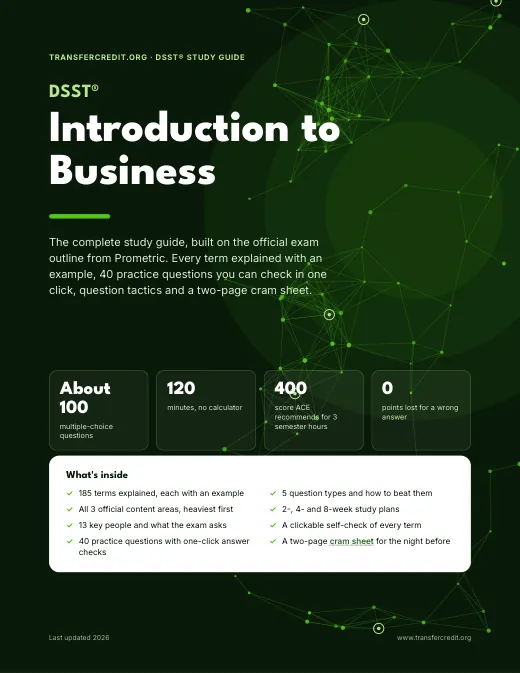
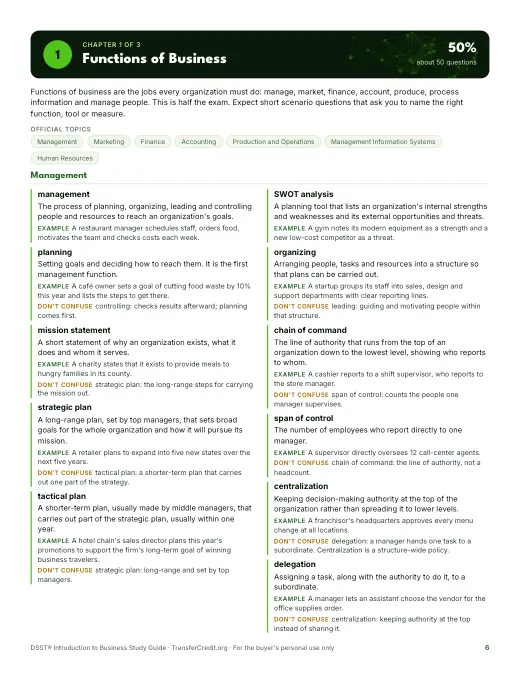
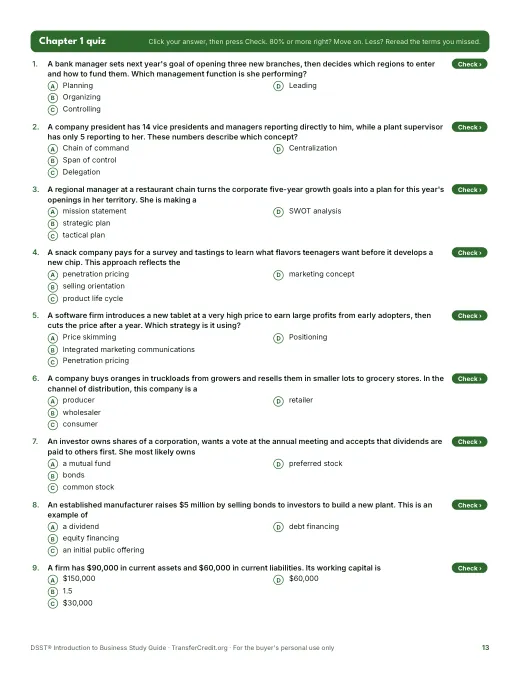
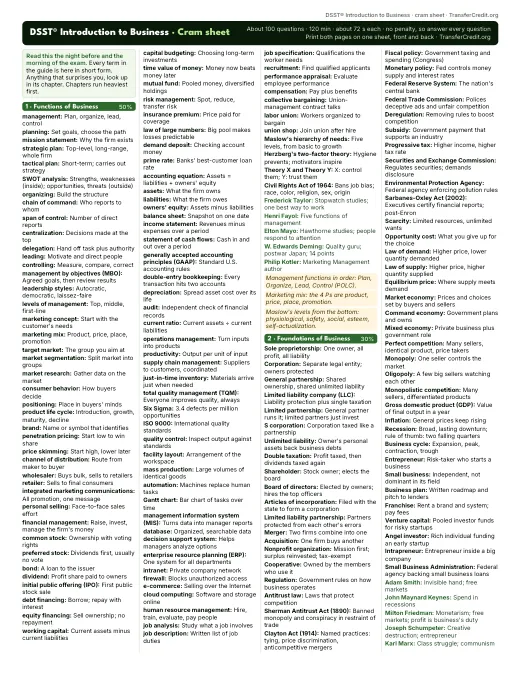
One chapter for each official content area, in the order the exam weighs them.
In the style of the real exam, from all 3 areas. About 10 minutes, with every answer explained and a score by area.
A bank manager sets next year's goal of opening three new branches, then decides which regions to enter and how to fund them. Which management function is she performing?
Answer: B. Planning. Setting goals and deciding how to reach them is planning, the first management function.
The trap: Organizing is tempting because branches will need staff and structure, but that comes after the goals and the approach are set.
Setting goals and deciding how to reach them is planning, the first management function.
The trap: Organizing is tempting because branches will need staff and structure, but that comes after the goals and the approach are set.
Nina and Raj run a bakery as partners with no formal agreement. The bakery cannot repay a $60,000 supplier debt, and its assets are worth far less. Which statement is true?
Answer: C. Either partner's personal assets can be used to pay the debt.. A general partnership has unlimited liability. Creditors can collect the full debt from any partner's personal assets, including the home.
The trap: Limiting losses to the amount invested is tempting, but that protection comes with a corporation or an LLC, not a general partnership.
A general partnership has unlimited liability. Creditors can collect the full debt from any partner's personal assets, including the home.
The trap: Limiting losses to the amount invested is tempting, but that protection comes with a corporation or an LLC, not a general partnership.
An accountant discovers that her employer is hiding losses from investors. When her manager ignores her concerns, she reports the matter to federal regulators. In doing so she is acting as a
Answer: D. whistleblower.. A whistleblower is an employee who reports illegal or unethical conduct by the employer to outside authorities.
The trap: Stakeholder is true of her in a loose sense, but the term describes anyone affected by the firm and does not name the act of reporting wrongdoing.
A whistleblower is an employee who reports illegal or unethical conduct by the employer to outside authorities.
The trap: Stakeholder is true of her in a loose sense, but the term describes anyone affected by the firm and does not name the act of reporting wrongdoing.
A company president has 14 vice presidents and managers reporting directly to him, while a plant supervisor has only 5 reporting to her. These numbers describe which concept?
Answer: A. Span of control. Span of control is the number of employees who report directly to one manager.
The trap: Chain of command is about the line of authority, who reports to whom, rather than how many people report to a manager.
Span of control is the number of employees who report directly to one manager.
The trap: Chain of command is about the line of authority, who reports to whom, rather than how many people report to a manager.
A regular corporation earns a profit and pays corporate income tax. It then pays a dividend, and the shareholder reports it as taxable income. What is this tax disadvantage called?
Answer: A. Double taxation. The same profit is taxed once at the corporate level and again when paid out to the shareholder. That is double taxation.
The trap: Pass-through taxation is the opposite: S corporations and partnerships avoid the corporate layer, so profit is taxed only once.
The same profit is taxed once at the corporate level and again when paid out to the shareholder. That is double taxation.
The trap: Pass-through taxation is the opposite: S corporations and partnerships avoid the corporate layer, so profit is taxed only once.
A vice president learns that another firm will soon offer to buy her company at a high price. Before the news is public, she buys a large block of her company's stock. Her action is
Answer: C. illegal insider trading.. Trading on important information that is not yet public breaks securities laws, whatever the person's job.
The trap: Calling it a permitted use of her pay is tempting because executives can own stock, but ownership is legal only when the trade does not use secret information.
Trading on important information that is not yet public breaks securities laws, whatever the person's job.
The trap: Calling it a permitted use of her pay is tempting because executives can own stock, but ownership is legal only when the trade does not use secret information.
A regional manager at a restaurant chain turns the corporate five-year growth goals into a plan for this year's openings in her territory. She is making a
Answer: D. tactical plan. A tactical plan is a shorter-term plan, made by middle managers, that carries out part of the strategic plan.
The trap: Strategic plan is wrong because strategic plans are long-range and made by top managers for the whole firm.
A tactical plan is a shorter-term plan, made by middle managers, that carries out part of the strategic plan.
The trap: Strategic plan is wrong because strategic plans are long-range and made by top managers for the whole firm.
Four accountants want to run one firm together, with every partner taking part in management. They also want protection from personal liability if another partner makes a professional error. Which form fits best?
Answer: B. Limited liability partnership. An LLP lets all partners manage while shielding each from liability for the others' wrongdoing or negligence.
The trap: A limited partnership offers protection only to partners who do not manage. Here all four manage, so they would be general partners with unlimited liability.
An LLP lets all partners manage while shielding each from liability for the others' wrongdoing or negligence.
The trap: A limited partnership offers protection only to partners who do not manage. Here all four manage, so they would be general partners with unlimited liability.
A company recruits qualified candidates at colleges with high minority enrollment and sets a goal of correcting a long-standing imbalance in its workforce. This policy is best called
Answer: B. affirmative action.. Actively recruiting and promoting qualified members of underrepresented groups to correct past imbalance is affirmative action.
The trap: A glass ceiling is the invisible barrier that blocks advancement. It is the problem such policies try to fix, not the policy itself.
Actively recruiting and promoting qualified members of underrepresented groups to correct past imbalance is affirmative action.
The trap: A glass ceiling is the invisible barrier that blocks advancement. It is the problem such policies try to fix, not the policy itself.
A snack company pays for a survey and tastings to learn what flavors teenagers want before it develops a new chip. This approach reflects the
Answer: D. marketing concept. The marketing concept starts with finding out what customers want and then delivering it.
The trap: Selling orientation is tempting, but it pushes products the firm already makes rather than starting with customer needs.
The marketing concept starts with finding out what customers want and then delivering it.
The trap: Selling orientation is tempting, but it pushes products the firm already makes rather than starting with customer needs.
The DSST Introduction to Business exam is a 120-minute, computer-based test from Prometric with about 100 multiple-choice questions. A score of 400 on the 200–500 scale earns an ACE credit recommendation of 3 semester hours, though each college sets its own policy. The exam covers 3 content areas; the heaviest is Functions of Business at 50%.
3 areas, heaviest first. The guide's chapters follow this order.
Start with the guide, or get everything for DSST in one plan.
DSST® is a registered trademark of Prometric, which was not involved in producing this guide and does not endorse it. TransferCredit.org is independent and not affiliated with Prometric. © 2026 UPI Globale Edu Inc.