← DSST Business Mathematics course
DSST® Study Guide Printable PDF · 32 pages

DSST Business Mathematics Study Guide

Everything the DSST Business Mathematics exam tests, in one PDF you can print. Built from Prometric's official outline, heaviest topics first.

  • 180 key terms, each with an example
  • 43 practice questions with every answer explained
  • A 2-page cram sheet for the night before
  • 2-, 4- and 8-week study plans built from the exam weights
Not sure yet? Try 10 free questions

Last updated 2026 · exam details checked against Prometric's published exam information in 2026

Look inside the guide

Real pages from the 32-page PDF.

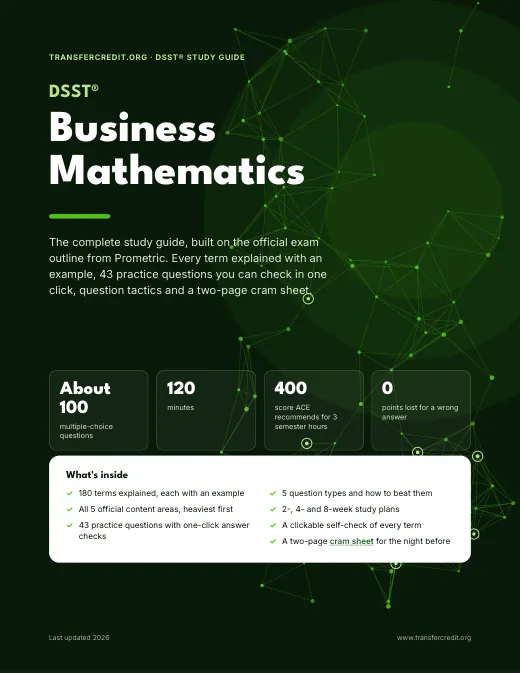
Page 1 of the DSST Business Mathematics Study Guide: the cover
Page 1 The cover
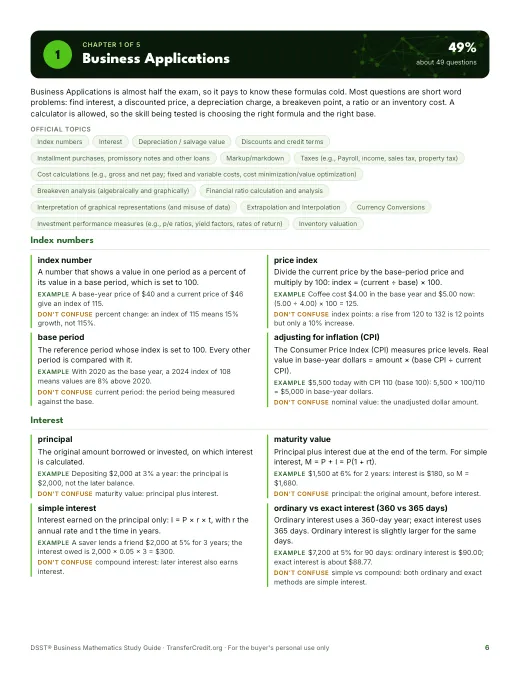
Page 6 of the DSST Business Mathematics Study Guide: the Chapter 1 opener
Page 6 The Chapter 1 opener
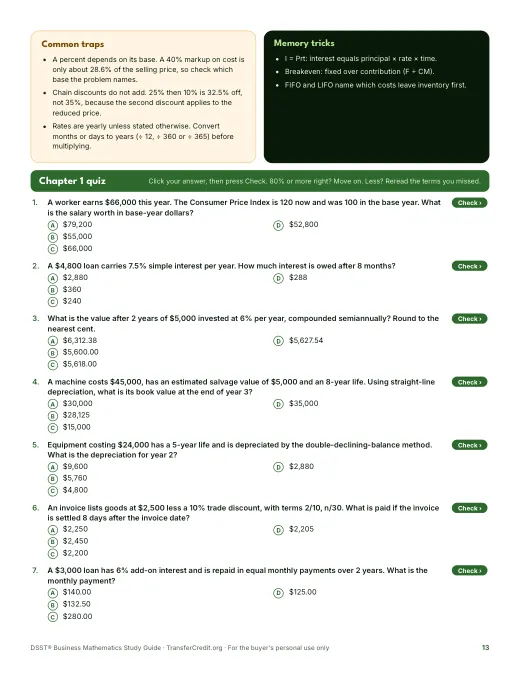
Page 13 of the DSST Business Mathematics Study Guide: a chapter quiz
Page 13 A chapter quiz
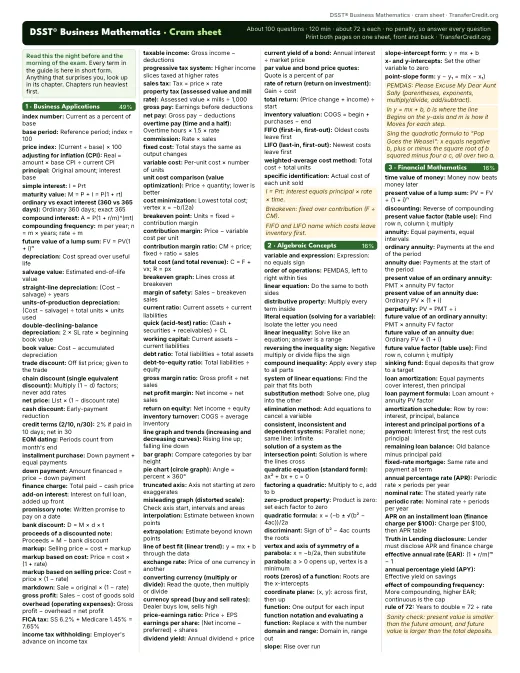
Page 31 of the DSST Business Mathematics Study Guide: the 2-page cram sheet
Page 31 The 2-page cram sheet

What you get for $5

One chapter for each official content area, in the order the exam weighs them.

  • 📘32pages, printable
  • 🧭5chapters, heaviest first
  • 🔑180terms with examples
  • ✍️43practice questions, answers explained
  • ⚠️15exam traps to avoid
  • 📄2page cram sheet

Try 10 free Business Mathematics questions

In the style of the real exam, from all 5 areas. About 10 minutes, with every answer explained and a score by area.

10 questions  
  1. Question 1 · Business Applications

    A worker earns $66,000 this year. The Consumer Price Index is 120 now and was 100 in the base year. What is the salary worth in base-year dollars?

    Show the answer

    Answer: D. $55,000. Real value = amount × (base CPI ÷ current CPI) = 66,000 × 100/120 = $55,000.

    The trap: $52,800 is tempting because prices rose 20%, but subtracting 20% of the salary is the wrong base. Divide by 1.20 instead.

  2. Question 2 · Algebraic Concepts

    A plumber charges a $45 service fee plus $38 per hour. A customer's bill came to $273. How many hours did the job take?

    Show the answer

    Answer: B. 6 hours. Write 38h + 45 = 273. Then 38h = 228 and h = 6.

    The trap: 3.3 hours comes from 273 ÷ (38 + 45), which treats the $45 fee as charged every hour. It is charged once.

  3. Question 3 · Financial Mathematics

    A company needs $15,000 in 4 years to replace a machine. An account pays 6% compounded annually. How much must it deposit today, to the nearest cent?

    Show the answer

    Answer: C. $11,881.40. PV = 15,000/(1.06)⁴ = 15,000/1.262477 ≈ $11,881.40. The table factor 0.7921 gives $11,881.50, which points to the same choice.

    The trap: $18,937.15 is 15,000 × (1.06)⁴, the future value of $15,000. Finding what to deposit now means discounting.

  4. Question 4 · Statistics

    A shop's daily sales, in hundreds of dollars, were 8, 12, 9, 40 and 11. What are the mean and the median?

    Show the answer

    Answer: A. Mean 16, median 11. The sum is 80, so the mean is 80/5 = 16. Sorted, the values are 8, 9, 11, 12, 40, and the middle one is 11.

    The trap: Mean 80 is the sum of the sales; it forgets to divide by the 5 days.

  5. Question 5 · Number Sense

    A store raised the price of a jacket from $64 to $80. By what percent did the price increase?

    Show the answer

    Answer: C. 25%. Percent change = (80 − 64)/64 = 16/64 = 0.25, which is 25%.

    The trap: Dividing the $16 change by the new price of $80 gives 20%, but the base is always the original price.

  6. Question 6 · Business Applications

    A $4,800 loan carries 7.5% simple interest per year. How much interest is owed after 8 months?

    Show the answer

    Answer: A. $240. Time is 8/12 of a year: I = 4,800 × 0.075 × 8/12 = $240.

    The trap: $2,880 comes from using 8 as the time in years. Months must be divided by 12 first.

  7. Question 7 · Algebraic Concepts

    Solve the inequality −4x + 7 ≥ 27.

    Show the answer

    Answer: D. x ≤ −5. Subtract 7: −4x ≥ 20. Dividing by −4 reverses the sign, so x ≤ −5.

    The trap: x ≥ −5 finds the right number but forgets to reverse the inequality sign when dividing by a negative.

  8. Question 8 · Financial Mathematics

    A contest pays $5,000 at the end of each year for 6 years. Using an 8% discount rate, what is the present value of the payments, to the nearest cent?

    Show the answer

    Answer: B. $23,114.40. PV = 5,000 × [1 − 1.08⁻⁶]/0.08 = 5,000 × 4.62288 ≈ $23,114.40. The table factor 4.6229 gives $23,114.50, which points to the same choice.

    The trap: $24,963.55 treats the payments as an annuity due (multiplying by 1.08). These payments come at year-end.

  9. Question 9 · Statistics

    A raffle sells 500 tickets at $4 each. It has one $800 prize and two $150 prizes. What is the expected net value of buying one ticket?

    Show the answer

    Answer: A. −$1.80. Expected prize = (800 + 150 + 150)/500 = $2.20. Subtract the $4 cost: 2.20 − 4 = −$1.80.

    The trap: $2.20 is the expected prize only. It ignores the $4 paid for the ticket.

  10. Question 10 · Number Sense

    A worker's raise of $2.40 an hour was exactly 6% of her old hourly wage. What was her old hourly wage?

    Show the answer

    Answer: B. $40.00. The raise is the portion and 6% the rate, so base = 2.40 ÷ 0.06 = $40.00.

    The trap: $42.40 is her new wage after the raise. The question asks for the old wage, which is the base.

The DSST Business Mathematics exam at a glance

The DSST Business Mathematics exam is a 120-minute, computer-based test from Prometric with about 100 multiple-choice questions. A score of 400 on the 200–500 scale earns an ACE credit recommendation of 3 semester hours, though each college sets its own policy. The exam covers 5 content areas; the heaviest is Business Applications at 49%.

Questions
About 100multiple choice
Time
120 minabout 72 seconds a question
Passing score
400on a 200–500 scale
ACE credit
3semester hours
Exam fee
$100paid to Prometric
Calculator
Yesnon-programmable allowed

Source: official DSST Business Mathematics exam page.

What the exam covers

5 areas, heaviest first. The guide's chapters follow this order.

  1. Business Applications49%
  2. Algebraic Concepts16%
  3. Financial Mathematics16%
  4. Statistics14%
  5. Number Sense5%

How it works

  1. 1Buy once, $5Secure checkout. No subscription needed.
  2. 2Download the PDFFrom your TransferCredit.org account, right away and any time later.
  3. 3Study the heaviest areas firstFollow the 2-, 4- or 8-week plan, then read the cram sheet the night before.

Questions students ask

What's in the full DSST Business Mathematics study guide?
32 pages: 5 chapters, one per official content area, heaviest first. 180 terms, each with a plain-English definition and an example, common traps and memory tricks, 43 practice questions with an answer key that explains every answer, question tactics, 2-, 4- and 8-week study plans and a 2-page cram sheet.
How much is the full DSST Business Mathematics study guide?
The full 32-page PDF is $5, a one-time payment. The 10 practice questions on this page are free, with no account.
What does the $29 plan include?
$29 a month gives you all DSST subjects: every DSST study guide plus the full prep course for each subject, and you can cancel anytime. If you only need this exam, the guide on its own is a one-time $5.
How do I get the full guide?
Choose Buy this guide ($5) and check out. Then sign in to your TransferCredit.org account, then open the course and its Download Your Study Guide lesson. The PDF is yours to keep, and you can download it again from your account at any time.
Can I print the guide or use it on my phone?
Yes. It's a PDF, so it opens on phones, tablets and computers, and printing is allowed. Its tick boxes and answer bubbles work in PDF readers that support forms. Copying and editing are turned off.
Is this an official DSST study guide?
No. DSST® is a registered trademark of Prometric, which was not involved in producing this guide and does not endorse it. TransferCredit.org is independent. We built the guide from the official exam outline, and the exam details were checked against Prometric's published exam information in 2026.
Why is this study guide better than a generic review?
It follows the official outline area by area and spends the most pages on what the exam weighs most. Every term comes with an example, each chapter names the traps the exam sets, and the answer key explains why the most tempting wrong answer is wrong, not just which answer is right. It ends with a 2-page cram sheet for the night before.
What is the DSST Business Mathematics exam?
The DSST Business Mathematics exam is a 120-minute, computer-based test from Prometric with about 100 multiple-choice questions. A score of 400 on the 200–500 scale earns an ACE credit recommendation of 3 semester hours, though each college sets its own policy. The exam covers 5 content areas; the heaviest is Business Applications at 49%.
More questions about the DSST Business Mathematics exam (23)
How many questions are on the DSST Business Mathematics exam, and how long is it?
It has 100 questions to be answered in 2 hours.
What is the passing score for DSST Business Mathematics?
The passing score is 400 on a 200–500 scale. At 400 or above, the American Council on Education (ACE) recommends 3 semester hours. Each college sets its own passing score and credit award, so check your school's policy before you book.
How much does the DSST Business Mathematics exam cost?
The exam fee is $100, paid to Prometric. Test centers may add their own administration fee. Eligible U.S. military service members can usually test for free through DANTES.
How many college credits is DSST Business Mathematics worth?
ACE recommends 3 semester hours for a passing score of 400. Your college decides how many credits it awards and which course they replace. Check your college's policy.
Can I use a calculator on the DSST Business Mathematics exam?
A non-programmable calculator is permitted.
Is there a penalty for guessing on DSST Business Mathematics?
No. Your score counts only correct answers, so a wrong answer costs nothing. Never leave a question blank: rule out what you can and pick your best guess.
What topics are on the DSST Business Mathematics exam?
5 content areas, from the official outline: Business Applications (49%); Algebraic Concepts (16%); Financial Mathematics (16%); Statistics (14%); Number Sense (5%).
Which DSST Business Mathematics topics should I study first?
Start with the three heaviest: Business Applications (49%), Algebraic Concepts (16%) and Financial Mathematics (16%). Together they are about 81% of the exam, roughly 81 of 100 questions. The guide's chapters run in that order, heaviest first.
Is the DSST Business Mathematics exam hard?
It depends on what you already know. A few big areas decide most of your score: Business Applications alone is 49% of the exam, while Number Sense is 5%. Take the free diagnostic above to see where you stand in about 10 minutes.
What kinds of questions are on the DSST Business Mathematics exam?
The guide sorts them into 5 types: “Percent and ratio word problems”, “Plug into a business formula”, “Table or annuity lookup”, “Which statement must be true” and “Read the graph or spot misuse”. Every question has 4 answer choices. Try the 10 free questions above to see the style.
How long should I study for DSST Business Mathematics?
Use the diagnostic to decide. If you already know most areas, two weeks of daily review is often enough; if the subject is new to you, plan on eight. The full guide has 2-, 4- and 8-week plans built from the exam weights.
How should I pace myself on the DSST Business Mathematics exam?
On average you have about 72 seconds per question (120 minutes for 100 questions). Be past question 33 a third of the way through and past question 67 two-thirds through. If a question takes more than a minute, pick your best guess, mark it and come back.
What happens if I don't pass DSST Business Mathematics?
You can retake a DSST exam after 30 days. Use the wait to work through the areas the score report and the diagnostic show you missed.
Do colleges accept DSST Business Mathematics for credit?
DSST exams are accepted at more than 1,500 colleges and universities, but each school decides which exams it accepts, the score it requires and the credit it gives. Look up your college's DSST policy before you book.
How is the guide different from the DSST Business Mathematics course?
The guide is a 32-page PDF for review and self-testing. The DSST Business Mathematics course is a full online course with lessons, quizzes and a practice exam, for $19 with lifetime access. Many students use the guide first, then take the course for the areas the diagnostic flags.
How up to date is this DSST Business Mathematics guide?
Last updated 2026. The exam details were checked against Prometric's published exam information in 2026. Exams change, so confirm the details on the official exam page before you register.
What should I do the night before the exam?
Read the cram sheet once, slowly. Check your test time, the location or remote-proctoring setup, and the ID you need. Then sleep: a rested brain recalls more than a crammed one. In the morning, skim the memory tricks and common traps, then stop studying.
Does DSST Business Mathematics include statistics?
Yes. Statistics is 14% of the exam and covers central tendency, expected value, weighted averages, dispersion and probability distributions. The official sample questions include comparing a data set's mean and median.
Does DSST Business Mathematics cover payroll and taxes?
Yes. Business applications, 49% of the exam, include payroll, income, sales and property taxes and gross versus net pay. An official sample question asks you to compute net pay with overtime at time and a half after FICA and federal income tax deductions.
How much algebra is on DSST Business Mathematics?
Algebraic concepts are 16% of the exam: linear equations and inequalities, simultaneous linear equations, quadratic equations and functions, and graphing and evaluating functions. Break-even analysis, solved algebraically and graphically, also appears under business applications.
Can I take DSST Business Mathematics online?
Yes. DSST exams can be taken at a test center or online with a remote Prometric proctor.
What formulas should I know for DSST Business Math?
Simple interest (I = Prt), compound interest, markup on cost and on selling price, trade and cash discounts, straight-line and accelerated depreciation, break-even point, and present and future value of annuities.
Is DSST Business Mathematics the same as CLEP College Mathematics?
No. DSST Business Mathematics is built around business problems like interest, pricing and payroll. CLEP College Mathematics is a general-education survey of math for non-majors.

Choose how you want to study

Start with the guide, or get everything for DSST in one plan.

This study guide
$5one-time
  • 32-page printable PDF
  • 180 terms with examples
  • 43 practice questions, answers explained
  • 2-page cram sheet and study plans
Get the guide · $5
Best value Get it all
$29/month
  • Every DSST study guide
  • Prep courses for all DSST subjects
  • Cancel anytime
Get it all · $29/mo

DSST® is a registered trademark of Prometric, which was not involved in producing this guide and does not endorse it. TransferCredit.org is independent and not affiliated with Prometric. © 2026 UPI Globale Edu Inc.