
$5one-time
- 35-page printable PDF
- 180 terms with examples
- 42 practice questions, answers explained
- 2-page cram sheet and study plans
Everything the DSST Introduction to Law Enforcement exam tests, in one PDF you can print. Built from Prometric's official outline, heaviest topics first.
Last updated 2026 · exam details checked against Prometric's published exam information in 2026
Real pages from the 35-page PDF.



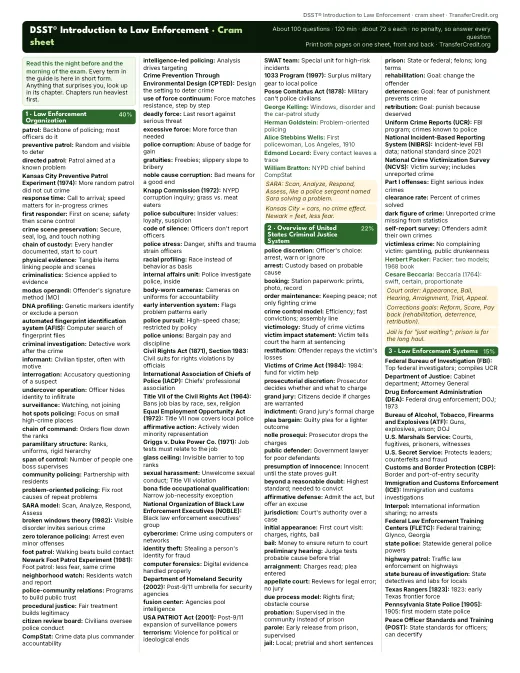
One chapter for each official content area, in the order the exam weighs them.
In the style of the real exam, from all 5 areas. About 10 minutes, with every answer explained and a score by area.
A department finds that most of its robberies occur on a handful of street corners. It assigns officers to spend set periods at those corners each shift. This is best described as
Answer: A. directed patrol. Directed patrol sends officers to specific places and times that crime analysis has identified as problems.
The trap: Preventive patrol is tempting because patrol is involved, but it is random and general, while this assignment is targeted.
Directed patrol sends officers to specific places and times that crime analysis has identified as problems.
The trap: Preventive patrol is tempting because patrol is involved, but it is random and general, while this assignment is targeted.
After arresting a suspect, an officer takes her to the station, where her fingerprints and photograph are taken and her information is entered in the police record. This step is called
Answer: B. booking. Booking is the administrative record of an arrest, including prints and a photograph.
The trap: Arraignment was wrong because it is a court proceeding in which charges are read and a plea entered.
Booking is the administrative record of an arrest, including prints and a photograph.
The trap: Arraignment was wrong because it is a court proceeding in which charges are read and a plea entered.
A single county has a sheriff, three town departments, a university force and a transit police unit, none of which answers to the others. This illustrates the
Answer: D. fragmentation of policing. Thousands of independent agencies, each with its own jurisdiction, is the fragmentation of policing.
The trap: Chain of command was wrong because it describes the line of authority inside a single agency.
Thousands of independent agencies, each with its own jurisdiction, is the fragmentation of policing.
The trap: Chain of command was wrong because it describes the line of authority inside a single agency.
At 2 a.m., an officer sees a man walk slowly along a row of parked cars, look into each one, then walk away fast when he notices the patrol car. The officer has
Answer: C. reasonable suspicion, enough for a brief stop. Specific facts suggest a car break-in may be underway, which is reasonable suspicion and supports a brief stop under Terry.
The trap: Probable cause is tempting, but no crime has been seen; the facts suggest possible crime, not a fair probability that one occurred.
Specific facts suggest a car break-in may be underway, which is reasonable suspicion and supports a brief stop under Terry.
The trap: Probable cause is tempting, but no crime has been seen; the facts suggest possible crime, not a fair probability that one occurred.
A colonial town in the 1700s relied on unpaid citizens to walk the streets at night, call out the hour and raise an alarm. This arrangement was borrowed most directly from
Answer: C. the English constable and watch tradition. Colonists copied England's constables and night watchmen, which dated back centuries.
The trap: London's Metropolitan Police was wrong because it was created in 1829, long after the colonial period.
Colonists copied England's constables and night watchmen, which dated back centuries.
The trap: London's Metropolitan Police was wrong because it was created in 1829, long after the colonial period.
When Kansas City police varied the amount of routine car patrol among beats for a year in the early 1970s, researchers found that more patrol
Answer: B. had no effect on crime, fear or citizen satisfaction. The Kansas City Preventive Patrol Experiment found no meaningful differences among beats with more, normal or no routine patrol.
The trap: Raising satisfaction while crime stayed the same is the Newark foot patrol finding, not Kansas City's.
The Kansas City Preventive Patrol Experiment found no meaningful differences among beats with more, normal or no routine patrol.
The trap: Raising satisfaction while crime stayed the same is the Newark foot patrol finding, not Kansas City's.
A prosecutor learns that the only eyewitness has changed her story and concludes the case cannot be won. The prosecutor files a notice that the state will not go forward. This is a
Answer: D. nolle prosequi. A nolle prosequi is the prosecutor's formal decision to drop charges.
The trap: A plea bargain was wrong because it needs the defendant to plead guilty in exchange for something.
A nolle prosequi is the prosecutor's formal decision to drop charges.
The trap: A plea bargain was wrong because it needs the defendant to plead guilty in exchange for something.
A county official who answers directly to voters runs the county jail and sends deputies to patrol rural areas. This official is the
Answer: A. The sheriff. In most states the sheriff is elected and runs the jail as well as patrolling outside city limits.
The trap: The county police chief was wrong because that office is appointed rather than elected.
In most states the sheriff is elected and runs the jail as well as patrolling outside city limits.
The trap: The county police chief was wrong because that office is appointed rather than elected.
A suspect in custody is questioned for hours without being told he may remain silent. Under Miranda v. Arizona (1966), his statements will most likely be
Answer: A. excluded from the prosecution's case. Statements from custodial interrogation without warnings generally cannot be used by the prosecution.
The trap: Saying the statements are admitted because he was arrested ignores that Miranda attaches to custody plus questioning.
Statements from custodial interrogation without warnings generally cannot be used by the prosecution.
The trap: Saying the statements are admitted because he was arrested ignores that Miranda attaches to custody plus questioning.
A reformer proposes a uniformed, paid force organized to prevent crime and judged by the absence of crime and disorder, not by arrests. These ideas are best known as the
Answer: D. Peelian principles. The Peelian principles came with the 1829 London force and stress prevention and public approval.
The trap: The Wickersham Commission report was wrong because it was a 1931 American report about brutality and training.
The Peelian principles came with the 1829 London force and stress prevention and public approval.
The trap: The Wickersham Commission report was wrong because it was a 1931 American report about brutality and training.
The DSST Introduction to Law Enforcement exam is a 120-minute, computer-based test from Prometric with about 100 multiple-choice questions. A score of 400 on the 200–500 scale earns an ACE credit recommendation of 3 semester hours, though each college sets its own policy. The exam covers 5 content areas; the heaviest is Law Enforcement Organization, Management, and Issues at 40%.
Source: official DSST Introduction to Law Enforcement exam page.
5 areas, heaviest first. The guide's chapters follow this order.
Start with the guide, or get everything for DSST in one plan.
DSST® is a registered trademark of Prometric, which was not involved in producing this guide and does not endorse it. TransferCredit.org is independent and not affiliated with Prometric. © 2026 UPI Globale Edu Inc.