← All study guides
DSST® Study Guide Printable PDF · 36 pages

DSST Personal Finance Study Guide

Everything the DSST Personal Finance exam tests, in one PDF you can print. Built from Prometric's official outline, heaviest topics first.

  • 185 key terms, each with an example
  • 42 practice questions with every answer explained
  • A 2-page cram sheet for the night before
  • 2-, 4- and 8-week study plans built from the exam weights
Not sure yet? Try 10 free questions

Last updated 2026 · exam details checked against Prometric's published exam information in 2026

Look inside the guide

Real pages from the 36-page PDF.

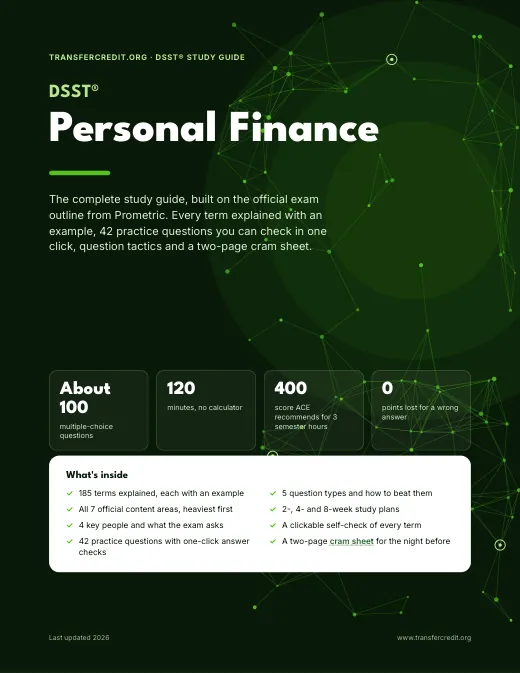
Page 1 of the DSST Personal Finance Study Guide: the cover
Page 1 The cover
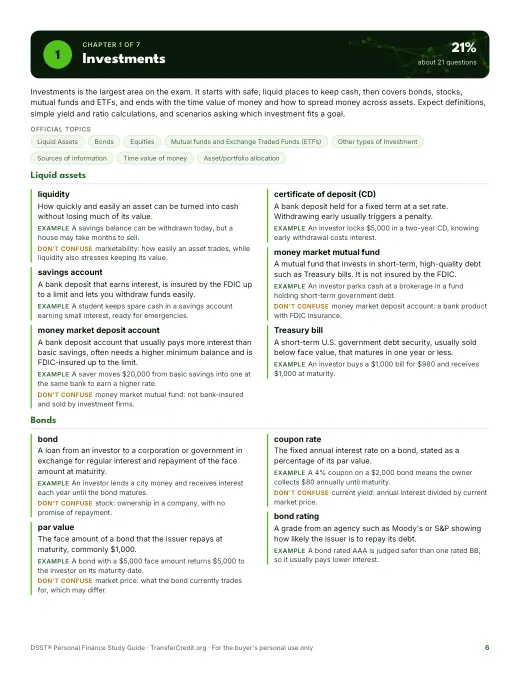
Page 6 of the DSST Personal Finance Study Guide: the Chapter 1 opener
Page 6 The Chapter 1 opener
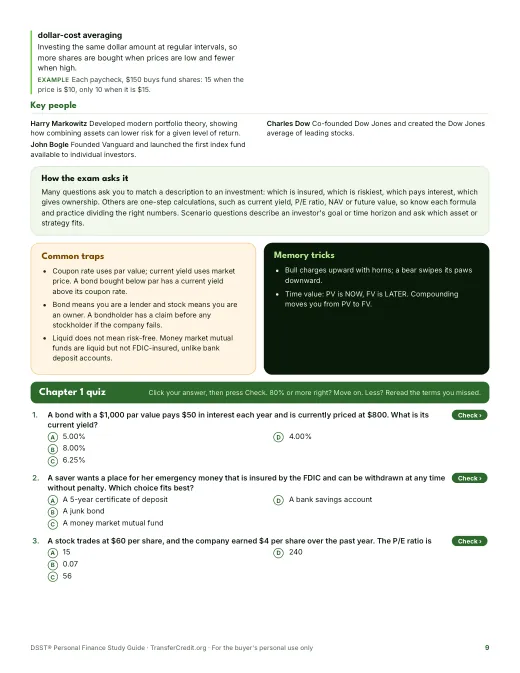
Page 9 of the DSST Personal Finance Study Guide: a chapter quiz
Page 9 A chapter quiz
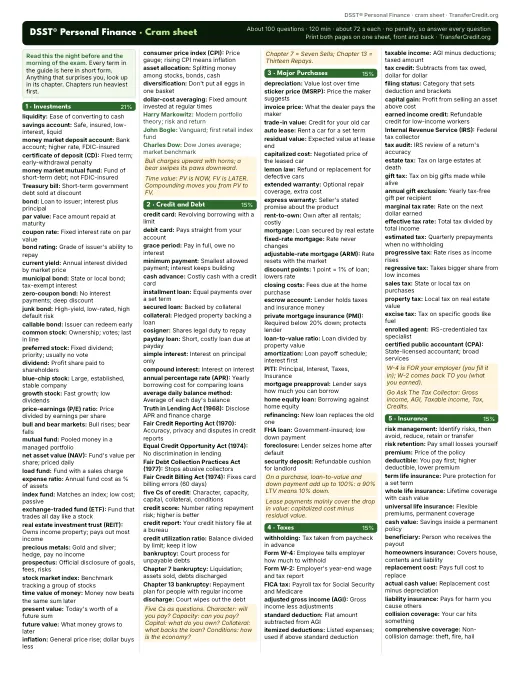
Page 35 of the DSST Personal Finance Study Guide: the 2-page cram sheet
Page 35 The 2-page cram sheet

What you get for $5

One chapter for each official content area, in the order the exam weighs them.

  • 📘36pages, printable
  • 🧭7chapters, heaviest first
  • 🔑185terms with examples
  • ✍️42practice questions, answers explained
  • ⚠️21exam traps to avoid
  • 📄2page cram sheet

Try 10 free Personal Finance questions

In the style of the real exam, from all 7 areas. About 10 minutes, with every answer explained and a score by area.

10 questions  
  1. Question 1 · Investments

    A bond with a $1,000 par value pays $50 in interest each year and is currently priced at $800. What is its current yield?

    Show the answer

    Answer: B. 6.25%. Current yield is annual interest divided by market price: 50 divided by 800 equals 6.25%.

    The trap: 5.00% is the coupon rate because it divides by par value, but current yield uses the current market price.

  2. Question 2 · Credit and Debt

    Priya borrows $4,000 at 6% simple interest for 9 months. How much interest does she owe?

    Show the answer

    Answer: A. $180. Time must be in years: 9 months is 0.75 of a year. $4,000 × 0.06 × 0.75 = $180.

    The trap: $240 is a full year's interest. The loan runs only 9 months, three-quarters of a year.

  3. Question 3 · Major Purchases

    The Parks buy a $225,000 home with 20% down. Their lender charges two discount points on the loan. How much do the points cost?

    Show the answer

    Answer: C. $3,600. The loan is $225,000 − $45,000 = $180,000. Two points are 2% of the loan: 0.02 × $180,000 = $3,600.

    The trap: $4,500 takes 2% of the $225,000 price. Points are figured on the amount borrowed, not on the price of the home.

  4. Question 4 · Taxes

    A new employee wants her employer to withhold the correct amount of income tax from each paycheck. Which form should she complete?

    Show the answer

    Answer: D. Form W-4. The W-4 tells the employer how much income tax to withhold, based on filing status and other details.

    The trap: Form W-2 is tempting, but it is issued by the employer after the year ends to report wages and withholding.

  5. Question 5 · Insurance

    Sam's health plan has a $1,000 deductible and 80/20 coinsurance. Before he has paid anything toward the deductible this year, he has a covered $10,000 hospital bill. How much of the bill does Sam pay?

    Show the answer

    Answer: B. $2,800. The $1,000 deductible comes first. On the remaining $9,000, he pays 20%, which is $1,800. His share is $1,000 + $1,800 = $2,800.

    The trap: $2,000 takes 20% of the full $10,000 and ignores the deductible. $7,200 is what the insurer pays, not what Sam pays.

  6. Question 6 · Retirement and Estate Planning

    A worker's employer promises a monthly pension based on salary and years of service. The employer is responsible for investing enough to pay it. This is a

    Show the answer

    Answer: A. defined-benefit plan. The employer promises a set benefit and bears the investment risk, which is a defined-benefit plan.

    The trap: A defined-contribution plan is tempting, but there the worker's balance and payout depend on investment results, and the employer promises only the contribution.

  7. Question 7 · Foundations of Personal Finance

    Marcus, 24, plans to take a trip with friends in eight months, buy a car in three years, pay off his student loans in ten years and retire at 65. Which of these is an intermediate-term goal?

    Show the answer

    Answer: C. Buying a car three years from now. Intermediate goals take about two to five years, so the car in three years fits. The trip is short-term; the loans and retirement are more than five years away, so they are long-term.

    The trap: Repaying the loans is a big, important goal, but ten years is more than five, which makes it long-term, not intermediate.

  8. Question 8 · Investments

    A saver wants a place for her emergency money that is insured by the FDIC and can be withdrawn at any time without penalty. Which choice fits best?

    Show the answer

    Answer: D. A bank savings account. A savings account is bank-insured and liquid with no withdrawal penalty.

    The trap: A money market mutual fund is liquid, but it is sold by investment firms and is not covered by FDIC insurance.

  9. Question 9 · Credit and Debt

    A credit card's billing cycle has 30 days. Carla owed $600 for the first 10 days and $900 for the last 20 days. Her average daily balance is

    Show the answer

    Answer: A. $800. Add each day's balance: ($600 × 10) + ($900 × 20) = $24,000. Divide by 30 days to get $800.

    The trap: $750 averages the two balances and ignores how many days each one lasted. The longer period at $900 must count more.

  10. Question 10 · Major Purchases

    Tara buys a $250,000 house with a down payment of $25,000. Which additional cost will the lender most likely require?

    Show the answer

    Answer: D. Private mortgage insurance. A $25,000 down payment is 10%, below the usual 20%. Lenders then require PMI to protect themselves against default.

    The trap: A cosigner is a way to qualify with weak credit, not a standard result of a small down payment.

The DSST Personal Finance exam at a glance

The DSST Personal Finance exam is a 120-minute, computer-based test from Prometric with about 100 multiple-choice questions. A score of 400 on the 200–500 scale earns an ACE credit recommendation of 3 semester hours, though each college sets its own policy. The exam covers 7 content areas; the heaviest is Investments at 21%.

Questions
About 100multiple choice
Time
120 minabout 72 seconds a question
Passing score
400on a 200–500 scale
ACE credit
3semester hours
Exam fee
$100paid to Prometric
Calculator
Nonot allowed

Source: official DSST Personal Finance exam page.

What the exam covers

7 areas, heaviest first. The guide's chapters follow this order.

  1. Investments21%
  2. Credit and Debt15%
  3. Major Purchases15%
  4. Taxes15%
  5. Insurance15%
  6. Retirement and Estate Planning13%
  7. Foundations of Personal Finance6%

How it works

  1. 1Buy once, $5Secure checkout. No subscription needed.
  2. 2Download the PDFFrom your TransferCredit.org account, right away and any time later.
  3. 3Study the heaviest areas firstFollow the 2-, 4- or 8-week plan, then read the cram sheet the night before.

Questions students ask

What's in the full DSST Personal Finance study guide?
36 pages: 7 chapters, one per official content area, heaviest first. 185 terms, each with a plain-English definition and an example, 4 key people, common traps and memory tricks, 42 practice questions with an answer key that explains every answer, question tactics, 2-, 4- and 8-week study plans and a 2-page cram sheet.
How much is the full DSST Personal Finance study guide?
The full 36-page PDF is $5, a one-time payment. The 10 practice questions on this page are free, with no account.
What does the $29 plan include?
$29 a month gives you all DSST subjects: every DSST study guide plus the full prep course for each subject, and you can cancel anytime. If you only need this exam, the guide on its own is a one-time $5.
How do I get the full guide?
Choose Buy this guide ($5) and check out. Then sign in to your TransferCredit.org account, then open the course and its Download Your Study Guide lesson. The PDF is yours to keep, and you can download it again from your account at any time.
Can I print the guide or use it on my phone?
Yes. It's a PDF, so it opens on phones, tablets and computers, and printing is allowed. Its tick boxes and answer bubbles work in PDF readers that support forms. Copying and editing are turned off.
Is this an official DSST study guide?
No. DSST® is a registered trademark of Prometric, which was not involved in producing this guide and does not endorse it. TransferCredit.org is independent. We built the guide from the official exam outline, and the exam details were checked against Prometric's published exam information in 2026.
Why is this study guide better than a generic review?
It follows the official outline area by area and spends the most pages on what the exam weighs most. Every term comes with an example, each chapter names the traps the exam sets, and the answer key explains why the most tempting wrong answer is wrong, not just which answer is right. It ends with a 2-page cram sheet for the night before.
What is the DSST Personal Finance exam?
The DSST Personal Finance exam is a 120-minute, computer-based test from Prometric with about 100 multiple-choice questions. A score of 400 on the 200–500 scale earns an ACE credit recommendation of 3 semester hours, though each college sets its own policy. The exam covers 7 content areas; the heaviest is Investments at 21%.
More questions about the DSST Personal Finance exam (21)
How many questions are on the DSST Personal Finance exam, and how long is it?
It has 100 questions to be answered in 2 hours.
What is the passing score for DSST Personal Finance?
The passing score is 400 on a 200–500 scale. At 400 or above, the American Council on Education (ACE) recommends 3 semester hours. Each college sets its own passing score and credit award, so check your school's policy before you book.
How much does the DSST Personal Finance exam cost?
The exam fee is $100, paid to Prometric. Test centers may add their own administration fee. Eligible U.S. military service members can usually test for free through DANTES.
How many college credits is DSST Personal Finance worth?
ACE recommends 3 semester hours for a passing score of 400. Your college decides how many credits it awards and which course they replace. Check your college's policy.
Can I use a calculator on the DSST Personal Finance exam?
No. This exam doesn't allow a calculator.
Is there a penalty for guessing on DSST Personal Finance?
No. Your score counts only correct answers, so a wrong answer costs nothing. Never leave a question blank: rule out what you can and pick your best guess.
What topics are on the DSST Personal Finance exam?
7 content areas, from the official outline: Investments (21%); Credit and Debt (15%); Major Purchases (15%); Taxes (15%); Insurance (15%); Retirement and Estate Planning (13%); Foundations of Personal Finance (6%).
Which DSST Personal Finance topics should I study first?
Start with the three heaviest: Investments (21%), Credit and Debt (15%) and Major Purchases (15%). Together they are about 51% of the exam, roughly 51 of 100 questions. The guide's chapters run in that order, heaviest first.
Is the DSST Personal Finance exam hard?
It depends on what you already know. No single area dominates: the largest, Investments, is 21% and the smallest, Foundations of Personal Finance, is 6%, so broad coverage matters more than deep expertise in one topic. Take the free diagnostic above to see where you stand in about 10 minutes.
What kinds of questions are on the DSST Personal Finance exam?
The guide sorts them into 5 types: “Definition and identification”, “Scenario: pick the product or law”, “Short calculation, no calculator”, “Compare two similar terms” and “Which is NOT or EXCEPT”. Every question has 4 answer choices. Try the 10 free questions above to see the style.
How long should I study for DSST Personal Finance?
Use the diagnostic to decide. If you already know most areas, two weeks of daily review is often enough; if the subject is new to you, plan on eight. The full guide has 2-, 4- and 8-week plans built from the exam weights.
How should I pace myself on the DSST Personal Finance exam?
On average you have about 72 seconds per question (120 minutes for 100 questions). Be past question 33 a third of the way through and past question 67 two-thirds through. If a question takes more than a minute, pick your best guess, mark it and come back.
What happens if I don't pass DSST Personal Finance?
You can retake a DSST exam after 30 days. Use the wait to work through the areas the score report and the diagnostic show you missed.
Do colleges accept DSST Personal Finance for credit?
DSST exams are accepted at more than 1,500 colleges and universities, but each school decides which exams it accepts, the score it requires and the credit it gives. Look up your college's DSST policy before you book.
How up to date is this DSST Personal Finance guide?
Last updated 2026. The exam details were checked against Prometric's published exam information in 2026. Exams change, so confirm the details on the official exam page before you register.
What should I do the night before the exam?
Read the cram sheet once, slowly. Check your test time, the location or remote-proctoring setup, and the ID you need. Then sleep: a rested brain recalls more than a crammed one. In the morning, skim the memory tricks and common traps, then stop studying.
Is there math on DSST Personal Finance?
Some. Expect interest calculations, loan costs and time value of money questions, but nothing beyond basic algebra.
Is DSST Personal Finance multiple choice only?
Yes. All 100 questions are multiple choice, each with one correct answer and three incorrect options, answered in two hours.
What's the biggest area on DSST Personal Finance?
Investments, at 21%: liquid assets, bonds, stocks, mutual funds and ETFs, time value of money and asset allocation. Credit and debt, major purchases, taxes and insurance follow at 15% each.
Is DSST Personal Finance the same as DSST Principles of Finance?
No. Personal Finance covers individual money decisions — budgets, credit, insurance, investing and retirement. Principles of Finance is corporate finance: valuation, capital budgeting and the cost of capital.
Can I take DSST Personal Finance online?
Yes. DSST exams can be taken at a test center or online with a remote Prometric proctor.

Choose how you want to study

Start with the guide, or get everything for DSST in one plan.

This study guide
$5one-time
  • 36-page printable PDF
  • 185 terms with examples
  • 42 practice questions, answers explained
  • 2-page cram sheet and study plans
Get the guide · $5
Best value Get it all
$29/month
  • Every DSST study guide
  • Prep courses for all DSST subjects
  • Cancel anytime
Get it all · $29/mo

DSST® is a registered trademark of Prometric, which was not involved in producing this guide and does not endorse it. TransferCredit.org is independent and not affiliated with Prometric. © 2026 UPI Globale Edu Inc.