
$5one-time
- 38-page printable PDF
- 183 terms with examples
- 46 practice questions, answers explained
- 2-page cram sheet and study plans
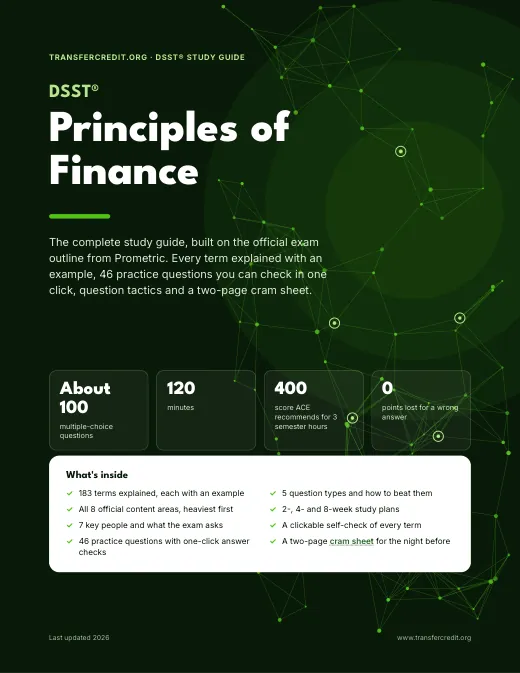
Everything the DSST Principles of Finance exam tests, in one PDF you can print. Built from Prometric's official outline, heaviest topics first.
Last updated 2026 · exam details checked against Prometric's published exam information in 2026
Real pages from the 38-page PDF.
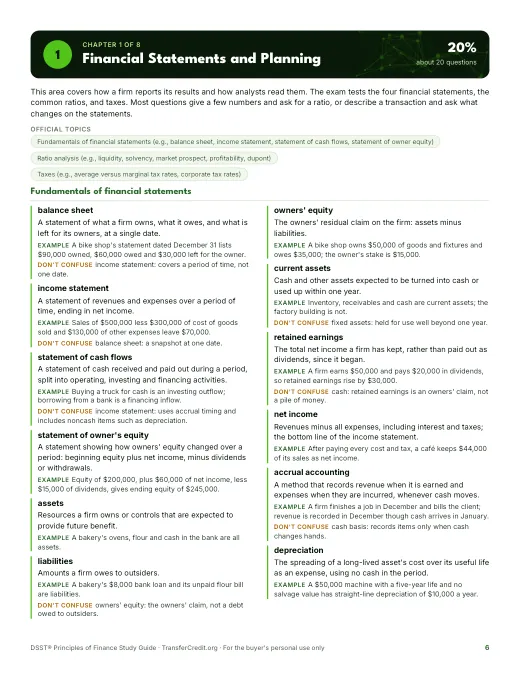
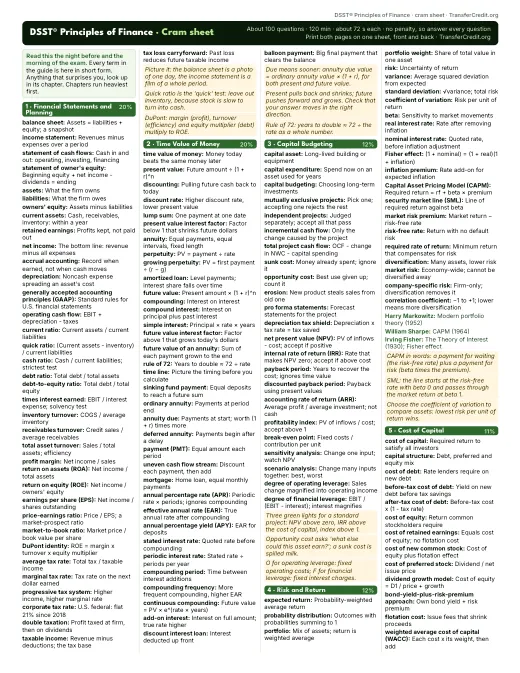
One chapter for each official content area, in the order the exam weighs them.
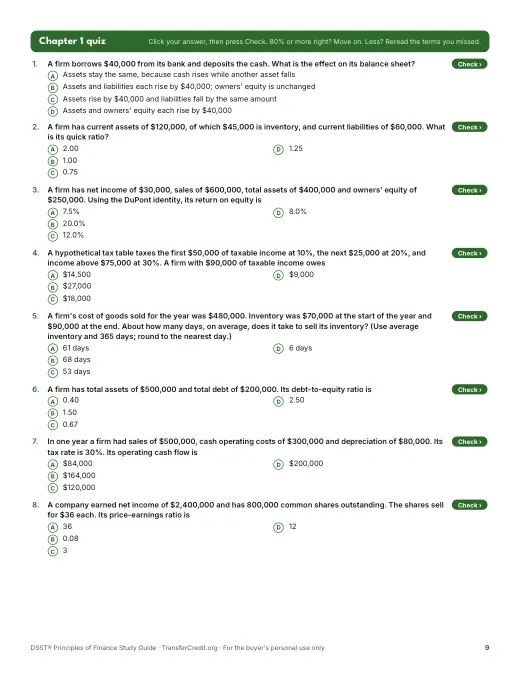
In the style of the real exam, from all 8 areas. About 10 minutes, with every answer explained and a score by area.
A firm borrows $40,000 from its bank and deposits the cash. What is the effect on its balance sheet?
Answer: C. Assets and liabilities each rise by $40,000; owners' equity is unchanged. The cash received raises assets, and the loan raises liabilities by the same amount. Owners' equity is untouched because no profit was earned.
The trap: Assets and owners' equity each rising treats the loan as income. A loan is a debt, so it adds to liabilities, not equity.
The cash received raises assets, and the loan raises liabilities by the same amount. Owners' equity is untouched because no profit was earned.
The trap: Assets and owners' equity each rising treats the loan as income. A loan is a debt, so it adds to liabilities, not equity.
An ordinary annuity of equal yearly payments has a present value of $3,000 at an 8% discount rate. What is the present value of an otherwise identical annuity due?
Answer: A. $3,240. Each payment of an annuity due arrives one period earlier, so its value is the ordinary annuity value times (1 + 0.08): 3,000 × 1.08 = $3,240.
The trap: The $2,778 choice divides by 1.08, which moves the value the wrong way. Earlier payments are worth more, not less.
Each payment of an annuity due arrives one period earlier, so its value is the ordinary annuity value times (1 + 0.08): 3,000 × 1.08 = $3,240.
The trap: The $2,778 choice divides by 1.08, which moves the value the wrong way. Earlier payments are worth more, not less.
A project costs $140,000 today and is expected to return $50,000, $60,000 and $70,000 at the ends of years 1, 2 and 3. At a 10% required return, its NPV is closest to (round to the nearest dollar)
Answer: D. $7,633. Present values: $50,000/1.10 = $45,454.55; $60,000/1.10^2 = $49,586.78; $70,000/1.10^3 = $52,592.04. They total about $147,633. Subtracting the $140,000 cost gives $7,633.
The trap: $40,000 adds the cash flows without discounting ($180,000 - $140,000). That ignores the time value of money.
Present values: $50,000/1.10 = $45,454.55; $60,000/1.10^2 = $49,586.78; $70,000/1.10^3 = $52,592.04. They total about $147,633. Subtracting the $140,000 cost gives $7,633.
The trap: $40,000 adds the cash flows without discounting ($180,000 - $140,000). That ignores the time value of money.
An investor puts $7,000 in stock A with an expected return of 12% and $3,000 in stock B with an expected return of 6%. What is the expected return of the portfolio?
Answer: B. 10.2%. The weights are 70% and 30%, so the expected return is 0.7 × 12% + 0.3 × 6% = 8.4% + 1.8% = 10.2%.
The trap: The 9.0% choice is the simple average of 12% and 6%. It ignores that most of the money is in the higher-return stock.
The weights are 70% and 30%, so the expected return is 0.7 × 12% + 0.3 × 6% = 8.4% + 1.8% = 10.2%.
The trap: The 9.0% choice is the simple average of 12% and 6%. It ignores that most of the money is in the higher-return stock.
A firm can sell new bonds that yield 8%. Its tax rate is 25%. Its after-tax cost of debt is
Answer: A. 6.0%. Interest is tax deductible, so the cost is 8% x (1 - 0.25) = 6.0%.
The trap: 8.0% is the before-tax cost. The tax saving on interest must be removed before debt enters the capital cost.
Interest is tax deductible, so the cost is 8% x (1 - 0.25) = 6.0%.
The trap: 8.0% is the before-tax cost. The tax saving on interest must be removed before debt enters the capital cost.
A firm receives a $20,000 invoice dated June 1 with terms of 2/10 net 30. How much should the firm pay if it pays on June 9?
Answer: B. $19,600. Paying within 10 days earns the 2% discount: 20,000 × 0.98 = $19,600.
The trap: The $20,000 choice is the full invoice, due only if the firm pays after the discount period ends. Day 9 is inside the 10-day window.
Paying within 10 days earns the 2% discount: 20,000 × 0.98 = $19,600.
The trap: The $20,000 choice is the full invoice, due only if the firm pays after the discount period ends. Day 9 is inside the 10-day window.
A bond has a 5% coupon rate, and similar bonds now offer a 7% yield to investors. At what price should this bond sell?
Answer: C. Below its par value. The bond pays less than the market demands, so its price must fall below par until its yield rises to 7%.
The trap: The at-par choice only holds when the coupon rate equals the market yield. Here the coupon is lower than the yield.
The bond pays less than the market demands, so its price must fall below par until its yield rises to 7%.
The trap: The at-par choice only holds when the coupon rate equals the market yield. Here the coupon is lower than the yield.
A U.S. retailer buys goods from a British supplier and pays in pounds. The pound falls from $1.30 to $1.20. For the retailer, this change
Answer: D. lowers the dollar cost of the goods, because the pound has depreciated. A pound that costs fewer dollars has depreciated. The same pound price now takes fewer dollars to pay, so the goods cost the retailer less.
The trap: Saying the cost rises mixes up the direction. A cheaper pound means each pound of the bill costs fewer dollars.
A pound that costs fewer dollars has depreciated. The same pound price now takes fewer dollars to pay, so the goods cost the retailer less.
The trap: Saying the cost rises mixes up the direction. A cheaper pound means each pound of the bill costs fewer dollars.
A firm has current assets of $120,000, of which $45,000 is inventory, and current liabilities of $60,000. What is its quick ratio?
Answer: B. 1.25. Remove inventory from current assets: $120,000 - $45,000 = $75,000. Divide by current liabilities: $75,000 / $60,000 = 1.25.
The trap: 2.00 is the current ratio, which leaves inventory in. The quick ratio takes it out.
Remove inventory from current assets: $120,000 - $45,000 = $75,000. Divide by current liabilities: $75,000 / $60,000 = 1.25.
The trap: 2.00 is the current ratio, which leaves inventory in. The quick ratio takes it out.
A trust is promised $250 at the end of every year forever. If the appropriate discount rate is 5%, what is the present value of this stream?
Answer: D. $5,000. A perpetuity's present value is the payment divided by the rate: 250 ÷ 0.05 = $5,000.
The trap: The $12.50 choice multiplies the payment by the rate, which finds the interest on $250 instead of the value of the stream.
A perpetuity's present value is the payment divided by the rate: 250 ÷ 0.05 = $5,000.
The trap: The $12.50 choice multiplies the payment by the rate, which finds the interest on $250 instead of the value of the stream.
The DSST Principles of Finance exam is a 120-minute, computer-based test from Prometric with about 100 multiple-choice questions. A score of 400 on the 200–500 scale earns an ACE credit recommendation of 3 semester hours, though each college sets its own policy. The exam covers 8 content areas; the heaviest is Financial Statements and Planning at 20%.
8 areas, heaviest first. The guide's chapters follow this order.
Start with the guide, or get everything for DSST in one plan.
DSST® is a registered trademark of Prometric, which was not involved in producing this guide and does not endorse it. TransferCredit.org is independent and not affiliated with Prometric. © 2026 UPI Globale Edu Inc.