
$5one-time
- 31-page printable PDF
- 184 terms with examples
- 40 practice questions, answers explained
- 2-page cram sheet and study plans
Everything the DSST Principles of Supervision exam tests, in one PDF you can print. Built from Prometric's official outline, heaviest topics first.
Last updated 2026 · exam details checked against Prometric's published exam information in 2026
Real pages from the 31-page PDF.
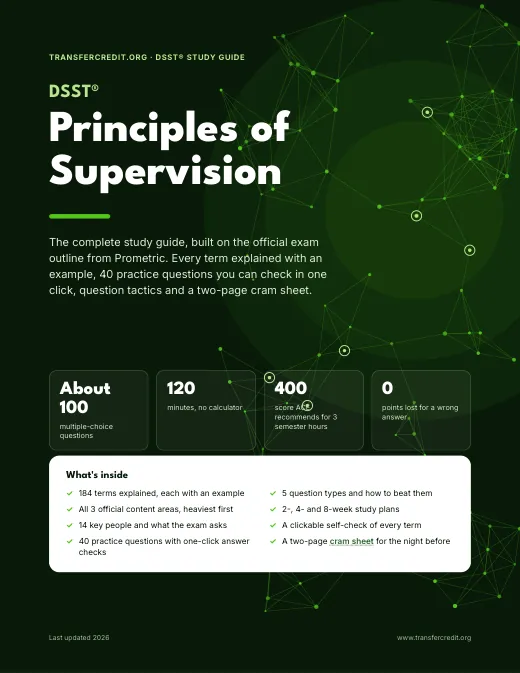
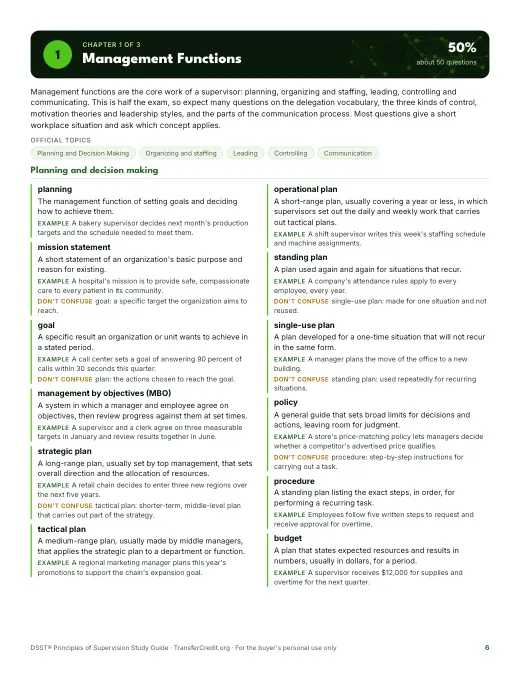
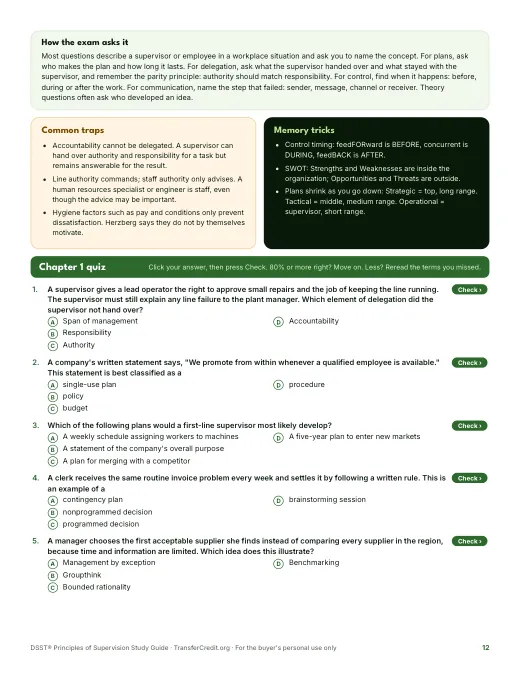
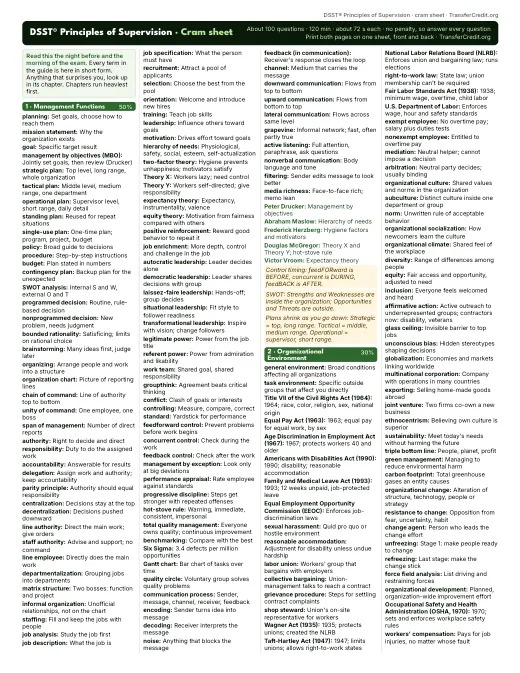
One chapter for each official content area, in the order the exam weighs them.
In the style of the real exam, from all 3 areas. About 10 minutes, with every answer explained and a score by area.
A supervisor gives a lead operator the right to approve small repairs and the job of keeping the line running. The supervisor must still explain any line failure to the plant manager. Which element of delegation did the supervisor not hand over?
Answer: C. Accountability. Authority and responsibility can be passed to the lead operator, but the supervisor remains answerable for the results. That answerability is accountability.
The trap: Responsibility is tempting because the lead operator now has the work, but it was delegated. The supervisor keeps accountability.
Authority and responsibility can be passed to the lead operator, but the supervisor remains answerable for the results. That answerability is accountability.
The trap: Responsibility is tempting because the lead operator now has the work, but it was delegated. The supervisor keeps accountability.
A manager refuses to promote a fully qualified employee because of the employee's religion. Which federal law does this action most directly violate?
Answer: D. Title VII of the Civil Rights Act (1964). Title VII bans employment discrimination based on race, color, religion, sex or national origin.
The trap: The Equal Pay Act is wrong because it covers unequal pay for equal work by sex, not promotion decisions based on religion.
Title VII bans employment discrimination based on race, color, religion, sex or national origin.
The trap: The Equal Pay Act is wrong because it covers unequal pay for equal work by sex, not promotion decisions based on religion.
A bakery supervisor changes how dough is cut and cuts flour waste by 20% while baking the same number of loaves each day. This improvement is best described as greater
Answer: A. Efficiency. Using fewer resources for the same output is efficiency. Nothing in the situation says a new goal was set or reached.
The trap: Effectiveness is wrong because it concerns reaching a goal; the output stayed the same and only the waste fell.
Using fewer resources for the same output is efficiency. Nothing in the situation says a new goal was set or reached.
The trap: Effectiveness is wrong because it concerns reaching a goal; the output stayed the same and only the waste fell.
A company's written statement says, "We promote from within whenever a qualified employee is available." This statement is best classified as a
Answer: B. policy. A policy is a general guide to decisions that leaves room for judgment. The statement does not list exact steps or numbers.
The trap: A procedure lists exact steps in order. This statement is only a broad guide.
A policy is a general guide to decisions that leaves room for judgment. The statement does not list exact steps or numbers.
The trap: A procedure lists exact steps in order. This statement is only a broad guide.
A qualified 58-year-old applicant is turned down, and a younger applicant with less experience gets the job. Which law protects the older applicant?
Answer: C. Age Discrimination in Employment Act (1967). The ADEA protects workers aged 40 and older from age discrimination in hiring, firing and other terms of employment.
The trap: The Americans with Disabilities Act is wrong because age alone is not a disability.
The ADEA protects workers aged 40 and older from age discrimination in hiring, firing and other terms of employment.
The trap: The Americans with Disabilities Act is wrong because age alone is not a disability.
According to Katz, which skill matters relatively more for supervisors than for top managers and becomes less important as a manager moves up?
Answer: D. Technical skill. Supervisors oversee hands-on work, so they need more technical skill than higher managers do. Its importance falls at higher levels while conceptual skill rises.
The trap: Human skill is wrong because it is needed at about the same level in all management positions.
Supervisors oversee hands-on work, so they need more technical skill than higher managers do. Its importance falls at higher levels while conceptual skill rises.
The trap: Human skill is wrong because it is needed at about the same level in all management positions.
Which of the following plans would a first-line supervisor most likely develop?
Answer: A. A weekly schedule assigning workers to machines. Operational plans are short-range plans made by supervisors for daily and weekly activities, such as assigning workers to machines.
The trap: A five-year plan to enter markets is a strategic plan, which top managers make.
Operational plans are short-range plans made by supervisors for daily and weekly activities, such as assigning workers to machines.
The trap: A five-year plan to enter markets is a strategic plan, which top managers make.
An employee asks for 12 weeks of unpaid time off to care for a newborn and expects to return to the same or an equivalent job. Which law applies?
Answer: B. Family and Medical Leave Act (1993). The FMLA gives eligible employees up to 12 weeks of unpaid, job-protected leave for family and medical reasons.
The trap: The ADA is wrong because the request is for family leave, not an accommodation for a disability.
The FMLA gives eligible employees up to 12 weeks of unpaid, job-protected leave for family and medical reasons.
The trap: The ADA is wrong because the request is for family leave, not an accommodation for a disability.
A supervisor spends part of each week meeting peers in purchasing and shipping, and attends a trade group lunch, mainly to build contacts that help her department. Which managerial role is she playing?
Answer: B. Liaison. Building and keeping a network of contacts outside one's own unit is the liaison role, one of the interpersonal roles.
The trap: Figurehead is wrong because it covers symbolic and ceremonial duties, not networking for the department's benefit.
Building and keeping a network of contacts outside one's own unit is the liaison role, one of the interpersonal roles.
The trap: Figurehead is wrong because it covers symbolic and ceremonial duties, not networking for the department's benefit.
A clerk receives the same routine invoice problem every week and settles it by following a written rule. This is an example of a
Answer: C. programmed decision. Repetitive, well-understood problems can be solved by rules. Decisions made that way are programmed.
The trap: A nonprogrammed decision is for new or unusual problems. This problem recurs weekly and has a rule.
Repetitive, well-understood problems can be solved by rules. Decisions made that way are programmed.
The trap: A nonprogrammed decision is for new or unusual problems. This problem recurs weekly and has a rule.
The DSST Principles of Supervision exam is a 120-minute, computer-based test from Prometric with about 100 multiple-choice questions. A score of 400 on the 200–500 scale earns an ACE credit recommendation of 3 semester hours, though each college sets its own policy. The exam covers 3 content areas; the heaviest is Management Functions at 50%.
3 areas, heaviest first. The guide's chapters follow this order.
Start with the guide, or get everything for DSST in one plan.
DSST® is a registered trademark of Prometric, which was not involved in producing this guide and does not endorse it. TransferCredit.org is independent and not affiliated with Prometric. © 2026 UPI Globale Edu Inc.