
$5one-time
- 42-page printable PDF
- 182 terms with examples
- 47 practice questions, answers explained
- 2-page cram sheet and study plans
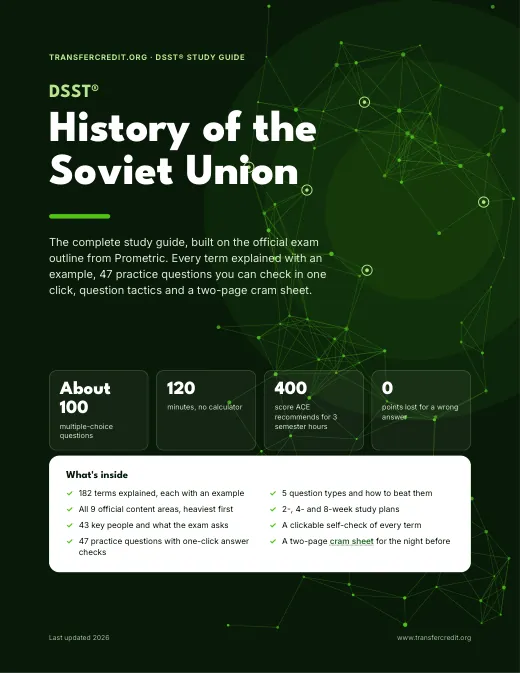
Everything the DSST History of the Soviet Union exam tests, in one PDF you can print. Built from Prometric's official outline, heaviest topics first.
Last updated 2026 · exam details checked against Prometric's published exam information in 2026
Real pages from the 42-page PDF.
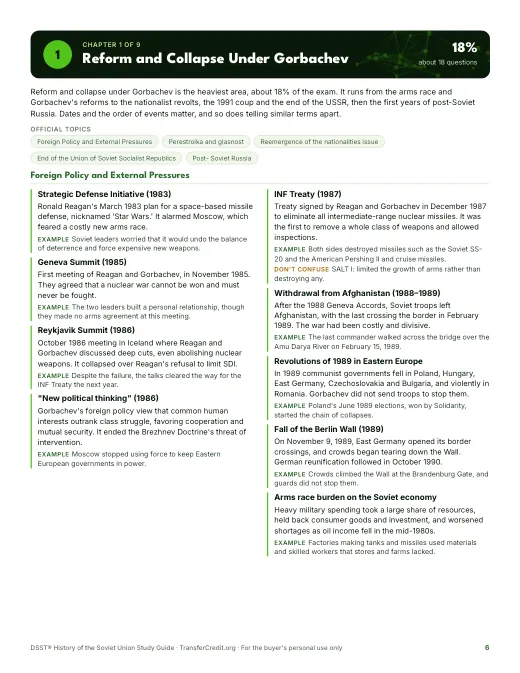
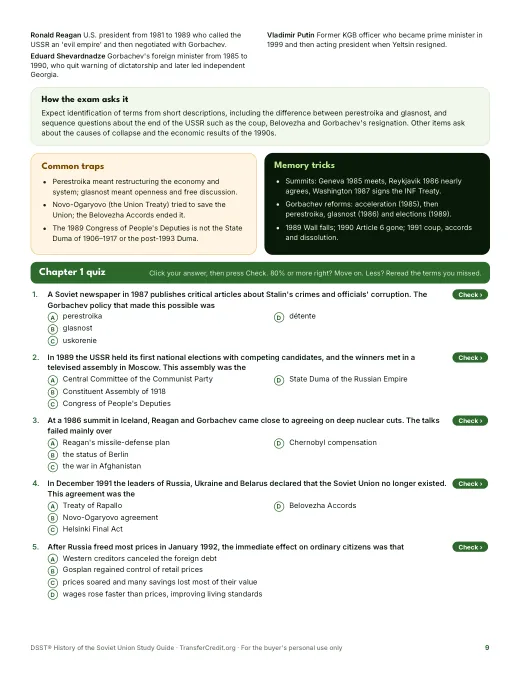
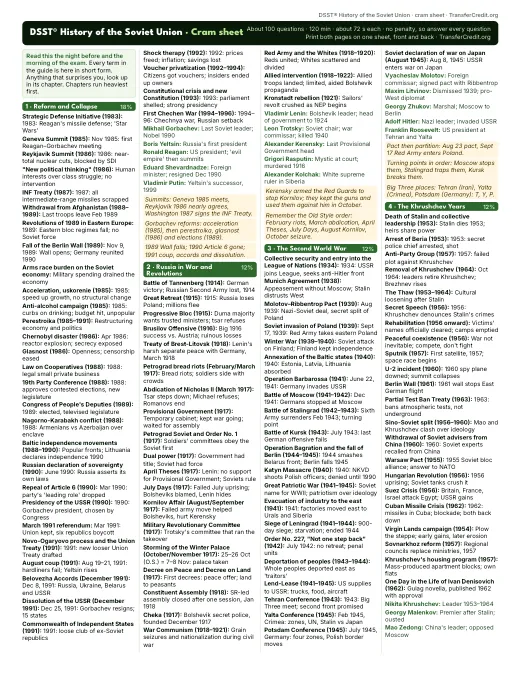
One chapter for each official content area, in the order the exam weighs them.
In the style of the real exam, from all 9 areas. About 10 minutes, with every answer explained and a score by area.
A Soviet newspaper in 1987 publishes critical articles about Stalin's crimes and officials' corruption. The Gorbachev policy that made this possible was
Answer: C. glasnost. Glasnost, or openness, relaxed censorship and encouraged public debate about the past and present.
The trap: Perestroika is tempting because it was Gorbachev's other signature policy, but it meant restructuring the economy and politics, not freedom of expression.
Glasnost, or openness, relaxed censorship and encouraged public debate about the past and present.
The trap: Perestroika is tempting because it was Gorbachev's other signature policy, but it meant restructuring the economy and politics, not freedom of expression.
In late August 1917 (early September New Style) Kerensky gave weapons to Petrograd workers' Red Guards, including Bolsheviks. His purpose was to
Answer: A. block Kornilov's troops from reaching the capital. Kerensky feared that Kornilov's advance on Petrograd was a coup, so he turned to the workers' militias. This rearmed the Bolsheviks and damaged his own standing.
The trap: Putting down a Bolshevik uprising is wrong: he armed Bolshevik-led Red Guards because he needed them against Kornilov.
Kerensky feared that Kornilov's advance on Petrograd was a coup, so he turned to the workers' militias. This rearmed the Bolsheviks and damaged his own standing.
The trap: Putting down a Bolshevik uprising is wrong: he armed Bolshevik-led Red Guards because he needed them against Kornilov.
In August 1939 a Soviet diplomat signs a treaty with Germany that includes a secret protocol dividing Poland and the Baltic region into spheres of influence. The treaty is the
Answer: D. Molotov–Ribbentrop Pact. The Molotov–Ribbentrop Pact paired a public nonaggression promise with a secret protocol dividing Eastern Europe.
The trap: The Munich Agreement concerned Czechoslovakia in 1938 and was signed by Britain, France, Germany and Italy, not by the USSR.
The Molotov–Ribbentrop Pact paired a public nonaggression promise with a secret protocol dividing Eastern Europe.
The trap: The Munich Agreement concerned Czechoslovakia in 1938 and was signed by Britain, France, Germany and Italy, not by the USSR.
In June 1957 a majority in the Presidium voted to remove Khrushchev as first secretary. How did he turn the situation around?
Answer: B. He appealed to the Central Committee, which overruled them. Khrushchev insisted that only the Central Committee could remove him, and it supported him. His opponents were then labeled the Anti-Party Group and removed.
The trap: Having the army arrest the Presidium members is wrong: he won by an appeal inside the party, not by force.
Khrushchev insisted that only the Central Committee could remove him, and it supported him. His opponents were then labeled the Anti-Party Group and removed.
The trap: Having the army arrest the Presidium members is wrong: he won by an appeal inside the party, not by force.
In August 1968 troops from the USSR and several Warsaw Pact allies entered a country whose Communist leader had promised 'socialism with a human face.' That country was
Answer: C. Czechoslovakia. The invasion ended Alexander Dubček's Prague Spring, and Moscow defended it with the doctrine that socialism anywhere was a common concern.
The trap: Hungary is tempting because Soviet tanks crushed its uprising too, but that was in 1956 and under Nagy, not in 1968.
The invasion ended Alexander Dubček's Prague Spring, and Moscow defended it with the doctrine that socialism anywhere was a common concern.
The trap: Hungary is tempting because Soviet tanks crushed its uprising too, but that was in 1956 and under Nagy, not in 1968.
In the 1890s a peasant family farmed land it had received at emancipation. What obligation did the 1861 settlement place on it?
Answer: A. Installments paid to the state for its land over many years. Emancipation freed the serfs, but they paid for their land: the state compensated the landlords, and peasants repaid the state in installments over 49 years.
The trap: Full ownership with nothing owed is wrong: peasants paid for their allotments and usually held them through the commune.
Emancipation freed the serfs, but they paid for their land: the state compensated the landlords, and peasants repaid the state in installments over 49 years.
The trap: Full ownership with nothing owed is wrong: peasants paid for their allotments and usually held them through the commune.
A Soviet planner in 1930 is told to maximize investment in line with the First Five-Year Plan. Which expenditure fits the plan's priorities?
Answer: D. A new steel mill and machine plant. The First Five-Year Plan stressed heavy industry such as steel, coal and machinery, at the expense of consumer goods and living standards.
The trap: A chain of consumer goods stores is wrong: the plan held down consumption to invest in factories.
The First Five-Year Plan stressed heavy industry such as steel, coal and machinery, at the expense of consumer goods and living standards.
The trap: A chain of consumer goods stores is wrong: the plan held down consumption to invest in factories.
In 1948 the leader of a communist country refused to accept Moscow's direction of his economy and foreign policy, and his party was expelled from the Cominform. He was
Answer: B. Josip Broz Tito. Tito, whose Partisans had freed Yugoslavia largely by themselves, would not become Stalin's subordinate, so Yugoslavia was expelled in June 1948.
The trap: Imre Nagy led Hungary's 1956 uprising and Dubček led Czechoslovakia in 1968; neither was expelled from the Cominform in 1948.
Tito, whose Partisans had freed Yugoslavia largely by themselves, would not become Stalin's subordinate, so Yugoslavia was expelled in June 1948.
The trap: Imre Nagy led Hungary's 1956 uprising and Dubček led Czechoslovakia in 1968; neither was expelled from the Cominform in 1948.
A Soviet economist in 1925 is hired to prepare long-range forecasts for industry and agriculture across the Union. Which body does he join?
Answer: A. Gosplan. Gosplan, the state planning commission, prepared economic forecasts and later the five-year plans. The Politburo and Orgburo were party bodies for policy and personnel, and the Comintern dealt with foreign Communist parties.
The trap: The Orgburo is wrong: it was a party body that dealt with organizational matters, not economic planning.
Gosplan, the state planning commission, prepared economic forecasts and later the five-year plans. The Politburo and Orgburo were party bodies for policy and personnel, and the Comintern dealt with foreign Communist parties.
The trap: The Orgburo is wrong: it was a party body that dealt with organizational matters, not economic planning.
In 1989 the USSR held its first national elections with competing candidates, and the winners met in a televised assembly in Moscow. This assembly was the
Answer: B. Congress of People's Deputies. The Congress of People's Deputies, elected in March 1989, was the first partly free legislature in Soviet history.
The trap: The State Duma was the lower house of the Russian parliament from 1906 to 1917, long before the Gorbachev era.
The Congress of People's Deputies, elected in March 1989, was the first partly free legislature in Soviet history.
The trap: The State Duma was the lower house of the Russian parliament from 1906 to 1917, long before the Gorbachev era.
The DSST History of the Soviet Union exam is a 120-minute, computer-based test from Prometric with about 100 multiple-choice questions. A score of 400 on the 200–500 scale earns an ACE credit recommendation of 3 semester hours, though each college sets its own policy. The exam covers 9 content areas; the heaviest is Reform and Collapse Under Gorbachev at 18%.
Source: official DSST History of the Soviet Union exam page.
9 areas, heaviest first. The guide's chapters follow this order.
Start with the guide, or get everything for DSST in one plan.
DSST® is a registered trademark of Prometric, which was not involved in producing this guide and does not endorse it. TransferCredit.org is independent and not affiliated with Prometric. © 2026 UPI Globale Edu Inc.