
$5one-time
- 50-page printable PDF
- 186 terms with examples
- 70 practice questions, answers explained
- 2-page cram sheet and study plans
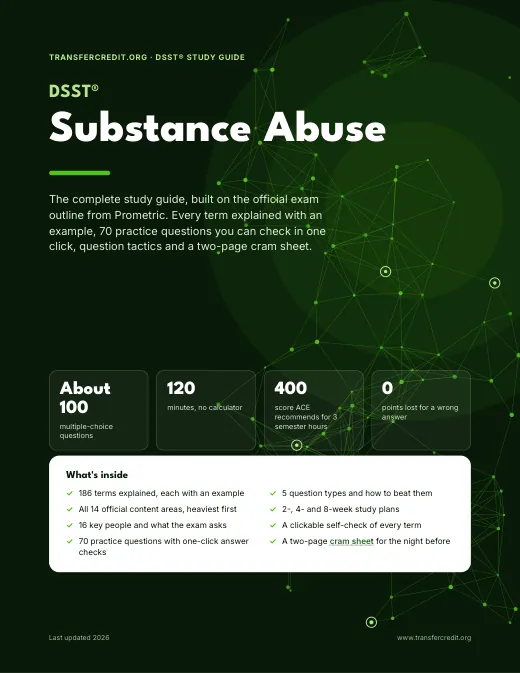
Everything the DSST Substance Abuse exam tests, in one PDF you can print. Built from Prometric's official outline, heaviest topics first.
Last updated 2026 · exam details checked against Prometric's published exam information in 2026
Real pages from the 50-page PDF.
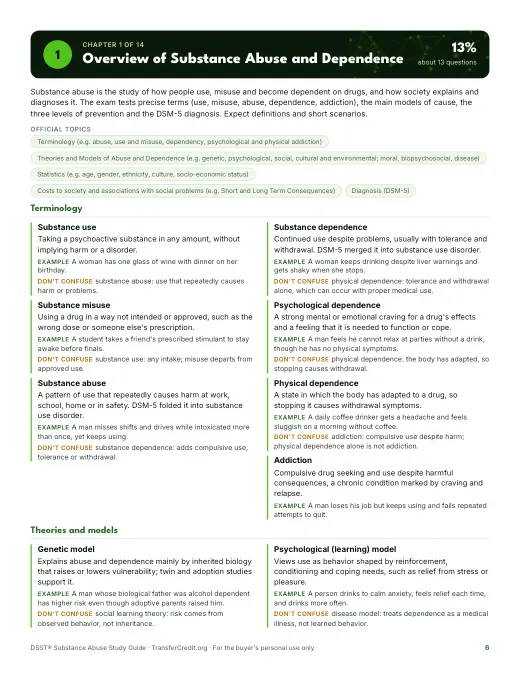
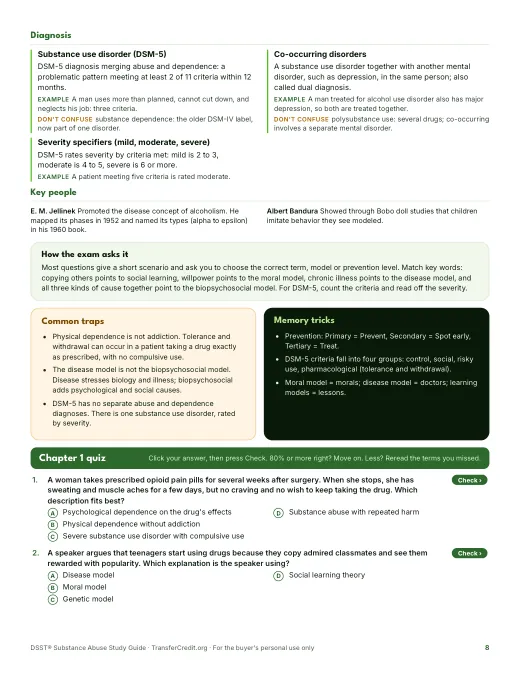
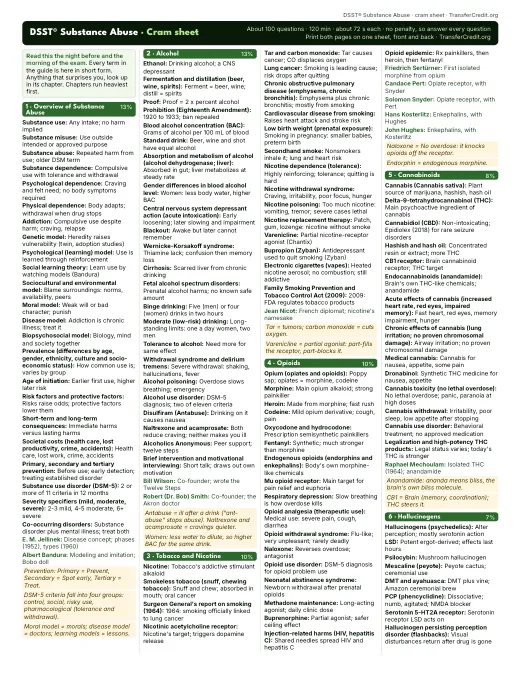
One chapter for each official content area, in the order the exam weighs them.
In the style of the real exam, one from each of the ten heaviest areas. About 10 minutes, with every answer explained and a score by area.
A woman takes prescribed opioid pain pills for several weeks after surgery. When she stops, she has sweating and muscle aches for a few days, but no craving and no wish to keep taking the drug. Which description fits best?
Answer: C. Physical dependence without addiction. Her body adapted to the drug, so stopping caused withdrawal. She shows no compulsive use, craving or harm, so this is physical dependence without addiction.
The trap: Severe substance use disorder is tempting because withdrawal occurred, but a disorder requires a problematic pattern of use, which she lacks.
Her body adapted to the drug, so stopping caused withdrawal. She shows no compulsive use, craving or harm, so this is physical dependence without addiction.
The trap: Severe substance use disorder is tempting because withdrawal occurred, but a disorder requires a problematic pattern of use, which she lacks.
A woman and a man of equal weight each drink the same amount of beer in the same period. Her blood alcohol concentration is higher. Which factor best explains this?
Answer: D. She has less body water available to dilute the alcohol. Women generally have less total body water and lower stomach alcohol dehydrogenase, so more alcohol reaches the blood.
The trap: Slower absorption is wrong because slower absorption would lower the peak BAC, not raise it.
Women generally have less total body water and lower stomach alcohol dehydrogenase, so more alcohol reaches the blood.
The trap: Slower absorption is wrong because slower absorption would lower the peak BAC, not raise it.
Smoke from a cigarette contains a gas that attaches to hemoglobin and leaves the blood carrying less oxygen. Which substance is it?
Answer: A. Carbon monoxide. Carbon monoxide binds hemoglobin much more tightly than oxygen does, reducing oxygen delivery to tissues.
The trap: Tar is tempting because it is a harmful part of smoke, but it deposits in the airways and contains carcinogens; it does not bind hemoglobin.
Carbon monoxide binds hemoglobin much more tightly than oxygen does, reducing oxygen delivery to tissues.
The trap: Tar is tempting because it is a harmful part of smoke, but it deposits in the airways and contains carcinogens; it does not bind hemoglobin.
A man is found unresponsive with very slow breathing and pinpoint pupils. A bystander has access to one emergency medication. Which should be given?
Answer: B. Naloxone. Naloxone is an opioid antagonist that rapidly reverses opioid overdose and restores breathing.
The trap: Flumazenil is tempting because it also reverses an overdose, but it reverses benzodiazepines, not opioids.
Naloxone is an opioid antagonist that rapidly reverses opioid overdose and restores breathing.
The trap: Flumazenil is tempting because it also reverses an overdose, but it reverses benzodiazepines, not opioids.
A college student has been smoking marijuana at a party. Which pair of findings would a clinician most expect?
Answer: A. Rapid heartbeat and bloodshot eyes. Increased heart rate and conjunctival redness are classic acute signs of cannabis intoxication.
The trap: Constricted pupils with slow breathing is tempting as a drug-intoxication pattern, but that pattern belongs to opioids.
Increased heart rate and conjunctival redness are classic acute signs of cannabis intoxication.
The trap: Constricted pupils with slow breathing is tempting as a drug-intoxication pattern, but that pattern belongs to opioids.
A chemist at a pharmaceutical company accidentally absorbs a trace of a compound he has synthesized from ergot fungus and soon experiences vivid visual distortions and a dreamlike state. Which drug had he discovered?
Answer: C. LSD. Hofmann discovered LSD's effects this way after accidental exposure.
The trap: Psilocybin is tempting as another hallucinogen, but it comes from mushrooms, not ergot fungus.
Hofmann discovered LSD's effects this way after accidental exposure.
The trap: Psilocybin is tempting as another hallucinogen, but it comes from mushrooms, not ergot fungus.
A neurotransmitter released from the end of one neuron crosses a narrow gap and acts on the next cell. What is this gap and its surrounding junction called?
Answer: D. The synapse. The synapse is the junction where chemical messengers pass from one neuron to the next.
The trap: The axon is tempting because the transmitter is released from the axon end, but the axon is part of the sending cell, not the gap.
The synapse is the junction where chemical messengers pass from one neuron to the next.
The trap: The axon is tempting because the transmitter is released from the axon end, but the axon is part of the sending cell, not the gap.
A woman who has taken diazepam every night for two years stops all at once and has a seizure three days later. What best explains the seizure?
Answer: B. Withdrawal after physical dependence on a CNS depressant. Long-term sedative use causes physical dependence. Abrupt cessation causes rebound brain excitability, and seizures are a hallmark of sedative withdrawal.
The trap: Overdose from accumulation is tempting, but she stopped taking the drug. Overdose would cause sedation and slow breathing, not a seizure after abstinence.
Long-term sedative use causes physical dependence. Abrupt cessation causes rebound brain excitability, and seizures are a hallmark of sedative withdrawal.
The trap: Overdose from accumulation is tempting, but she stopped taking the drug. Overdose would cause sedation and slow breathing, not a seizure after abstinence.
A 15-year-old has sniffed paint thinner for months. His parents notice poor memory, tremor and an unsteady gait that persists even when he is not using. Which explanation fits best?
Answer: C. Solvent chemicals have damaged his brain. Solvents such as toluene can damage myelin and brain tissue, leaving lasting memory and coordination problems.
The trap: Opioid withdrawal is wrong because the described problems are neurological damage, not the flu-like symptoms of withdrawal.
Solvents such as toluene can damage myelin and brain tissue, leaving lasting memory and coordination problems.
The trap: Opioid withdrawal is wrong because the described problems are neurological damage, not the flu-like symptoms of withdrawal.
Which mechanism best explains cocaine's stimulant effects in the brain?
Answer: A. It blocks reuptake of dopamine, norepinephrine and serotonin. Cocaine blocks the transporters that remove monoamines from the synapse, so more transmitter remains and activates receptors.
The trap: Blocking dopamine receptors is tempting because dopamine is involved, but receptor blockade would reduce dopamine's effect, as antipsychotics do.
Cocaine blocks the transporters that remove monoamines from the synapse, so more transmitter remains and activates receptors.
The trap: Blocking dopamine receptors is tempting because dopamine is involved, but receptor blockade would reduce dopamine's effect, as antipsychotics do.
The DSST Substance Abuse exam is a 120-minute, computer-based test from Prometric with about 100 multiple-choice questions. A score of 400 on the 200–500 scale earns an ACE credit recommendation of 3 semester hours, though each college sets its own policy. The exam covers 14 content areas; the heaviest is Overview of Substance Abuse and Dependence at 13%.
14 areas, heaviest first. The guide's chapters follow this order.
Start with the guide, or get everything for DSST in one plan.
DSST® is a registered trademark of Prometric, which was not involved in producing this guide and does not endorse it. TransferCredit.org is independent and not affiliated with Prometric. © 2026 UPI Globale Edu Inc.