← All study guides
DSST® Study Guide Printable PDF · 49 pages

DSST History of the Vietnam War Study Guide

Official exam name: A History of the Vietnam War

Everything the DSST History of the Vietnam War exam tests, in one PDF you can print. Built from Prometric's official outline, heaviest topics first.

  • 179 key terms, each with an example
  • 60 practice questions with every answer explained
  • A 2-page cram sheet for the night before
  • 2-, 4- and 8-week study plans built from the exam weights
Not sure yet? Try 10 free questions

Last updated 2026 · exam details checked against Prometric's published exam information in 2026

Look inside the guide

Real pages from the 49-page PDF.

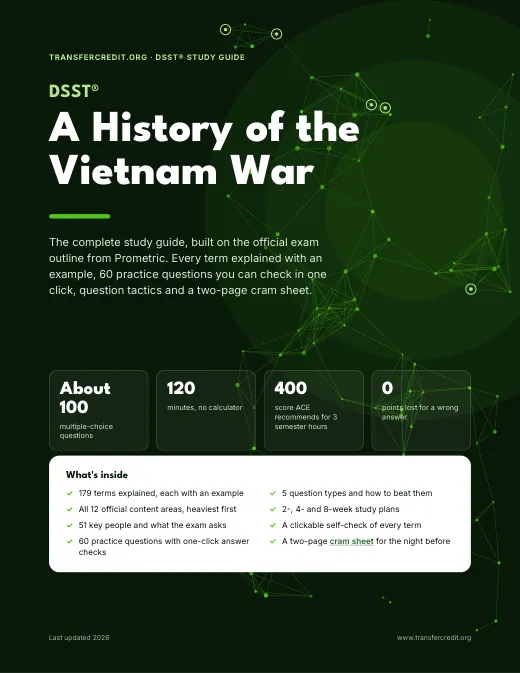
Page 1 of the DSST History of the Vietnam War Study Guide: the cover
Page 1 The cover
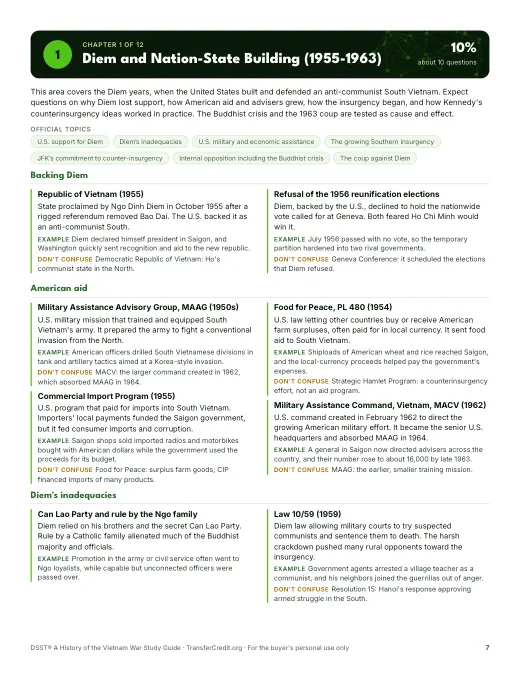
Page 7 of the DSST History of the Vietnam War Study Guide: the Chapter 1 opener
Page 7 The Chapter 1 opener
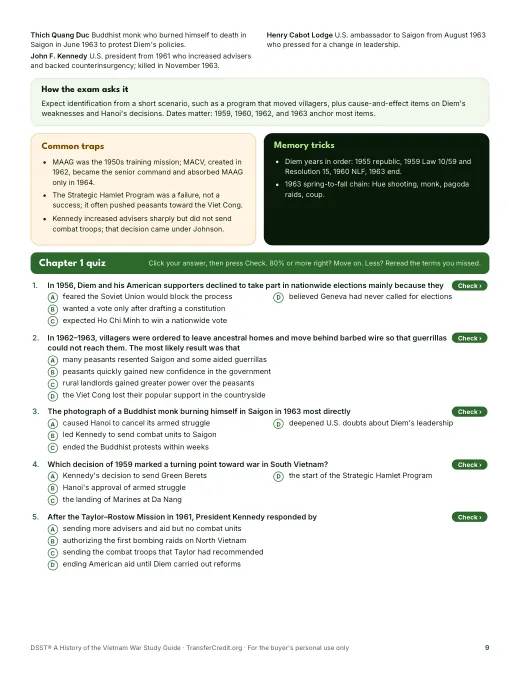
Page 9 of the DSST History of the Vietnam War Study Guide: a chapter quiz
Page 9 A chapter quiz
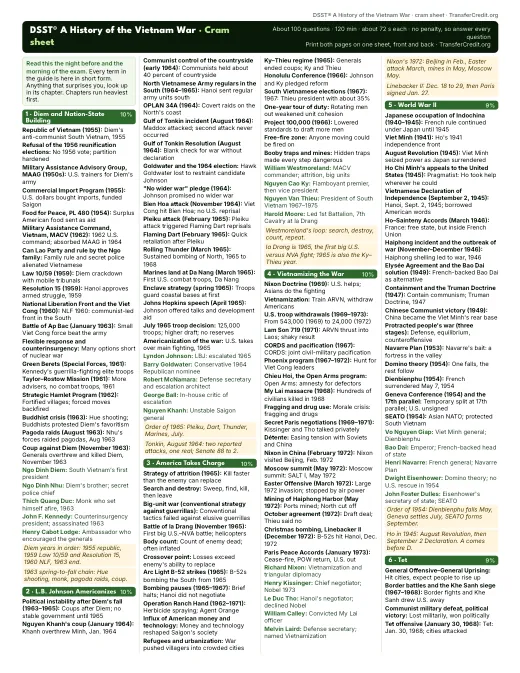
Page 48 of the DSST History of the Vietnam War Study Guide: the 2-page cram sheet
Page 48 The 2-page cram sheet

What you get for $5

One chapter for each official content area, in the order the exam weighs them.

  • 📘49pages, printable
  • 🧭12chapters, heaviest first
  • 🔑179terms with examples
  • ✍️60practice questions, answers explained
  • ⚠️36exam traps to avoid
  • 📄2page cram sheet

Try 10 free History of the Vietnam War questions

In the style of the real exam, one from each of the ten heaviest areas. About 10 minutes, with every answer explained and a score by area.

10 questions  
  1. Question 1 · Diem and Nation-State Building (1955-1963)

    In 1956, Diem and his American supporters declined to take part in nationwide elections mainly because they

    Show the answer

    Answer: C. expected Ho Chi Minh to win a nationwide vote. The elections promised at Geneva threatened to give Ho control of a united Vietnam, so Saigon and Washington refused to proceed.

    The trap: The claim that Geneva never called for elections is false; the settlement scheduled them for 1956.

  2. Question 2 · L.B. Johnson Americanizes the War (1964-1965)

    In August 1964 Congress overwhelmingly passed a resolution after reported attacks on American destroyers off North Vietnam. What did the resolution do?

    Show the answer

    Answer: B. It let the president use force in Southeast Asia without a war declaration. The Tonkin Gulf Resolution gave Johnson broad authority to take all necessary measures, and he later relied on it for escalation.

    The trap: A declaration of war is tempting, but Congress never declared war; the resolution gave open-ended authority instead.

  3. Question 3 · America Takes Charge (1965-1967)

    Briefers in Saigon insist that enemy casualties now exceed the number of men Hanoi can send or recruit, so the war is being won. They are describing the

    Show the answer

    Answer: A. crossover point. The crossover point was the claimed moment when attrition would outpace enemy replacements.

    The trap: Body count is tempting because it supplied the numbers, but it was the raw tally of dead, not the claimed turning point.

  4. Question 4 · Vietnamizing the War (1969-1973)

    A President announces that American combat units will go home in stages while South Vietnam's army is expanded and re-equipped to take over the fighting. This policy is called

    Show the answer

    Answer: D. Vietnamization. Vietnamization shifted combat to South Vietnamese forces and allowed Nixon to withdraw American troops without admitting defeat.

    The trap: Americanization is the reverse, since it describes the 1965 shift of the fighting to American forces.

  5. Question 5 · World War II, the Cold War, and the First Indochina War (1940-1955)

    As Japan surrendered in 1945, Viet Minh forces and crowds took control of Hanoi and other cities with little resistance. This event is called the

    Show the answer

    Answer: C. August Revolution. The August Revolution was the Viet Minh seizure of power as Japan collapsed; Emperor Bao Dai abdicated soon after.

    The trap: The Declaration of Independence is tempting because it came days later, but it was Ho's speech announcing a government already in place.

  6. Question 6 · Tet (1968)

    North Vietnamese planners ordered attacks on South Vietnam's cities in early 1968. What did they expect these attacks to accomplish?

    Show the answer

    Answer: A. A popular uprising against Saigon and a loss of American will to continue. General Offensive–General Uprising assumed city dwellers would rise and Americans would conclude the war could not be won.

    The trap: Khe Sanh was under siege at the same time, but the city attacks aimed at an uprising, and the Seventh Fleet was never a target.

  7. Question 7 · Home Front USA (1963-1967)

    A reporter notes that the military briefing claims steady progress, while soldiers in the field describe an enemy that is still strong. This difference is best described as the

    Show the answer

    Answer: B. credibility gap. The credibility gap was the distance between official statements and events.

    The trap: Guns and butter concerns the budget choice between war and domestic programs, not the truth of official claims.

  8. Question 8 · The War at Home (1968-1972)

    Across the country in October 1969, people left work, held vigils and attended speeches rather than join a single large march. Which event was this?

    Show the answer

    Answer: D. The Moratorium to End the War. The October 15 Moratorium was decentralized, with local events in many towns, while the Mobilization in November was one big march.

    The trap: The Mobilization is tempting because it was a major antiwar event, but it was a single march in the capital in November.

  9. Question 9 · Cambodia and Laos

    In 1969 B-52 raids struck North Vietnamese sanctuaries inside Cambodia, and the bombing was kept from the public and most of Congress. The raids were known as

    Show the answer

    Answer: A. Operation Menu. Menu was the secret bombing campaign Nixon ordered against sanctuaries in Cambodia.

    The trap: Linebacker II is tempting because it was also a B-52 campaign, but it struck the Hanoi area in December 1972 and was no secret.

  10. Question 10 · “A Decent Interval”

    A president sends troops into a foreign crisis without asking Congress for a declaration of war. Under the 1973 law passed over Nixon's veto, what must he do?

    Show the answer

    Answer: C. Report to Congress within 48 hours, then withdraw after 60 days unless Congress approves. The War Powers Act lets a president act in an emergency but sets a reporting and time limit.

    The trap: The declaration-of-war answer is tempting, but the law did not require approval in advance.

The DSST History of the Vietnam War exam at a glance

The DSST A History of the Vietnam War exam is a 120-minute, computer-based test from Prometric with about 100 multiple-choice questions. A score of 400 on the 200–500 scale earns an ACE credit recommendation of 3 semester hours, though each college sets its own policy. The exam covers 12 content areas; the heaviest is Diem and Nation-State Building (1955-1963) at 10%.

Questions
About 100multiple choice
Time
120 minabout 72 seconds a question
Passing score
400on a 200–500 scale
ACE credit
3semester hours
Exam fee
$100paid to Prometric
Calculator
Nonot allowed

Source: official DSST A History of the Vietnam War exam page.

What the exam covers

12 areas, heaviest first. The guide's chapters follow this order.

  1. Diem and Nation-State Building (1955-1963)10%
  2. L.B. Johnson Americanizes the War (1964-1965)10%
  3. America Takes Charge (1965-1967)10%
  4. Vietnamizing the War (1969-1973)10%
  5. World War II, the Cold War, and the First Indochina War (1940-1955)9%
  6. Tet (1968)9%
  7. Home Front USA (1963-1967)8%
  8. The War at Home (1968-1972)8%
  9. Cambodia and Laos8%
  10. “A Decent Interval”8%
  11. Vietnam Before 19405%
  12. U.S. Legacies and Lessons5%

How it works

  1. 1Buy once, $5Secure checkout. No subscription needed.
  2. 2Download the PDFFrom your TransferCredit.org account, right away and any time later.
  3. 3Study the heaviest areas firstFollow the 2-, 4- or 8-week plan, then read the cram sheet the night before.

Questions students ask

What's in the full DSST History of the Vietnam War study guide?
49 pages: 12 chapters, one per official content area, heaviest first. 179 terms, each with a plain-English definition and an example, 51 key people, common traps and memory tricks, 60 practice questions with an answer key that explains every answer, question tactics, 2-, 4- and 8-week study plans and a 2-page cram sheet.
How much is the full DSST History of the Vietnam War study guide?
The full 49-page PDF is $5, a one-time payment. The 10 practice questions on this page are free, with no account.
What does the $29 plan include?
$29 a month gives you all DSST subjects: every DSST study guide plus the full prep course for each subject, and you can cancel anytime. If you only need this exam, the guide on its own is a one-time $5.
How do I get the full guide?
Choose Buy this guide ($5) and check out. Then sign in to your TransferCredit.org account, then open the course and its Download Your Study Guide lesson. The PDF is yours to keep, and you can download it again from your account at any time.
Can I print the guide or use it on my phone?
Yes. It's a PDF, so it opens on phones, tablets and computers, and printing is allowed. Its tick boxes and answer bubbles work in PDF readers that support forms. Copying and editing are turned off.
Is this an official DSST study guide?
No. DSST® is a registered trademark of Prometric, which was not involved in producing this guide and does not endorse it. TransferCredit.org is independent. We built the guide from the official exam outline, and the exam details were checked against Prometric's published exam information in 2026.
Why is this study guide better than a generic review?
It follows the official outline area by area and spends the most pages on what the exam weighs most. Every term comes with an example, each chapter names the traps the exam sets, and the answer key explains why the most tempting wrong answer is wrong, not just which answer is right. It ends with a 2-page cram sheet for the night before.
What is the DSST History of the Vietnam War exam?
The DSST A History of the Vietnam War exam is a 120-minute, computer-based test from Prometric with about 100 multiple-choice questions. A score of 400 on the 200–500 scale earns an ACE credit recommendation of 3 semester hours, though each college sets its own policy. The exam covers 12 content areas; the heaviest is Diem and Nation-State Building (1955-1963) at 10%.
More questions about the DSST History of the Vietnam War exam (21)
How many questions are on the DSST History of the Vietnam War exam, and how long is it?
It contains 100 questions to be answered in 2 hours, all multiple choice with one correct answer and three incorrect options. Some questions are pretest questions that will not be scored.
What is the passing score for DSST History of the Vietnam War?
The passing score is 400 on a 200–500 scale. At 400 or above, the American Council on Education (ACE) recommends 3 semester hours. Each college sets its own passing score and credit award, so check your school's policy before you book.
How much does the DSST History of the Vietnam War exam cost?
The exam fee is $100, paid to Prometric. Test centers may add their own administration fee. Eligible U.S. military service members can usually test for free through DANTES.
How many college credits is DSST History of the Vietnam War worth?
ACE recommends 3 semester hours for a passing score of 400. Your college decides how many credits it awards and which course they replace. Check your college's policy.
Is there a penalty for guessing on DSST History of the Vietnam War?
No. Your score counts only correct answers, so a wrong answer costs nothing. Never leave a question blank: rule out what you can and pick your best guess.
What topics are on the DSST History of the Vietnam War exam?
12 content areas, from the official outline: Diem and Nation-State Building (1955-1963) (10%); L.B. Johnson Americanizes the War (1964-1965) (10%); America Takes Charge (1965-1967) (10%); Vietnamizing the War (1969-1973) (10%); World War II, the Cold War, and the First Indochina War (1940-1955) (9%); Tet (1968) (9%); Home Front USA (1963-1967) (8%); The War at Home (1968-1972) (8%); Cambodia and Laos (8%); “A Decent Interval” (8%); Vietnam Before 1940 (5%); U.S. Legacies and Lessons (5%).
Which DSST History of the Vietnam War topics should I study first?
Start with the three heaviest: Diem and Nation-State Building (1955-1963) (10%), L.B. Johnson Americanizes the War (1964-1965) (10%) and America Takes Charge (1965-1967) (10%). Together they are about 30% of the exam, roughly 30 of 100 questions. The guide's chapters run in that order, heaviest first.
Is the DSST History of the Vietnam War exam hard?
It depends on what you already know. No single area dominates: the largest, Diem and Nation-State Building (1955-1963), is 10% and the smallest, U.S. Legacies and Lessons, is 5%, so broad coverage matters more than deep expertise in one topic. Take the free diagnostic above to see where you stand in about 10 minutes.
What kinds of questions are on the DSST History of the Vietnam War exam?
The guide sorts them into 5 types: “Name the event or term”, “Cause and effect”, “Best description or policy purpose”, “Multiple statements (Roman numerals)” and “Motives and viewpoints”. Every question has 4 answer choices. Try the 10 free questions above to see the style.
How long should I study for DSST History of the Vietnam War?
Use the diagnostic to decide. If you already know most areas, two weeks of daily review is often enough; if the subject is new to you, plan on eight. The full guide has 2-, 4- and 8-week plans built from the exam weights.
How should I pace myself on the DSST History of the Vietnam War exam?
On average you have about 72 seconds per question (120 minutes for 100 questions). Be past question 33 a third of the way through and past question 67 two-thirds through. If a question takes more than a minute, pick your best guess, mark it and come back.
What happens if I don't pass DSST History of the Vietnam War?
You can retake a DSST exam after 30 days. Use the wait to work through the areas the score report and the diagnostic show you missed.
Do colleges accept DSST History of the Vietnam War for credit?
DSST exams are accepted at more than 1,500 colleges and universities, but each school decides which exams it accepts, the score it requires and the credit it gives. Look up your college's DSST policy before you book.
How up to date is this DSST History of the Vietnam War guide?
Last updated 2026. The exam details were checked against Prometric's published exam information in 2026. Exams change, so confirm the details on the official exam page before you register.
What should I do the night before the exam?
Read the cram sheet once, slowly. Check your test time, the location or remote-proctoring setup, and the ID you need. Then sleep: a rested brain recalls more than a crammed one. In the morning, skim the memory tricks and common traps, then stop studying.
Does the exam cover the antiwar movement?
Yes. Two areas cover the home front: 1963–1967 (guns versus butter, the credibility gap, the press, the draft) and 1968–1972 (campus unrest, moratoria, the 1968 conventions, the Pentagon Papers), 16% of the exam together.
Which U.S. presidents should I know for DSST A History of the Vietnam War?
Know Truman (aid to the French), Eisenhower (the domino theory and support for Diem), Kennedy (advisers and counterinsurgency), Johnson (the Tonkin Gulf Resolution, Rolling Thunder and combat troops), Nixon (Vietnamization and the Paris Peace Accords) and Ford (the fall of Saigon in 1975). Learning the war president by president is the easiest way to keep its 12 areas in order.
What was the Tet Offensive, and how much of the DSST Vietnam War exam covers it?
Tet was the coordinated North Vietnamese and Viet Cong attack on South Vietnam's cities and towns in early 1968. It failed militarily but shook American confidence in the war, and Johnson soon announced he wouldn't seek reelection. Tet is its own area on the exam, 9% of the questions.
Does the DSST Vietnam War exam cover history before American involvement?
Yes. Vietnam Before 1940 (5%) covers Chinese domination, French colonialism and Ho Chi Minh, and World War II, the Cold War and the First Indochina War (9%) runs through Dienbienphu and the 1954 Geneva Conference. Together that's 14% of the exam.
Does the exam cover Cambodia and Laos?
Yes, 8% of the exam: Laotian neutrality, the Ho Chi Minh Trail, the secret war and secret bombing, Cambodia from Sihanouk to Lon Nol, and the Khmer Rouge victory in 1975.
Can I take DSST A History of the Vietnam War online?
Yes. DSST exams can be taken at a test center or online with a remote Prometric proctor.

Choose how you want to study

Start with the guide, or get everything for DSST in one plan.

This study guide
$5one-time
  • 49-page printable PDF
  • 179 terms with examples
  • 60 practice questions, answers explained
  • 2-page cram sheet and study plans
Get the guide · $5
Best value Get it all
$29/month
  • Every DSST study guide
  • Prep courses for all DSST subjects
  • Cancel anytime
Get it all · $29/mo

DSST® is a registered trademark of Prometric, which was not involved in producing this guide and does not endorse it. TransferCredit.org is independent and not affiliated with Prometric. © 2026 UPI Globale Edu Inc.