← All AP® study guides
AP® Study Guide Printable PDF · 44 pages

TransferCredit.org Guide to AP® African American Studies

AP® African American Studies study guide: a printable PDF built from the College Board's official course and exam description, in the official order.

  • 208 key terms, each with an example
  • 40 practice questions with every answer explained
  • A 2-page cram sheet for the night before
  • 2-, 4- and 8-week study plans built from the exam weights
Not sure yet? Try 10 free questions

Last updated 2026 · exam details checked against the College Board's published exam information in 2026

Look inside the guide

Real pages from the 44-page PDF.

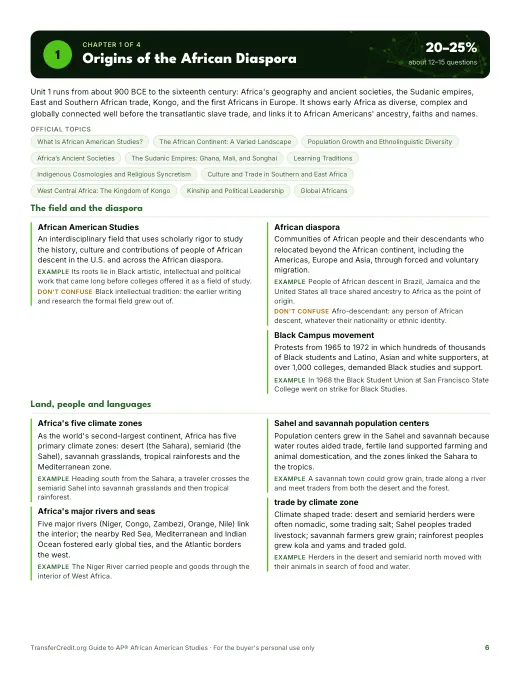
Page 1 of the TransferCredit.org Guide to AP® African American Studies: the cover
Page 1 The cover
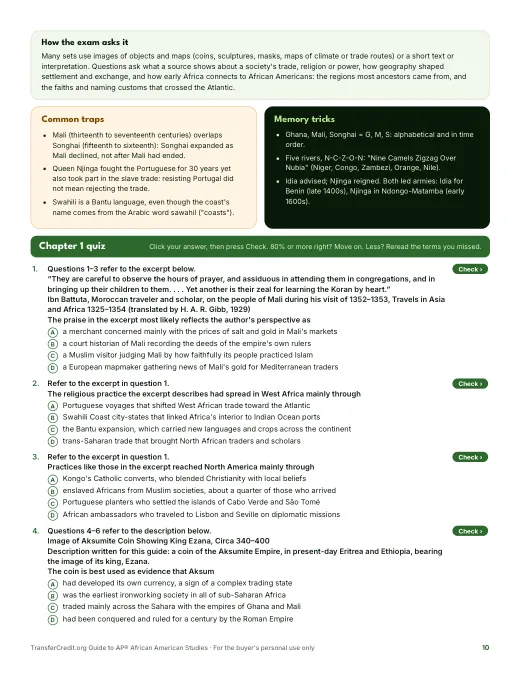
Page 6 of the TransferCredit.org Guide to AP® African American Studies: the Chapter 1 opener
Page 6 The Chapter 1 opener
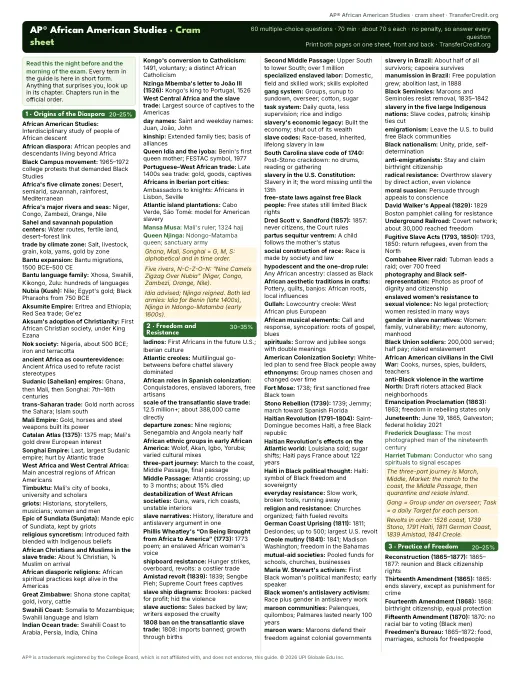
Page 10 of the TransferCredit.org Guide to AP® African American Studies: a chapter quiz
Page 10 A chapter quiz
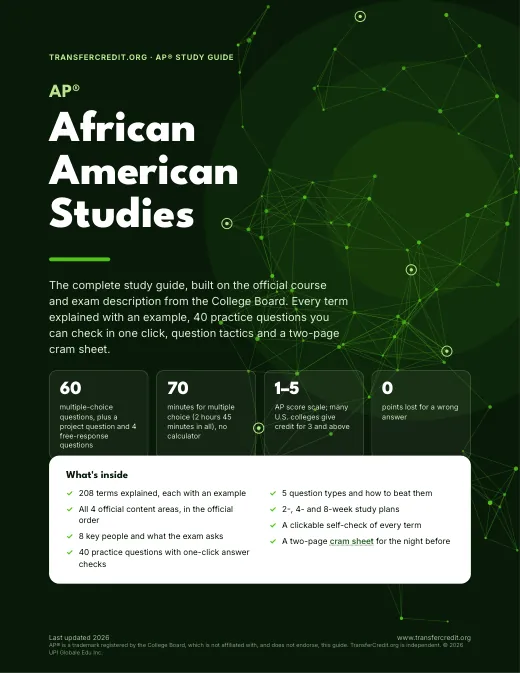
Page 43 of the TransferCredit.org Guide to AP® African American Studies: the 2-page cram sheet
Page 43 The 2-page cram sheet

What you get for $5

One chapter for each area of the official course and exam description, in the official order.

  • 📘44pages, printable
  • 🧭4chapters
  • 🔑208terms with examples
  • ✍️40practice questions, answers explained
  • ⚠️12exam traps to avoid
  • 📄2page cram sheet

Try 10 free AP® African American Studies questions

Multiple-choice questions taken from the guide's chapter quizzes: 4 areas, heaviest first. About 10 minutes, with every answer explained and a score by area. The exam's free-response questions aren't in this quiz: see how the exam works.

10 questions  
  1. Question 1 · Freedom and Resistance
    Questions 1–4 refer to the excerpt below.
    “. . . two of my wearied countrymen who were chained together . . . preferring death to such a life of misery, somehow made through the nettings and jumped into the sea . . . and I believe many more would very soon have done the same if they had not been prevented by the ship's crew . . .”
    Olaudah Equiano, The Interesting Narrative of the Life of Olaudah Equiano, or Gustavus Vassa, the African. Written by Himself, 1789
    The excerpt provides evidence that captives aboard slave ships
    Show the answer

    Answer: B. resisted enslavement even when resistance meant risking their lives. Equiano describes chained men choosing to drown rather than live enslaved, and others ready to follow them: the individual and collective resistance captives showed during the Middle Passage.

    The trap: The idea that captives shared one language is wrong: they came from many societies and had to overcome language differences to organize revolts.

  2. Question 2 · Origins of the Diaspora
    Questions 1–3 refer to the excerpt below.
    “They are careful to observe the hours of prayer, and assiduous in attending them in congregations, and in bringing up their children to them. . . . Yet another is their zeal for learning the Koran by heart.”
    Ibn Battuta, Moroccan traveler and scholar, on the people of Mali during his visit of 1352–1353, Travels in Asia and Africa 1325–1354 (translated by H. A. R. Gibb, 1929)
    The praise in the excerpt most likely reflects the author's perspective as
    Show the answer

    Answer: A. a Muslim visitor judging Mali by how faithfully its people practiced Islam. Ibn Battuta was a Muslim scholar from North Africa. The things he praises (keeping the hours of prayer, attending congregations, memorizing the Koran) are the standards a devout Muslim visitor would apply.

    The trap: The court historian fits the role of Mali's griots, but Ibn Battuta was an outsider visiting from North Africa, not the empire's own keeper of history.

  3. Question 3 · Practice of Freedom
    Questions 1–3 refer to the excerpt below.
    “All persons born or naturalized in the United States, and subject to the jurisdiction thereof, are citizens of the United States and of the State wherein they reside. No State shall . . . deny to any person within its jurisdiction the equal protection of the laws.”
    Fourteenth Amendment to the United States Constitution, Section 1, 1868
    The first sentence of the excerpt was written mainly to
    Show the answer

    Answer: D. secure citizenship for African Americans born in the United States. The citizenship clause defined birthright citizenship, so African Americans born in the United States, formerly enslaved or born free, became citizens. It overturned Dred Scott v. Sandford (1857), which had ruled they could never be citizens.

    The trap: Black men's right to vote came from the Fifteenth Amendment (1870); the Fourteenth's first sentence defines who is a citizen.

  4. Question 4 · Movements and Debates
    Questions 1–3 refer to the excerpt below.
    “To separate them from others of similar age and qualifications solely because of their race generates a feeling of inferiority as to their status in the community that may affect their hearts and minds in a way unlikely ever to be undone. . . . Separate educational facilities are inherently unequal.”
    Brown v. Board of Education of Topeka, Opinion, May 17, 1954
    The Court's claim about a “feeling of inferiority” drew most directly on
    Show the answer

    Answer: C. Mamie and Kenneth Clark's doll test on how segregation affected children. The Court cited the 1940s doll test by psychologists Mamie and Kenneth Clark, which showed the impact of segregation on Black children's self-esteem: the harm the excerpt calls a feeling of inferiority.

    The trap: The Little Rock Nine integrated their school in 1957, three years after this 1954 opinion, so their experience could not be its evidence.

  5. Question 5 · Freedom and Resistance
    Refer to the excerpt in question 1.
    The “nettings” mentioned in the excerpt are best explained as
    Show the answer

    Answer: D. a change in ship design that captives' resistance pushed enslavers to make. Captives' attempts to jump overboard and their revolts made the trade more costly and dangerous, so enslavers changed ship design, adding barricades, nets and guns.

    The trap: Keeping ethnic groups apart is not what the nets were for; as the excerpt shows, they were meant to stop captives from jumping into the sea.

  6. Question 6 · Origins of the Diaspora
    Refer to the excerpt in question 1.
    The religious practice the excerpt describes had spread in West Africa mainly through
    Show the answer

    Answer: B. trans-Saharan trade that brought North African traders and scholars. Trans-Saharan commerce brought North African traders, scholars and administrators who introduced Islam to West Africa and helped it spread there.

    The trap: Portuguese voyages along West Africa's coast came in the fifteenth century, after Ibn Battuta's visit, and they pulled trade away from the Sahara rather than spreading Islam.

  7. Question 7 · Practice of Freedom
    Refer to the excerpt in question 1.
    When it was ratified, the equal protection clause was aimed most directly at state laws that
    Show the answer

    Answer: A. restricted freedpeople's property, labor and movement after slavery ended. The amendment overturned related state-level Black codes: laws of 1865 and 1866 that limited African Americans' property, forced them into labor contracts and controlled their movement.

    The trap: Poll taxes and literacy tests spread after Reconstruction's defeat and targeted voting, the concern of the Fifteenth Amendment rather than this clause's original aim.

  8. Question 8 · Movements and Debates
    Refer to the excerpt in question 1.
    The Court's conclusion that separate schools are “inherently unequal” most directly rejected
    Show the answer

    Answer: C. the “separate but equal” doctrine the Court set in Plessy v. Ferguson. Brown held that state-sanctioned school segregation violated the Fourteenth Amendment's equal protection clause, overturning the “separate but equal” ruling of Plessy v. Ferguson.

    The trap: The Civil Rights Act of 1875 outlawed racial discrimination in public places; the movement sought to enforce rights like these, not reject them.

  9. Question 9 · Freedom and Resistance
    Refer to the excerpt in question 1.
    Unlike Equiano's account, slave ship diagrams such as Stowage of the British Slave Ship Brookes
    Show the answer

    Answer: D. rarely showed the nets and guns enslavers used to stop resistance. Ship diagrams showed captives packed in rows to maximize profit, yet they rarely included the guns, nets and force-feeding tools enslavers used against resistance, the very nets Equiano mentions.

    The trap: The diagrams showed fewer captives, not more: typically only about half the number on any given ship.

  10. Question 10 · Origins of the Diaspora
    Refer to the excerpt in question 1.
    Practices like those in the excerpt reached North America mainly through
    Show the answer

    Answer: B. enslaved Africans from Muslim societies, about a quarter of those who arrived. About one-quarter of the enslaved Africans who arrived in North America came from Muslim societies in Africa, and they brought their religious practices with them.

    The trap: Kongo's converts were also brought to North America, but they came from a Christian kingdom, so they carried Catholic rather than Muslim practices.

The AP® African American Studies exam at a glance

The AP® African American Studies exam is from the College Board. It has 60 multiple-choice questions, plus a project question and 4 free-response questions. You get 70 minutes for multiple choice (2 hours 45 minutes in all), no calculator. The score scale is 1–5 (AP® score scale; many U.S. colleges give credit for 3 and above). The guide has 4 chapters, one for each area of the official course and exam description; the heaviest is Freedom, Enslavement, and Resistance at 30–35%.

Questions
60multiple-choice questions, plus a project question and 4 free-response questions
Time
70 minfor the 60 multiple-choice questions, about 70 seconds a question
Score
1–5AP® score scale; many U.S. colleges give credit for 3 and above
Fee
$99per exam in the U.S. and Canada in 2026-27; your school may charge more
Calculator
Nonot allowed
Wrong answers
No penaltya wrong answer costs nothing
  • Section I has 60 multiple-choice questions in 70 minutes (60% of your score), in sets of 3–4 questions on one or two sources. Up to half of the sources are required sources from the course; the rest are new to you but tied to required content.
  • Section IB is one written Exam Day Validation Question about your Individual Student Project (10 minutes, 1.5%). Section II has 3 short-answer questions (40 minutes suggested, 18%) and a document-based question on 5 documents (45 minutes suggested, 12%).
  • Your Individual Student Project, a 3-week research project with a presentation and oral defense, is scored by your teacher and counts 8.5% of your AP® score (10% with the validation question).
  • The exam is fully digital: you answer every question in the Bluebook testing app. No calculator is allowed.
  • Your multiple-choice score is the number of questions you answer correctly, so a wrong answer costs nothing.

Source: official AP® African American Studies page and the official course and exam description. Last updated 2026.

What the exam covers

4 chapters, in the official order, with each area's official weight. The guide's chapters follow this order.

  1. Origins of the African Diaspora20–25% · ~12–15 Q
  2. Freedom, Enslavement, and Resistance30–35% · ~18–21 Q
  3. The Practice of Freedom20–25% · ~12–15 Q
  4. Movements and Debates20–25% · ~12–15 Q

Where to start: the 3 heaviest areas (marked in the map) carry about 47 of the 60 questions. The chapters run in the official order, so start with those.

AP® African American Studies study guide by area

The heaviest area is open to read now. The full guide has a chapter for every area, each with all its terms, a quiz and an answer key.

1 of 4 chapters open  ·  in the guide's order
30–35% · about 18–21 questions · free preview Freedom, Enslavement, and Resistance Chapter 2 of the guide

Unit 2 runs from the sixteenth century to 1865: from the first Africans in Spanish America, through the slave trade and the laws, labor and culture of slavery, to the Civil War and Juneteenth. It is the heaviest unit, and its main thread is resistance in every form, from shipboard revolts and maroon communities to slave narratives, emigration debates and the Underground Railroad.

Key terms, with examples

ladinos
Free and enslaved Africans familiar with Iberian (Spanish and Portuguese) culture who joined Europeans' first explorations of the Americas, including the first Africans in the future United States.
Example: Africans in Spanish exploring parties helped Spain claim “La Florida,” an area that included Florida, South Carolina and Georgia.
scale of the transatlantic slave trade
Over 350 years (early 1500s to mid-1800s), more than 12.5 million Africans were forced to the Americas; only about 5 percent of survivors came straight to the U.S.
Example: Portugal, Great Britain, France, Spain and the Netherlands were the top five enslaving nations; 48 percent of direct U.S. arrivals landed in Charleston.
shipboard resistance
Captives' resistance aboard slave ships: hunger strikes, attempts to jump overboard and revolts organized across language differences. It made the trade costlier and more dangerous and changed ship design.
Example: Captives who refused food were sometimes force-fed with iron instruments, yet hunger strikes continued.
slave auctions
Public sales of enslaved people, backed by the law and white supremacist doctrine. Those who resisted sale could be whipped, at times in front of their families and friends.
Example: In Twelve Years a Slave (1853), Solomon Northup described being sold to counter enslavers' claims that slavery was benign.
slave codes
Laws defining chattel slavery as race-based, inheritable and lifelong, restricting enslaved people's movement, gatherings, weapons and even fine fabrics; they hardened the color line.
Example: French colonies used the Code Noir, such as Louisiana's of 1724, and Spanish colonies the Código Negro.
African aesthetic traditions in crafts
African American art blending African, community, European and Indigenous influences: pottery, quilts used for storytelling and memory keeping, and instruments such as gourd rattles, banjos and drums.
Example: Storage Jar by David Drake, an enslaved potter, dates from 1858; a cream and red appliquéd quilted bedcover dates from about 1850.
Fort Mose
A fortified settlement set up by Spanish Florida's governor in 1738 under Francisco Menéndez, a once-enslaved Senegambian; the first sanctioned free Black town in what is now the United States.
Example: Refugees fleeing the Carolinas and Georgia reached St. Augustine, where Spanish Florida offered freedom to those who converted to Catholicism.
mutual-aid societies
Organizations through which free Black people pooled resources to fund Black schools, businesses and independent churches and to support Black writers and speakers.
Example: Free Black communities in Philadelphia, New York and New Orleans built such institutions; by 1860 free people were 12 percent of the Black population.
maroon communities
Free communities of Afro-descendants who escaped slavery (maroons) and those born free there, often in remote, hidden places; some lasted a few years, others a century.
Example: African Americans formed maroon communities in the Great Dismal Swamp, between Virginia and North Carolina, and within Indigenous communities.
emigrationism
The nineteenth-century view that African Americans should build new communities in Latin America, the Caribbean or West Africa as an alternative to slavery and racial discrimination.
Example: In 1815 Paul Cuffee took 39 African Americans to Freetown, Sierra Leone, the first relocation of African Americans to Africa.
Underground Railroad
A covert network of Black and white abolitionists who gave transportation, shelter and other help to people fleeing slavery in the South to reach the North, Canada and Mexico.
Example: A family hiding freedom seekers in a cellar and guiding them north at night was part of the network.
photography and Black self-representation
Nineteenth-century African American leaders used photography, a new technology, to counter stereotypes by portraying themselves as citizens worthy of dignity, respect and equal rights.
Example: Sojourner Truth sold her cartes de visite, small photo cards, to raise money for the abolitionist cause.

What this area covers

Africans in early Spanish AmericaThe slave trade and the journeyResistance at seaAuctions, labor and the slave economySlavery, law and raceCreating African American cultureRefuge, revolt and HaitiBlack organizing in the NorthMaroons, Brazil and Indigenous nationsEmigration and radical resistanceThe Underground RailroadPhotography and gender in slave narrativesThe Civil War and Freedom Days

Key people

Frederick DouglassEscaped slavery and became a leading abolitionist writer and speaker: My Bondage and My Freedom (1855), the speech “West India Emancipation” (1857) and a lecture on Haiti at the Chicago World's Fair (1893).
Harriet TubmanAfter fleeing enslavement, returned to the South at least 19 times as an Underground Railroad conductor, leading about 80 people to freedom; later a Union spy and nurse. Subject of Sarah H. Bradford's Harriet, the Moses of Her People (1886).

How the exam asks it

Most sets give you a short primary source from this era, often a narrative, poem, law, petition or speech from the required list, and ask what it shows and why it was written, then move to related content. Know each required source's author, date and purpose, link each law to the resistance that prompted it, and keep the forms of resistance apart: everyday acts, shipboard and plantation revolts, maroon communities, freedom suits, emigration, the Underground Railroad and calls to rise up.

Common traps

Trap 1. Only about 5 percent of the Africans who survived the crossing came directly to what became the United States; about half landed in Brazil. Don't assume most captives came to North America.

Trap 2. Maroon wars were not slave revolts. Maroons were already free and fought colonial governments to protect their own communities.

Trap 3. Black–Indigenous relations were not one story: the Seminoles welcomed maroons as kin, but the five large Indigenous nations also enslaved African Americans and adopted slave codes.

Memory trick

The three-part journey is March, Middle, Market: the march to the coast, the Middle Passage, then quarantine and resale inland.

Gang = Group under an overseer; Task = a daily Target for each person.

How AP® African American Studies questions are written

The exam has 60 multiple-choice questions, plus a project question and 4 free-response questions. The guide sorts the questions into 5 types; spot the type and you'll know what the question wants before you read the choices.

Type 1

Explain a development and why it matters to the field

"The development described most directly shows . . ." or "Why does this matter to African American Studies?" (Skills 1A and 1D)

  • Name the development in your own words: who, what, when and where.
  • Ask what it changed or revealed, for Black communities or for how scholars study them.
  • Cross out choices from the wrong era or region, and choices that are true but answer a different question.
Type 2

Place a development in its context

"This development is best understood in the context of . . ." or "Which broader development helps explain . . . ?" (Skill 1B)

  • Fix the date and the place first.
  • Recall what else was happening there at that time: trade, wars, laws, movements.
  • Choose the setting that explains why it happened, not just something from the same century.
Type 3

Connect developments: cause, comparison, continuity and change

"Which development most directly set off . . . ?", "How did X differ from Y?" or "Which practice continued after . . . ?" (Skill 1C)

  • Name the link the stem asks for: cause, effect, similarity, difference, continuity or change.
  • Connect the two developments in one sentence before reading the choices.
  • Check the dates: a cause must come before its effect.
Type 4

Weigh a source's claim, evidence and data

"Which evidence would best support the claim . . . ?", "The list best supports which conclusion?" or "What can these figures not show?" (Skills 2A and 2D)

  • Find the claim, or the pattern in the data, and say it in a few words.
  • Pick the choice the source actually shows, not one that is merely true.
  • For data, note what the figures leave out: places, dates, causes.
Type 5

Read a source's perspective, purpose, context and audience

"The author's purpose was most likely to . . .", "Why was this published where it was?" or "How does the author's situation shape the source?" (Skills 2B and 2C)

  • Read the citation: who made the source, when, where it appeared and for whom.
  • Ask what the creator wanted readers or viewers to do or believe.
  • Choose the answer that fits both the content and the creator's situation.

Test-day habits that add points

  1. Answer every question. There's no penalty for a wrong answer. A blank is always worth zero, so never leave one.
  2. Predict, then look. Name the answer before reading the choices. It protects you from distractors written to sound right.
  3. Eliminate. Cross out choices you know are wrong. Every choice you rule out raises your odds on a guess.
  4. Mark and move on. If a question takes more than a minute, pick your best guess, mark it and come back if time allows.
  5. Watch absolute words. Choices with "always", "never" or "only" are often wrong, because most rules and findings have exceptions. Treat this as a tiebreaker, not a rule.
  6. Change answers for a reason. Switch an answer only when you can say why the new one is better, such as a detail you missed.
  7. The project question. Section IB is 1 written question in 10 minutes, worth 1.5% of your score. It is like one of your project's oral defense questions: you analyze, reflect on, compare or evaluate at least one source you used in your own Individual Student Project. The CED's sample is scored 0–2 points, so know your project's sources well.
  8. The short-answer questions. 3 required questions in a suggested 40 minutes, 18% of your score. One is based on a text source, one on a visual source, and one has no source and asks about a broad theme that recurs across units. Each has 3 or 4 parts. In the source-based questions, at least one part is about the source, one moves beyond it to related course content, and one asks for connections across the course.
  9. The document-based question. 1 question in a suggested 45 minutes, including reading time, 12% of your score, on 5 documents offering various perspectives on a historical development or process. 7 points: thesis or claim 1, context 1, evidence up to 3 (evidence from the sources 1 or 2: 1 for using the content of at least 2 sources, 2 for supporting an argument with at least 3; evidence beyond the sources 1), source use 1, reasoning 1. For source use, explain for at least 2 sources how or why their perspective, purpose, context or audience is relevant to your argument.

Pacing: 60 questions in 70 minutes, about 70 seconds a question.

AP® African American Studies flashcards

Try the first 8 cards free. Read the term, say the definition out loud, then select the card to check yourself. Arrow keys move between cards.

Free card 1 of 8 (deck total: 208)

How to study for AP® African American Studies: a 5-step plan

Follow the steps, then enter your test date. The planner gives you a dated plan that starts with the heaviest areas and saves the last days for review.

  1. Take the 10 free questionsSee which AP® African American Studies areas you already know.
  2. Study the heaviest areas firstStart with Freedom, Enslavement, and Resistance, Origins of the African Diaspora and the Practice of Freedom, then work down the exam map.
  3. Learn each term with an exampleSay the definition out loud, then check it with the flashcards. A term you can't use in an example isn't learned yet.
  4. Quiz yourself and study the trapsAfter each area, answer its quiz and read why the tempting wrong answer is wrong.
  5. Plan backwards from your exam dateBuild a dated plan, keep the last days for a full review, and read the cram sheet the night before.

How it works

  1. 1Check outSelect Get the guide · $5 and pay on TransferCredit.org's secure checkout.
  2. 2Download the PDFFrom your TransferCredit.org account.
  3. 3Study the heaviest areas firstFollow the 2-, 4- or 8-week plan, then read the cram sheet the night before.

This page or the full guide

Everything on this page is free with no account. The full guide is a PDF you keep.

What's on this page and in the full study guide
Study toolThis pageFull study guide ($5)
ChaptersA preview of 1 of 4All 4
Terms explainedA sample from the open chaptersAll 208, each with an example
Practice questions10 free questions40, with an answer key
Flashcards8 cardsAll 208 terms on the self-check list
Study planDated planner2-, 4- and 8-week plans
Cram sheet—2 pages, for the night before
FormatWeb page44-page PDF, printable

Questions students ask

What's in the full AP® African American Studies study guide?
44 pages: 4 chapters, one for each area of the College Board's official course and exam description, in the official order. 208 terms, each with a plain-English definition and an example, 8 key people, common traps and memory tricks, 40 practice questions with an answer key that explains every answer, question tactics, 2-, 4- and 8-week study plans and a 2-page cram sheet.
How much is the full AP® African American Studies study guide?
The full 44-page PDF is $5. The 10 practice questions on this page are free.
How do I get the full guide?
Select Get the guide · $5 and check out on TransferCredit.org. Then sign in to your TransferCredit.org account to download the PDF.
Can I print the guide or use it on my phone?
Yes. It's a PDF, so it opens on phones, tablets and computers, and printing is allowed. Its tick boxes and answer bubbles work in PDF readers that support forms. Copying and editing are turned off.
Can I try the AP® African American Studies guide before I buy it?
Yes. This page has 10 questions from the guide's own chapter quizzes, a preview of the heaviest area, 8 flashcards and a study planner. No account needed.
Is this an official AP® study guide?
No. AP® is a trademark registered by the College Board, which is not affiliated with, and does not endorse, this guide. TransferCredit.org is independent. We built the guide from the College Board's official course and exam description, and the exam details were checked against the College Board's published exam information in 2026.
How was this study guide made?
One chapter for each area of the official course and exam description, using its published weights. Each chapter was written, then fact-checked against the official exam information in a separate review. The practice questions are original: none are copied from the College Board's released questions.
How up to date is this AP® African American Studies guide?
Last updated 2026. The exam details were checked against the College Board's published exam information in 2026. Exams change, so confirm the details on the official AP® African American Studies page before you test.
More questions about the AP® African American Studies exam (16)
What is the AP® African American Studies exam?
The AP® African American Studies exam is from the College Board. It has 60 multiple-choice questions, plus a project question and 4 free-response questions. You get 70 minutes for multiple choice (2 hours 45 minutes in all), no calculator. The score scale is 1–5 (AP® score scale; many U.S. colleges give credit for 3 and above). The guide has 4 chapters, one for each area of the official course and exam description; the heaviest is Freedom, Enslavement, and Resistance at 30–35%.
How many questions are on the AP® African American Studies exam, and how long is it?
Section I has 60 multiple-choice questions in 70 minutes (60% of your score), in sets of 3–4 questions on one or two sources. Up to half of the sources are required sources from the course; the rest are new to you but tied to required content. Section IB is one written Exam Day Validation Question about your Individual Student Project (10 minutes, 1.5%). Section II has 3 short-answer questions (40 minutes suggested, 18%) and a document-based question on 5 documents (45 minutes suggested, 12%).
How is the AP® African American Studies exam scored?
The score scale is 1–5: AP® score scale; many U.S. colleges give credit for 3 and above. Your multiple-choice score is the number of questions you answer correctly, so a wrong answer costs nothing.
What AP® African American Studies score do I need for college credit?
Many U.S. colleges give credit for 3 and above. Each college sets its own credit policy, so check the one at your college before you count on the credit.
How much does the AP® African American Studies exam cost?
The fee is $99: per exam in the U.S. and Canada in 2026-27; your school may charge more. Fees can change, so check the official page when you register.
Can I use a calculator on the AP® African American Studies exam?
No calculator is allowed.
Is there a penalty for guessing on AP® African American Studies?
No. There's no penalty for a wrong answer. A blank is always worth zero, so never leave one.
What topics are on the AP® African American Studies exam?
4 areas, from the official course and exam description: Origins of the African Diaspora (20–25%); Freedom, Enslavement, and Resistance (30–35%); The Practice of Freedom (20–25%); Movements and Debates (20–25%).
Which AP® African American Studies topics should I study first?
The 3 heaviest areas (marked in the map) carry about 47 of the 60 questions. The chapters run in the official order, so start with those.
Is the AP® African American Studies exam hard?
It depends on what you already know. There are only 4 areas, so each one carries real weight: Freedom, Enslavement, and Resistance (30–35%), Origins of the African Diaspora (20–25%), the Practice of Freedom (20–25%) and Movements and Debates (20–25%). Try the 10 free questions above to see where you stand in about 10 minutes.
What kinds of questions are on the AP® African American Studies exam?
The exam has 60 multiple-choice questions, plus a project question and 4 free-response questions. The guide sorts the questions into 5 types: “Explain a development and why it matters to the field”, “Place a development in its context”, “Connect developments: cause, comparison, continuity and change”, “Weigh a source's claim, evidence and data” and “Read a source's perspective, purpose, context and audience”. Multiple-choice questions have 4 answer choices. See how each type is written.
What are the free-response questions on the AP® African American Studies exam?
3 required questions in a suggested 40 minutes, 18% of your score. One is based on a text source, one on a visual source, and one has no source and asks about a broad theme that recurs across units. Each has 3 or 4 parts. In the source-based questions, at least one part is about the source, one moves beyond it to related course content, and one asks for connections across the course. 1 question in a suggested 45 minutes, including reading time, 12% of your score, on 5 documents offering various perspectives on a historical development or process. 7 points: thesis or claim 1, context 1, evidence up to 3 (evidence from the sources 1 or 2: 1 for using the content of at least 2 sources, 2 for supporting an argument with at least 3; evidence beyond the sources 1), source use 1, reasoning 1. For source use, explain for at least 2 sources how or why their perspective, purpose, context or audience is relevant to your argument.
How should I pace myself on the AP® African American Studies exam?
60 questions in 70 minutes, about 70 seconds a question. If a question takes more than a minute, pick your best guess, mark it and come back if time allows.
How long should I study for AP® African American Studies?
Take the 10 free questions to see where you stand. The full guide has 2-, 4- and 8-week plans built from the exam weights, and the planner on this page builds a dated plan from your exam date.
How do I know I'm ready for the AP® African American Studies exam?
The guide's readiness checklist: You can explain every term on the checklist without notes. You score 80% or better on every chapter quiz. You can say what each person in the key people lists is known for. You can read the cram sheet and nothing on it surprises you. You know the AP® score your college gives credit for, and your exam date.
What should I do the night before?
Read the 2-page cram sheet once, slowly. Check your exam time and room with your AP® coordinator. The whole exam is taken in the Bluebook app. In the morning, skim the traps, then stop studying.

How we built this guide

We built one chapter for each area of the College Board's official course and exam description for AP® African American Studies, using its published weights to order the chapters and size the quizzes. Each chapter was written, then fact-checked against the official exam information in a separate review. The exam details were checked against the College Board's published exam information in 2026.

Sources: official AP® African American Studies page, official course and exam description. Last updated 2026.

AP® is a trademark registered by the College Board, which is not affiliated with, and does not endorse, this guide. TransferCredit.org is independent and not affiliated with the College Board. © 2026 UPI Globale Edu Inc.

Ready for the full AP® African American Studies guide? 44 pages, 208 terms, 40 practice questions and a 2-page cram sheet, $5.

Get the guide · $5

In the full guide

TransferCredit.org Guide to AP® African American Studies

  • All 4 chapters
  • 208 terms with examples and 8 key people
  • 40 practice questions with an answer key
  • A 2-page cram sheet and 2-, 4- and 8-week plans
Get the guide · $5