← All AP® study guides
AP® Study Guide Printable PDF · 45 pages

TransferCredit.org Guide to AP® Comparative Government and Politics

AP® Comparative Government and Politics study guide: a printable PDF built from the College Board's official course and exam description, heaviest topics first.

  • 226 key terms, each with an example
  • 40 practice questions with every answer explained
  • A 2-page cram sheet for the night before
  • 2-, 4- and 8-week study plans built from the exam weights
Not sure yet? Try 10 free questions

Last updated 2026 · exam details checked against the College Board's published exam information in 2026

Look inside the guide

Real pages from the 45-page PDF.

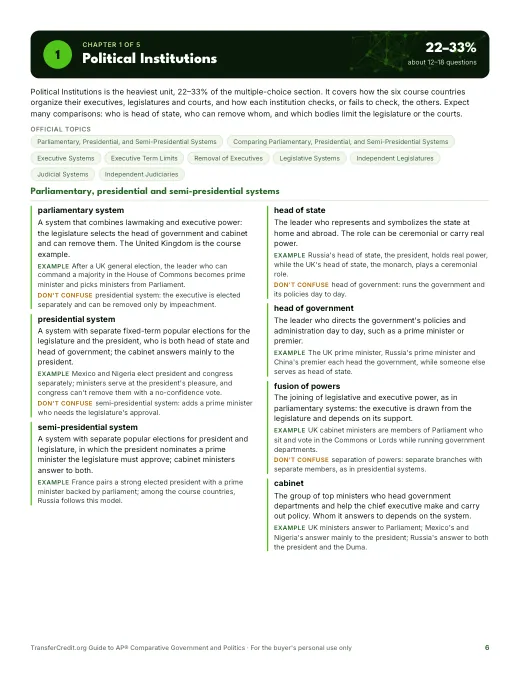
Page 1 of the TransferCredit.org Guide to AP® Comparative Government and Politics: the cover
Page 1 The cover
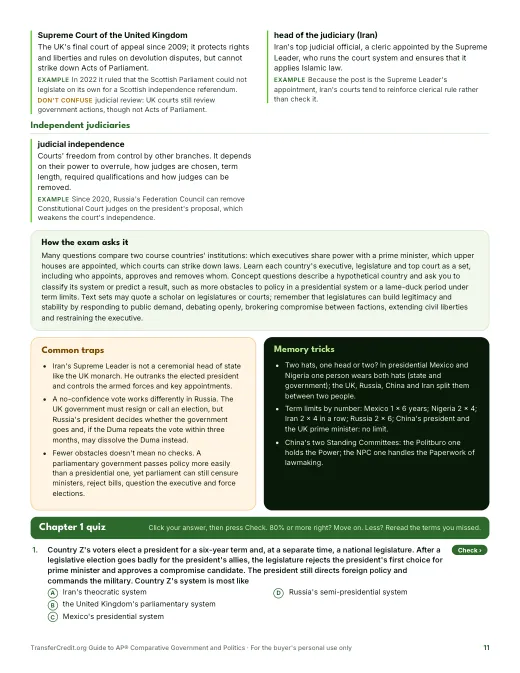
Page 6 of the TransferCredit.org Guide to AP® Comparative Government and Politics: the Chapter 1 opener
Page 6 The Chapter 1 opener
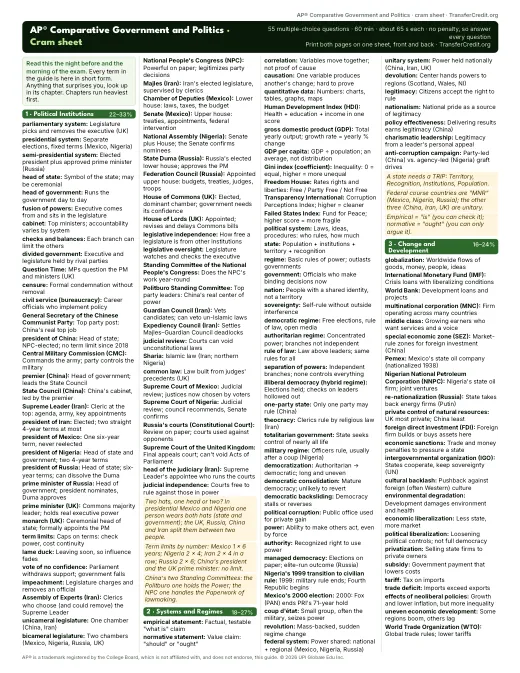
Page 11 of the TransferCredit.org Guide to AP® Comparative Government and Politics: a chapter quiz
Page 11 A chapter quiz
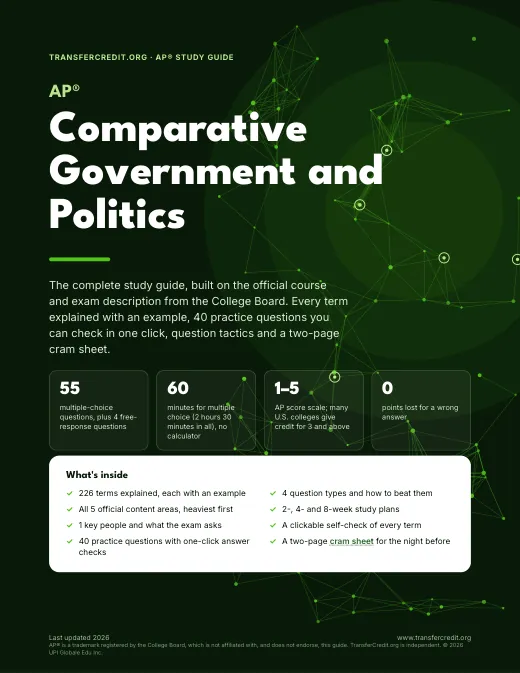
Page 44 of the TransferCredit.org Guide to AP® Comparative Government and Politics: the 2-page cram sheet
Page 44 The 2-page cram sheet

What you get for $5

One chapter for each area of the official course and exam description, heaviest topics first.

  • 📘45pages, printable
  • 🧭5chapters
  • 🔑226terms with examples
  • ✍️40practice questions, answers explained
  • ⚠️15exam traps to avoid
  • 📄2page cram sheet

Try 10 free AP® Comparative Government and Politics questions

Multiple-choice questions taken from the guide's chapter quizzes: 5 areas, heaviest first. About 10 minutes, with every answer explained and a score by area. The exam's free-response questions aren't in this quiz: see how the exam works.

10 questions  
  1. Question 1 · Political Institutions
    Country Z's voters elect a president for a six-year term and, at a separate time, a national legislature. After a legislative election goes badly for the president's allies, the legislature rejects the president's first choice for prime minister and approves a compromise candidate. The president still directs foreign policy and commands the military. Country Z's system is most like
    Show the answer

    Answer: A. Russia's semi-presidential system. A popularly elected president with real powers, plus a prime minister who needs the legislature's approval, is the semi-presidential model. Russia's president nominates the prime minister, and the State Duma must approve.

    The trap: Mexico's presidential system also has a separately elected president, but it has no prime minister: Mexico's president is head of both state and government.

  2. Question 2 · Systems and Regimes
    Questions 1 and 2 refer to the hypothetical data below.
    Country W: GDP per capita $12,000; Gini index 0.48; HDI 0.70
    Country X: GDP per capita $12,000; Gini index 0.31; HDI 0.79
    Country Y: GDP per capita $26,000; Gini index 0.40; HDI 0.86
    Country Z: GDP per capita $4,000; Gini index 0.36; HDI 0.55
    Which statement is supported by the data?
    Show the answer

    Answer: B. Income is distributed more equally in Country X than in Country W. A lower Gini index means more equal incomes. Country X's 0.31 is below Country W's 0.48, so income is shared more equally in Country X, even though both have the same GDP per capita.

    The trap: Country Z has the lowest GDP per capita, but its Gini index (0.36) is not the highest; Country W's (0.48) is. Low average income and high inequality are different things.

  3. Question 3 · Change and Development
    Questions 1 and 2 refer to the hypothetical data below.
    Country R, a rentier state
    Year 1: average oil price $100 a barrel; government revenue $80 billion
    Year 2: average oil price $50 a barrel; government revenue $44 billion
    Year 3: average oil price $75 a barrel; government revenue $62 billion
    Which statement describes the data?
    Show the answer

    Answer: D. Revenue fell by 45 percent from Year 1 to Year 2 as the oil price halved. Revenue dropped from $80 billion to $44 billion, a fall of $36 billion, which is 45 percent of $80 billion, while the oil price fell from $100 to $50, exactly half.

    The trap: Year 3 revenue ($62 billion) recovered only partly: it stayed $18 billion below Year 1's $80 billion.

  4. Question 4 · Parties and Elections
    Election results in hypothetical Country X, where each of 100 districts elects one member by plurality:
    Party A: 42% of the vote, 60 seats
    Party B: 35% of the vote, 38 seats
    Party C: 18% of the vote, 0 seats
    Party D: 5% of the vote, 2 seats
    Which conclusion do the results best support?
    Show the answer

    Answer: C. Party D's votes were likely concentrated in a few districts, while Party C's were spread thinly. Under single-member plurality, a seat goes to whoever tops each district. Party D's 5 percent still won two districts, so its support was probably concentrated; Party C's 18 percent topped no district, so it was spread thinly. Party A turned 42 percent of the vote into 60 percent of the seats.

    The trap: Party A's 42 percent is a plurality, not an absolute majority (more than half); plurality rules let it win most seats anyway.

  5. Question 5 · Culture and Participation
    Hypothetical scores for Country X (0 = no protection, 10 = full protection)
    Press freedom: 2010, 8; 2015, 6; 2020, 3
    Freedom of assembly: 2010, 7; 2015, 5; 2020, 2
    Multiparty elections held on schedule: 2010, yes; 2015, yes; 2020, yes
    Which conclusion is best supported by the data?
    Show the answer

    Answer: D. Country X kept holding elections while moving toward a hybrid regime. Press freedom fell from 8 to 3 and freedom of assembly from 7 to 2, while elections continued. Elections without protected liberties fit a hybrid regime, so the data place Country X lower on the democratic–authoritarian scale over time.

    The trap: Holding elections on schedule doesn't make a regime more democratic when the liberties that make elections meaningful are shrinking.

  6. Question 6 · Political Institutions
    Which comparison of how chief executives reach office is accurate?
    Show the answer

    Answer: B. Mexico's president is chosen directly by voters, whereas China's president is elected by the National People's Congress. Mexico's president is elected by popular vote. China's president is elected by the National People's Congress, not by voters.

    The trap: The UK prime minister isn't chosen directly by voters: voters elect MPs, and the leader who commands a Commons majority becomes prime minister. Russia's prime minister needs the Duma's approval, not the Federation Council's.

  7. Question 7 · Systems and Regimes
    Refer to the hypothetical data in question 1. A student concludes from GDP per capita alone that people in Countries W and X are equally well off. What is the main limitation of that conclusion?
    Show the answer

    Answer: A. It is an average that hides how income is shared and leaves out health and education. GDP per capita is total output divided by population, so it says nothing about distribution or well-being. The data show Country X with a lower Gini index and a higher HDI than Country W, so people in X are likely better off despite equal GDP per capita.

    The trap: GDP per capita is empirical data, not a normative statement. The problem is what the measure leaves out, not the researcher's values.

  8. Question 8 · Change and Development
    Refer to the hypothetical data in question 1. The pattern most directly illustrates which problem associated with rentier states?
    Show the answer

    Answer: C. Severe revenue swings that follow world market prices. Government revenue rises and falls with the world oil price, one of the outcomes of rentier status that the course description lists as part of the resource curse.

    The trap: Brain drain is a demographic problem; nothing in the data shows people leaving the country.

  9. Question 9 · Parties and Elections
    In a hypothetical presidential election, the leading candidate wins 46 percent of the national vote and the runner-up 31 percent. The leader reaches 25 percent of the vote in only half of the country's states. Under which course country's rules would the leader take office with no further vote?
    Show the answer

    Answer: B. Mexico. Mexico elects its president by plurality in a single round, so 46 percent is enough. Iran and Russia require an absolute majority, so 46 percent would mean a runoff between the top two.

    The trap: Nigeria requires the most votes plus at least 25 percent in two-thirds of the states; 25 percent in only half of them falls short, so another round would be needed.

  10. Question 10 · Culture and Participation
    Which statement accurately compares how the governments of China and Russia limit the media?
    Show the answer

    Answer: C. China filters social media and blocks foreign sites; Russia's state controls most national TV. China's Communist Party uses the Great Firewall to block foreign websites and limit political criticism on social media. Russia's government brought most broadcast media under state control and tightly restricts opposition news.

    The trap: Jury findings that lead courts to suspend or revoke media licenses describe Iran, not China or Russia.

The AP® Comparative Government and Politics exam at a glance

The AP® Comparative Government and Politics exam is from the College Board. It has 55 multiple-choice questions, plus 4 free-response questions. You get 60 minutes for multiple choice (2 hours 30 minutes in all), no calculator. The score scale is 1–5 (AP® score scale; many U.S. colleges give credit for 3 and above). The guide has 5 chapters, one for each area of the official course and exam description; the heaviest is Political Institutions at 22–33%.

Questions
55multiple-choice questions, plus 4 free-response questions
Time
60 minfor the 55 multiple-choice questions, about 65 seconds a question
Score
1–5AP® score scale; many U.S. colleges give credit for 3 and above
Fee
$99per exam in the U.S. and Canada in 2026-27; your school may charge more
Calculator
Nonot allowed
Wrong answers
No penaltya wrong answer costs nothing
  • Section I has 55 multiple-choice questions in 60 minutes (50% of your score). Section II has 4 free-response questions in 90 minutes (50%): Conceptual Analysis (11%, 10 minutes recommended), Quantitative Analysis (12.5%, 20 minutes), Comparative Analysis (12.5%, 20 minutes) and an Argument Essay (14%, 40 minutes).
  • Most multiple-choice questions (40–44) stand alone with no source. The rest come in sets of 2–3: 3 sets on quantitative data (line graphs, charts, tables, maps or infographics) and 2 sets on a secondary-source text passage.
  • The course compares six countries: China, Iran, Mexico, Nigeria, Russia and the United Kingdom. About 25–32% of multiple-choice questions ask you to compare them.
  • The exam is fully digital: you answer every question in the Bluebook testing app. No calculator is allowed.
  • Your multiple-choice score is the number of questions you answer correctly, so a wrong answer costs nothing.

Source: official AP® Comparative Government and Politics page and the official course and exam description. Last updated 2026.

What the exam covers

5 chapters, heaviest first, with each area's official weight. The guide's chapters follow this order.

  1. Political Institutions22–33% · ~12–18 Q
  2. Political Systems, Regimes, and Governments18–27% · ~10–15 Q
  3. Political and Economic Changes and Development16–24% · ~9–13 Q
  4. Party and Electoral Systems and Citizen Organizations13–18% · ~7–10 Q
  5. Political Culture and Participation11–18% · ~6–10 Q

Where to start: the 3 heaviest areas (marked in the map) carry about 39 of the 55 questions. The guide puts them first, so working front to back covers the most points earliest.

AP® Comparative Government and Politics study guide by area

The heaviest area is open to read now. The full guide has a chapter for every area, each with all its terms, a quiz and an answer key.

1 of 5 chapters open  ·  in the guide's order
22–33% · about 12–18 questions · free preview Political Institutions Chapter 1 of the guide

Political Institutions is the heaviest unit, 22–33% of the multiple-choice section. It covers how the six course countries organize their executives, legislatures and courts, and how each institution checks, or fails to check, the others. Expect many comparisons: who is head of state, who can remove whom, and which bodies limit the legislature or the courts.

Key terms, with examples

parliamentary system
A system that combines lawmaking and executive power: the legislature selects the head of government and cabinet and can remove them. The United Kingdom is the course example.
Example: After a UK general election, the leader who can command a majority in the House of Commons becomes prime minister and picks ministers from Parliament.
checks and balances
Arrangements that let each branch of government limit the others, so no single institution can act without restraint.
Example: Nigeria's president can withhold assent from a bill, but the National Assembly can override the veto with two-thirds votes in each house.
civil service (bureaucracy)
The career officials and government agencies that carry out laws and policies day to day under the direction of the chief executive.
Example: China's premier, Iran's president, Russia's prime minister and the UK prime minister each oversee their country's civil service.
term limits
Legal caps on how long or how often a leader may hold office. They check executive power and bring new ideas but can force out good leaders and disrupt policy.
Example: Russia's 2020 amendments capped presidents at two terms in total but restarted the count for the incumbent, who then ran again in 2024.
vote of no confidence
A legislative vote declaring that the government no longer has the legislature's support. In a parliamentary system, losing it forces the government to resign or call an election.
Example: In 1979 the UK government lost a no-confidence vote by a single vote, 311 to 310, and a general election followed.
unicameral legislature
A legislature with only one chamber, so a bill needs the approval of a single body.
Example: China's National People's Congress and Iran's Majles each have one chamber, though other bodies limit what both can do.
legislative independence
The degree to which a legislature is free to use its powers without control by other branches or institutions.
Example: The UK Commons can bring down a government, while China's NPC rarely rejects anything the party proposes: high versus low independence.
judicial review
The power of courts to strike down laws or government actions that violate the constitution.
Example: Constitutions in Mexico, Nigeria and Russia grant judicial review, but how freely courts use it against the government differs widely.
judicial independence
Courts' freedom from control by other branches. It depends on their power to overrule, how judges are chosen, term length, required qualifications and how judges can be removed.
Example: Since 2020, Russia's Federation Council can remove Constitutional Court judges on the president's proposal, which weakens the court's independence.
presidential system
A system with separate fixed-term popular elections for the legislature and the president, who is both head of state and head of government; the cabinet answers mainly to the president.
Example: Mexico and Nigeria elect president and congress separately; ministers serve at the president's pleasure, and congress can't remove them with a no-confidence vote.
divided government
Control of the executive and the legislature by different parties. It is possible where the two are elected separately and can slow or block policy.
Example: In 1997 Mexico's PRI lost its Chamber of Deputies majority for the first time, so the PRI president needed opposition votes to pass laws.
General Secretary of the Chinese Communist Party
The top leader of the Communist Party of China and the most powerful post in the country. Changes in top leadership are settled behind closed doors.
Example: One leader usually holds this post, the presidency and the chair of the Central Military Commission at once, joining party, state and army power.

What this area covers

Parliamentary, presidential and semi-presidential systemsHow the systems check executive powerExecutives in the six course countriesExecutive term limitsRemoving executivesLegislatures in the six course countriesWhat limits legislaturesCourts in the six course countriesIndependent judiciaries

How the exam asks it

Many questions compare two course countries' institutions: which executives share power with a prime minister, which upper houses are appointed, which courts can strike down laws. Learn each country's executive, legislature and top court as a set, including who appoints, approves and removes whom. Concept questions describe a hypothetical country and ask you to classify its system or predict a result, such as more obstacles to policy in a presidential system or a lame-duck period under term limits. Text sets may quote a scholar on legislatures or courts; remember that legislatures can build legitimacy and stability by responding to public demand, debating openly, brokering compromise between factions, extending civil liberties and restraining the executive.

Common traps

Trap 1. Iran's Supreme Leader is not a ceremonial head of state like the UK monarch. He outranks the elected president and controls the armed forces and key appointments.

Trap 2. A no-confidence vote works differently in Russia. The UK government must resign or call an election, but Russia's president decides whether the government goes and, if the Duma repeats the vote within three months, may dissolve the Duma instead.

Trap 3. Fewer obstacles doesn't mean no checks. A parliamentary government passes policy more easily than a presidential one, yet parliament can still censure ministers, reject bills, question the executive and force elections.

Memory trick

Two hats, one head or two? In presidential Mexico and Nigeria one person wears both hats (state and government); the UK, Russia, China and Iran split them between two people.

Term limits by number: Mexico 1 × 6 years; Nigeria 2 × 4; Iran 2 × 4 in a row; Russia 2 × 6; China's president and the UK prime minister: no limit.

How AP® Comparative Government and Politics questions are written

The exam has 55 multiple-choice questions, plus 4 free-response questions. The guide sorts the questions into 4 types; spot the type and you'll know what the question wants before you read the choices.

Type 1

Concept application

A short scenario about a course country or a hypothetical one, then "which concept does this illustrate?" or "which outcome is most likely?" About 40–55% of the multiple-choice questions test concept application, in both stand-alone questions and sets.

  • Find the key detail in the scenario and name the concept yourself before reading the choices.
  • Check the regime type: the same tool, such as elections or media rules, works differently in democratic and authoritarian regimes.
  • Cross out choices that are true in general but don't match the detail in the scenario.
Type 2

Country comparison

A question that names two or more of the six course countries (China, Iran, Mexico, Nigeria, Russia, the United Kingdom) and asks which statement accurately compares them or why they differ. About 25–32% of the multiple-choice questions.

  • Recall one key fact about each country on its own before comparing them.
  • Test both halves of every choice: if one half is wrong, the whole choice is wrong.
  • Watch for choices that swap the two countries' facts.
Type 3

Quantitative analysis set

A line graph, chart, table, map or infographic followed by 2–3 questions: describe the data, find a pattern or trend, draw a conclusion, or say what the data show about a political concept. Section I has three of these sets.

  • Read the title, labels, units and source before the numbers.
  • Answer from the data shown: a choice can be true in real life and still not be supported by the data.
  • Work out differences and percentages by hand, since no calculator is allowed.
Type 4

Text-based analysis set

A short passage from a secondary source, such as a scholar's article or a news analysis, followed by 2–3 questions on the author's claim, evidence and perspective and how the argument relates to political concepts. Section I has two of these sets.

  • Before reading the choices, put the author's main claim in one sentence of your own.
  • Separate what the author argues from what you know: the answer must match the passage.
  • For a question about implications, pick the choice that follows from the claim, not one that just repeats a detail.

Test-day habits that add points

  1. Answer every question. There's no penalty for a wrong answer. A blank is always worth zero, so never leave one.
  2. Predict, then look. Name the answer before reading the choices. It protects you from distractors written to sound right.
  3. Eliminate. Cross out choices you know are wrong. Every choice you rule out raises your odds on a guess.
  4. Mark and move on. If a question takes more than a minute, pick your best guess, mark it and come back if time allows.
  5. Watch absolute words. Choices with "always", "never" or "only" are often wrong, because most rules and findings have exceptions. Treat this as a tiebreaker, not a rule.
  6. Change answers for a reason. Switch an answer only when you can say why the new one is better, such as a detail you missed.
  7. The four free-response questions. Section II has four free-response questions in 90 minutes (50% of your score); the times below are recommended. Question 1, Conceptual Analysis (4 points, 11%, 10 minutes): define or describe a political concept and explain and/or compare political systems, principles, institutions, processes, policies or behaviors; no course country is required. Question 2, Quantitative Analysis (5 points, 12.5%, 20 minutes), gives a table, graph, map or infographic: describe the data, describe a pattern, trend, similarity or difference, describe relevant course concepts, draw a conclusion, and explain how the data demonstrate political systems, principles, institutions, processes, policies or behaviors. Question 3, Comparative Analysis (5 points, 12.5%, 20 minutes): define a political concept, system, institution or policy, describe examples of it in two different course countries, and compare or explain the two countries' responses. Question 4, Argument Essay (5 points, 14%, 40 minutes): a defensible claim or thesis with a line of reasoning (1 point), specific evidence from one or more course countries tied to the course concepts in the prompt (0–2 points: one point per piece, up to two), reasoning that explains why the evidence supports the claim (1 point), and a response to an opposing or alternate perspective using refutation, concession or rebuttal (1 point).

Pacing: 55 questions in 60 minutes, about 65 seconds a question.

AP® Comparative Government and Politics flashcards

Try the first 8 cards free. Read the term, say the definition out loud, then select the card to check yourself. Arrow keys move between cards.

Free card 1 of 8 (deck total: 226)

How to study for AP® Comparative Government and Politics: a 5-step plan

Follow the steps, then enter your test date. The planner gives you a dated plan that starts with the heaviest areas and saves the last days for review.

  1. Take the 10 free questionsSee which AP® Comparative Government and Politics areas you already know.
  2. Study the heaviest areas firstStart with Political Institutions, Political Systems, Regimes, and Governments and Political and Economic Changes and Development, then work down the exam map.
  3. Learn each term with an exampleSay the definition out loud, then check it with the flashcards. A term you can't use in an example isn't learned yet.
  4. Quiz yourself and study the trapsAfter each area, answer its quiz and read why the tempting wrong answer is wrong.
  5. Plan backwards from your exam dateBuild a dated plan, keep the last days for a full review, and read the cram sheet the night before.

How it works

  1. 1Check outSelect Get the guide · $5 and pay on TransferCredit.org's secure checkout.
  2. 2Download the PDFFrom your TransferCredit.org account.
  3. 3Study the heaviest areas firstFollow the 2-, 4- or 8-week plan, then read the cram sheet the night before.

This page or the full guide

Everything on this page is free with no account. The full guide is a PDF you keep.

What's on this page and in the full study guide
Study toolThis pageFull study guide ($5)
ChaptersA preview of 1 of 5All 5
Terms explainedA sample from the open chaptersAll 226, each with an example
Practice questions10 free questions40, with an answer key
Flashcards8 cardsAll 226 terms on the self-check list
Study planDated planner2-, 4- and 8-week plans
Cram sheet—2 pages, for the night before
FormatWeb page45-page PDF, printable

Questions students ask

What's in the full AP® Comparative Government and Politics study guide?
45 pages: 5 chapters, one for each area of the College Board's official course and exam description, heaviest topics first. 226 terms, each with a plain-English definition and an example, 1 key people, common traps and memory tricks, 40 practice questions with an answer key that explains every answer, question tactics, 2-, 4- and 8-week study plans and a 2-page cram sheet.
How much is the full AP® Comparative Government and Politics study guide?
The full 45-page PDF is $5. The 10 practice questions on this page are free.
How do I get the full guide?
Select Get the guide · $5 and check out on TransferCredit.org. Then sign in to your TransferCredit.org account to download the PDF.
Can I print the guide or use it on my phone?
Yes. It's a PDF, so it opens on phones, tablets and computers, and printing is allowed. Its tick boxes and answer bubbles work in PDF readers that support forms. Copying and editing are turned off.
Can I try the AP® Comparative Government and Politics guide before I buy it?
Yes. This page has 10 questions from the guide's own chapter quizzes, a preview of the heaviest area, 8 flashcards and a study planner. No account needed.
Is this an official AP® study guide?
No. AP® is a trademark registered by the College Board, which is not affiliated with, and does not endorse, this guide. TransferCredit.org is independent. We built the guide from the College Board's official course and exam description, and the exam details were checked against the College Board's published exam information in 2026.
How was this study guide made?
One chapter for each area of the official course and exam description, using its published weights. Each chapter was written, then fact-checked against the official exam information in a separate review. The practice questions are original: none are copied from the College Board's released questions.
How up to date is this AP® Comparative Government and Politics guide?
Last updated 2026. The exam details were checked against the College Board's published exam information in 2026. Exams change, so confirm the details on the official AP® Comparative Government and Politics page before you test.
More questions about the AP® Comparative Government and Politics exam (16)
What is the AP® Comparative Government and Politics exam?
The AP® Comparative Government and Politics exam is from the College Board. It has 55 multiple-choice questions, plus 4 free-response questions. You get 60 minutes for multiple choice (2 hours 30 minutes in all), no calculator. The score scale is 1–5 (AP® score scale; many U.S. colleges give credit for 3 and above). The guide has 5 chapters, one for each area of the official course and exam description; the heaviest is Political Institutions at 22–33%.
How many questions are on the AP® Comparative Government and Politics exam, and how long is it?
Section I has 55 multiple-choice questions in 60 minutes (50% of your score). Section II has 4 free-response questions in 90 minutes (50%): Conceptual Analysis (11%, 10 minutes recommended), Quantitative Analysis (12.5%, 20 minutes), Comparative Analysis (12.5%, 20 minutes) and an Argument Essay (14%, 40 minutes).
How is the AP® Comparative Government and Politics exam scored?
The score scale is 1–5: AP® score scale; many U.S. colleges give credit for 3 and above. Your multiple-choice score is the number of questions you answer correctly, so a wrong answer costs nothing.
What AP® Comparative Government and Politics score do I need for college credit?
Many U.S. colleges give credit for 3 and above. Each college sets its own credit policy, so check the one at your college before you count on the credit.
How much does the AP® Comparative Government and Politics exam cost?
The fee is $99: per exam in the U.S. and Canada in 2026-27; your school may charge more. Fees can change, so check the official page when you register.
Can I use a calculator on the AP® Comparative Government and Politics exam?
No calculator is allowed.
Is there a penalty for guessing on AP® Comparative Government and Politics?
No. There's no penalty for a wrong answer. A blank is always worth zero, so never leave one.
What topics are on the AP® Comparative Government and Politics exam?
5 areas, from the official course and exam description: Political Institutions (22–33%); Political Systems, Regimes, and Governments (18–27%); Political and Economic Changes and Development (16–24%); Party and Electoral Systems and Citizen Organizations (13–18%); Political Culture and Participation (11–18%).
Which AP® Comparative Government and Politics topics should I study first?
The 3 heaviest areas (marked in the map) carry about 39 of the 55 questions. The guide puts them first, so working front to back covers the most points earliest.
Is the AP® Comparative Government and Politics exam hard?
It depends on what you already know. The largest area, Political Institutions, is 22–33%, and the smallest, Political Culture and Participation, is 11–18%. Try the 10 free questions above to see where you stand in about 10 minutes.
What kinds of questions are on the AP® Comparative Government and Politics exam?
The exam has 55 multiple-choice questions, plus 4 free-response questions. The guide sorts the questions into 4 types: “Concept application”, “Country comparison”, “Quantitative analysis set” and “Text-based analysis set”. Multiple-choice questions have 4 answer choices. See how each type is written.
What are the free-response questions on the AP® Comparative Government and Politics exam?
Section II has four free-response questions in 90 minutes (50% of your score); the times below are recommended. Question 1, Conceptual Analysis (4 points, 11%, 10 minutes): define or describe a political concept and explain and/or compare political systems, principles, institutions, processes, policies or behaviors; no course country is required. Question 2, Quantitative Analysis (5 points, 12.5%, 20 minutes), gives a table, graph, map or infographic: describe the data, describe a pattern, trend, similarity or difference, describe relevant course concepts, draw a conclusion, and explain how the data demonstrate political systems, principles, institutions, processes, policies or behaviors. Question 3, Comparative Analysis (5 points, 12.5%, 20 minutes): define a political concept, system, institution or policy, describe examples of it in two different course countries, and compare or explain the two countries' responses. Question 4, Argument Essay (5 points, 14%, 40 minutes): a defensible claim or thesis with a line of reasoning (1 point), specific evidence from one or more course countries tied to the course concepts in the prompt (0–2 points: one point per piece, up to two), reasoning that explains why the evidence supports the claim (1 point), and a response to an opposing or alternate perspective using refutation, concession or rebuttal (1 point).
How should I pace myself on the AP® Comparative Government and Politics exam?
55 questions in 60 minutes, about 65 seconds a question. If a question takes more than a minute, pick your best guess, mark it and come back if time allows.
How long should I study for AP® Comparative Government and Politics?
Take the 10 free questions to see where you stand. The full guide has 2-, 4- and 8-week plans built from the exam weights, and the planner on this page builds a dated plan from your exam date.
How do I know I'm ready for the AP® Comparative Government and Politics exam?
The guide's readiness checklist: You can explain every term on the checklist without notes. You score 80% or better on every chapter quiz. You can say what each person in the key people lists is known for. You can read the cram sheet and nothing on it surprises you. You know the AP® score your college gives credit for, and your exam date.
What should I do the night before?
Read the 2-page cram sheet once, slowly. Check your exam time and room with your AP® coordinator. The whole exam is taken in the Bluebook app. In the morning, skim the traps, then stop studying.

How we built this guide

We built one chapter for each area of the College Board's official course and exam description for AP® Comparative Government and Politics, using its published weights to order the chapters and size the quizzes. Each chapter was written, then fact-checked against the official exam information in a separate review. The exam details were checked against the College Board's published exam information in 2026.

Sources: official AP® Comparative Government and Politics page, official course and exam description. Last updated 2026.

AP® is a trademark registered by the College Board, which is not affiliated with, and does not endorse, this guide. TransferCredit.org is independent and not affiliated with the College Board. © 2026 UPI Globale Edu Inc.

Ready for the full AP® Comparative Government and Politics guide? 45 pages, 226 terms, 40 practice questions and a 2-page cram sheet, $5.

Get the guide · $5

In the full guide

TransferCredit.org Guide to AP® Comparative Government and Politics

  • All 5 chapters
  • 226 terms with examples and 1 key people
  • 40 practice questions with an answer key
  • A 2-page cram sheet and 2-, 4- and 8-week plans
Get the guide · $5