← All AP® study guides
AP® Study Guide Printable PDF · 45 pages

TransferCredit.org Guide to AP® United States Government and Politics

AP® United States Government and Politics study guide: a printable PDF built from the College Board's official course and exam description, heaviest topics first.

  • 216 key terms, each with an example
  • 39 practice questions with every answer explained
  • A 2-page cram sheet for the night before
  • 2-, 4- and 8-week study plans built from the exam weights
Not sure yet? Try 10 free questions

Last updated 2026 · exam details checked against the College Board's published exam information in 2026

Look inside the guide

Real pages from the 45-page PDF.

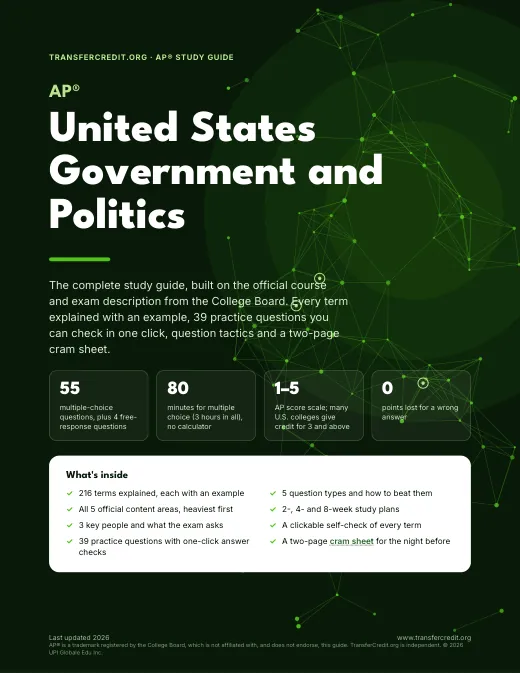
Page 1 of the TransferCredit.org Guide to AP® United States Government and Politics: the cover
Page 1 The cover
Page 6 of the TransferCredit.org Guide to AP® United States Government and Politics: the Chapter 1 opener
Page 6 The Chapter 1 opener
Page 12 of the TransferCredit.org Guide to AP® United States Government and Politics: a chapter quiz
Page 12 A chapter quiz
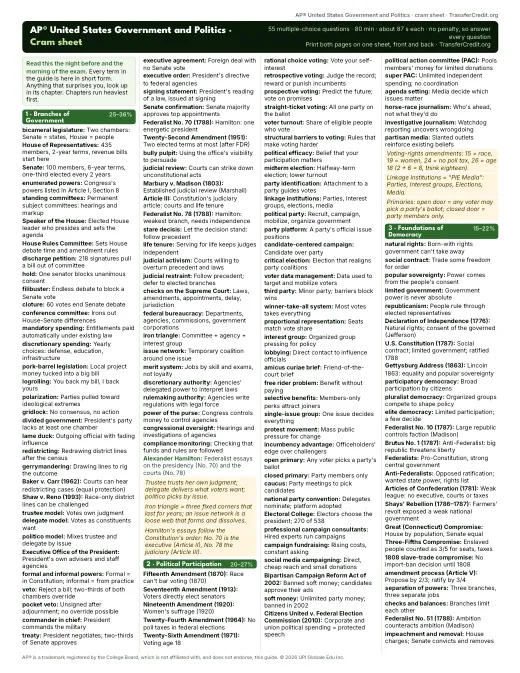
Page 44 of the TransferCredit.org Guide to AP® United States Government and Politics: the 2-page cram sheet
Page 44 The 2-page cram sheet

What you get for $5

One chapter for each area of the official course and exam description, heaviest topics first.

  • 📘45pages, printable
  • 🧭5chapters
  • 🔑216terms with examples
  • ✍️39practice questions, answers explained
  • ⚠️15exam traps to avoid
  • 📄2page cram sheet

Try 10 free AP® United States Government and Politics questions

Multiple-choice questions taken from the guide's chapter quizzes: 5 areas, heaviest first. About 15 minutes, with every answer explained and a score by area. The exam's free-response questions aren't in this quiz: see how the exam works.

10 questions  
  1. Question 1 · Branches of Government
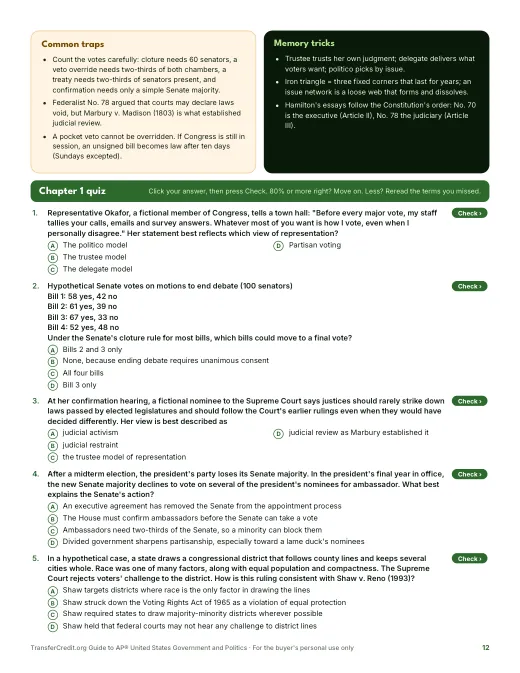
    Representative Okafor, a fictional member of Congress, tells a town hall: "Before every major vote, my staff tallies your calls, emails and survey answers. Whatever most of you want is how I vote, even when I personally disagree." Her statement best reflects which view of representation?
    Show the answer

    Answer: B. The delegate model. She casts her votes as an agent of the people who elected her, following their wishes even over her own views. That is the delegate model.

    The trap: The politico model is tempting, but a politico switches between roles depending on the issue; she says she follows constituents on every major vote.

  2. Question 2 · Political Participation
    Questions 1 and 2 refer to the hypothetical data below.
    Turnout in a fictional state, percent of eligible voters
    Presidential year, ages 18–29: 48%
    Presidential year, ages 65 and older: 74%
    Midterm year, ages 18–29: 27%
    Midterm year, ages 65 and older: 63%
    Which statement is supported by the data?
    Show the answer

    Answer: A. Turnout fell in the midterm year for both age groups, but it fell more among younger voters. Turnout among 18–29-year-olds fell 21 points (48% to 27%), while turnout among those 65 and older fell 11 points (74% to 63%). Both dropped, but the drop was larger for younger voters.

    The trap: The gap did not shrink: it was 26 points in the presidential year (74 minus 48) and grew to 36 points in the midterm year (63 minus 27).

  3. Question 3 · Foundations of Democracy
    Congress gives a fictional state $40 million that may be spent only on hiring school counselors. The state must follow federal hiring guidelines and report how every dollar is used. This funding is best described as
    Show the answer

    Answer: C. a categorical grant. The money is restricted to one specific category of spending and comes with detailed federal rules, which defines a categorical grant, the most common form of federal funding.

    The trap: A block grant also sends federal money, but with minimal restrictions on its use; this money can pay only for counselors, under federal guidelines.

  4. Question 4 · Civil Liberties and Rights
    In Morse v. Frederick (2007), a high school student displayed a banner that his principal read as promoting illegal drug use at a school-supervised event. The Supreme Court upheld his suspension. What best explains why Morse was decided differently from Tinker v. Des Moines (1969)?
    Show the answer

    Answer: D. Morse's banner seemed to promote drug use; Tinker's armbands were nondisruptive political protest. Tinker protects student political expression that does not substantially disrupt school. Morse allowed schools to restrict speech at a school event that is reasonably read as promoting illegal drug use, so the outcome differed.

    The trap: The off-school-grounds choice is wrong: the Court treated the banner as speech at a school-supervised event, and students keep First Amendment rights off campus too.

  5. Question 5 · Ideologies and Beliefs
    A hypothetical poll of 600 likely voters has a margin of error of plus or minus 4 percentage points:
    Candidate Okafor: 47%
    Candidate Lindqvist: 44%
    Undecided: 9%
    Which conclusion is best supported by the poll?
    Show the answer

    Answer: A. The race is too close to call, since the lead is within the margin of error. Okafor leads by 3 points (47 minus 44), less than the 4-point margin of error, so either candidate could actually be ahead. The poll can't name a winner.

    The trap: A well-drawn random sample of 600 can represent a large population. The poll's limit is its margin of error, not its size.

  6. Question 6 · Branches of Government
    Hypothetical Senate votes on motions to end debate (100 senators)
    Bill 1: 58 yes, 42 no
    Bill 2: 61 yes, 39 no
    Bill 3: 67 yes, 33 no
    Bill 4: 52 yes, 48 no
    Under the Senate's cloture rule for most bills, which bills could move to a final vote?
    Show the answer

    Answer: C. Bills 2 and 3 only. Cloture on most bills needs three-fifths of the Senate, 60 votes. Only Bill 2 (61) and Bill 3 (67) reach 60; Bills 1 (58) and 4 (52) fall short.

    The trap: The choice naming Bill 3 alone applies the two-thirds rule used for veto overrides. Cloture needs 60 votes, so Bill 2's 61 is enough.

  7. Question 7 · Political Participation
    Hypothetical data from a fictional state show that citizens aged 18–29 vote at much lower rates than citizens 65 and older, especially in midterm years. Which change in state election law would most likely raise turnout among the younger group?
    Show the answer

    Answer: D. Registering eligible residents automatically when they get a driver's license. Registration rules are a structural barrier, and young people move often and are less likely to be registered. Automatic registration removes that barrier, so it is the change most likely to raise their turnout.

    The trap: Moving the registration deadline earlier adds a barrier rather than removing one: people who move or decide late would miss it.

  8. Question 8 · Foundations of Democracy
    As Congress writes a new farm bill, organizations representing grain growers, food banks, conservationists and fertilizer makers each testify at hearings, meet lawmakers and run ads. The final law reflects bargains among them. Which model of democracy does this process best illustrate?
    Show the answer

    Answer: B. Pluralist democracy. Organized nongovernmental groups compete to influence the decision, and policy reflects bargains among them. That group-based activism defines pluralist democracy.

    The trap: Participatory democracy is tempting because many people are involved, but it stresses broad participation by individual citizens, not activism through organized groups.

  9. Question 9 · Civil Liberties and Rights
    Hypothetical data for a fictional public university that receives federal funds
    Students enrolled: 54% women, 46% men
    Varsity athletes: 31% women, 69% men
    Which statement best describes the data and the federal policy most relevant to them?
    Show the answer

    Answer: A. Women are most of the students but under a third of athletes, a gap Title IX addresses. Women are 54% of students but only 31% of varsity athletes. Title IX bans sex discrimination in education programs that receive federal funds, including athletics, so this gap is what a Title IX complaint would cite.

    The trap: The choice naming Brown reads the data correctly but picks the wrong policy: Brown concerns race-based school segregation, not sex discrimination.

  10. Question 10 · Ideologies and Beliefs
    In a hypothetical year, unemployment is low but prices are rising quickly. The Federal Reserve votes to raise interest rates, while Congress debates a bill to cut income taxes. Which statement correctly describes these actions?
    Show the answer

    Answer: B. The Fed's vote is monetary policy; the tax bill is fiscal policy. Monetary policy is the Federal Reserve's action on interest rates; fiscal policy is taxing and spending by Congress and the president.

    The trap: Both actions affect the economy, but that doesn't make both fiscal policy: what matters is who acts and with which tool.

The AP® United States Government and Politics exam at a glance

The AP® United States Government and Politics exam is from the College Board. It has 55 multiple-choice questions, plus 4 free-response questions. You get 80 minutes for multiple choice (3 hours in all), no calculator. The score scale is 1–5 (AP® score scale; many U.S. colleges give credit for 3 and above). The guide has 5 chapters, one for each area of the official course and exam description; the heaviest is Interactions Among Branches of Government at 25–36%.

Questions
55multiple-choice questions, plus 4 free-response questions
Time
80 minfor the 55 multiple-choice questions, about 87 seconds a question
Score
1–5AP® score scale; many U.S. colleges give credit for 3 and above
Fee
$99per exam in the U.S. and Canada in 2026-27; your school may charge more
Calculator
Nonot allowed
Wrong answers
No penaltya wrong answer costs nothing
  • Section I has 55 multiple-choice questions in 80 minutes (50% of your score). Section II has 4 free-response questions in 100 minutes (50%), each worth 12.5%: Concept Application, Quantitative Analysis, SCOTUS Comparison (20 minutes recommended each) and an Argument Essay (40 minutes).
  • About 30 multiple-choice questions stand alone. The rest come in sets of 2–4 on one source: 5 sets on data (graphs, charts, tables, maps or infographics), 2 sets on a text (one of them a foundational document) and 3 sets on a map, cartoon or infographic.
  • You must know 13 required foundational documents and 14 required Supreme Court cases (facts, issue, holding, reasoning and majority opinion). Any other case on the exam comes with a summary.
  • The exam is fully digital: you answer every question in the Bluebook testing app. No calculator is allowed.
  • Your multiple-choice score is the number of questions you answer correctly, so a wrong answer costs nothing.

Source: official AP® United States Government and Politics page and the official course and exam description. Last updated 2026.

What the exam covers

5 chapters, heaviest first, with each area's official weight. The guide's chapters follow this order.

  1. Interactions Among Branches of Government25–36% · ~14–20 Q
  2. Political Participation20–27% · ~11–15 Q
  3. Foundations of American Democracy15–22% · ~8–12 Q
  4. Civil Liberties and Civil Rights13–18% · ~7–10 Q
  5. American Political Ideologies and Beliefs10–15% · ~6–8 Q

Where to start: the 3 heaviest areas (marked in the map) carry about 40 of the 55 questions. The guide puts them first, so working front to back covers the most points earliest.

AP® United States Government and Politics study guide by area

The heaviest area is open to read now. The full guide has a chapter for every area, each with all its terms, a quiz and an answer key.

1 of 5 chapters open  ·  in the guide's order
25–36% · about 14–20 questions · free preview Interactions Among Branches of Government Chapter 1 of the guide

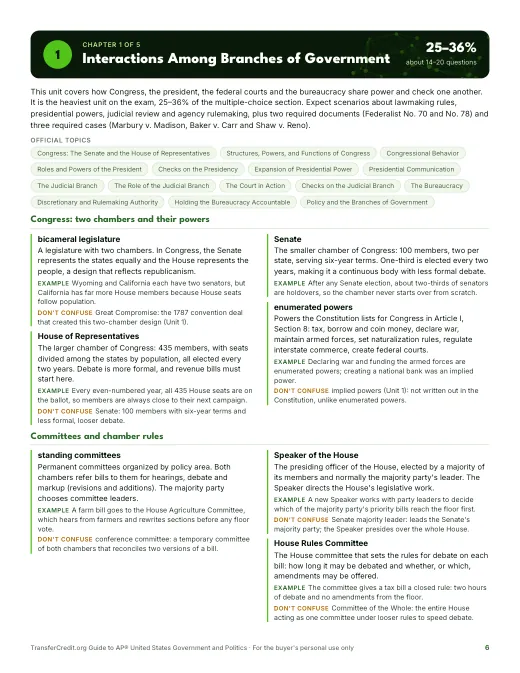
This unit covers how Congress, the president, the federal courts and the bureaucracy share power and check one another. It is the heaviest unit on the exam, 25–36% of the multiple-choice section. Expect scenarios about lawmaking rules, presidential powers, judicial review and agency rulemaking, plus two required documents (Federalist No. 70 and No. 78) and three required cases (Marbury v. Madison, Baker v. Carr and Shaw v. Reno).

Key terms, with examples

bicameral legislature
A legislature with two chambers. In Congress, the Senate represents the states equally and the House represents the people, a design that reflects republicanism.
Example: Wyoming and California each have two senators, but California has far more House members because House seats follow population.
standing committees
Permanent committees organized by policy area. Both chambers refer bills to them for hearings, debate and markup (revisions and additions). The majority party chooses committee leaders.
Example: A farm bill goes to the House Agriculture Committee, which hears from farmers and rewrites sections before any floor vote.
mandatory spending
Federal spending required by existing law, mainly for entitlement programs such as Social Security, Medicare and Medicaid. It continues each year unless Congress changes the law.
Example: As more Americans turn 65, Medicare spending rises automatically, without any new vote by Congress.
polarization
The movement of political attitudes toward ideological extremes. In Congress it shows up as partisan voting, when members vote according to their party affiliation.
Example: In a fictional Congress, nearly every major vote splits along party lines, with each party voting as a bloc.
trustee model
A view of representation in which a member votes on issues based on his or her own knowledge and judgment.
Example: A representative who is a physician votes on a vaccine-funding plan based on her own study of the medical evidence.
Executive Office of the President
The president's advisers and staff agencies, such as the White House staff, the Office of Management and Budget and the National Security Council, who help carry out the policy agenda.
Example: Office of Management and Budget staff prepare the president's annual budget proposal before it goes to Congress.
Senate confirmation
Senate approval, by majority vote, of the president's choices for Cabinet members, ambassadors, some Executive Office posts and federal judges. It checks the appointment power.
Example: Judges confirmed during one presidency can serve for decades, so judicial picks are a president's longest-lasting influence.
judicial review
The power of courts to declare an act of the legislative or executive branch unconstitutional. The Constitution does not spell it out; Marbury v. Madison established it.
Example: In United States v. Lopez (1995), the Court used judicial review to strike down a federal gun-free school zones law.
stare decisis
The doctrine that courts follow precedent when deciding cases with similar facts. New appointments that shift the Court's ideology can lead to new precedents or overturned ones.
Example: Gideon v. Wainwright (1963) overruled Betts v. Brady (1942), which had let states refuse appointed lawyers to many poor felony defendants.
federal bureaucracy
The departments, agencies, commissions and government corporations that implement federal policy by writing and enforcing regulations, issuing fines and testifying before Congress.
Example: The Department of Veterans Affairs (a department), the Federal Election Commission (a commission) and the Postal Service (a government corporation) are all part of it.
power of the purse
Congress's power to tax and spend. It checks the bureaucracy because Congress can appropriate or withhold the funds agencies need.
Example: After an agency ignores a committee's requests for records, Congress cuts the agency's travel budget in the next appropriations bill.
House of Representatives
The larger chamber of Congress: 435 members, with seats divided among the states by population, all elected every two years. Debate is more formal, and revenue bills must start here.
Example: Every even-numbered year, all 435 House seats are on the ballot, so members are always close to their next campaign.

What this area covers

Congress: two chambers and their powersCommittees and chamber rulesThe budget and legislative bargainingParties, divided government and district linesModels of representationThe president's formal and informal powersChecks on and growth of presidential powerJudicial review and its foundationsPrecedent, life tenure and checks on the CourtThe federal bureaucracyHolding the bureaucracy accountable

Key people

Alexander HamiltonNew York delegate to the 1787 Constitutional Convention who wrote most of The Federalist essays, including No. 70 and No. 78, and became the first secretary of the treasury.

How the exam asks it

Most questions give a scenario and ask which power, procedure or model it shows: a senator's hold, a pocket veto, an executive agreement, an iron triangle. Others ask how one branch checks another, what Marbury v. Madison, Baker v. Carr or Shaw v. Reno held, or what Federalist No. 70 or No. 78 argues, sometimes from a short excerpt. Data sets on vote counts or party control ask for a pattern and what it shows, and bureaucracy questions ask how Congress, the president and the courts each keep agencies accountable.

Common traps

Trap 1. Count the votes carefully: cloture needs 60 senators, a veto override needs two-thirds of both chambers, a treaty needs two-thirds of senators present, and confirmation needs only a simple Senate majority.

Trap 2. Federalist No. 78 argued that courts may declare laws void, but Marbury v. Madison (1803) is what established judicial review.

Trap 3. A pocket veto cannot be overridden. If Congress is still in session, an unsigned bill becomes law after ten days (Sundays excepted).

Memory trick

Trustee trusts her own judgment; delegate delivers what voters want; politico picks by issue.

Iron triangle = three fixed corners that last for years; an issue network is a loose web that forms and dissolves.

How AP® United States Government and Politics questions are written

The exam has 55 multiple-choice questions, plus 4 free-response questions. The guide sorts the questions into 5 types; spot the type and you'll know what the question wants before you read the choices.

Type 1

Concept application

A short scenario about a voter, official, group or law, then "which of the following best explains..." or "...is an example of which of the following?" About 30 of the 55 multiple-choice questions stand alone like this.

  • Name the concept yourself from the key detail in the scenario before reading the choices.
  • If two choices look alike, find the one detail that separates them: who acts, which level of government, looking back or looking ahead.
  • Cross out choices that need a fact the scenario never gives.
Type 2

SCOTUS application

A question on one of the 14 required Supreme Court cases (its facts, holding or the clause it turned on), or a short summary of another case to compare with a required one.

  • Recall the required case's facts, the constitutional clause it turned on and its holding.
  • For a comparison, ask whether the two cases turned on the same clause and whether they came out the same way.
  • Eliminate choices that name the wrong clause or reverse a holding.
Type 3

Quantitative analysis

A table, line graph, chart, map or infographic, usually with 2–3 questions: describe the data, find a pattern or trend, draw a conclusion, or say which concept the data illustrate.

  • Read the title, labels and units before the numbers.
  • Answer only what the data show: a choice can be true in real life and still not be supported by the data.
  • For "what does this illustrate", state the trend first, then match it to a concept.
Type 4

Text-based source analysis

A short excerpt, one set always from a required foundational document, with 3–4 questions on the author's argument or perspective and how it relates to a principle or institution.

  • Identify the document and its side in the debate, such as Federalist or Anti-Federalist.
  • Put the main claim in your own words before reading the choices.
  • Pick the choice that matches the author's argument, not one that is merely true.
Type 5

Visual source analysis

A political cartoon, map or infographic, usually with 2 questions: what the visual shows and which principle, process or behavior it relates to.

  • Describe what you see: labels, captions, symbols and who is doing what.
  • State the creator's point in one sentence.
  • Match that point to a course concept, and reject choices about things the image doesn't show.

Test-day habits that add points

  1. Answer every question. There's no penalty for a wrong answer. A blank is always worth zero, so never leave one.
  2. Predict, then look. Name the answer before reading the choices. It protects you from distractors written to sound right.
  3. Eliminate. Cross out choices you know are wrong. Every choice you rule out raises your odds on a guess.
  4. Mark and move on. If a question takes more than a minute, pick your best guess, mark it and come back if time allows.
  5. Watch absolute words. Choices with "always", "never" or "only" are often wrong, because most rules and findings have exceptions. Treat this as a tiebreaker, not a rule.
  6. Change answers for a reason. Switch an answer only when you can say why the new one is better, such as a detail you missed.
  7. The four free-response questions. Section II has four free-response questions in 100 minutes (50% of your score), each worth 12.5%. Question 1, Concept Application (3 points, 20 minutes recommended), gives an authentic scenario: describe and explain the effects of a political institution, behavior or process, and apply course concepts to it. Question 2, Quantitative Analysis (4 points, 20 minutes), gives a table, graph, map or infographic: describe the data, describe a pattern, trend, similarity or difference, draw a conclusion, and explain how the data demonstrate a political principle, institution, process, policy or behavior. Question 3, SCOTUS Comparison (4 points, 20 minutes), gives a summary of a non-required Supreme Court case to compare with a required case the question names. Question 4, Argument Essay (6 points, 40 minutes): a defensible claim or thesis with a line of reasoning (1 point), two pieces of specific and relevant evidence, one from a foundational document listed in the question (up to 3 points), reasoning (1 point), and a response to an opposing or alternate perspective with rebuttal or refutation (1 point).

Pacing: 55 questions in 80 minutes, about 87 seconds a question.

AP® United States Government and Politics flashcards

Try the first 8 cards free. Read the term, say the definition out loud, then select the card to check yourself. Arrow keys move between cards.

Free card 1 of 8 (deck total: 216)

How to study for AP® United States Government and Politics: a 5-step plan

Follow the steps, then enter your test date. The planner gives you a dated plan that starts with the heaviest areas and saves the last days for review.

  1. Take the 10 free questionsSee which AP® United States Government and Politics areas you already know.
  2. Study the heaviest areas firstStart with Interactions Among Branches of Government, Political Participation and Foundations of American Democracy, then work down the exam map.
  3. Learn each term with an exampleSay the definition out loud, then check it with the flashcards. A term you can't use in an example isn't learned yet.
  4. Quiz yourself and study the trapsAfter each area, answer its quiz and read why the tempting wrong answer is wrong.
  5. Plan backwards from your exam dateBuild a dated plan, keep the last days for a full review, and read the cram sheet the night before.

How it works

  1. 1Check outSelect Get the guide · $5 and pay on TransferCredit.org's secure checkout.
  2. 2Download the PDFFrom your TransferCredit.org account.
  3. 3Study the heaviest areas firstFollow the 2-, 4- or 8-week plan, then read the cram sheet the night before.

This page or the full guide

Everything on this page is free with no account. The full guide is a PDF you keep.

What's on this page and in the full study guide
Study toolThis pageFull study guide ($5)
ChaptersA preview of 1 of 5All 5
Terms explainedA sample from the open chaptersAll 216, each with an example
Practice questions10 free questions39, with an answer key
Flashcards8 cardsAll 216 terms on the self-check list
Study planDated planner2-, 4- and 8-week plans
Cram sheet—2 pages, for the night before
FormatWeb page45-page PDF, printable

Questions students ask

What's in the full AP® United States Government and Politics study guide?
45 pages: 5 chapters, one for each area of the College Board's official course and exam description, heaviest topics first. 216 terms, each with a plain-English definition and an example, 3 key people, common traps and memory tricks, 39 practice questions with an answer key that explains every answer, question tactics, 2-, 4- and 8-week study plans and a 2-page cram sheet.
How much is the full AP® United States Government and Politics study guide?
The full 45-page PDF is $5. The 10 practice questions on this page are free.
How do I get the full guide?
Select Get the guide · $5 and check out on TransferCredit.org. Then sign in to your TransferCredit.org account to download the PDF.
Can I print the guide or use it on my phone?
Yes. It's a PDF, so it opens on phones, tablets and computers, and printing is allowed. Its tick boxes and answer bubbles work in PDF readers that support forms. Copying and editing are turned off.
Can I try the AP® United States Government and Politics guide before I buy it?
Yes. This page has 10 questions from the guide's own chapter quizzes, a preview of the heaviest area, 8 flashcards and a study planner. No account needed.
Is this an official AP® study guide?
No. AP® is a trademark registered by the College Board, which is not affiliated with, and does not endorse, this guide. TransferCredit.org is independent. We built the guide from the College Board's official course and exam description, and the exam details were checked against the College Board's published exam information in 2026.
How was this study guide made?
One chapter for each area of the official course and exam description, using its published weights. Each chapter was written, then fact-checked against the official exam information in a separate review. The practice questions are original: none are copied from the College Board's released questions.
How up to date is this AP® United States Government and Politics guide?
Last updated 2026. The exam details were checked against the College Board's published exam information in 2026. Exams change, so confirm the details on the official AP® United States Government and Politics page before you test.
More questions about the AP® United States Government and Politics exam (16)
What is the AP® United States Government and Politics exam?
The AP® United States Government and Politics exam is from the College Board. It has 55 multiple-choice questions, plus 4 free-response questions. You get 80 minutes for multiple choice (3 hours in all), no calculator. The score scale is 1–5 (AP® score scale; many U.S. colleges give credit for 3 and above). The guide has 5 chapters, one for each area of the official course and exam description; the heaviest is Interactions Among Branches of Government at 25–36%.
How many questions are on the AP® United States Government and Politics exam, and how long is it?
Section I has 55 multiple-choice questions in 80 minutes (50% of your score). Section II has 4 free-response questions in 100 minutes (50%), each worth 12.5%: Concept Application, Quantitative Analysis, SCOTUS Comparison (20 minutes recommended each) and an Argument Essay (40 minutes).
How is the AP® United States Government and Politics exam scored?
The score scale is 1–5: AP® score scale; many U.S. colleges give credit for 3 and above. Your multiple-choice score is the number of questions you answer correctly, so a wrong answer costs nothing.
What AP® United States Government and Politics score do I need for college credit?
Many U.S. colleges give credit for 3 and above. Each college sets its own credit policy, so check the one at your college before you count on the credit.
How much does the AP® United States Government and Politics exam cost?
The fee is $99: per exam in the U.S. and Canada in 2026-27; your school may charge more. Fees can change, so check the official page when you register.
Can I use a calculator on the AP® United States Government and Politics exam?
No calculator is allowed.
Is there a penalty for guessing on AP® United States Government and Politics?
No. There's no penalty for a wrong answer. A blank is always worth zero, so never leave one.
What topics are on the AP® United States Government and Politics exam?
5 areas, from the official course and exam description: Interactions Among Branches of Government (25–36%); Political Participation (20–27%); Foundations of American Democracy (15–22%); Civil Liberties and Civil Rights (13–18%); American Political Ideologies and Beliefs (10–15%).
Which AP® United States Government and Politics topics should I study first?
The 3 heaviest areas (marked in the map) carry about 40 of the 55 questions. The guide puts them first, so working front to back covers the most points earliest.
Is the AP® United States Government and Politics exam hard?
It depends on what you already know. The largest area, Interactions Among Branches of Government, is 25–36%, and the smallest, American Political Ideologies and Beliefs, is 10–15%. Try the 10 free questions above to see where you stand in about 15 minutes.
What kinds of questions are on the AP® United States Government and Politics exam?
The exam has 55 multiple-choice questions, plus 4 free-response questions. The guide sorts the questions into 5 types: “Concept application”, “SCOTUS application”, “Quantitative analysis”, “Text-based source analysis” and “Visual source analysis”. Multiple-choice questions have 4 answer choices. See how each type is written.
What are the free-response questions on the AP® United States Government and Politics exam?
Section II has four free-response questions in 100 minutes (50% of your score), each worth 12.5%. Question 1, Concept Application (3 points, 20 minutes recommended), gives an authentic scenario: describe and explain the effects of a political institution, behavior or process, and apply course concepts to it. Question 2, Quantitative Analysis (4 points, 20 minutes), gives a table, graph, map or infographic: describe the data, describe a pattern, trend, similarity or difference, draw a conclusion, and explain how the data demonstrate a political principle, institution, process, policy or behavior. Question 3, SCOTUS Comparison (4 points, 20 minutes), gives a summary of a non-required Supreme Court case to compare with a required case the question names. Question 4, Argument Essay (6 points, 40 minutes): a defensible claim or thesis with a line of reasoning (1 point), two pieces of specific and relevant evidence, one from a foundational document listed in the question (up to 3 points), reasoning (1 point), and a response to an opposing or alternate perspective with rebuttal or refutation (1 point).
How should I pace myself on the AP® United States Government and Politics exam?
55 questions in 80 minutes, about 87 seconds a question. If a question takes more than a minute, pick your best guess, mark it and come back if time allows.
How long should I study for AP® United States Government and Politics?
Take the 10 free questions to see where you stand. The full guide has 2-, 4- and 8-week plans built from the exam weights, and the planner on this page builds a dated plan from your exam date.
How do I know I'm ready for the AP® United States Government and Politics exam?
The guide's readiness checklist: You can explain every term on the checklist without notes. You score 80% or better on every chapter quiz. You can say what each person in the key people lists is known for. You can read the cram sheet and nothing on it surprises you. You know the AP® score your college gives credit for, and your exam date.
What should I do the night before?
Read the 2-page cram sheet once, slowly. Check your exam time and room with your AP® coordinator. The whole exam is taken in the Bluebook app. In the morning, skim the traps, then stop studying.

How we built this guide

We built one chapter for each area of the College Board's official course and exam description for AP® United States Government and Politics, using its published weights to order the chapters and size the quizzes. Each chapter was written, then fact-checked against the official exam information in a separate review. The exam details were checked against the College Board's published exam information in 2026.

Sources: official AP® United States Government and Politics page, official course and exam description. Last updated 2026.

AP® is a trademark registered by the College Board, which is not affiliated with, and does not endorse, this guide. TransferCredit.org is independent and not affiliated with the College Board. © 2026 UPI Globale Edu Inc.

Ready for the full AP® United States Government and Politics guide? 45 pages, 216 terms, 39 practice questions and a 2-page cram sheet, $5.

Get the guide · $5

In the full guide

TransferCredit.org Guide to AP® United States Government and Politics

  • All 5 chapters
  • 216 terms with examples and 3 key people
  • 39 practice questions with an answer key
  • A 2-page cram sheet and 2-, 4- and 8-week plans
Get the guide · $5